
Blue Statice Flower: A Practical Guide to Choosing and Caring
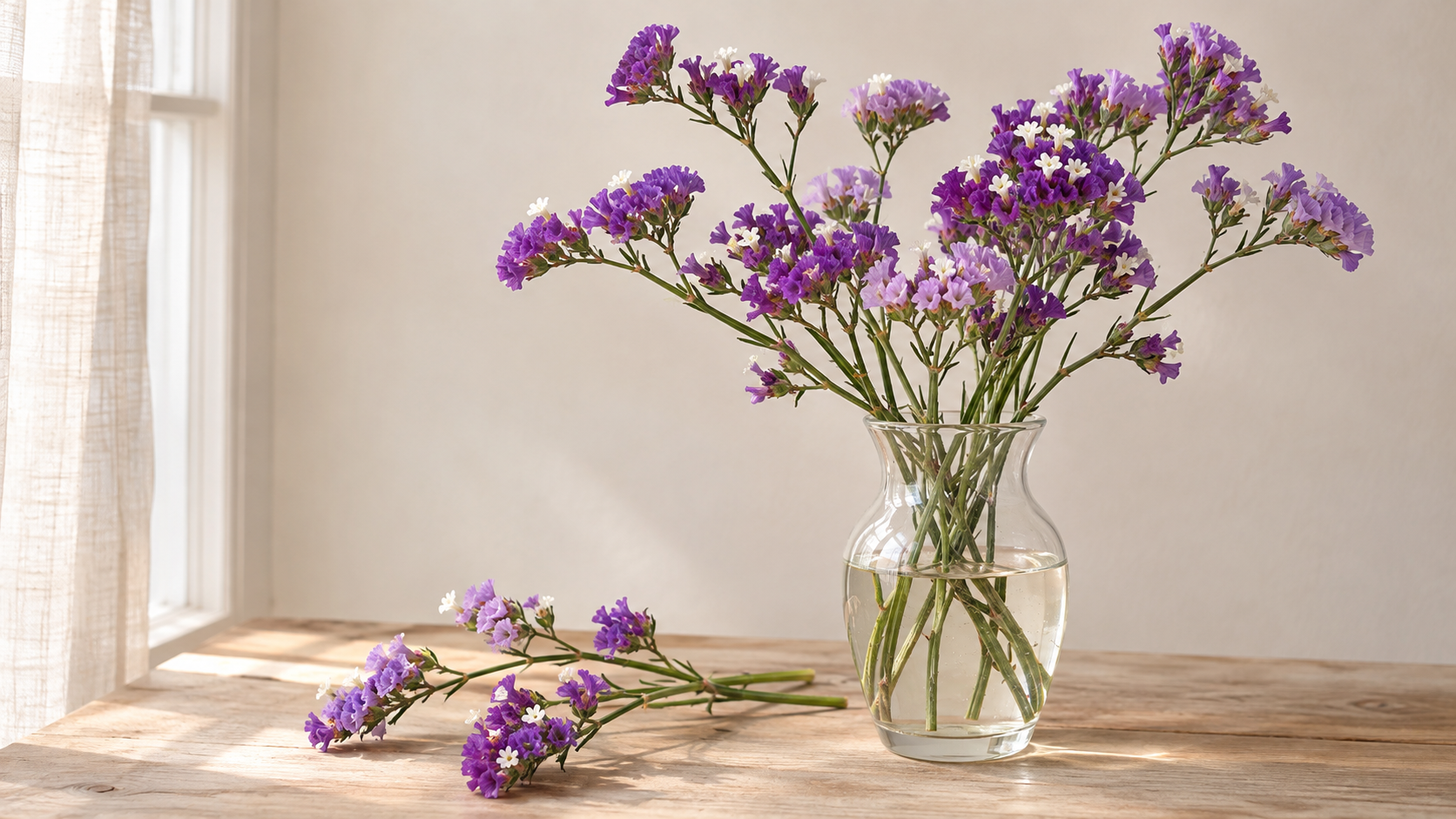
The blue statice flower is a cut flower commonly sold as Limonium, with branching stems and tiny blooms surrounded by papery blue to violet calyces. Those coloured calyces hold their shape well as they dry, which makes statice useful in both fresh bouquets and dried arrangements. If you want a clear sky-blue shade, check the actual flowers: much of what is called blue statice looks lavender or purple.
At Pyat Tsvetov (5 Flowers), the useful starting point is the effect you want: a few blue accents, a soft cloud around larger flowers, or a bouquet that you can later dry. We have been working with flowers in Saint Petersburg since 2011, and the distinction between colour, texture and bouquet shape matters more than a catalogue name alone. This guide explains what to look for, how to care for the stems and what to check when sending flowers to someone in Russia.
Recognising blue statice and understanding its colour
Common florist statice, often Limonium sinuatum, carries clusters of small flowers on stiff, branching stems. The part that looks like a coloured paper flower is largely the calyx, which surrounds the much smaller true flower. That structure explains why a stem can feel dry to the touch while it is still being sold for a fresh arrangement. Papery texture alone is therefore a poor test of freshness; inspect the stems and the condition of the clusters as well.
Blue is a broad colour label in the flower trade, and statice may lean towards indigo, violet or lilac. Warm indoor lighting can make a violet shade appear redder, while a photograph on a phone can shift the colour again. If the exact shade matters for a gift or table setting, ask whether the flowers available look predominantly blue or purple. For the wider naming differences, our statice definition guide explains how statice and sea lavender relate.
Choosing a bouquet with the right balance of blue
Statice creates texture through many small clusters, so its visual effect differs from the broad surface of a rose or hydrangea. A few branching stems can carry blue through an arrangement without making blue its dominant colour. Used more densely, statice gives a bouquet a loose, cloudlike outline, although tightly packed stems can look busy. Judge the proportion of blue across the whole bouquet rather than counting individual flower heads.
White flowers make blue-violet statice look crisp, while peach or apricot tones create a warmer contrast. Pink can work well when both colours share a cool undertone, but strong purple statice may compete with a very delicate blush flower. For a compact gift, keep the branches within a clear rounded outline; for a relaxed arrangement, allow a little space between the clusters. Browse the bouquets catalogue for an overall style, then check the composition and availability rather than assuming every design includes statice.
Bouquets we can deliver




Meaning and gift etiquette without rigid flower rules
Statice is often associated with remembrance and lasting affection, a connection that suits its ability to retain colour when dried. These are floral traditions rather than a message every recipient will recognise. Blue may suggest calm or restraint, but the recipient's preferences are a better guide than a fixed colour dictionary. A short card explaining your intention makes a birthday, thank-you or supportive gift easier to understand.
For someone in Russia, an odd number is the usual convention when giving a clearly countable group of flowers for a celebration; even numbers are traditionally associated with mourning. Statice complicates counting because one stem can divide into many flowering branches, so individual clusters should not be treated as separate flowers. In a mixed bouquet, consider the presentation of the main blooms and the occasion. For a condolence gift, follow the family's wishes and the setting instead of assuming that blue statice alone communicates sympathy.
Fresh blue statice care, from unpacking to vase placement
Unwrap the bouquet enough to inspect the stems and choose a clean vase that supports them without crushing the branches. Remove leaves or other plant material that would sit below the waterline, then make a fresh cut at the base with clean, sharp tools. Place the stems in fresh water and use cut-flower food according to its packet if you have it. Keep the coloured clusters above the water: soaking the flower heads does not help them drink and can encourage deterioration.
Check the water daily and change it whenever it becomes cloudy, cleaning the vase before refilling. Remove any soft or deteriorating material promptly, especially in a mixed bouquet where another flower may decline before the statice. A cool position away from direct sun, heaters and ripening fruit helps reduce avoidable stress. Vase life depends on the condition of the stems and their surroundings, so rely on those checks rather than expecting a fixed number of days.
Drying statice while the branches still look good
Start drying while the clusters look clean and well shaped, before stems become soft or develop mould. Take the statice out of the water, remove unwanted foliage and divide a large bunch into small bundles so air can move between the stems. Tie each bundle securely without crushing it, then hang it upside down in a dry, shaded, ventilated place. Avoid an enclosed bathroom or a sunny window, where moisture or strong light can spoil the result.
Allow the stems to dry fully before arranging them; the time needed varies with humidity, bundle size and airflow. The coloured calyces usually retain their shape, but some fading or change in tone is normal and the branches become more brittle. Once dry, display statice without water and handle it by the stems rather than squeezing the clusters. If you intend to dry part of a mixed bouquet, separate it early so the needs of fresh flowers and drying stems do not conflict.
Sending a blue-accented bouquet to someone in Russia
We deliver flowers across Russia, with city delivery costing 500 RUB; the operator confirms the price for remote districts and suburbs when confirming the order. If blue statice is essential to your choice, clarify its availability and shade before treating a catalogue photograph as confirmation. Express delivery in large cities is 1–2 hours after the order is confirmed. You can also choose an exact time within ±30 minutes, a 09–12, 12–15, 15–18 or 18–21 window, or preorder 1–30 days ahead; delivery in Saint Petersburg is around the clock.
Delivery is anonymous by default: the courier does not name the sender, and a card with your text is free. The courier calls the recipient about 15 minutes before arrival; if they are absent, we agree a second delivery that day or a handover to a neighbour or concierge with the sender's consent. Online checkout uses CloudPayments, so check the payment options displayed there rather than assuming a particular foreign card will be accepted. See delivery and payment for ordering information, or call 8 (812) 507-67-05 to clarify your order.
Frequently asked questions
Is blue statice naturally blue or dyed?
Statice is available in naturally blue-violet shades, although the colour of a particular bunch may look more purple than blue. A catalogue name alone does not establish whether stems have been dyed, so ask about the flowers you are considering if this matters.
Does fresh blue statice need water?
Yes, keep fresh cut statice in a clean vase with fresh water and remove any material below the waterline. Fully dried statice should be displayed without water.
Can I dry blue statice from a mixed bouquet?
Yes, separate healthy statice stems while their clusters still look good and hang small bundles upside down in a dry, shaded, ventilated place. Do not wait for stems to become soft or mouldy, and expect some change in colour as they dry.
Can I order flowers for Russia while I am abroad?
We deliver flowers across Russia, and online checkout uses CloudPayments. Check the options displayed at checkout for your payment method; acceptance of every foreign card is not guaranteed.
Will the recipient know who sent the bouquet?
The courier does not name the sender because delivery is anonymous by default. If you want the recipient to know, include your name in the text for the free card.
Ready to send a bouquet?
Pick a city, choose the flowers, and we will hand them over with a photo confirmation.
Choose a city →