
Corporate Flower Delivery for Hotels: Lobbies, VIP Rooms and Restaurant Tables
Hotel procurement managers and F&B directors ask us the same thing within the first five minutes: can you guarantee the flowers look fresh at 7 a.m. when the first guests come down for breakfast, and again at 6 p.m. when the restaurant fills up for dinner? The answer is yes, but only if the schedule, the varieties and the storage conditions are agreed in advance. This article walks through exactly how recurring corporate flower delivery works for hospitality businesses — what goes where, which flowers hold up under hotel conditions, and what to check before signing a service agreement.
Why Hotel Flower Programs Fail Without a Proper Schedule
Most hotel flower programs collapse not because of bad flowers but because of bad timing. A bouquet delivered at noon for a lobby that opens to guests at eight in the morning has already spent four hours wilting in a back corridor. Hospitality businesses operate on fixed service rhythms — breakfast, check-in peaks, dinner service, late-night bar — and flower delivery must map onto those rhythms exactly, not approximate them. At Five Flowers we build a delivery calendar for each hotel client that specifies the day, the time window and the responsible contact on site. For a full-service hotel in Saint Petersburg this typically means lobby arrangements delivered before 8 a.m. on Monday, Wednesday and Friday, restaurant table posies refreshed Tuesday and Friday before noon, and VIP room bouquets placed on demand within a two-hour window from the moment a reservation is confirmed by the front desk. The person receiving the flowers matters too. Housekeeping staff and florists speak different languages about flower care. We include a one-page handling note with every corporate delivery: water temperature, trim instructions, which arrangements need direct light and which do not. Hotels that skip this step find their expensive roses drooping by the afternoon because a well-meaning staff member moved them next to a radiator or topped up the vase with cold tap water straight from the pipe. Schedule discipline and basic on-site handling together determine whether a flower program actually works.
Bouquets we can deliver

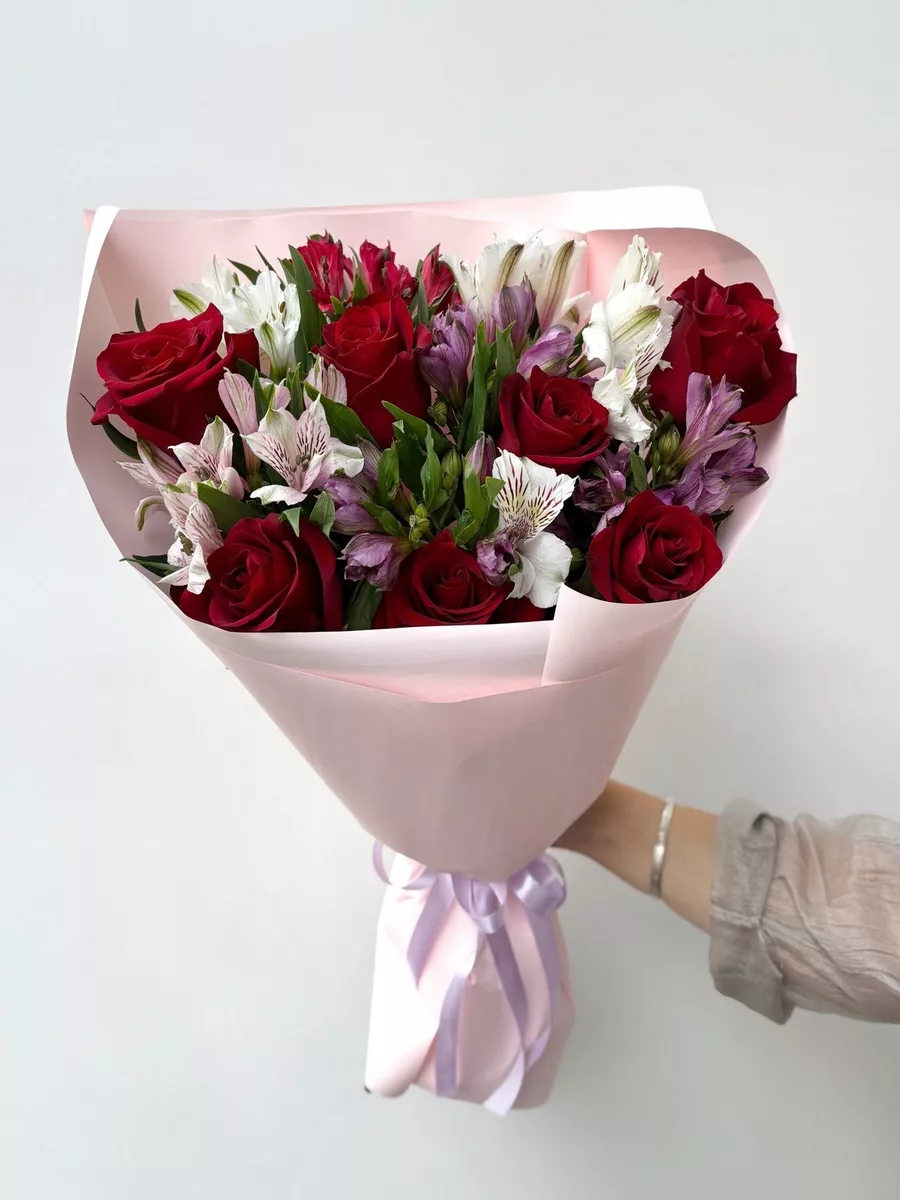

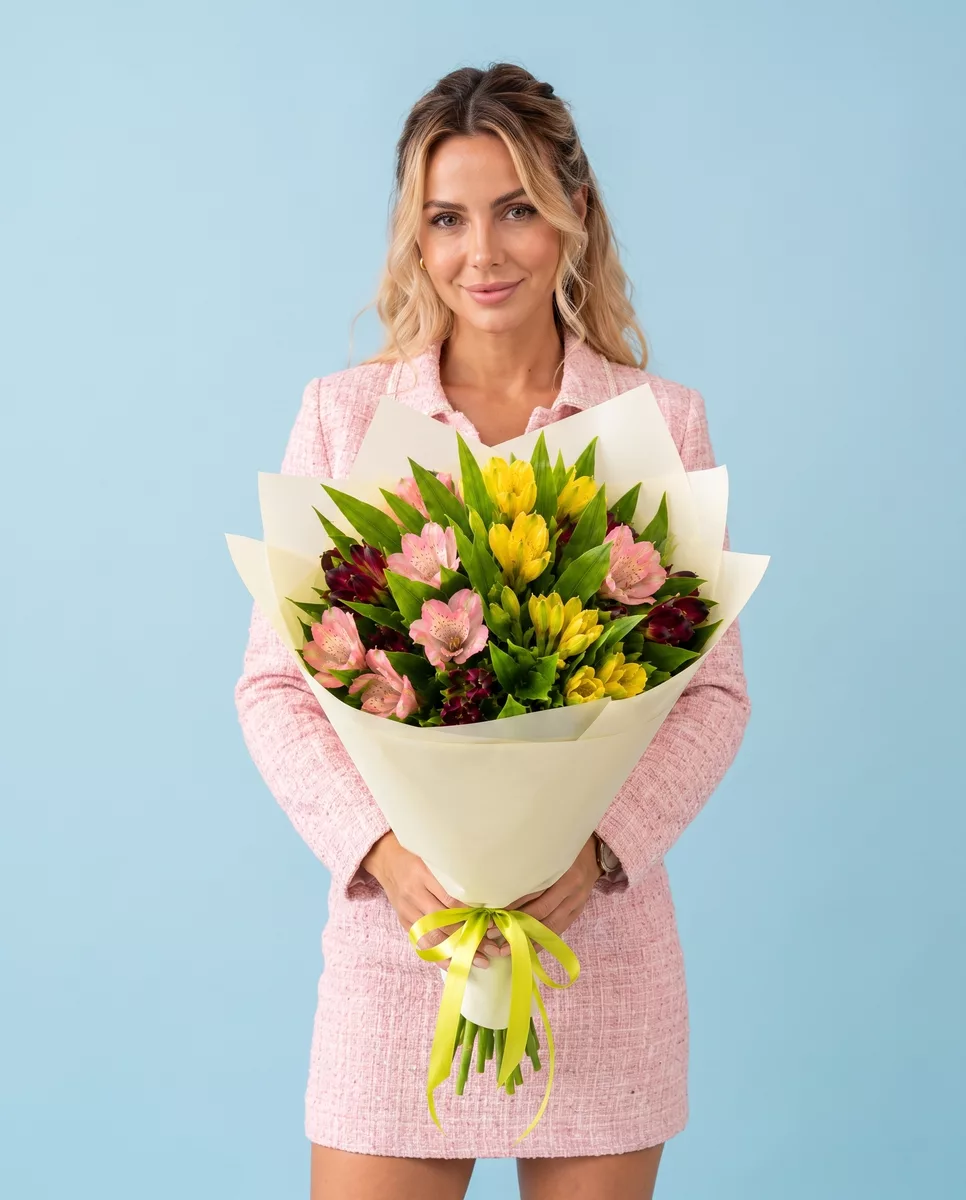
Lobby Arrangements: Scale, Varieties and Replacement Frequency
A hotel lobby is one of the harshest environments for cut flowers. The space is large, climate control is aggressive, foot traffic creates constant air movement, and the arrangement must read well from ten metres away and from one metre away simultaneously. That combination rules out most delicate varieties immediately. For tall statement arrangements in lobbies we rely on Anthurium, Strelitzia, large-headed Chrysanthemum varieties such as Anastasia and Bacardi, and spray roses. These hold their structure under air conditioning and do not shed petals onto polished floors, which housekeeping teams appreciate enormously. Hydrangea is popular with interior designers specifying flower programs, but it is honest to say that Hydrangea in a dry lobby with strong air conditioning requires daily water checks and rarely lasts more than four days looking presentable. If the hotel's aesthetic demands Hydrangea, we schedule replacement at four days rather than the standard seven. Standard replacement frequency for lobby arrangements in our hotel contracts is twice per week for most varieties, moving to three times per week in summer months when ambient temperatures in Saint Petersburg push above twenty-two degrees Celsius even in air-conditioned spaces. Vase size matters more than most clients expect. A lobby arrangement in a vase that holds less than three litres of water will need daily topping up; we recommend five-litre minimum for any arrangement standing more than eighty centimetres tall. We can supply the vessels as part of the contract or work with the hotel's existing inventory after inspecting it on site.
VIP Room Flowers: Timing, Composition and the Check-In Window
VIP room flower delivery is the part of a hotel flower program that causes the most operational stress, because the timing is driven by the guest, not by a fixed calendar. A suite needs fresh flowers in place before the guest arrives, which means the hotel must communicate the check-in time to us with enough lead time for delivery. Our standard commitment for VIP room orders within Saint Petersburg is two hours from confirmation, which works for most hotel operations provided the front desk sends the request the moment a VIP reservation is confirmed rather than the morning of arrival. The composition for a VIP room is different from a lobby arrangement. The scale is smaller, the viewing distance is closer, and the flowers will be in an enclosed space where fragrance matters. We avoid heavily scented varieties like Lilium Orientalis in rooms where guests may have sensitivities, and instead use lightly fragrant or unscented options: garden roses such as David Austin varieties, Ranunculus, Lisianthus, and Tulips in season. A typical VIP room arrangement runs to fifteen to twenty-five stems depending on the vessel and the room category. We ask hotels to specify three tiers — standard VIP, premium suite, and presidential — so we can prepare compositions in advance that match each tier without renegotiating every order. Flowers for VIP rooms are cut and conditioned the same day they are delivered; we do not use stock that has been in water for more than twenty-four hours for these placements. The freshness difference is visible and guests at this level notice it.
Restaurant Table Flowers: Size Constraints and What Actually Lasts
Restaurant table flowers operate under a very specific constraint that lobby and room flowers do not: they must not interfere with service. That means nothing taller than twenty-five centimetres, nothing that drops petals onto plates, nothing with a fragrance strong enough to compete with the food, and nothing that takes up more than fifteen centimetres of table diameter. These constraints eliminate a large portion of what florists typically enjoy working with, but they also clarify the brief. For restaurant tables we use compact arrangements built around spray roses, Matthiola in low-fragrance varieties, Alstroemeria, Eustoma, and single-variety posies of Freesia or Anemone depending on season. Carnations, which have an unfair reputation in Russia as a purely ceremonial flower associated with Soviet-era celebrations, are in fact excellent for restaurant tables: they last eight to ten days in good conditions, they do not shed, and modern varieties like Prado and Delphi come in a range of colours that work with contemporary restaurant interiors. We raise this because hotel F&B managers sometimes reject Carnations on aesthetic grounds before seeing what current varieties actually look like. Restaurant flowers are typically refreshed twice per week. We deliver before the restaurant opens for lunch service, which in Saint Petersburg usually means before noon. If the hotel runs a breakfast operation in a separate space, that requires its own delivery slot. One delivery covering both spaces sounds efficient but usually means one space gets flowers that are slightly past their best, and in hospitality that compromise is visible to guests.
Freshness Guarantees and What They Actually Mean in Practice
Hospitality procurement teams ask for freshness guarantees and we provide them, but it is worth being precise about what that term covers. A freshness guarantee from Five Flowers means the flowers are delivered in bud or early-open stage, conditioned in clean water at the correct temperature before dispatch, and will remain presentable for the agreed number of days under normal indoor conditions. Normal indoor conditions means ambient temperature between eighteen and twenty-two degrees Celsius, no direct sunlight on the arrangement, no proximity to heating or cooling vents, and daily water checks. What a freshness guarantee does not cover is what happens after the flowers are placed. If a hotel's lobby runs at twenty-six degrees because the climate control is struggling in July, roses will not last seven days regardless of their condition at delivery. We address this by conducting a site walk-through before starting a hotel contract, noting the temperature and airflow conditions in each placement zone, and building the replacement schedule around what we actually observe rather than what the building management system says the temperature should be. Hotels in older Saint Petersburg buildings, particularly those in historic centre properties, often have uneven heating and cooling that creates microclimates within a single floor. A corridor arrangement and a lobby arrangement twenty metres apart may need different replacement frequencies. We map this out at the start and update it seasonally. The guarantee is meaningful only when it is tied to a specific schedule, specific varieties and specific placement conditions — a blanket promise without those details is not worth much.
Seasonal Planning for Hotel Flower Programs in Russia
Russia has pronounced flower seasonality that affects both availability and price, and hotel procurement teams benefit from planning around it rather than being surprised by it. The clearest example is Tulips. From late February through April, Tulip supply in Russia is abundant and the quality is high because domestic greenhouse production peaks around International Women's Day on March 8, which is the largest flower-giving occasion in the Russian calendar. Hotels running spring promotions or hosting events in this period can use Tulips extensively and economically. By June the picture changes: Tulips are gone from domestic supply and imports become the only source, which affects both price and freshness at delivery. Summer in Saint Petersburg brings strong local supply of garden flowers — Peonies in late May and June, Lisianthus through the summer, Sunflowers from July — and we incorporate these into hotel programs when the hotel's aesthetic allows. Winter is the period when import dependency is highest. From November through February the bulk of cut flowers in Russia come through the Netherlands auction and direct imports from Ecuador, Kenya and Colombia. Quality is consistent but lead times from the auction to our shop mean we need slightly more advance notice for large hotel orders during this period. We discuss seasonal substitution with hotel clients at the start of each quarter, proposing what will be at its best in the coming weeks and flagging anything that may be limited. Hotels that allow seasonal flexibility in their flower specifications consistently get better-looking arrangements than those locked into a fixed list year-round.
Setting Up a Corporate Contract: What to Agree Before the First Delivery
Before the first delivery goes out to a hotel client, several things need to be settled in writing. The placement map is first: every location where flowers will be placed, with dimensions of the surface, the vessel if the hotel supplies it, and the ambient conditions we noted during the site walk. The replacement schedule comes next, broken down by location and day of week, with the delivery time window and the name of the person on site who signs for the order. Colour palette and any exclusions follow — some hotels have brand guidelines that specify flower colours, and some have genuine operational exclusions such as no fragrant flowers anywhere due to a guest allergy policy. We also agree on the escalation process for VIP room orders: which email address or phone number sends the request, what information must be included, and what the confirmed response time is. Payment terms for hotel contracts are typically monthly invoicing against a fixed schedule, with VIP room orders billed separately at the end of each month. We ask for a contact in the hotel's finance department as well as the operational contact, because invoice queries that go to a front desk manager tend to take longer to resolve than queries that go directly to accounts payable. Finally, we schedule a review call at the thirty-day mark. Hotel flower programs almost always need small adjustments after the first month — a placement that is working less well than expected, a variety that the restaurant manager wants to change, a delivery time that turns out to conflict with a regular supplier arrival. Catching these early keeps the program running smoothly and avoids the gradual drift that causes hotel flower programs to quietly fall apart after six months.
Corporate flower delivery for hotels is a logistics problem as much as it is a creative one. The varieties, the replacement frequency, the delivery timing, the on-site handling instructions and the seasonal planning all have to work together or the program looks neglected within weeks. Five Flowers has been delivering to hospitality clients in Saint Petersburg long enough to know where the common failure points are, and the service is built around avoiding them: fixed schedules, same-day-cut flowers for VIP placements, site-specific freshness assessments and a clear contract that everyone on both sides actually understands. If your hotel, restaurant or hospitality venue is currently managing flowers on an ad-hoc basis and finding it inconsistent, a structured corporate program is the straightforward solution. We deliver bouquets across Russia in 1–2 hours.
Frequently asked questions
How far in advance does a hotel need to send a VIP room flower request?
For deliveries within Saint Petersburg, two hours of lead time is our standard commitment. In practice we ask hotels to send the request the moment a VIP arrival is confirmed rather than on the day itself, because early notice allows us to prepare the composition properly rather than pulling from ready stock. For other Russian cities, timing depends on the delivery zone.
Which flowers should hotels avoid in air-conditioned lobbies?
Hydrangea and Delphinium struggle most in lobbies with strong air conditioning because they lose moisture quickly through their petals and wilt faster than their stem condition suggests they should. Gypsophila dries out and looks dusty within days. For lobbies we consistently recommend Anthurium, Strelitzia, large Chrysanthemum varieties and spray roses, all of which hold structure well in dry, climate-controlled air.
Can a hotel specify exact flower colours to match its interior design?
Yes, and we encourage it. Most hotel contracts include a colour palette agreed at the start, sometimes derived from the hotel's brand guidelines. We work within that palette across all placements. The only caveat is that very specific shades — a particular tone of burgundy or a specific peach — may not always be available in every variety, so we agree on acceptable alternatives for each colour before the program starts.
What happens if a delivered arrangement does not meet the freshness standard on arrival?
The hotel's receiving contact documents the issue at the time of delivery and notifies us immediately. We replace the arrangement within the same delivery window that day. This is written into the contract rather than handled case by case. We have found that clear documentation at receipt — rather than a complaint raised two days later — is the fastest path to resolution for both sides.
Is March 8 a problem for hotel flower supply in Russia?
International Women's Day on March 8 is the peak demand day for flowers across Russia, comparable to Valentine's Day in other markets but significantly larger in scale. Hotels that need flowers in the days immediately around March 8 should place their orders at least two weeks in advance. We allocate stock for corporate clients before the open market, but only for accounts where the order is confirmed early.
Ready to send a bouquet?
Pick a city, choose the flowers, and we will hand them over with a photo confirmation.
Choose a city →