
Courier English Proficiency in Russia: Honest Expectations and Practical Tips
This question comes up in our order notes more than almost any other: 'Will the courier speak English?' It is a fair thing to ask, especially if you are sending flowers to a colleague in Moscow, a friend in Novosibirsk, or a partner in Kazan and you yourself are coordinating the whole thing from abroad. The short answer is that most couriers in Russia have limited conversational English, and you should plan accordingly rather than hope for the best. The good news is that a successful handoff does not actually require a shared language if you set things up correctly before the courier ever rings the doorbell.
The Realistic Picture of English Proficiency Among Couriers
Courier work in Russia is physically demanding and the hiring pool is broad, drawing people from many different professional and educational backgrounds. English language instruction is part of the standard Russian school curriculum, so most couriers will have encountered basic vocabulary — numbers, colours, simple greetings — at some point in their education. What that rarely produces is confident spoken English under time pressure, standing outside a door with a box of refrigerated ranunculus and a phone ringing in their pocket. In practice, you can expect a courier to recognise the words 'hello', 'thank you' and perhaps 'sign here', but a flowing conversation about delivery instructions, substitution preferences or access codes is unlikely to happen in English. This is not a failing specific to flower delivery; it reflects the general situation across logistics, hospitality and retail in most Russian cities outside of central Moscow and Saint Petersburg tourist districts. Even in Saint Petersburg, where international visitors are more common, the courier on a fast 1–2 hour delivery run is focused on speed and accuracy in their native language. Setting your expectations at 'basic recognition of written English words' rather than 'conversational exchange' will prevent frustration on both sides. The practical implication is simple: the information the courier needs must travel with the order itself, written out clearly before dispatch, rather than being communicated at the door.
Bouquets we can deliver
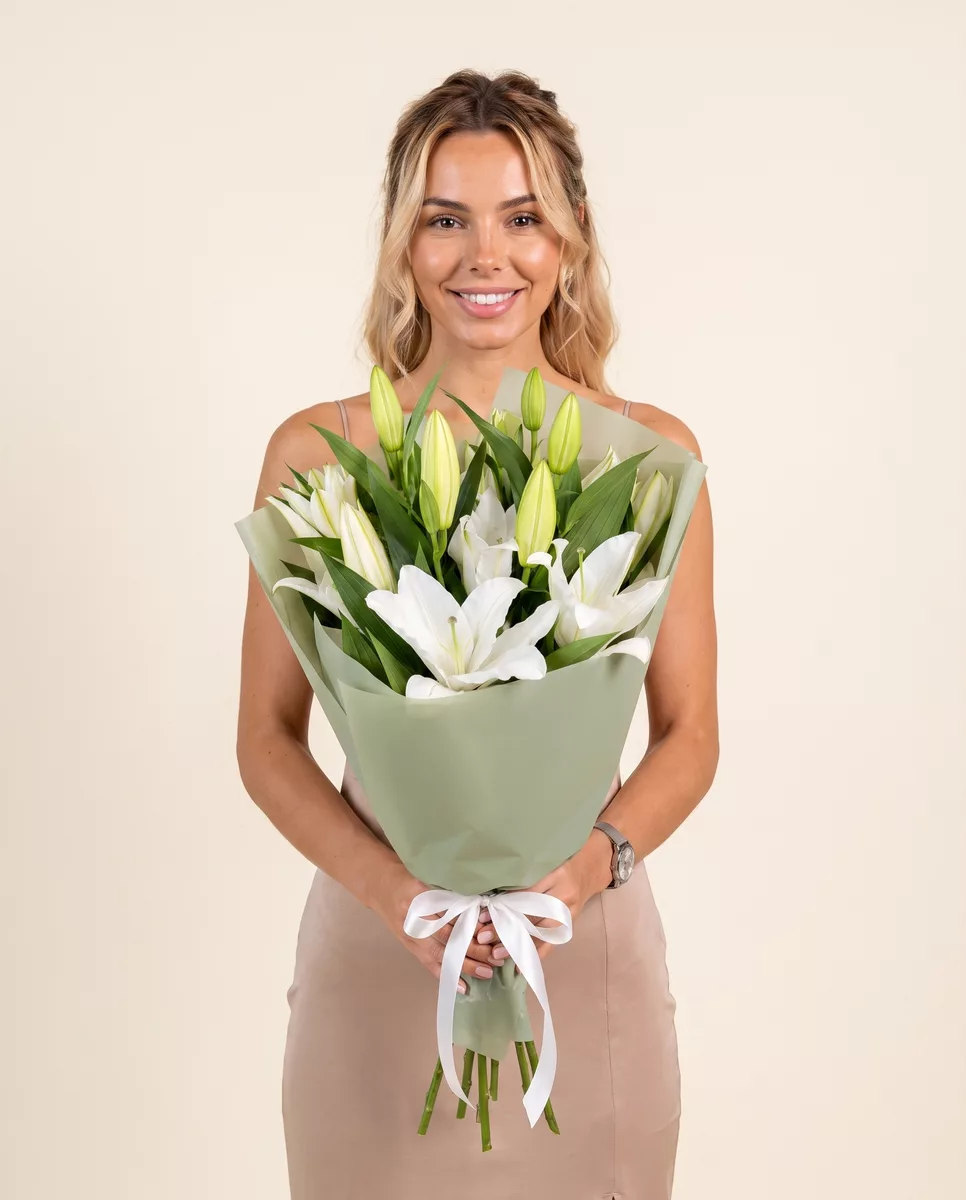
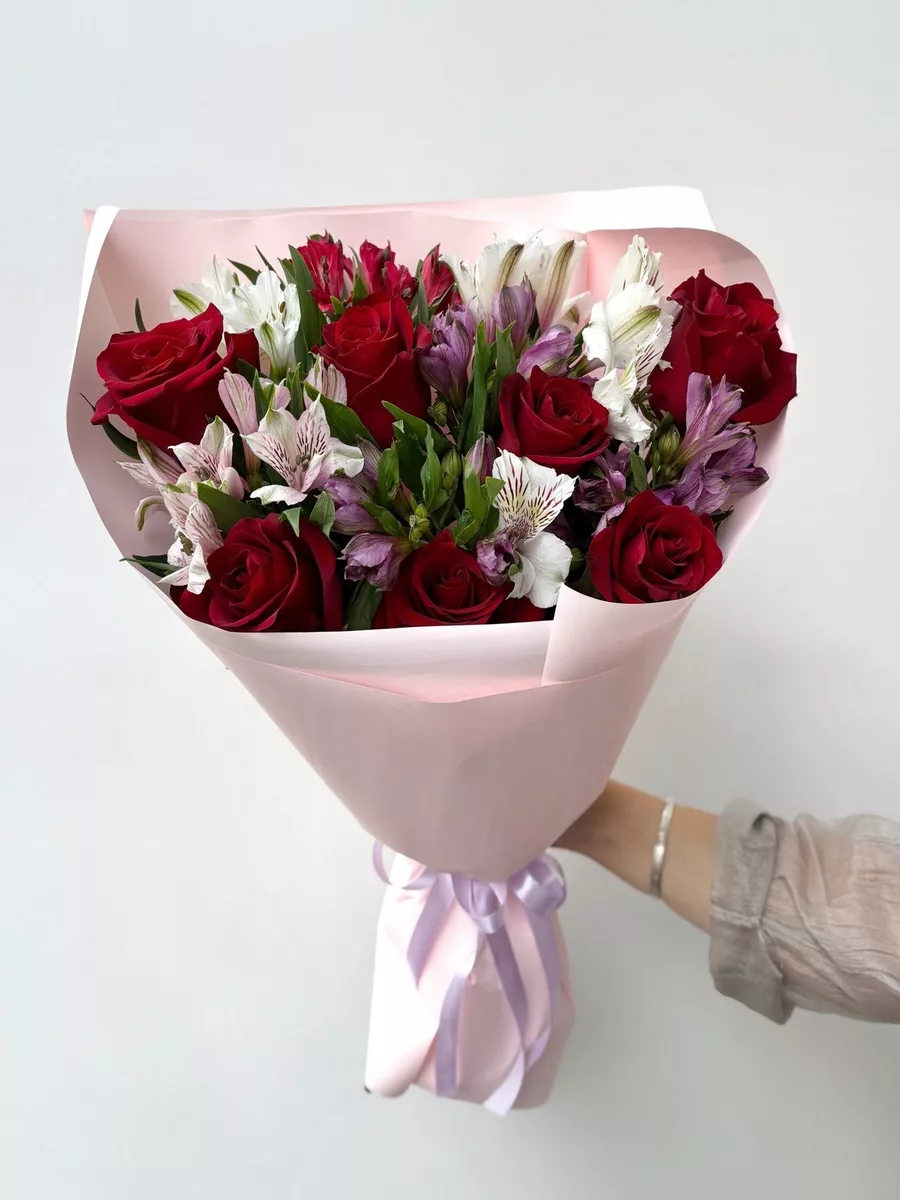

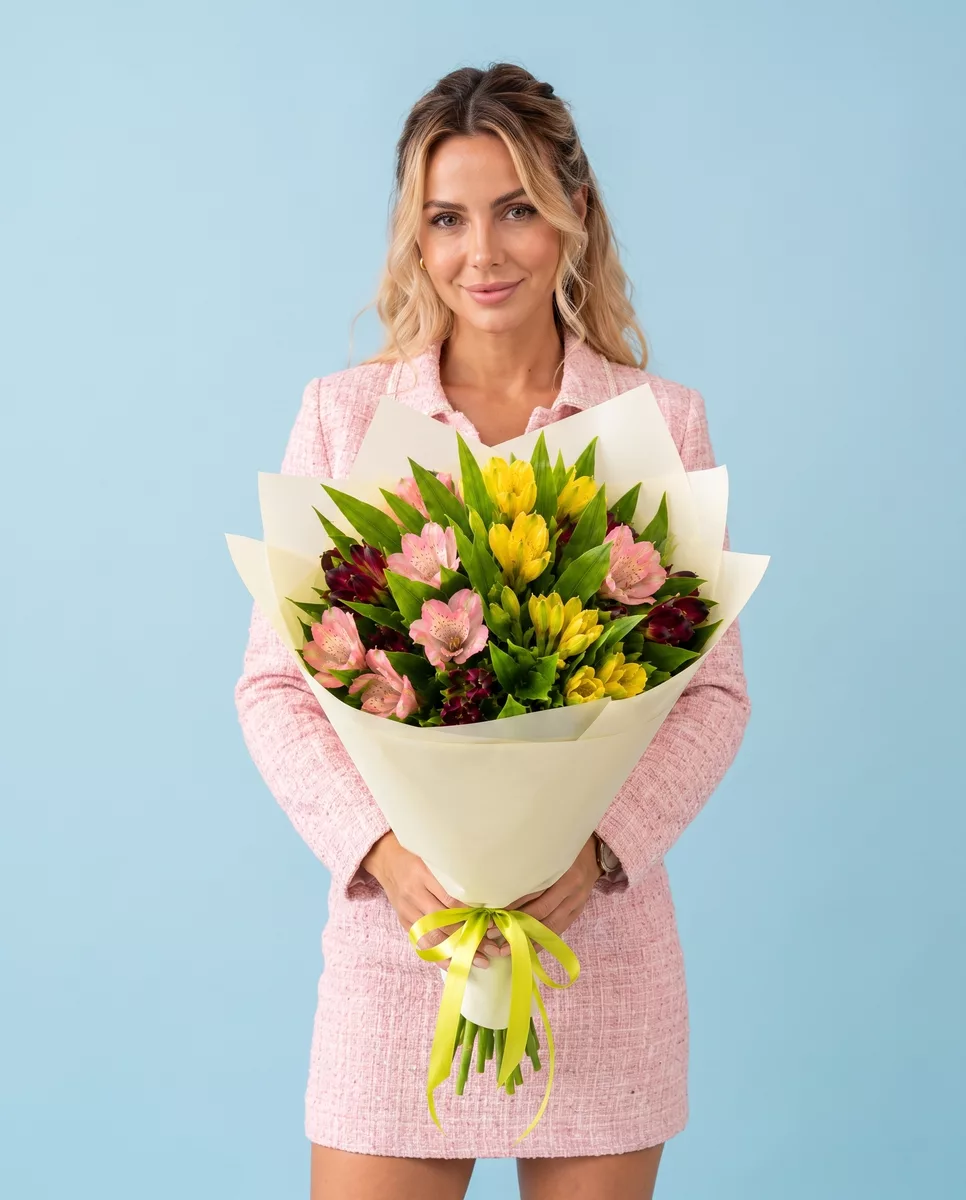
Why the Order Form Matters More Than the Courier's Language Skills
Every delivery we send out carries a printed card attached to the bouquet and a separate instruction sheet for the courier. What goes into the order form at the time of booking is what shapes both of those documents. If you write the recipient's full name in both Latin and Cyrillic script, the courier can match it to the intercom panel or the building register without guessing. If you include the apartment number, floor, entrance number and any gate or door codes, the courier can navigate a large residential complex — which in Russian cities often means a cluster of identical twelve-storey buildings sharing one address number — without needing to ask anyone for directions in English. Russian addresses follow a specific structure: city, street, building number, then corpus (a sub-building letter or number common in Soviet-era complexes), then apartment. Getting all of these fields filled correctly is more valuable than any language skill. The phone number field is equally important. Write the recipient's Russian mobile number in full international format. Our couriers will call or send a short SMS before arrival, and a Russian-language call to a Russian number is the most reliable way to confirm someone is home. If the recipient also speaks English and has been warned to expect a call from an unfamiliar number, that one small piece of preparation removes the single biggest source of failed deliveries.
Using the Order Notes Field to Pre-Translate Everything Relevant
The notes field in an online flower order form is not just for writing 'please add a ribbon'. It is the place where an international sender can deposit every piece of logistical information the courier might need, written in Russian. You do not need to speak Russian to do this. Copy-paste tools and machine translation have become reliable enough for short, factual sentences about addresses and timing. A sentence like 'The recipient works on the second floor, the office door is always locked, please call on arrival' takes thirty seconds to translate and can prevent a failed delivery entirely. Write the note in both English and Russian if you are uncertain about the translation quality — our dispatch team reads the notes before the order goes out and can correct obvious errors. Avoid idioms, abbreviations and relative time references like 'in the morning' without specifying the hour. State exact times in 24-hour format. If the recipient has a name that is difficult to pronounce in Russian, include a phonetic hint in Cyrillic if you can, or simply note that the name is foreign and the courier should verify by showing the printed card. Flowers like peonies and garden roses are already labelled on the packaging, so the contents are not something the courier needs to explain — the presentation handles itself. What the notes field cannot do is fix a wrong phone number or a missing apartment number after the order has been dispatched.
What Happens When the Recipient Does Not Speak Russian Either
Occasionally the recipient is also a foreign national living or working in Russia temporarily — an expat employee, a visiting researcher, a diplomat's family member. In that case neither party at the door has Russian as a first language, and the interaction becomes a short performance of universal gestures: the courier holds out the bouquet, the recipient takes it, someone produces a phone screen with a confirmation code or a signature prompt. This actually works more smoothly than people expect because flower delivery is a visually self-explanatory transaction. The courier is not there to explain the arrangement or discuss the flower varieties; they are there to hand over a box or a wrapped bouquet and confirm receipt. Where it can break down is in buildings with strict security procedures — some Moscow business centres and gated residential complexes require the courier to state the recipient's name and company to a guard who may also have no English. Solving this requires the recipient to be notified in advance and to come down to the lobby or instruct the guard to admit the delivery. We always recommend that the sender message the recipient directly before placing the order, especially for workplace deliveries. A bouquet of white freesia and spray roses sitting at a reception desk because no one knew to expect it is a preventable situation. Advance notice to the recipient is the single most effective preparation an international sender can make.
The Role of the Written Card and How to Use It Across Languages
Every bouquet we send includes a small printed card with the message the sender writes at checkout. This card is the one element of the delivery that speaks directly to the recipient rather than to the logistics chain. If you are sending flowers from abroad and you want the recipient to understand your message, write it in whatever language you share with them — English, French, German, Japanese — and we will print it exactly as written. The courier does not read the card; it is sealed in an envelope attached to the bouquet. There is no need to translate your personal message into Russian for the sake of the delivery process. However, if you also want to include a practical note for the recipient — something like 'these tulips need to be cut at an angle and placed in cool water immediately' — writing that in both English and Russian is worth the small effort. Tulips in particular continue to grow after cutting and will bend toward the light within hours if not properly conditioned. Ranunculus and anemones are similarly sensitive to warmth and should be unwrapped and placed in water within twenty minutes of arrival, especially in summer when indoor temperatures in Russian apartments can exceed 24 degrees Celsius. A bilingual care note on the card means the recipient gets that information regardless of what language they are most comfortable reading. It is a small detail that protects the flowers you have paid for.
Timing, Callbacks and What to Do If Something Goes Wrong
Our standard delivery window in Saint Petersburg and across Russia is 1–2 hours from order confirmation. Within that window the courier will typically call the recipient roughly fifteen to twenty minutes before arrival. That call will be in Russian. If the recipient does not pick up an unknown Russian number — which is increasingly common as spam calls have made people cautious — the courier will send a short SMS and attempt the delivery anyway. If there is no answer at the door, the courier will wait a few minutes and try the number again before contacting our dispatch. This is the moment where international senders sometimes panic because they are watching a tracking update stall and cannot reach anyone by phone from abroad. The clearest prevention is to tell the recipient explicitly: expect a call from an unknown Russian number around the delivery time, pick it up or reply to any SMS. If a delivery does fail — genuinely rare, but it happens — our dispatch team communicates in English via the contact details on your order. You can reach us by email or through the website chat in English and we will resolve the situation, whether that means rescheduling, redirecting to a neighbour or holding the flowers at a cool point until a new attempt is arranged. Flowers like chrysanthemums and alstroemeria hold well for several hours at the right temperature, giving us flexibility. More delicate varieties like garden roses or sweet peas need to move faster.
Preparing the Recipient: the Step Most International Senders Skip
The most common mistake we see from international senders is treating the delivery as a surprise right up to the moment the courier rings the bell, without giving the recipient any logistical preparation. Surprises are lovely; an unprepared recipient who misses the delivery because they stepped out, ignored an unknown number or could not communicate with a security guard is not. There is a middle path: tell the recipient that flowers are coming today, without revealing the sender or the occasion, and ask them to watch for a delivery call from a Russian number in the afternoon. That one message preserves most of the emotional impact while eliminating the most common failure point. If the recipient is at a workplace, it helps to let the reception or security desk know in advance that a flower delivery is expected for a named person. In Russian office culture, reception staff are generally accustomed to handling deliveries and will hold a bouquet safely. Roses and lisianthus travel wrapped and can wait at room temperature for up to an hour without significant damage. Peonies in bud are even more forgiving. What does not wait well is a bunch of fully open garden roses in July heat — those need to reach water within the hour. Knowing the variety in your order helps you judge how much timing flexibility you actually have. If you ordered something delicate and the recipient is genuinely unreachable for several hours, contact us early rather than waiting to see what happens.
Flower delivery across a language barrier is genuinely manageable if the preparation happens before the courier leaves our facility rather than at the door. Fill every address field completely, write your notes in Russian as well as English, give the recipient a heads-up about the incoming call, and let the printed card carry your personal message in whatever language you and the recipient share. The courier's job is to move a fresh, well-packaged bouquet from our refrigerated storage to the recipient's hands within the delivery window — and that job does not require a conversation. It requires a correct address, a reachable phone number and a recipient who is expecting something. Get those three things right and the language question becomes almost irrelevant. We deliver bouquets across Russia in 1–2 hours.
Frequently asked questions
Can I place my order in English on the Five Flowers website?
Yes. The order form accepts Latin script for names and messages, and our dispatch team reads English-language notes without difficulty. Write any logistical instructions in both English and Russian if you can manage a quick machine translation — it helps the courier directly — but English alone in the notes is fine for our team to process before dispatch.
What if the courier calls the recipient and neither of them can communicate?
The courier will still attempt the delivery and ring the apartment or office. Most handoffs complete without any spoken exchange beyond a nod and a signature. If genuine confusion arises, the courier contacts our Russian-speaking dispatch team, who can then reach you as the sender through the English-language contact details on your order to coordinate.
Should I write the recipient's name in Cyrillic on the order form?
If the recipient has a Russian name, yes — Cyrillic helps the courier match the name to an intercom panel or building register. For foreign names, Latin script is fine. Including both versions when possible removes any ambiguity, especially in large residential complexes where several residents may share a similar surname.
How do I write a Russian address correctly if I am ordering from abroad?
Follow this order: city, street name, building number, corpus or block number if applicable, apartment number, floor, and entrance number. Entrance numbers matter in Russian apartment buildings — a wrong entrance means the courier is at the wrong stairwell. If you are unsure of any field, ask the recipient to send you their full address in Russian text and paste it directly into the form.
Is it possible to request an English-speaking courier for an extra fee?
We do not offer this as a standard service option. Our couriers are selected and rostered based on geography and timing to meet the 1–2 hour delivery window. The preparation steps described above — complete address, Russian-language notes, recipient notification — reliably substitute for a shared language and are available to every customer at no extra cost.
Ready to send a bouquet?
Pick a city, choose the flowers, and we will hand them over with a photo confirmation.
Choose a city →