
The Famous Russian Flower: Chamomile and Other Familiar Blooms
If you mean the famous Russian flower with white petals and a yellow centre, the usual answer is chamomile, known in Russian as romashka. Its familiar daisy shape is strongly associated with Russian meadows, affection and family life, although calling it Russia’s official national flower would overstate its status. For someone choosing a gift, that cultural association matters more than finding a single flower that represents the whole country.
At Pyat Tsvetov (5 Flowers), the useful starting point is what the recipient will recognise and enjoy: a meadow-style bouquet, a romantic arrangement or flowers for a formal occasion. We have worked in Saint Petersburg since 2011 and have three flower shops in the city. Below, we explain what people usually mean by a Russian flower, how familiar blooms differ as gifts and how to arrange delivery when you are ordering from abroad.
Why chamomile is so closely associated with Russia
Romashka appears in Russian songs, illustrations and the familiar petal-plucking game used to ask whether someone loves you. Its appeal is informal: white rays around a yellow centre suggest a summer meadow rather than a ceremonial bouquet. Chamomile is also associated with Russia’s Day of Family, Love and Fidelity on 8 July. These connections make the flower a recognisable cultural reference, but they do not mean that every Russian recipient considers it their favourite.
The English word can create confusion when you start shopping. Chamomile usually refers to particular plants, including those used for herbal tea, while a florist’s daisy-like flowers may belong to other groups. Flowers with the same white-and-yellow appearance can differ in scent, stem strength and care needs. If the meadow look is what matters, describe the colour and shape you want and check the bouquet description instead of assuming that every daisy-like stem is botanical chamomile.
Other flowers that feel familiar in Russian culture
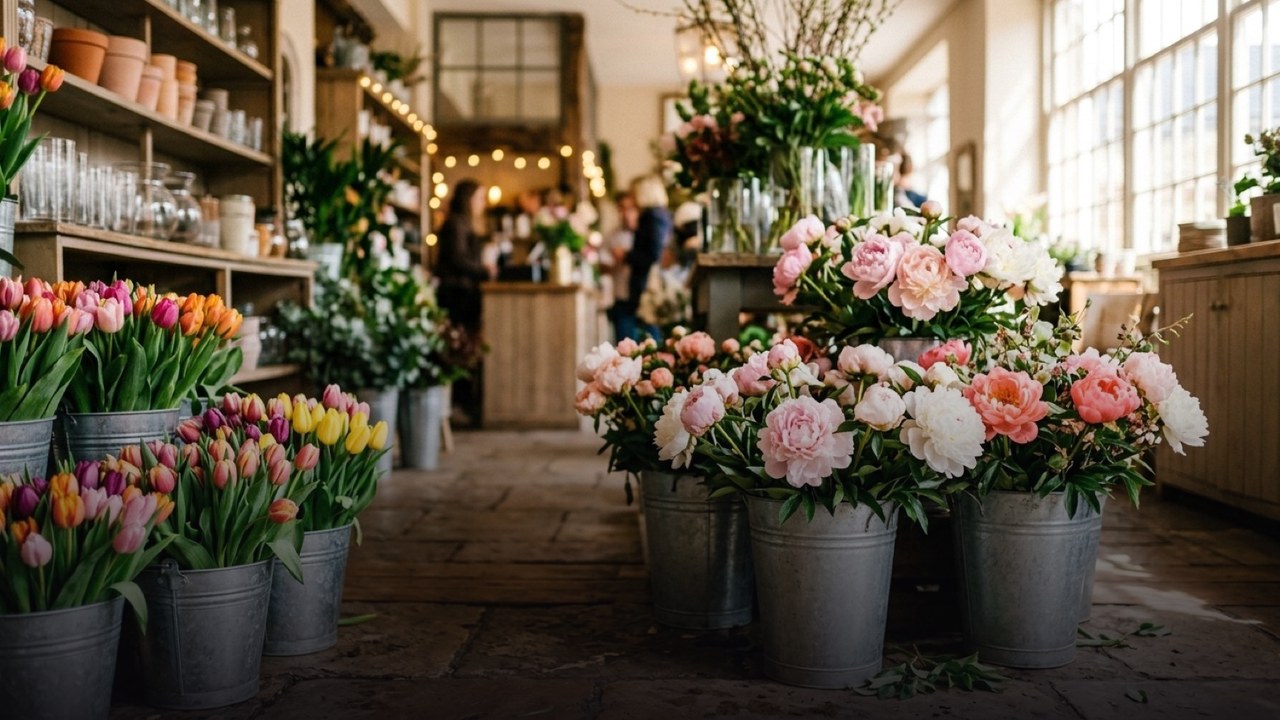
Tulips are closely associated with spring gifts and International Women’s Day on 8 March, while mimosa’s yellow flowering sprays are another familiar image of that holiday. In flower-shop language, mimosa usually means flowering acacia rather than the sensitive plant sold as Mimosa pudica. Peonies are a popular reference for generous, softly rounded early-summer bouquets. These are cultural and seasonal associations, so a photograph of a traditional gift does not establish what is available for a particular delivery date.
Roses offer a more formal or romantic direction, depending on their colour and presentation. Chrysanthemums can suit substantial mixed arrangements, while carnations have several uses in Russia, including commemorative occasions; context matters more than a blanket rule against giving them. Irises bring a distinct blue or violet shape, although their individual flowers can be relatively short-lived. Our guide to irises in Russia explains that choice if the recipient values spring colour over a long-lasting display.
Bouquets we can deliver




Choose the meaning around the person and occasion
A chamomile-style bouquet works well when you want the gift to feel affectionate, relaxed and connected to summer. It can recall a family garden or countryside holiday without making a grand romantic statement. For someone whose taste you know, a favourite flower is a stronger guide than a symbolic dictionary. If their home is full of restrained white arrangements, a bright mixed meadow bouquet may be culturally recognisable but still miss their preference.
Red roses commonly suggest romance, but flower colours do not form a fixed code that every recipient follows. Yellow flowers are sometimes linked with separation in popular associations, yet many people simply enjoy their warmth and brightness. Use what you know about the recipient, especially if they have expressed a dislike of a colour. Add a short card that states the occasion or feeling plainly; a personal sentence gives the gift clearer meaning than expecting the flowers to explain everything.
Russian bouquet etiquette: numbers, presentation and timing
For a simple bouquet with an obvious stem count, choose an odd number of flowers for a happy occasion. Even numbers are traditionally associated with funerals and remembrance in Russia, so a pair of roses can convey an unintended message. The convention is clearest when the individual flowers are easy to count; mixed arrangements and branching stems make counting less straightforward. If you are unsure, choose a bouquet presented for the occasion rather than calculating the number of every small bloom.
Match the size and delivery time to what the recipient will be doing that day. A large arrangement can be awkward for someone leaving work by public transport or attending several events, while a strongly scented bouquet may be unwelcome in a shared room. Birthdays and anniversaries usually benefit from a message that names the occasion, particularly when the sender is abroad. For a surprise, remember that delivery still requires coordination: our courier calls the recipient about 15 minutes before arrival.
Help a meadow-style bouquet settle into a vase
Start with a clean vase, fresh water and enough space for the stems without packing them tightly together. Remove leaves that would sit below the waterline, then trim the stem ends with a clean, sharp tool before arranging the flowers. Follow any flower-food instructions rather than guessing the concentration or adding kitchen ingredients. Check the water daily, replenish it as needed and change it when it becomes cloudy, cleaning the vase at the same time.
Keep the bouquet away from radiators, direct sun and ripening fruit, which can shorten the useful life of many cut flowers. Remove fading flowers and submerged plant material promptly, and follow any care instructions supplied for the particular stems. A daisy-like appearance does not guarantee that every flower in a mixed bouquet will last equally long. If scent matters as much as appearance, our guide to matthiola offers another flower to consider, provided the recipient enjoys fragrant stems.
How to send a thoughtful bouquet to Russia
Start with the recipient’s city, delivery address, contact number and preferred date, then browse the bouquets catalogue for an arrangement that suits their taste. We deliver flowers across Russia, with city delivery costing 500 RUB; for remote districts and suburbs, the operator confirms the delivery price when confirming the order. In large cities, express delivery is available 1–2 hours after order confirmation. Other timing options include an exact time within plus or minus 30 minutes, windows of 09–12, 12–15, 15–18 or 18–21, and advance orders 1–30 days ahead.
Delivery in Saint Petersburg is available around the clock; check the delivery and payment information when planning your order. Delivery is anonymous by default, meaning the courier does not name the sender, and a card with your text is free. If the recipient is absent, we agree a second delivery that day or, with the sender’s consent, hand the flowers to a neighbour or concierge. Online checkout uses CloudPayments: check the payment options displayed there, as acceptance of every foreign card is not guaranteed; questions can be directed to 8 (812) 507-67-05.
Frequently asked questions
What is the most famous Russian flower?
Chamomile, or romashka, is the usual answer, especially if you mean a white flower with a yellow centre associated with Russian meadows. It is a familiar cultural symbol, but describing it as Russia’s official national flower would be misleading.
Are chamomile and daisies the same flower?
Chamomile has a daisy-like flower head, but many different plants share that appearance. Check the bouquet description if you want a particular plant rather than simply white petals and yellow centres.
How many flowers should I send for a birthday in Russia?
Choose an odd number when giving a simple bouquet whose flowers are easy to count. Even numbers are traditionally associated with funerals and remembrance.
Can I send flowers to Russia without naming myself?
Yes, our delivery is anonymous by default, and the courier does not name the sender. A card with your text is free, so you can decide whether to include your name in the message.
Can I pay for an order with a foreign card?
Online checkout uses CloudPayments; check the options displayed at checkout for your payment method. Acceptance of every foreign card is not guaranteed.
Ready to send a bouquet?
Pick a city, choose the flowers, and we will hand them over with a photo confirmation.
Choose a city →