
Flower Colours in Russia: What Each Shade Actually Signals
Colour is the first thing a recipient reads before they even touch the stems. In Russia that reading is faster and more opinionated than in many other countries, and senders who choose by personal taste alone regularly cause confusion — a well-meaning purple bouquet arriving at a birthday, a white arrangement sent to a new mother, a red bunch handed to a colleague. This guide goes colour by colour through the shades customers ask about most: pink, orange, purple, and mixed palettes. For each one you get the real cultural weight, the varieties that carry it best, and the ordering details that determine whether the flowers arrive looking the way they should.
Why Colour Matters More Than Variety in Russian Gifting
Most customers call us asking for 'something beautiful,' but when we press for the occasion, it becomes clear that colour is doing the heaviest symbolic work. Russian gifting culture inherited a strong visual grammar from Soviet-era flower markets, where variety choice was limited but colour was always the primary signal. That grammar is still very much alive. A florist in Saint Petersburg hears the same questions daily: can I send white to a birthday, is red only for romance, does purple mean something bad. The short answers are yes, mostly yes, and absolutely not — but the longer answers depend on context, and context is what this guide provides. Colour also affects how long a bouquet looks fresh. Pale pinks and creams in warm delivery conditions — anything above eighteen degrees Celsius in the car — can show petal bruising within two hours. Saturated reds, deep oranges, and strong purples hold structure longer because the pigment concentration in the cell walls is higher, which slows visible wilting. When you order for a same-day delivery in summer, choosing a darker palette is not just aesthetics; it is practical. We keep our vans cooled to between eight and twelve degrees, but the final walk from the door to the vase still matters. Knowing your colour also helps us source the right stem: a customer who says 'any pink' might receive a spray rose when they pictured a garden peony, and those two flowers send very different messages across a Russian table.
Bouquets we can deliver



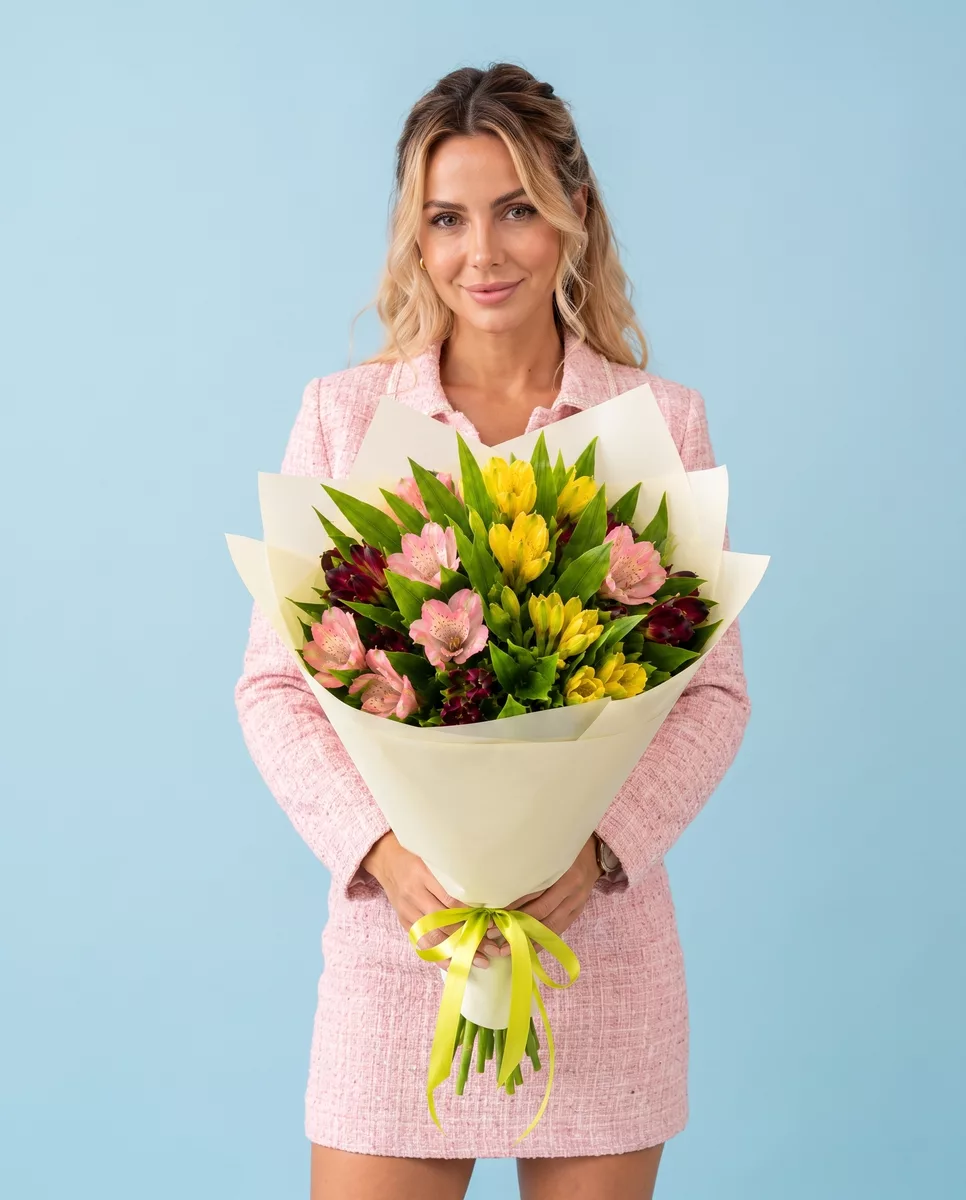
Pink: The Most Requested Colour and Its Variations
Pink is the single most ordered colour at our shop, and it covers a wider range of meaning than any other shade. Light blush pink — found in varieties like Mondial roses, Keira garden roses, and early-season peonies — reads as tender, appropriate for a young woman's birthday, a new baby, a first date, or a thank-you to a teacher. Deep pink, closer to magenta, is bolder and works well for a colleague's promotion or a mother's anniversary where red would feel too romantic. The distinction matters practically: a customer who orders 'pink roses' without specifying can receive anything from a pale champagne-edged stem to a near-fuchsia spray rose, and those sit differently in a Russian living room. Pink chrysanthemums, particularly the Zembla variety, are a budget-conscious option that holds for ten to fourteen days in a cool room, making them excellent for recipients who live alone and will be enjoying the bouquet without help. Pink tulips arrive in Russia from Dutch growers between October and April and are among the fastest-selling stems we handle during that window. Outside that season we substitute with lisianthus, which mimics the layered look of a peony at a lower price point. One mistake we see repeatedly: customers ordering pink for a male recipient and then second-guessing themselves. Pale pink on a man is unusual in Russian culture and will be noticed; if the intention is warmth without romance, a terracotta-and-cream palette achieves that more comfortably. Always confirm the recipient's age and relationship before settling on a pink shade.
Red: Romance, Respect, and the Odd Number Rule
Red carries the most specific set of rules in Russian flower culture, and breaking them is the most common mistake international senders make. The core rule is odd numbers: bouquets of three, five, seven, eleven, or twenty-five stems are for living recipients; even numbers are reserved for mourning. This is not a vague tradition — it is noticed immediately by Russian recipients, and an even-numbered red bouquet will cause genuine discomfort. Red roses are the dominant variety in this category, and the most reliable long-stemmed option is the Explorer or Red Naomi variety, both of which have dense petals that resist bruising during transit. For a bouquet of eleven stems in a standard box, expect a stem length of sixty to seventy centimetres; shorter stems at fifty centimetres work better in hand-tied arrangements where the recipient will put them straight into a vase. Red is appropriate for romantic partners, for significant anniversaries, and as a mark of deep respect toward an older woman — a grandmother or a revered teacher on professional holidays. It is not appropriate for a male colleague, a child, or a casual acquaintance. Red tulips share the romantic weight of red roses and are significantly less expensive during their natural season from February through April, which makes them popular for the period around March 8th, International Women's Day. Red gerberas are a lighter, more cheerful read of the same colour and work for birthdays without the romantic weight. If the relationship is ambiguous, shifting to burgundy — varieties like Black Baccara rose — softens the signal while keeping the richness.
Orange: The Colour That Russians Associate With Energy, Not Caution
Orange is underused by senders who assume it reads as a warning colour, as it does on road signs. In Russian gifting it reads as energetic, warm, and celebratory — closer to how yellow functions in Western European cultures. It is an excellent choice for a birthday where the recipient is known to have an outgoing personality, for a sports achievement, or for a housewarming where you want the arrangement to feel alive in a new space. The most practical orange varieties we work with are Naranja roses, orange gerberas, orange ranunculus in spring, and Leonidas roses, which sit at the copper-orange boundary and photograph exceptionally well. Orange tulips are available from November through April and are among the most structurally reliable tulips for delivery because the stem is thicker than in many pink varieties. One technical point: orange flowers, particularly gerberas, are sensitive to ethylene gas, which is released by ripening fruit. A recipient who keeps a fruit bowl near the vase will see orange gerberas droop within two days rather than the expected five to seven. We include a care card with every delivery, but it is worth mentioning this to the sender if they know the recipient's home setup. Mixed orange-and-yellow arrangements are popular for corporate deliveries to an office because they are gender-neutral and read as professional warmth rather than personal sentiment. Orange combined with white — white lisianthus or white spray roses alongside orange focal flowers — is one of the cleaner combinations we build regularly, and it holds well in the temperature range of a typical Russian apartment, which in winter can run quite dry from central heating.
Purple and Violet: Sophistication Without the Romantic Weight of Red
Purple is the colour we recommend most often when a sender wants to express admiration or deep affection without the explicit romantic signal of red. In Russian culture purple does not carry any negative association — the occasional worry we hear from foreign senders is unfounded. It reads as refined, slightly formal, and appropriate for a wide range of recipients: a senior colleague, a mentor, a woman in her forties or older receiving flowers for a professional milestone. The varieties that carry purple most effectively are Blue Curiosa roses, which are a true lilac-purple and hold their colour well for five to seven days in a cool room, and statice, which is often used as filler but can anchor a monochrome purple arrangement on its own. Eustoma in violet shades — sometimes sold as lisianthus — is one of the most durable purple flowers we stock, lasting up to two weeks with a clean water change every two days. Lavender, both fresh and dried, is popular for postal deliveries across Russia because it survives transit without water, but fresh lavender is only reliably available from June through August. Purple irises are a spring option available from February through May, with a strong stem that handles the transition from cold storage to a warm apartment without wilting quickly. One detail senders often miss: purple flowers darken under artificial light, which is how most Russian recipients will see them in the evening. A bouquet that photographs as bright violet outdoors will look closer to deep plum under an LED ceiling fixture, so if the recipient has a specific aesthetic in mind, communicate that to us when ordering.
White and Cream: Clean Signal, But Context Is Everything
White is the colour that generates the most questions from international senders, because in many Asian cultures white is associated with mourning and they assume Russia shares that convention. Russia does not. White flowers are entirely appropriate for birthdays, weddings, graduations, and professional celebrations. The association to be careful about is not the colour itself but the specific context of an all-white wreath-style arrangement, which is a funeral form. A loose hand-tied bouquet of white flowers, a box arrangement, or a mixed white-and-green composition carries no such weight. The strongest white varieties for Russian deliveries are Avalanche roses, which have a cream-white centre that does not bruise visibly during transit, and white peonies in season from May through July. White chrysanthemums are durable and economical but carry a slightly formal, restrained feeling that works for a teacher or a doctor but feels underweight for a close friend's birthday. White tulips are among the most popular stems for March 8th and are available in reliable supply from January through April. Cream shades — closer to ivory than pure white — read as warmer and more personal than stark white, and varieties like Mondial roses or Caramel Antike garden roses sit in that zone. For a new mother, white or cream with a single pink accent is a classic combination that reads clearly and avoids the all-pink cliché. One practical note: white petals show water spots from hard water more visibly than any other colour, so advise recipients in cities with high mineral content in the tap water — Moscow is a common example — to use filtered or bottled water in the vase.
Mixed Palettes: How to Combine Colours Without Sending a Confused Message
Mixed bouquets are the most popular category we sell, and they are also the most frequently misread by recipients when the colour logic has not been thought through. The safest rule is to choose one dominant colour that carries the main signal and support it with one or two neutrals — white, green, or cream — rather than combining two equally weighted statement colours. Red and purple together, for example, creates visual competition and a muddled emotional signal; red and white, or purple and cream, each have a clear hierarchy. The most reliable mixed palettes for birthdays are pink-and-white, orange-and-cream, and yellow-and-white. For romantic occasions, red-and-white or red-and-deep-pink work well. For professional milestones, purple-and-white or burgundy-and-cream read as respectful without being personal. Seasonal availability shapes what mixes are actually possible. In winter, from November through February, the palette is dominated by roses, chrysanthemums, and imported tulips; the range of textures is narrower. In late spring and summer, peonies, ranunculus, anemones, and garden roses open up the mixing possibilities considerably. If you are ordering for a specific colour scheme — a party theme, a corporate brand colour — send us a reference image rather than a colour name, because what one person calls coral another calls salmon, and those two shades require different source flowers. Greenery choice also affects how a mixed palette reads: eucalyptus adds a grey-green coolness that suits purple and white arrangements, while ruscus and pittosporum read warmer and suit orange and pink compositions better.
Colour is a working language in Russian flower culture, and once you understand its basic grammar, ordering becomes straightforward rather than stressful. Pink for warmth and tenderness, red for romance and deep respect with odd numbers always, orange for energy and celebration, purple for admiration without romantic weight, white and cream for almost any positive occasion in a loose arrangement, and mixed palettes built around one dominant signal colour. Variety choice, stem condition, and delivery temperature all affect how that colour reads when it arrives, which is why giving a florist the full picture — occasion, recipient, relationship, and any known preferences — produces a better result than a colour name alone. Every bouquet we send from Saint Petersburg is assembled the same day and travels in a cooled vehicle, so the colour you choose is the colour that arrives. We deliver bouquets across Russia in 1–2 hours.
Frequently asked questions
Is it true that even numbers of flowers are forbidden in Russia?
Even numbers are associated with mourning and should be avoided for any celebratory or affectionate gift. Odd numbers — five, seven, eleven, fifteen, twenty-five — are the standard for living recipients. This applies across all colours, not just red or white. If you are unsure of the exact count in a bouquet, ask the florist to confirm before the order is finalised.
Can I send yellow flowers in Russia without it being taken badly?
Yellow has a mixed reputation in older Russian tradition, sometimes linked to separation or jealousy, but this association is weakest among recipients under forty and in urban centres like Saint Petersburg. A fully yellow bouquet can still cause raised eyebrows among older recipients. A safer approach is to mix yellow with white or orange, which dilutes any negative reading while keeping the warmth of the colour.
What is the most durable colour palette for a long delivery route across Russia?
Saturated colours — deep red, burgundy, strong orange, and violet — hold their appearance better over long transit times than pale blush or cream shades, which show petal bruising more visibly. Varieties like Explorer roses, Zembla chrysanthemums, and violet eustoma are reliable choices for deliveries where the flowers may spend several hours in transit before reaching a vase.
Does purple really have no negative meaning in Russian culture?
Correct. Purple, violet, and lilac carry no negative cultural association in Russia. The concern comes from senders familiar with other cultural contexts where these shades signal mourning or illness. In Russia purple reads as refined and respectful, making it one of the most versatile colours for recipients you do not know well, including senior colleagues and professional contacts.
How do I choose between pink shades when ordering online without seeing the flowers?
Specify the relationship and the recipient's approximate age in the order comments. Light blush pink suits younger recipients and tender occasions; deep or hot pink works for a bolder personality or a more significant milestone. If you can share a reference image of a shade you have in mind, that removes ambiguity entirely. Variety names like Mondial for blush or Aqua for mid-pink also help us match your expectation precisely.
Ready to send a bouquet?
Pick a city, choose the flowers, and we will hand them over with a photo confirmation.
Choose a city →