
Flower Delivery in Kirsanov: Zones, Timing and What to Expect
Kirsanov sits in Tambov Oblast, a compact city where most addresses are reachable from the central post within twenty minutes by car. Customers ordering flowers here for the first time often assume delivery works the same way it does in Moscow or Saint Petersburg — same-day, any hour, any bouquet. The reality is more specific, and knowing the details before you place an order saves a lot of frustration. Below is everything that actually matters: where we deliver, how long it takes, which flowers hold up on the road, and what questions to ask yourself before you confirm the order.
Which Parts of Kirsanov We Reach and Where the Limits Are
Kirsanov proper covers a relatively small footprint, and the central residential streets, the area around Sovetskaya Square, the hospital district and the railway station neighbourhood all fall within our standard delivery zone. Orders to addresses in these areas move through the same scheduling queue as any other city in our network. Outlying villages and rural addresses attached to the Kirsanov municipal district are a different matter: roads vary significantly in condition depending on the season, and delivery to those points requires a separate time estimate that our operators confirm by phone before the order is locked in. Customers sometimes list a village address and expect the same window as a city-centre flat — that mismatch is the single most common source of complaints we receive from this region. If the recipient lives outside the city boundary, tell the operator the exact settlement name and, if you know it, the road name; that information lets us give you an honest estimate rather than a guess. Apartment buildings along Michurinskaya and Krasnaya streets are straightforward. Private houses on the city's eastern edge occasionally add ten to fifteen minutes to the route depending on traffic near the level crossing. Always confirm the full postal address, including the flat or house number, at the point of ordering — a missing number delays delivery more reliably than almost any other factor.
Bouquets we can deliver



Delivery Timing: What One to Two Hours Actually Means Here
Our headline promise of one to two hours refers to the window between order confirmation and the moment the courier hands the bouquet to the recipient. In Kirsanov, that window holds reliably for orders placed before 18:00 local time on weekdays. Evening orders — anything confirmed after 18:00 — are fulfilled the following morning unless you have arranged a specific late slot with the operator. The city has no significant traffic congestion by the standards of a regional capital, which is genuinely helpful: a courier leaving the collection point in the city centre will reach almost any residential address within fifteen to twenty minutes of driving. The buffer in the one-to-two-hour window is occupied by bouquet assembly, quality check and the handover process at the door. Weekend timing follows the same rules, but demand spikes around public holidays — particularly February 23, March 8 and the weeks around graduation season in late May and early June — mean that the queue fills faster. On those dates, ordering four to six hours ahead rather than one to two hours ahead is simply more reliable. If the delivery is time-sensitive, for instance for a birthday dinner or a ceremony with a fixed start, tell the operator the hard deadline and we schedule backward from that point. Do not assume the system will infer urgency from the occasion; state it explicitly when you place the order.
Which Flowers Survive the Journey to Kirsanov in Good Condition
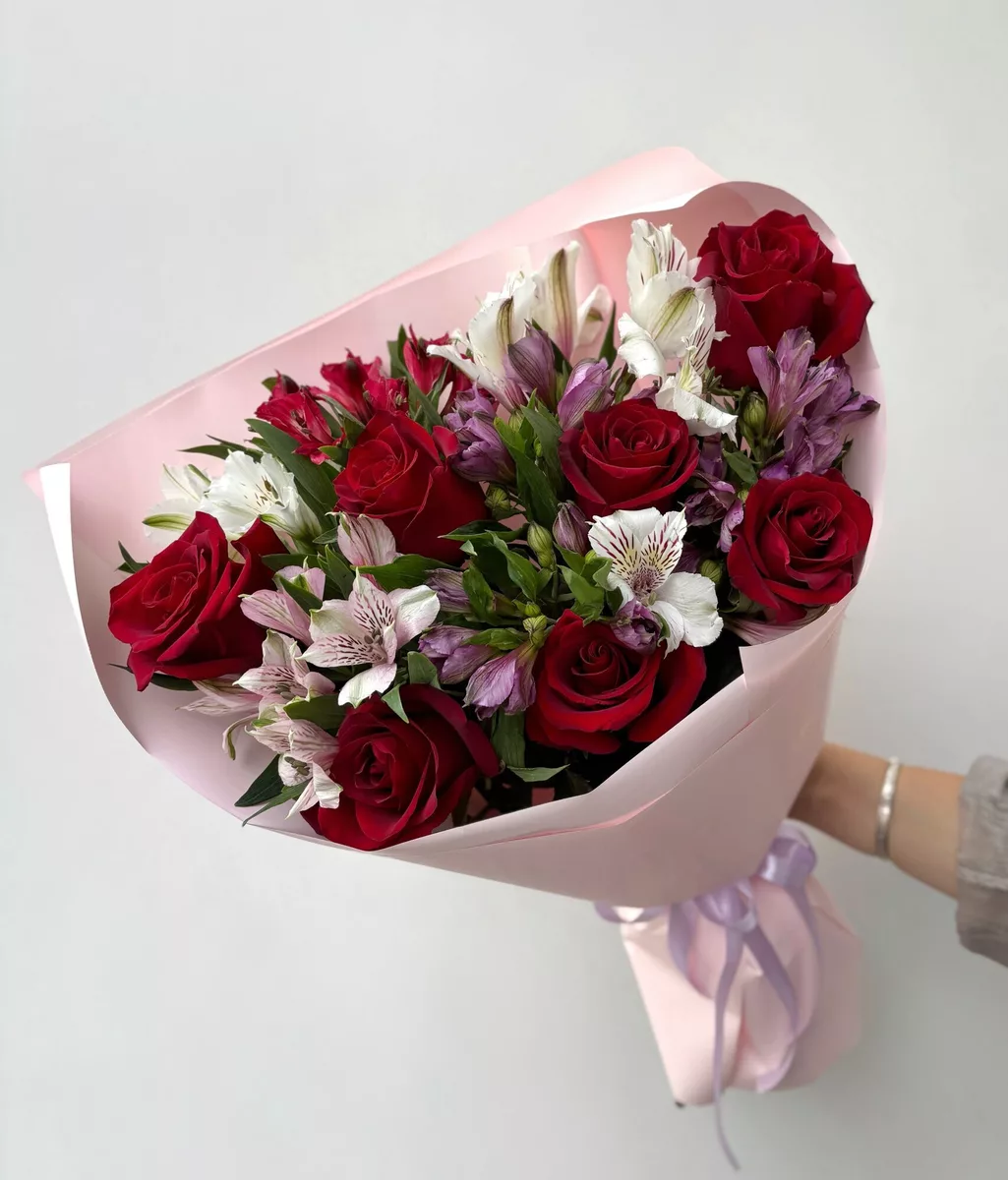
Flowers travel to Kirsanov from our Saint Petersburg facilities, which means they spend time in transit before local delivery begins. That transit is handled under refrigerated conditions, and the varieties we dispatch are chosen specifically because they hold their form and colour across that kind of journey. Roses — particularly large-headed Dutch varieties such as Explorer, Red Naomi and Avalanche — are reliable over distance when cut correctly and kept at four to six degrees Celsius during transport. Chrysanthemums, both spray and single-stem, are among the most road-tolerant flowers we work with and arrive looking essentially the same as they did at the point of cutting. Alstroemeria is another strong choice: the buds are typically closed on arrival and open over two to three days in the recipient's home, which customers sometimes misread as immaturity but is actually the correct state for a flower that has travelled. Flowers we approach more cautiously for long-distance orders include open garden roses, which bruise along petal edges under vibration, and fully open peonies during their short May-to-June season, which can lose petals in transit if they are past their prime. Tulips are fine when ordered in late winter and early spring but become less predictable in warm weather because they continue to grow after cutting and can shift position inside the packaging. Orchid stems — cymbidium and dendrobium — travel exceptionally well and are worth considering when the recipient wants something unusual that will last more than a week.
Seasonal Availability and What Changes Month by Month
Availability in Kirsanov follows the same seasonal logic as the rest of our network, because the source material comes from the same growers. January and February are dominated by roses, spray carnations, and imported tulips from Dutch and Ecuadorian farms; locally grown material is essentially absent in mid-winter, and that is fine because the imported stems are at their freshest during the cold months when transport stress is lowest. March brings the first wave of tulips in volume — single-colour bunches of ten or fifteen stems are the most ordered item of the year during the run-up to March 8, which in Russia is a major gift-giving occasion equivalent in scale to Valentine's Day in other countries. If you are ordering for March 8, place the order at least 48 hours ahead; the date is not a surprise to us, but slots fill completely by the morning of the 7th every year without exception. April and May see peonies appear, first as tight buds and then in full bloom by late May. Summer months bring sunflowers, lisianthus and eustoma in cream, purple and white; these are popular for informal bouquets and hold well in warm temperatures compared to roses. Autumn is the season for dahlias, which are available from August through October and offer a density of colour that photographs particularly well. December demand concentrates on white and red roses with conifer branches, and ordering lead time extends again as the New Year holiday approaches.
How to Describe the Bouquet So You Get What You Pictured
The most common ordering mistake is describing a bouquet by mood rather than by specifics. Telling us you want something cheerful and bright produces a different result from telling us you want yellow and orange spray roses with eucalyptus in a hand-tied round shape for a 40th birthday. Both instructions are valid starting points, but the second one gives our florists something concrete to work from and reduces the chance of a mismatch between expectation and delivery. If you have seen a specific bouquet on our website or social media, reference the product name or number rather than describing it from memory — colours shift between screens, and what looks coral on your phone may be closer to salmon or orange in person. Stem count matters: a bouquet of eleven roses looks noticeably different from one of twenty-five, and the price difference reflects that. When ordering for someone you know well, think about the vase situation at the recipient's home. A very large architectural arrangement of amaryllis and branches looks spectacular but requires a tall, wide vessel; if the recipient lives in a small flat with no suitable container, a hand-tied bouquet in moderate size is more practical. Packaging for Kirsanov deliveries uses kraft paper and a water-retaining base wrap on longer journeys, which keeps stems hydrated without making the outer layer wet. You do not need to request this specifically — it is standard — but it is worth knowing so you can reassure the recipient that the damp wrapping around the stems is intentional.
What to Tell the Recipient Before the Bouquet Arrives
A significant number of failed deliveries in any city come down to the recipient not expecting a courier. In Kirsanov, where many residential buildings are private houses or low-rise blocks without intercoms, the courier needs to reach the door, and that requires the recipient to be reachable by phone. If you are sending flowers as a surprise, you still need to ensure the recipient is at the address during the delivery window — a surprise bouquet left on a doorstep in summer heat will not be in good condition an hour later. The practical solution is to give the courier the recipient's phone number and ask us to call ten minutes before arrival; the recipient does not need to know what is coming, only that they should be home. For deliveries to workplaces — offices, schools, medical facilities — confirm in advance that the building accepts personal deliveries and that the recipient will be at their desk rather than in a meeting or off-site. Flowers delivered to a reception desk and left uncollected for three hours lose a portion of their freshness, particularly in heated indoor environments. Tambov Oblast winters are cold, and recipients sometimes worry that flowers delivered in January will freeze between the courier's vehicle and the front door; in practice, the exposure time is under two minutes and the packaging provides sufficient insulation, but if the recipient is anxious about this, ask the courier to keep the bouquet inside the vehicle until the door is open.
Care Instructions That Make the Flowers Last Longer in Kirsanov Homes
Once the bouquet is in the recipient's hands, its lifespan depends almost entirely on what happens in the first hour. The single most important step is re-cutting the stems: each stem should be cut at a forty-five degree angle, removing one to two centimetres, using a sharp knife rather than scissors. Scissors compress the stem tissue and reduce water uptake; a clean diagonal cut maximises the surface area in contact with water. Roses should go into clean water immediately after cutting, not left on a table while the recipient photographs the arrangement. The vase water should be cool, not cold — room temperature water with a small sachet of flower food, which we include with every order, extends vase life by two to three days on average. Kirsanov tap water is generally suitable for flowers without additional treatment. Keep the bouquet away from radiators, which are running at full capacity from October through April in most Russian apartments, and away from fruit bowls: ripening fruit releases ethylene gas, which accelerates petal drop in roses and carnations noticeably. Direct sunlight shortens vase life even in winter. Change the water every two days and re-cut the stems each time. Chrysanthemums and alstroemeria typically last ten to fourteen days under these conditions. Roses vary: a fresh Ecuadorian stem in good water will hold for seven to ten days, while a stem that was stressed in transit may show petal curl at five or six days. If any stems show signs of wilting within 24 hours of delivery, contact us with a photograph and we address it directly.
Ordering flowers for Kirsanov delivery is straightforward once you know the variables: confirm the full address including house or flat number, state any hard deadline explicitly, choose varieties that travel well for longer-distance orders, and make sure the recipient is reachable by phone during the delivery window. The city's compact geography works in your favour — once the bouquet is in the courier's hands, it reaches almost any address quickly. The work on your end is mostly in the preparation: the right information at the point of ordering produces the result you pictured, every time. We deliver bouquets across Russia in 1–2 hours.
Frequently asked questions
Can I order flower delivery to a village near Kirsanov, not the city itself?
Yes, but the timing and feasibility depend on the specific settlement and road conditions. Give the operator the exact village name and address when you call or place the order online. We confirm whether delivery is possible and provide a realistic time estimate before the order is finalised. Do not assume the same window applies as for a city-centre address.
What happens if the recipient is not home when the courier arrives in Kirsanov?
The courier calls the recipient's phone number before arrival. If there is no answer and no one is at the address, the courier contacts you as the sender. We then arrange a second delivery attempt, though this may fall outside the original time window. To avoid this entirely, confirm that the recipient will be at the address during the delivery slot before you place the order.
Do flowers freeze during winter delivery in Kirsanov?
The exposure between the courier's vehicle and the recipient's door is typically under two minutes, and our packaging includes insulating layers that protect flowers during that brief period. Tambov Oblast winters are genuinely cold, but this has not been a source of damage in practice. If temperatures drop below minus fifteen Celsius, we may adjust packaging further; the operator will mention this when confirming your order.
Is March 8 delivery available in Kirsanov, and how far ahead should I order?
March 8 is our highest-demand date of the year across all cities including Kirsanov. Delivery is available, but slots fill completely by the morning of March 7. We strongly recommend ordering at least 48 hours before the date. Tulips and roses in red, pink and white are the most requested items and sell out of specific varieties first, so ordering earlier gives you better choice.
Which bouquet size is most practical for a Kirsanov apartment recipient?
A hand-tied round bouquet of fifteen to twenty-five stems suits most standard apartments. Very large arrangements with tall branches or wide tropical leaves require specific vases that many recipients do not own. If you are unsure about the recipient's home setup, a mid-size bouquet of roses or mixed seasonal flowers in a classic round form is the most reliably practical choice and photographs well regardless of the setting.
Ready to send a bouquet?
Pick a city, choose the flowers, and we will hand them over with a photo confirmation.
Choose a city →