
Flower Delivery in Leninogorsk: Zones, Timing and Prices
Customers ordering flowers to Leninogorsk for the first time almost always ask the same question: will they actually arrive fresh, and on the same day? The answer depends on when you order, what you order, and which part of the city the recipient lives in. This article lays out the practical details so there are no surprises on either end of the delivery.
Where We Deliver in Leninogorsk and Which Areas Take Longer
Leninogorsk is a compact city in the Republic of Tatarstan, and most residential addresses — central streets, the districts around Neftyanikov Avenue, and the newer residential blocks on the eastern side — fall within our standard delivery zone. The city itself is not large, which means courier routes are predictable and timing holds up well on most days. Addresses closer to the industrial outskirts or the private house sectors on the city's edges may add fifteen to twenty minutes to the quoted window, so it is worth flagging those when you place the order. We ask for the full address including entrance number and floor, because Soviet-era apartment blocks in Leninogorsk often share a street number with several entrances, and a courier standing at the wrong door wastes time that affects freshness. Dacha addresses and seasonal residences outside the city boundary are handled as a separate zone — confirm availability at the time of ordering rather than assuming coverage. The recipient does not need to be home if you arrange a contactless drop-off at the door, but for bouquets with water-gel packs or temperature-sensitive arrangements, we recommend someone be present to bring them inside quickly. In winter, a bouquet left in an unheated hallway for even thirty minutes can suffer visible cold damage on petals, particularly on open roses and gerberas.
Bouquets we can deliver



Delivery Timing: What the Windows Actually Mean
When you select a two-hour delivery window, that window is the period during which the courier will arrive, not the moment the bouquet leaves the assembly point. For Leninogorsk, orders placed before noon local time can typically be fulfilled the same day within the afternoon window. Orders placed after 16:00 local time are more reliably scheduled for the following morning, and we will tell you this clearly rather than accept an order we cannot fulfil on time. The one-to-two-hour promise that applies to Saint Petersburg deliveries works differently for intercity destinations like Leninogorsk — transit logistics mean we plan routes in advance, and the bouquet is assembled and dispatched to meet the selected window, not improvised on the spot. This is actually an advantage: the florist assembling your order knows exactly how long the bouquet will be in transit and conditions it accordingly, using tighter binding, water-retaining materials and appropriate bud stage. If the recipient has a specific appointment — a work meeting ending at a certain time, a birthday dinner — give us that anchor point and we will work backwards from it. Same-day orders for Leninogorsk close at a cut-off time that varies slightly by season; summer heat and winter frost both compress the safe transit window, so earlier is always better. Express options outside standard windows exist but need to be confirmed by phone or chat before you finalise the order.
Which Bouquets Travel Well to Leninogorsk
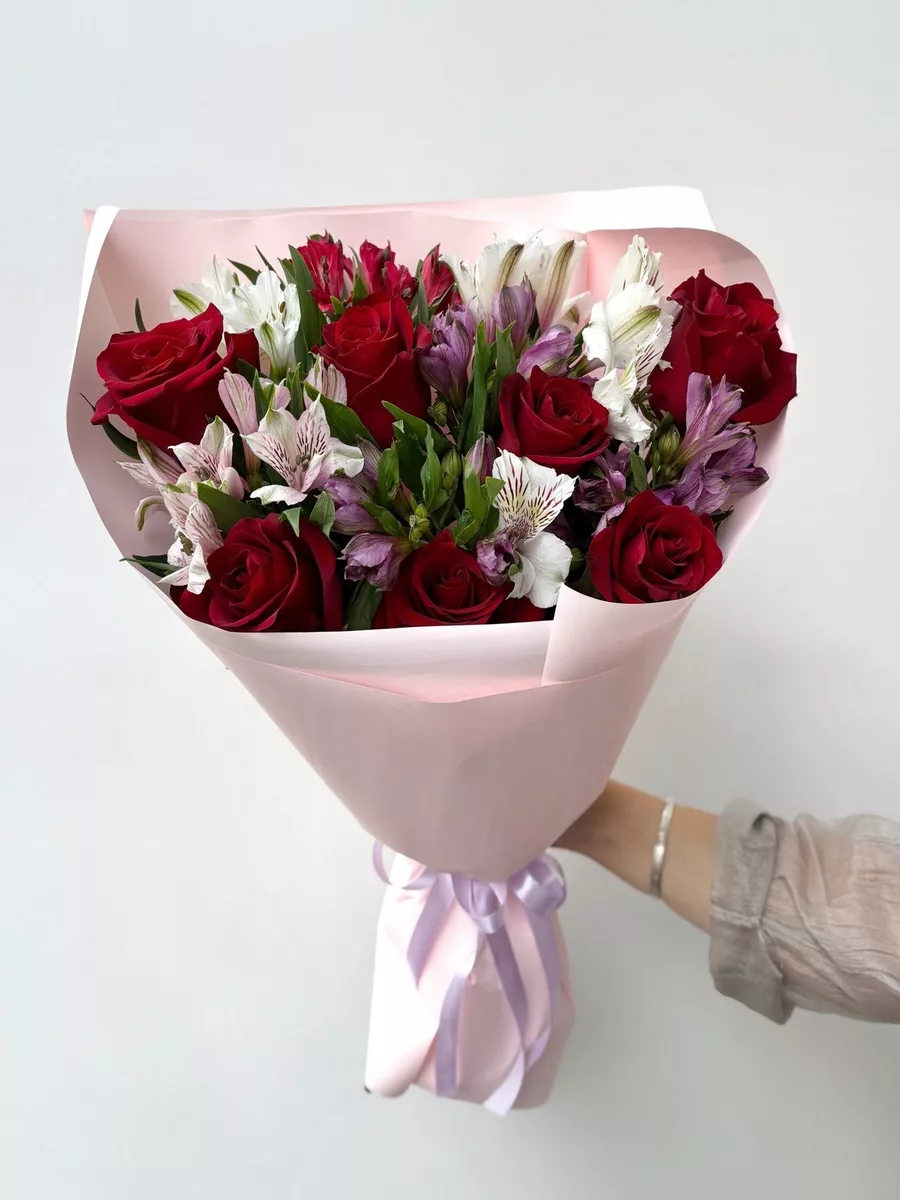
Not every flower handles a multi-hour transit equally well. Roses are the most reliable long-distance flower when cut at the right bud stage — tight to half-open buds arrive looking fresh and continue opening at the recipient's home, which most people find more impressive than a fully blown flower that has already peaked. Spray roses, which carry several smaller blooms per stem, are particularly sturdy and hold shape even when temperatures fluctuate during transit. Chrysanthemums, both spray and single-headed varieties, are excellent travellers: they are structurally rigid, not prone to bruising, and their water uptake is efficient enough that they stay upright in transit packaging. Alstroemeria is another strong choice — the stems are firm, the buds are usually closed at dispatch and open gradually over several days, giving the recipient a bouquet that evolves rather than fades. We are more cautious with fully open peonies and garden ranunculus in summer, because their petals bruise easily and heat accelerates the process. Tulips in spring are fine as long as the order goes out in the cooler part of the day. Orchid stems — cymbidium and dendrobium cuts specifically — are excellent for long transit because they are naturally long-lasting and the individual florets do not detach easily. If you want a specific variety, mention it in the order notes and we will confirm availability and suitability for the transit conditions that day.
Seasonal Factors That Affect Your Order
Leninogorsk sits in a continental climate zone, which means summers can push above 30 degrees Celsius and winters regularly drop well below minus fifteen. Both extremes affect flowers in transit, and we adjust our approach accordingly. In July and August, bouquets going to Leninogorsk are packed with additional insulating material and dispatched in the cooler morning hours where possible. Roses and gerberas are the most heat-sensitive: at high temperatures, petals soften and necks can bend within an hour of leaving a cool environment. We cut roses at a tighter bud stage in summer specifically to give them more structural integrity during transit. In January and February, the risk runs the other way — frozen petals on arrival, which thaw into translucent, collapsed tissue that cannot recover. Bouquets in winter are wrapped in thermal sleeves and the courier is instructed to keep them inside the vehicle rather than in the boot. The recipient should bring flowers indoors immediately and let them acclimatise at room temperature for twenty minutes before unwrapping — plunging cold flowers into a warm room too quickly can cause condensation damage on delicate petals. Spring and autumn are the most forgiving seasons for delivery, and this is when we can more confidently send open peonies, anemones and garden-style arrangements that would be risky in peak summer. If you are ordering in an extreme weather period, the order confirmation will note any substitutions made for transit safety.
What to Check When Placing Your Order for Leninogorsk
The most common reason a delivery goes wrong is incomplete address information, and this applies more to Leninogorsk than to larger cities where couriers know the layout instinctively. Always include the street name, building number, block letter if applicable, entrance number, floor and apartment number. If the building has a door code or intercom number, add it in the notes field — couriers cannot call the recipient if the order is a surprise. Confirm the recipient's phone number is current; we use it only if access to the building is blocked or the address proves ambiguous, not to announce the delivery. Check the delivery window against the recipient's actual schedule: a bouquet delivered to an empty apartment on a hot day can sit for hours, which shortens vase life significantly. If the recipient works during the day, an evening window or a workplace delivery is a better choice. Review the bouquet composition before confirming: some customers select a bouquet online and only notice on arrival that it contains a flower the recipient dislikes or is allergic to. Lilies are the most common allergen issue — their pollen is potent and the scent is strong in enclosed spaces. If allergy is a concern, ask for a pollen-free lily variety or substitute with lisianthus, which has a similar silhouette without the pollen load. Finally, check whether the order confirmation email has arrived within a few minutes of placing the order; if it has not, the order may not have gone through and it is worth contacting us directly.
How Russians Give Flowers: Context for International Customers
If you are sending flowers to someone in Leninogorsk and are unfamiliar with Russian customs, a few points help you choose more confidently. Odd numbers of flowers are the standard for celebratory occasions — one stem, three, five, seven, eleven, fifteen, and so on. Even numbers are traditionally associated with mourning and will be noticed by older recipients in particular, so it is worth keeping this in mind when selecting a bouquet or specifying a stem count. Red roses carry a strong romantic connotation and are less appropriate for professional congratulations or a thank-you to a colleague than they would be in some other cultures. For a teacher, a colleague, or a family friend, mixed bouquets with spray roses, alstroemeria, and seasonal greenery read as warm and respectful without being overly intimate. Yellow flowers have a mixed reputation in Russia — some older generations associate yellow with separation or bad luck, though this belief is much less common among younger people. If you are unsure, white, pink or coral tones are universally well-received. It is entirely normal in Russia to send flowers without a card and let the gesture speak for itself, but if you want to include a message, we print it on a small card tucked into the wrapping. Birthdays, name days, graduations, promotions and the first day of school in September are all major flower-giving occasions, and deliveries spike sharply around these events, so ordering a day ahead during busy periods is practical advice.
Caring for the Bouquet After It Arrives in Leninogorsk
A bouquet that arrives in good condition can still deteriorate quickly if it is not set up properly in the first hour, and this is something we explain to recipients when we can. The stems should be cut at an angle — about two centimetres from the bottom — immediately before placing them in water. An angled cut increases the surface area for water uptake and prevents the stem end from sitting flat against the vase bottom, which blocks absorption. Use a clean vase with cool, not cold, water; tap water in Leninogorsk is generally fine, but if it is heavily chlorinated, letting it stand for thirty minutes before use helps. Remove any leaves that fall below the waterline, because submerged foliage rots quickly and introduces bacteria that shorten the life of every stem in the vase. Change the water every two days and re-cut the stems each time. Keep the bouquet away from direct sunlight, heating radiators and draughts from windows — all three accelerate wilting. Roses and alstroemeria typically last seven to ten days with this care. Chrysanthemums can go two weeks. Tulips are shorter-lived, usually five to seven days, but they continue to grow and move toward light after cutting, which some people find charming. If any stem wilts early, remove it immediately rather than leaving it in the vase, as decomposing stems release ethylene gas that accelerates ageing in the remaining flowers. A small sachet of flower food is included with most of our bouquets and should be dissolved in the water at the first setup.
Ordering flowers to Leninogorsk is straightforward once you know the timing cut-offs, have the full address ready, and have matched the bouquet to the season and the transit conditions. The city's size works in your favour — routes are manageable and windows hold. The variables that cause problems are almost always the ones that can be checked before you confirm the order: the recipient's schedule, the address details, the flower choice relative to the temperature outside. Get those right and the bouquet arrives the way it left. We deliver bouquets across Russia in 1–2 hours.
Frequently asked questions
Which districts in Leninogorsk fall outside the standard delivery zone?
Addresses in the industrial outskirts and points beyond the main residential grid — areas away from Neftyanikov Avenue and the eastern residential blocks — may sit outside the standard zone or carry a surcharge. When placing an order, enter the full street address and the system flags zone status before you confirm. If there is any doubt, contact the shop directly before paying.
What bouquet size actually makes sense for a Leninogorsk delivery given the transit time?
Mid-sized bouquets of 15 to 25 stems travel better than very large arrangements, which shift in the box and arrive disordered. A compact rose bouquet at tight to half-open bud stage, priced from around 3 500 to 6 000 rubles depending on variety and stem count, is the most consistently presentable option after a multi-hour courier run from the assembly point.
If I order before noon, which afternoon window should I select for Leninogorsk?
Orders confirmed before 12:00 local time are eligible for same-day afternoon delivery, typically a two-hour window starting from 15:00 or 17:00 depending on courier load that day. The window shown at checkout reflects actual availability, not a default slot. Selecting the earliest available window does not guarantee it unless the order is fully paid and confirmed before the cutoff.
How does summer heat in Leninogorsk affect which flowers I should order?
Temperatures above 30 degrees Celsius hit thin-petalled flowers hardest — lisianthus and open garden roses lose structure quickly in an unrefrigerated vehicle. Spray roses and standard roses at bud stage handle heat better because the petals are still closed. In July and August, avoid requesting fully open peonies or hydrangea unless the recipient can receive the bouquet immediately and move it indoors.
Can I specify a morning delivery in Leninogorsk and how early does that start?
Morning slots for Leninogorsk begin at 09:00 local time and are available when the order is placed by 20:00 the previous evening. This is the most reliable option for workplace deliveries or occasions with a fixed time, such as a birthday morning. Confirm the recipient's address type — residential or office — when booking, since courier routing differs and affects which morning slot is actually offered.
Ready to send a bouquet?
Pick a city, choose the flowers, and we will hand them over with a photo confirmation.
Choose a city →