
Flower Delivery in Mendeleevsk: Zones, Timing and Prices
Mendeleevsk sits in the Republic of Tatarstan, a compact industrial city on the Kama River where most residents have never had flowers delivered to their door from a professional florist outside the region. We get calls every week from people in Mendeleevsk who are not sure whether delivery reaches them, how long it takes, or what bouquets actually arrive fresh after a long transit. This article answers those questions with the specifics that matter: zones, transit conditions, realistic timing and the varieties that hold up best on the road.
Where in Mendeleevsk We Deliver and What the Zone Covers
Mendeleevsk itself is a small city, and the delivery zone covers the central residential districts, the areas around Mendeleevsk Chemical Plant, and the private house sectors along the main arteries leading out toward Elabuga. The zone does not stop at the city boundary in any rigid administrative sense — if you are ordering to a street address within roughly fifteen kilometres of the city centre, the order reaches you. Customers in the villages immediately adjacent to Mendeleevsk, such as those along the Kama bank, should confirm the exact address with our operator before placing the order, because road access varies by season and some lanes become difficult in spring thaw or after heavy snow. The city is well-connected to Naberezhnye Chelny and Elabuga by road, but we deliver to Mendeleevsk as a standalone destination, not as a stopover on a multi-city route. When you place the order, the address field should include the street, building number, apartment or office number, and any gate or entry code for residential complexes — Mendeleevsk has several newer gated developments where the courier needs a code to reach the door. One common mistake is entering only the street name without a building number, which delays delivery because the courier cannot confirm the drop-off point without calling back.
Bouquets we can deliver



Realistic Delivery Timing from Saint Petersburg to Mendeleevsk
The distance from Saint Petersburg to Mendeleevsk is approximately 1,700 kilometres by road, which means the one-to-two-hour delivery window that applies inside Saint Petersburg does not apply here. Delivery to Mendeleevsk is handled as an intercity order, and the realistic window is same-day or next-day depending on when you place the order and which dispatch route is active. Orders placed before noon Saint Petersburg time have the strongest chance of same-day arrival; orders placed in the afternoon are typically scheduled for the following morning. We do not promise a two-hour slot for Mendeleevsk — any florist who does is either misleading you or relying on a local handler we do not use. What we do guarantee is a confirmed delivery window of four hours on the agreed date, communicated to you at the time of order confirmation. The courier contacts the recipient by phone roughly thirty minutes before arrival, which is standard Russian practice and helps in a city like Mendeleevsk where many recipients are at work during the day. If the recipient is unavailable, the courier waits up to fifteen minutes and then calls you, the sender, to decide whether to leave the bouquet with a neighbour, a building administrator, or to reschedule. Rescheduling within the same day is possible if the new drop-off point is reachable before the courier's route closes.
Which Bouquets Travel Well Over Long Distances
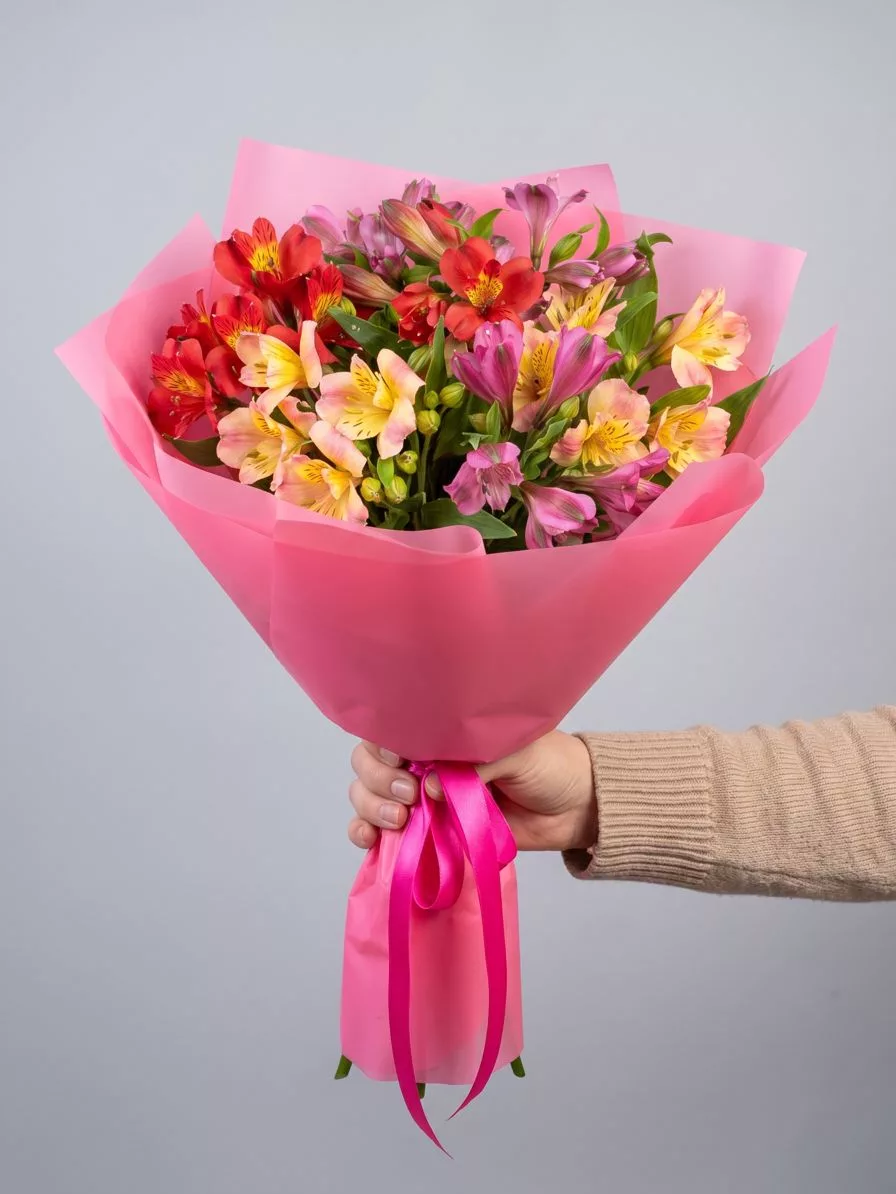
Not every flower survives a long transit in good condition, and this is where choosing the right bouquet matters more than it does for a local delivery. Roses with tight buds — particularly spray roses and standard roses in bud form — travel significantly better than fully open garden roses or peonies in bloom. Chrysanthemums, both single-stem and spray varieties, are among the most reliable for long transit because they hold water efficiently and do not bruise easily. Alstroemeria is another strong choice: the buds open gradually after delivery, which means the recipient gets flowers that look fresh and continue to develop over several days. Eustoma, also called lisianthus, holds well if the buds are at the right stage — partially open rather than fully blown. What tends to suffer on long routes are delicate open flowers: fully open garden roses, ranunculus in full bloom, and anemones, which wilt quickly once the water supply is interrupted. We pack intercity bouquets in water-retaining floral foam or water tubes sealed into the stem wrapping, which extends the hydration window considerably compared to a dry wrap. The outer packaging is a rigid box rather than a soft wrap for intercity orders, which protects the flowers from compression during loading and unloading. If you are ordering for a specific occasion and want a particular variety, mention it when you order and we will tell you honestly whether that flower is a good fit for the transit distance.
Temperature and Seasonal Conditions on the Route
Tatarstan has a continental climate, which means the temperature range across the year is wide — from minus twenty-five in January to plus thirty-five in July. Both extremes affect flowers in transit, and we adjust packaging accordingly. In winter, bouquets are wrapped in insulated thermal sleeves before being placed in the outer box, and the vehicle is temperature-controlled throughout the route. Roses and tulips are particularly vulnerable to freezing: even a few minutes of exposure to temperatures below minus five can cause the petals to blacken and collapse, which is irreversible. In summer, heat is the opposite problem — flowers respire faster, bacteria multiply in the stem water more quickly, and bouquets that sit in a warm vehicle for more than two hours without cooling begin to wilt. We use cooled vehicles on summer routes and add ice packs to the packaging for orders dispatched during the hottest part of the day. Spring and autumn are the most straightforward seasons for transit: temperatures between five and fifteen degrees are close to ideal for most cut flowers. If you are ordering in July or August, it is worth noting that delivery in the early morning slot — before ten o'clock local time — gives the flowers the best chance of arriving in peak condition, simply because the ambient temperature is lower and the route is completed before the midday heat. This is not a rule that applies only to Mendeleevsk, but the continental temperature swings here make it more relevant than in cities closer to the coast.
What the Recipient Should Do When the Flowers Arrive
Many recipients in smaller Russian cities are not accustomed to receiving professionally packaged bouquets and are sometimes unsure what to do when the box arrives. The first step is straightforward: open the box promptly and remove the outer packaging within thirty minutes of delivery. Leaving flowers sealed in a box, even a well-ventilated one, causes condensation and accelerates bacterial growth on the stems. The stems should be cut at a forty-five-degree angle under running water or while submerged in a basin — this prevents an air bubble from forming in the stem, which would block water uptake. A sharp knife is better than scissors for this because scissors can crush the stem tissue. The vase water should be cool, not cold, and changed every two days. Flower food sachets are included with every intercity order from us, and they make a measurable difference to vase life — the sachet contains a biocide, a sugar source and an acidifier that together extend the life of most bouquets by two to four days compared to plain water. Roses should be kept away from direct sunlight and from fruit bowls: ripening fruit releases ethylene gas, which accelerates petal drop in roses and causes carnations to close prematurely. In a Mendeleevsk apartment in winter, the dry heated air is a factor — placing the vase away from radiators and misting the petals lightly once a day helps. Tulips are the exception to most of these rules: they continue to grow after cutting, will lean toward the light source, and prefer very cold water.
Typical Mistakes When Ordering Flowers to Mendeleevsk
The most frequent mistake is assuming that the recipient's schedule does not need to be checked before placing the order. In a city like Mendeleevsk, where many residents work shift patterns at the chemical plant or related industrial facilities, the recipient may simply not be home during a standard delivery window. Checking availability before ordering takes two minutes and prevents a failed delivery. The second common mistake is ordering a bouquet type that is not suited to the season or the transit distance — we covered varieties above, but the specific error we see repeatedly is ordering fully open peonies in June for a Mendeleevsk delivery. Peonies at full bloom have a vase life of three to four days under ideal conditions; by the time they complete the transit and are unpacked, that window is already shortened. Order peonies in tight bud if you want them for a long-distance delivery. The third mistake is providing an incomplete address. Building numbers in Mendeleevsk sometimes include a corpus designation — for example, building 14, corpus 2 — and omitting the corpus number sends the courier to the wrong entrance. The fourth mistake is not specifying the occasion. We ask because occasion affects how we assemble the bouquet: a birthday arrangement is built differently from a congratulatory one for a work promotion, in terms of colour palette, stem count and the mix of focal flowers and filler. Telling us the occasion at the time of ordering costs nothing and improves the result significantly.
How to Check Your Order Status and What to Do If Something Goes Wrong
Once your order is confirmed, you receive a confirmation message with an order number and the agreed delivery window. You can use that order number to request a status update at any point by contacting us directly — we do not use an automated tracking link for intercity deliveries, so a quick message or call gets you a real answer from the team managing that route. If the delivery is delayed beyond the agreed window, contact us immediately rather than waiting. Delays on intercity routes are rare but do happen — road conditions on the M7 highway between Kazan and Naberezhnye Chelny can slow transit in winter, and that affects the Mendeleevsk leg of the route. We notify customers proactively if we anticipate a delay of more than one hour, but if you have not heard from us and the window has passed, call us. If the flowers arrive in poor condition — stems broken in transit, petals blackened from cold exposure, or significant wilting — photograph the bouquet in the packaging before removing it and send the photos to us within two hours of delivery. This is important: we cannot assess a claim made the following day without evidence of the condition at arrival. We handle complaints directly and resolve them with either a replacement delivery or a refund, depending on what is practical given the distance and timing. We take quality on intercity routes seriously precisely because the distance means we cannot simply send a replacement within an hour the way we can inside Saint Petersburg.
Ordering flowers to Mendeleevsk from a Saint Petersburg florist is a practical choice when you want quality and variety that local options may not offer, but it requires a little more planning than a city delivery. Confirm the recipient's schedule, choose varieties suited to transit, provide a complete address including any corpus or entry code, and communicate the occasion clearly. The flowers that arrive will be assembled by a working florist, packed for the specific conditions of the route, and delivered by a courier who knows the protocol for intercity handoffs. The distance is manageable when the order is set up correctly from the start. We deliver bouquets across Russia in 1–2 hours.
Frequently asked questions
Can you deliver flowers to a specific street in Mendeleevsk on the same day?
Same-day delivery to Mendeleevsk is possible for orders placed before noon Saint Petersburg time, subject to route availability. Orders placed after noon are typically scheduled for the following morning. Confirm the recipient's address and availability when you order so we can lock in the delivery window without delays.
What happens if the recipient is not home when the courier arrives?
The courier calls the recipient approximately thirty minutes before arrival. If there is no answer at the door, the courier waits up to fifteen minutes and then contacts the sender. You can then arrange for the bouquet to be left with a neighbour, a building administrator, or rescheduled to a later slot the same day if the route permits.
Which flowers last longest after a long-distance delivery to Mendeleevsk?
Chrysanthemums, alstroemeria, spray roses and eustoma in partial bud are the most reliable choices for long transit. They hold water well, resist bruising and continue to develop after delivery. Avoid ordering fully open peonies, ranunculus or anemones for intercity distances — they lose condition quickly once off the stem.
Is flower delivery to Mendeleevsk available in winter?
Yes. Winter orders are packed with insulated thermal sleeves and transported in temperature-controlled vehicles. Roses and tulips are the most cold-sensitive varieties — exposure below minus five degrees damages petals permanently. We adjust packaging to the forecast temperature on the delivery date, so winter orders are handled differently from spring or autumn ones.
Do I need to be present when I order, or can I send flowers as a surprise?
Surprise deliveries work well as long as the recipient's address is complete and someone is reachable at the delivery location. The courier calls ahead, which is standard practice in Russia, so the element of surprise is in the gift itself rather than the arrival. Provide a contact number for the recipient and a backup number for yourself when placing the order.
Ready to send a bouquet?
Pick a city, choose the flowers, and we will hand them over with a photo confirmation.
Choose a city →