
Flower Delivery in Minusinsk: Zones, Timing and What to Expect
Minusinsk sits in the Krasnoyarsk region, deep in southern Siberia, and customers ordering flowers here for the first time often ask the same question: will they actually arrive fresh? The answer is yes, provided you understand how courier logistics work across long distances, what packaging protects stems in transit, and which varieties travel reliably. This article covers delivery zones within the city, realistic timing windows, the bouquets that hold up best on the road, and the details worth confirming before you place an order.
Which Parts of Minusinsk Receive Deliveries and What the Zones Mean
Minusinsk is a compact city by Russian standards, with a population around 70,000, and the core residential districts — the historical centre around Lenin Square, the Nabereznaya embankment area, and the newer mikrorayon blocks on the northern and eastern edges — all fall within the standard delivery zone. Addresses on the outskirts, including private house sectors near the Yenisei riverbank and the suburban dacha areas that merge into the surrounding villages, may require additional lead time and should be confirmed when placing the order. The city itself has no administrative subdivision that blocks delivery, but the practical limit is the municipal boundary. Anything described as Minusinsk on the map is serviceable; settlements listed separately — Minusinsk district villages like Tesinskoye or Karatuzskoe — are a different matter and need individual arrangement. When you enter your address at checkout, use the full postal address including the apartment or office number, because couriers in Minusinsk often navigate by building entrance codes, and a missing detail can add 20 to 30 minutes to the actual handover. Customers ordering to workplaces should note the organisation name and floor, since larger administrative buildings and the regional hospital complex have multiple entrances. Getting the address precise at the start is the single most effective thing a customer can do to ensure the bouquet arrives at the right moment.
Bouquets we can deliver



Realistic Timing: What One to Two Hours Means for a Siberian City
The one-to-two-hour delivery window is a genuine operational target, not a marketing promise padded for safety. For Minusinsk specifically, the window applies to orders placed during standard daytime hours when courier capacity is active and the bouquet is assembled and ready to leave. Orders placed in the morning for a midday delivery, or afternoon orders targeting early evening, consistently meet this window. Where timing stretches is when orders arrive in clusters — major calendar dates like February 14th, March 8th, or graduation season in late May and June see order volumes spike sharply, and the honest advice is to add a two-to-three-hour buffer on those days or, better, order the evening before. Minusinsk's road grid is straightforward and traffic congestion is minimal compared to larger cities, which actually works in the courier's favour once the bouquet is dispatched. The main variable is assembly time at the florist end, not road conditions. If you need delivery at a specific time — say, the moment a person arrives at a restaurant — choose a one-hour window before that moment, not the moment itself. Winter conditions in Siberia, particularly between November and February when temperatures regularly drop below minus 20 Celsius, do not stop delivery but they do require the courier to move quickly from vehicle to door, and recipients should be reachable by phone so handover happens in under two minutes in the cold.
Varieties That Travel Well to Minusinsk and Which to Avoid
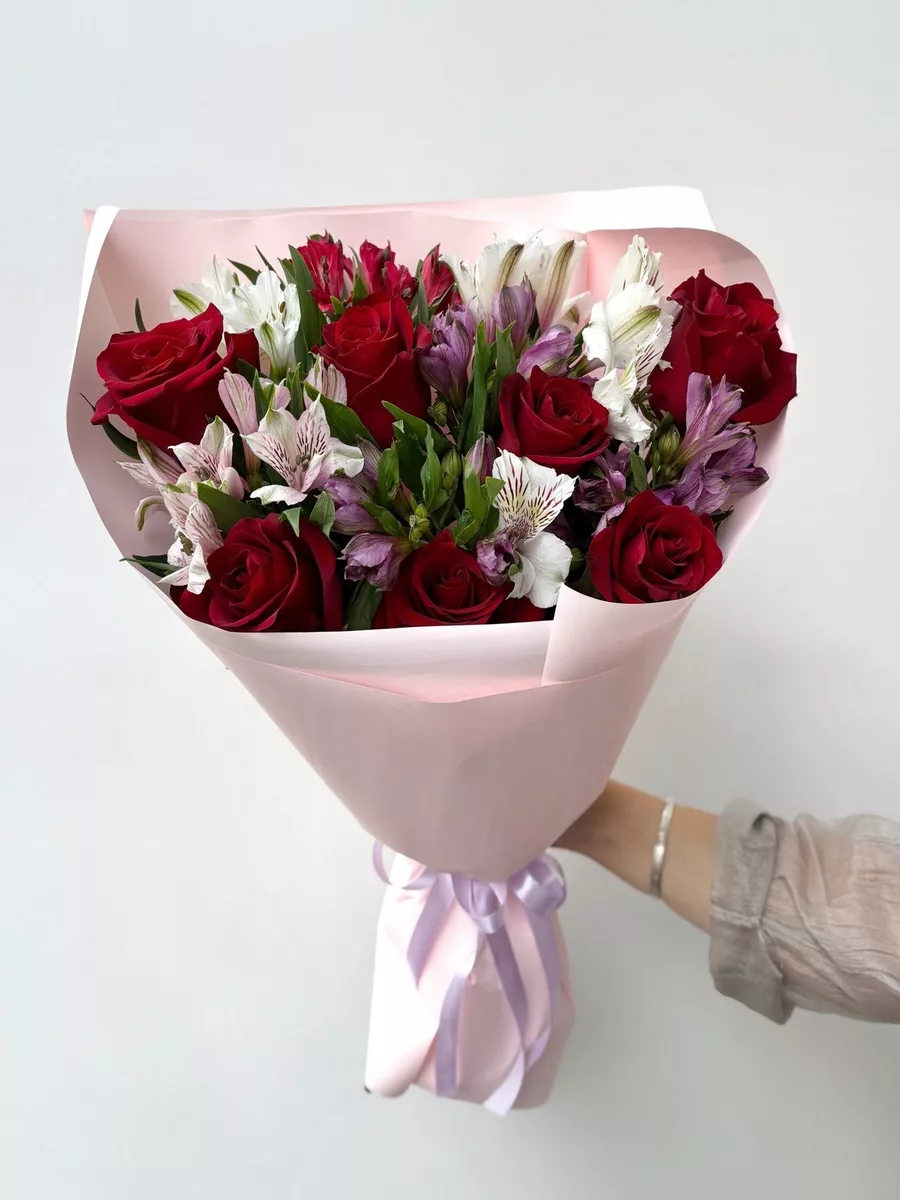
Not every flower handles a long-distance journey with equal composure, and knowing which varieties are reliable saves disappointment. Roses are the backbone of long-distance delivery because modern varieties bred for the cut flower trade — particularly Ecuadorian and Colombian stems — are selected partly for vase life and transport resilience. A rose that left the grower 48 hours ago and was kept in refrigeration the entire time will open beautifully in a Minusinsk apartment. Chrysanthemums, both spray and standard, are similarly robust; their stems drink water efficiently and the petals resist bruising. Alstroemeria is another dependable traveller — the buds arrive closed and open progressively over several days, which customers sometimes mistake for immaturity but is actually ideal. Eustoma, sold under the name lisianthus, holds well in cool conditions and presents multiple blooms per stem, making it excellent value in mixed bouquets. What requires more care are open garden-style flowers with delicate petals: garden roses with very full quartered blooms, open peonies in peak season, and large-headed hydrangeas all need careful hydration tubes on the stems and insulated packaging, which is standard practice but means these varieties are best ordered for same-day delivery rather than scheduled next-morning slots. Tulips in spring are widely loved and travel fine when cut at the correct stage — fully closed, showing colour but not yet open. Ask the florist to confirm cut stage if tulips are your priority variety.
Packaging and Temperature: What Protects the Bouquet in Transit
Siberian winters and hot Minusinsk summers — the city regularly reaches 30 Celsius in July — present opposite challenges for flower transport, and packaging has to account for both. In cold months, the outer wrapping is a kraft or film layer that traps air around the stems and blooms, functioning as basic insulation for the short walk between vehicle and door. Stems are kept in water-retaining material, typically a damp sponge or aqua pack sealed at the base, so the flowers are never without moisture during transit. In summer, the risk reverses: heat accelerates wilting and petal drop. Couriers in hot weather prioritise moving quickly and keeping flowers out of direct sun inside the vehicle. If a recipient is not home during a summer delivery and the bouquet is left at a door, it should be brought indoors within 20 minutes. The customer's responsibility in both seasons is to have someone available to receive the order. Leaving a bouquet outside in January for 40 minutes is as damaging as leaving it in a hot corridor in August. Once the flowers are indoors, trim the stems by one to two centimetres at a diagonal cut under running water before placing them in a clean vase, change the water every two days, and keep the arrangement away from radiators, direct sunlight and fruit bowls — ripening fruit releases ethylene gas, which shortens vase life noticeably. These are standard florist instructions that apply anywhere, but in Minusinsk's temperature extremes they matter more than in milder climates.
Bouquet Formats That Work for Minusinsk Occasions
Customers in Minusinsk order flowers for the same occasions as anywhere in Russia: birthdays, anniversaries, congratulations on a new job or graduation, and spontaneous gestures. The format question — mono-bouquet versus mixed arrangement, wrapped versus in a box — matters practically because it affects both transport stability and the impression on arrival. Mono-bouquets of 25 or 51 roses are perennially popular for significant birthdays and anniversaries; odd numbers are traditional in Russian gifting culture for living recipients, so 25, 51, and 101 stems appear constantly in orders. A customer unfamiliar with this convention should know it is worth following, as recipients notice. Mixed bouquets combining roses with eustoma, matthiola, or eucalyptus greenery are versatile and photograph well, which matters when the bouquet is being sent as a surprise and the sender wants to see a photo of the reaction. Hat boxes and round arrangements have grown in popularity over the past several years because they sit flat and stable without a vase, which is practical when delivering to an office or a recipient who travels. For a graduation ceremony, where the recipient may be standing in a crowd and holding the flowers for hours, a tightly wrapped single-variety bouquet of chrysanthemums or spray roses is more practical than a loose mixed arrangement. Ordering for a child's school performance or recital follows the same logic — compact, firm-stemmed bouquets that a child can carry without petals falling.
How to Place an Order Correctly for Minusinsk Delivery
The ordering process has a few points where mistakes cluster, and getting them right at the start prevents the most common problems. First, enter the recipient's mobile phone number accurately — the courier calls ahead to confirm arrival, and a wrong digit means a missed delivery. If the order is a surprise, note that in the comments field; the courier will then ring the sender's number instead of the recipient's when approaching. Second, specify the delivery time window as a range, not a fixed minute. Requesting delivery at exactly 15:00 creates a rigid expectation that is difficult to guarantee; requesting delivery between 14:30 and 16:00 gives the courier realistic flexibility while still fitting your event schedule. Third, add any building access details in the comments: entry code, security desk procedure, whether the recipient works on a floor that requires a visitor pass. Fourth, check the occasion note if you are including a card — the card text is printed or handwritten based on what you type, so review it before confirming. In Russian tradition, the card is often read aloud when the flowers are received, so brief and warm works better than long and formal. Fifth, confirm your own contact details are correct, because if a problem arises — address not found, recipient not answering — the shop needs to reach the sender immediately. Five minutes spent checking these details at order placement is worth more than any amount of follow-up if something goes wrong.
What Customers in Minusinsk Get Wrong Most Often
After handling many orders to Siberian cities, certain patterns repeat. The most common mistake is ordering on the morning of a major holiday without accounting for volume. March 8th — International Women's Day — is by far the busiest single day in the Russian flower calendar, and orders placed on the morning of March 8th compete with hundreds of others. The practical solution is to order on March 7th for morning delivery on the 8th, which is entirely normal and widely done. The second frequent mistake is underestimating how quickly flowers need to be put in water after arrival. A customer who receives a bouquet and sets it on the table while they make tea and take photos is not doing anything dramatic, but 30 minutes without water on a warm day does affect longevity. The third mistake is choosing a bouquet based on a photo without reading the composition description. Photos are styled and lit to look their best; the description tells you what stems and how many. A bouquet described as containing seven roses and assorted greenery is a small-to-medium arrangement regardless of how full it looks in the image. Fourth, customers sometimes assume the recipient must be home and do not arrange for a neighbour or colleague to receive the flowers. Coordinating a backup contact takes one text message and prevents a failed delivery entirely. Fifth, ordering flowers for a surprise and giving the recipient's number as the contact number defeats the surprise — use your own number as the callback contact and note the surprise instruction clearly in the order comments.
Flower delivery to Minusinsk is straightforward when you know what the process actually involves. The city is fully serviceable, the timing is reliable within the stated window on regular days, and the right variety choices mean the bouquet arrives looking the way it should. The variables that cause problems — wrong address details, same-day orders on peak dates, no one available to receive — are all within the customer's control. Order with accurate information, pick varieties suited to the season and transit conditions, and the flowers will do the rest. We deliver bouquets across Russia in 1–2 hours.
Frequently asked questions
How does a bouquet get from Saint Petersburg to Minusinsk without wilting?
Stems are cut, conditioned and packed in temperature-controlled boxes before the courier leg begins. Roses, chrysanthemums and alstroemerias are chosen for long-distance orders precisely because they hold water well in transit. The packaging includes hydration inserts for warm months and insulating layers in winter. A bouquet assembled correctly in Petersburg and kept cool throughout typically arrives in Minusinsk with two to five days of vase life remaining.
Which Ecuadorian or Colombian rose varieties actually travel well to Minusinsk?
Explorer, Freedom and Explorer Red are bred for stem strength and petal density, which reduces bruising in transit. These varieties also hold colour under the temperature swings Minusinsk sees between seasons. Avoid ordering garden or spray roses for long-distance delivery — their petals are thinner and they drop faster once the cold chain has any gap. Standard large-head Ecuadorian stems in the 60–70 cm range are the safest choice.
What is the price difference between a 25-stem and a 51-stem bouquet delivered to Minusinsk?
Assembly cost scales roughly with stem count, and courier charges to Minusinsk are fixed per order rather than per stem, so larger bouquets become proportionally cheaper per flower. A 25-stem rose bouquet typically sits in a lower price bracket than a 51-stem arrangement, but the delivery fee itself stays the same. Ordering 51 stems instead of 25 rarely doubles the total cost, making larger bouquets better value when the occasion justifies them.
Does the July heat in Minusinsk affect which flowers I should order?
Yes. At 30 Celsius, tulips, peonies and open garden roses deteriorate within hours of leaving a cooled environment. For summer orders to Minusinsk, stick to roses with tight buds, chrysanthemums, alstroemerias or anthuriums — all of which tolerate heat exposure during the final courier leg. Ask specifically about summer packaging when ordering, as insulated boxes with cooling inserts are the standard precaution for July and August deliveries in southern Siberia.
How early before the occasion should I place an order for delivery to Minusinsk's historical centre or Naberezhnaya area?
Both districts are within the standard delivery zone, so no extra lead time is required for the address itself. The practical rule is to order at least three to four hours before the intended delivery window during daytime hours. For evening deliveries, placing the order before midday gives couriers enough scheduling flexibility. Morning occasions — birthdays at work, for example — are safest when ordered the evening before or first thing in the morning.
Ready to send a bouquet?
Pick a city, choose the flowers, and we will hand them over with a photo confirmation.
Choose a city →