
Flower Delivery in Novoanninsky: Zones, Timing and What to Expect
Novoanninsky sits in the Volgograd region, and customers there order from us for the same reasons customers anywhere do — a birthday came up fast, an anniversary was nearly forgotten, or someone simply wants to send something real instead of a message. The questions we hear most often are about timing, about which flowers actually arrive looking fresh after a long route, and about what happens if the recipient is not home. This article answers all of that plainly, based on what we see every week from the shop floor.
Where in Novoanninsky We Deliver and What Counts as the Service Area
Novoanninsky is a small town of roughly 25,000 people, and the delivery zone covers the town itself plus the immediate surrounding settlements connected by the main roads. Streets in the central part of town — around the main square, the market area, and the residential blocks near the railway station — are straightforward to reach and fall within the standard delivery window. Outlying villages and rural addresses beyond the town boundary take longer and need to be confirmed at the time of ordering, because road conditions and distance from the central drop point vary significantly depending on the season. In winter, particularly between December and February, some rural roads become difficult after snowfall, and we ask customers to provide a phone number for the recipient so the courier can call ahead and arrange a meeting point if access to the address is blocked. For apartment buildings in the town centre, we deliver to the door. For private houses, the courier goes to the gate or entrance. If you are ordering to a workplace — an office, a school, a clinic — it helps to include the name of the person at the reception desk who can accept the bouquet, because not every organisation lets couriers past the entrance without a contact name. Confirming the full postal address, including the apartment number and building entrance number where relevant, prevents the most common delays we see on this route.
Bouquets we can deliver



Delivery Timing: What the Route from Saint Petersburg Actually Means
We are based in Saint Petersburg, and Novoanninsky is approximately 1,400 kilometres away by road. That distance means same-day delivery in the classic one-to-two-hour sense that works within a city is not what applies here. What we offer for Novoanninsky is scheduled delivery: you place the order in advance, confirm the date and a preferred time window, and the bouquet is dispatched so it arrives at the agreed time. The minimum lead time for Novoanninsky is typically 24 hours, and for weekend or public holiday deliveries we ask for 48 hours because routing and staffing on those days is tighter. Orders placed before noon on a weekday have the best chance of next-day morning delivery. Orders placed in the afternoon are more reliably scheduled for the following afternoon or the day after. We do not promise exact minute delivery for long-distance routes — we give a two-hour window, and the courier contacts the recipient 30 to 40 minutes before arrival. If the recipient does not answer the door and does not pick up the phone, the courier waits a reasonable time and then contacts the sender. The bouquet is never left unattended outside a door, because temperature exposure and theft are both real risks. If a second delivery attempt is needed, that is arranged between the sender and our team directly.
Which Flowers Travel Well on a Long Route and Which Do Not
This is the question florists care about most and customers ask least, and the mismatch causes most of the disappointment we hear about from people who ordered elsewhere. Roses are the most reliable long-distance flower when they are cut at the right bud stage — tight, with the outer petals just beginning to loosen. A rose cut too open will arrive with petals already dropping. We cut roses for long routes at a tighter stage than for local city delivery, which means the recipient sees them open over the following two days, which is actually a better experience. Chrysanthemums, both spray and standard, are extremely robust and hold colour and structure well even after 24 hours in transit packaging. Alstroemeria is another good choice — it is compact, does not bruise easily, and the buds continue opening after delivery. Carnations, often underestimated, are genuinely tough and last well in all temperatures. Flowers we are more careful with on long routes include gerbera, which has a fragile stem that bends under its own weight if not supported correctly, and lisianthus in full bloom, which loses petals with vibration. Tulips in spring, when they are in season and cut fresh, travel acceptably if the temperature is kept cool during transit. In summer, tulips are not in season and we do not source them. Hydrangea is beautiful but drinks a large amount of water and wilts faster than most flowers when dehydrated — we include it in long-route bouquets only when the packaging allows for water retention.
Packaging for Long-Distance Delivery and Temperature Conditions
Flowers going to Novoanninsky are packed differently from flowers going across Saint Petersburg. For city delivery, a kraft wrap and a bow are often enough. For a route of over 1,000 kilometres, the bouquet goes into a water-retaining base — a small sealed water capsule attached to the cut stems — and then into a rigid box with foam inserts that prevent movement during transport. The box is the right size for the bouquet so there is no shifting, and the lid is ventilated to prevent condensation buildup, which causes petal spotting on white and pale flowers. Temperature during transit matters significantly. Flowers do best between 4 and 10 degrees Celsius. In summer, when outside temperatures in the Volgograd region can reach 35 to 38 degrees, we use insulated packaging with cooling elements for the transit leg. In winter, the risk is the opposite — frost damage to petals happens quickly below zero, and the packaging includes insulating wrap to keep the bouquet above freezing during the final delivery stage from vehicle to door. Customers sometimes ask whether they should put the bouquet in the refrigerator immediately on arrival. The answer depends on the room temperature. In a cool room, 18 to 20 degrees, flowers on a table are fine. In a warm room above 24 degrees, placing the bouquet in the coolest part of the apartment — away from direct sunlight and heating vents — extends its life noticeably. Cutting one centimetre from the stems on a diagonal when the bouquet arrives and placing it in fresh water is the single most useful thing a recipient can do in the first five minutes.
Typical Bouquets Ordered for Novoanninsky and What Works for Each Occasion
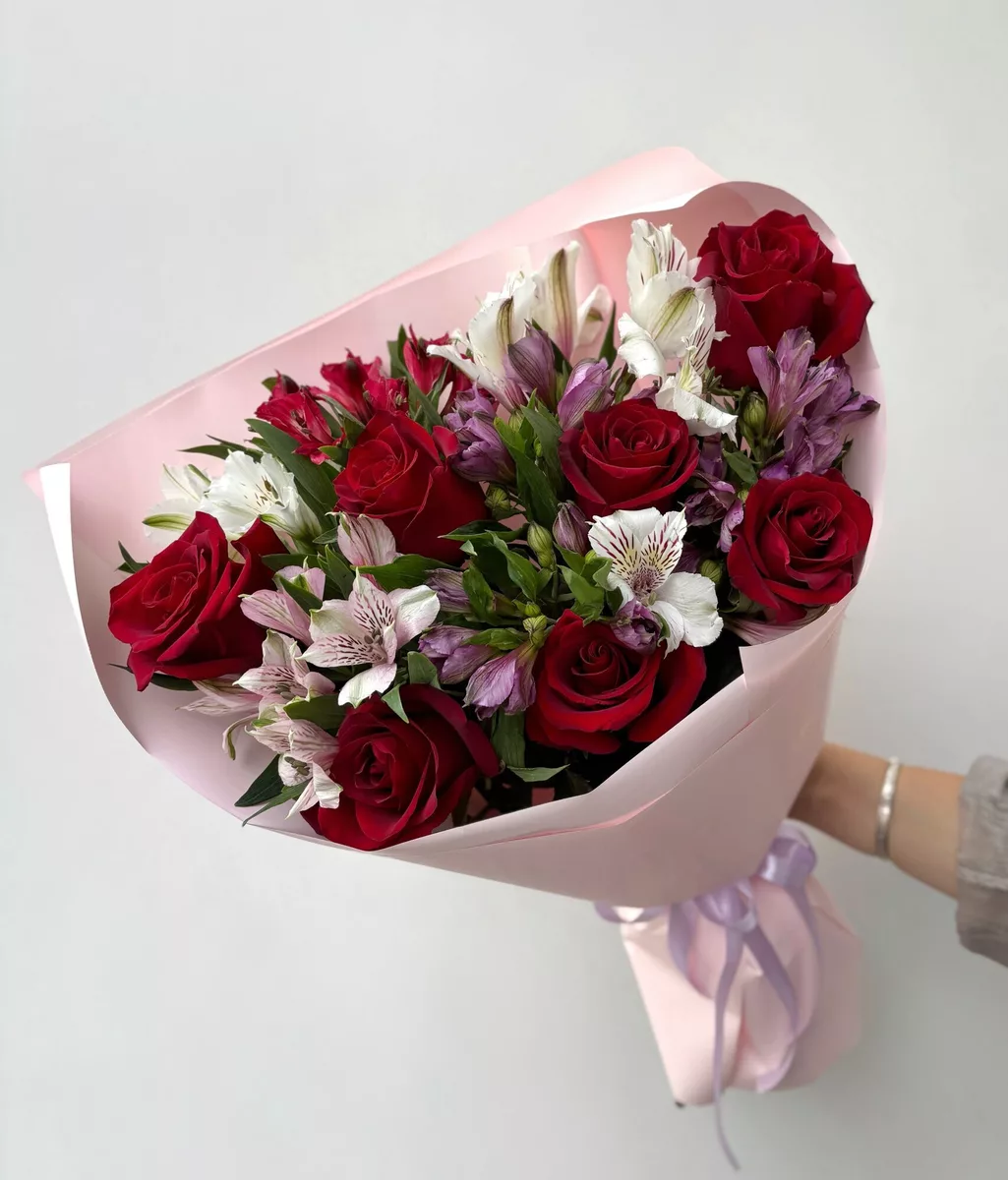
The most commonly ordered arrangement for Novoanninsky is a rose bouquet, usually between 11 and 25 stems, because roses are universally understood and the recipient does not need any context to appreciate them. For a birthday, customers tend to choose red or pink roses mixed with gypsophila, which adds volume without adding fragility. For a work anniversary or a professional occasion — a teacher's day, a promotion — white roses or white chrysanthemums read as respectful rather than romantic, which matters in Russian professional culture where the distinction is noticed. Alstroemeria bouquets are popular for younger recipients and for situations where the sender wants something colourful without spending on premium roses. A mixed bouquet of alstroemeria in orange, purple and white, with some greenery, is visually generous and travels well. For a significant occasion — a major birthday, a wedding anniversary — customers often choose a larger rose arrangement, 51 or 101 stems, which are traditional numbers in Russian gifting culture. Odd numbers of flowers are the norm for celebratory occasions in Russia; even numbers are associated with mourning, so a bouquet of 10 or 20 stems would be an unusual choice and might confuse the recipient. If you are not familiar with this custom, it is worth knowing before you select a quantity. Seasonal flowers are incorporated where available — peonies in May and June, sunflowers in summer, ranunculus in early spring — but availability depends on what is fresh at the time of order, and we confirm substitutions with the sender before packing.
What to Check Before Placing Your Order to Avoid Common Problems
The majority of delivery problems we deal with on long-distance routes come from incomplete information at the order stage, not from anything that happens in transit. The most frequent issue is an address that is missing the apartment number or building entrance code. In a town like Novoanninsky, many residential buildings have a door code or an intercom, and without it the courier cannot get past the entrance. If you do not know the code, the recipient's phone number is essential so the courier can call them to open the door. The second most common issue is the recipient not being at the given address during the delivery window. If the person works shifts, travels for work, or is simply unpredictable in their schedule, it helps to either coordinate with them in advance — which spoils a surprise but guarantees delivery — or to give us a secondary contact number for a neighbour, a family member, or a colleague who can accept the bouquet and keep it until the recipient is home. The third issue is ordering flowers that are out of season or not available on the required date without a substitution plan. We always call or message the sender if a specific flower is unavailable, but if the sender is unreachable, we make a professional substitution of equal or greater value and document it. Confirming your own contact number is reachable during the day of delivery solves this entirely. Finally, for large orders — more than 51 stems or a combination of multiple arrangements — 48 hours notice is the practical minimum regardless of the day of the week.
How Russian Flower Gifting Customs Affect What You Should Order
If you are ordering from outside Russia or are simply unfamiliar with how flowers are given here, a few customs are worth knowing because they affect how the bouquet is received. Odd numbers of flowers are strongly preferred for celebratory occasions — 1, 3, 5, 7, 11, 15, 21, 25, 51, 101. This is not a superstition in the way outsiders sometimes assume; it is simply the established norm, and recipients notice when the number is even. Even numbers are associated with sympathy contexts, so a bouquet of 10 roses would seem odd at a birthday. Yellow flowers have a complicated reputation in some parts of Russia — in popular belief, yellow flowers are associated with separation or bad luck in relationships, so unless the recipient has specifically said they love yellow flowers, it is safer to choose another colour for romantic occasions. For professional gifting, white and cream tones are reliable. For family occasions, mixed colours are perfectly appropriate. Wrapping style also carries meaning: a bouquet presented without any wrapping looks unfinished by Russian standards, while an elaborately wrapped bouquet with ribbon signals that the sender put thought into it. We wrap all bouquets to the standard expected for the occasion type you specify at checkout. If you are sending to someone you have never met in person — a business contact, a distant relative — a note card with a short message in Russian, which we can write for you if you provide the text in English, makes the gesture land much more warmly than flowers alone. The card is included at no extra cost and is written by hand.
Ordering flowers to Novoanninsky is straightforward once you understand what the route requires: a confirmed address with all the details, a reachable phone number for the recipient, and enough lead time for the bouquet to arrive in the condition it left the shop. The flowers themselves — roses, chrysanthemums, alstroemeria, carnations — are chosen and packed specifically for the distance, and the packaging is matched to the season. If you have a specific variety in mind or a particular occasion that calls for something unusual, call us before ordering and we will tell you honestly what is available and what will look best when it arrives. We deliver bouquets across Russia in 1–2 hours.
Frequently asked questions
How far in advance do I need to order flowers for delivery to Novoanninsky?
For weekday delivery, placing your order at least 24 hours ahead gives us enough time to prepare and dispatch the bouquet. For weekend or public holiday delivery, 48 hours is the safer lead time. Orders placed before noon on a weekday have the best chance of arriving the following morning within your chosen two-hour window.
Can I order an even number of flowers, say 10 or 20 roses, for a birthday in Novoanninsky?
You can, but we would advise against it. In Russian gifting culture, even numbers of flowers are associated with mourning contexts, and the recipient is very likely to notice. Choosing 11 or 21 roses costs nearly the same and reads correctly for a celebratory occasion. We will flag this if you select an even number at checkout.
What happens if the recipient is not home when the courier arrives?
The courier calls the recipient 30 to 40 minutes before arrival. If there is no answer at the door and no response by phone, the courier contacts the sender. A second delivery attempt is arranged. We never leave a bouquet unattended outside a door, both because of temperature risk and because an unattended bouquet in a hallway does not make the impression you intended.
Are there flowers you would not recommend for a delivery to Novoanninsky in summer?
In summer we are cautious with gerbera, open-bloom lisianthus, and hydrangea on long routes because heat and vibration affect them more than other varieties. Roses, chrysanthemums, alstroemeria and carnations are the most reliable choices in warm weather. We use insulated packaging with cooling elements in summer, but starting with a robust variety is always the better foundation.
Can I include a message card in a language other than Russian?
Yes. You can write your message in English and we will include it exactly as written, or you can ask us to translate it into Russian for a handwritten card. If the recipient does not read English, a Russian card will mean much more. Just include the text you want in the order notes and we will handle it.
Ready to send a bouquet?
Pick a city, choose the flowers, and we will hand them over with a photo confirmation.
Choose a city →