
Flower Delivery in Omutninsk: Zones, Timing and What to Expect
Customers ordering flowers to Omutninsk for the first time usually ask the same two questions: will the bouquet actually arrive today, and will it look the same as the photo? Both are fair. Omutninsk is a compact industrial town in the Kirov region, and delivery here follows patterns that differ from Saint Petersburg or Kazan — longer transit, temperature swings between seasons, and a smaller range of same-day windows. This article lays out exactly what you get: which streets and districts we cover, how long transit realistically takes, which flower varieties travel well on that route, and what details to confirm before you click the order button.
Which Parts of Omutninsk We Deliver To
Omutninsk sits along the Omutnitsa River and is organized around a central district near the metallurgical plant, with residential streets spreading outward toward the railway station and the quieter neighborhoods on the eastern side of town. We deliver across the whole town, including Lenina Street and the surrounding blocks, the station quarter, and the low-rise residential areas on the outskirts. Delivery to addresses within the central grid takes less additional handling time than addresses near the industrial perimeter, where road access can be slower, especially in winter when side roads are not always cleared promptly. When you place an order, enter the full street name and building number including any corpus or apartment designation — Omutninsk has several streets with similar numbering patterns, and an incomplete address adds an unnecessary delay. If the recipient lives in a private house rather than a multi-storey block, note that in the comment field and include a phone number that actually answers, because a courier arriving at a gated yard needs to reach someone quickly. We do not require a landmark description, but it helps for addresses on the eastern outskirts where street signs are sometimes missing or snow-covered in winter months.
Bouquets we can deliver



How Long Delivery Actually Takes from Order to Door
The honest answer is that Omutninsk is not a one-hour delivery zone. The town is roughly 1,000 kilometres northeast of Saint Petersburg, and flowers travel by refrigerated courier transport rather than by air. Orders placed before noon on a weekday are typically prepared and dispatched the same day, arriving the following day in the first half. Orders placed in the evening are prepared overnight and dispatched early the next morning, arriving in Omutninsk the same day that dispatch happens. This means the realistic window for most customers is next-day delivery, with same-day only possible in exceptional circumstances and only when the order is placed very early in the morning and logistics align. We are direct about this because customers who expect a two-hour window and then receive their bouquet the following afternoon feel let down even when the flowers are perfect. If you need flowers for a specific event — a birthday dinner, a graduation ceremony — order at least two days in advance and specify the preferred delivery window in the comment field. We will confirm the realistic arrival range with you by phone or message before dispatch so there are no surprises on the day.
Seasonal Temperatures and What They Do to Flowers in Transit
The Kirov region has a continental climate with serious winters. From November through March, outdoor temperatures in Omutninsk regularly drop below minus fifteen degrees Celsius, and occasionally reach minus twenty-five or lower. Flowers in transit are protected in insulated packaging, but a bouquet that sits in an unheated entrance hall or is left outside a door for more than twenty minutes in those conditions will suffer — petals of roses and ranunculus bruise quickly in the cold, and tulip stems go limp and do not always recover. In summer the problem reverses: July and August temperatures can climb above twenty-five degrees, and flowers without refrigeration deteriorate faster than customers expect. We pack bouquets with cooling elements in warm months and insulating wrap in cold months, but the recipient's side matters too. Ask the recipient to bring the bouquet indoors immediately, trim the stems by one to two centimetres under running water, and place the arrangement away from direct sunlight and radiators. Spring and early autumn — April through May and September through October — are the most forgiving transit seasons for flower quality, and bouquets of spray roses, alstroemeria and chrysanthemums hold up especially well during those months because these varieties have naturally robust cell walls and tolerate mild temperature variation without visible damage.
Which Flower Varieties We Recommend for This Route
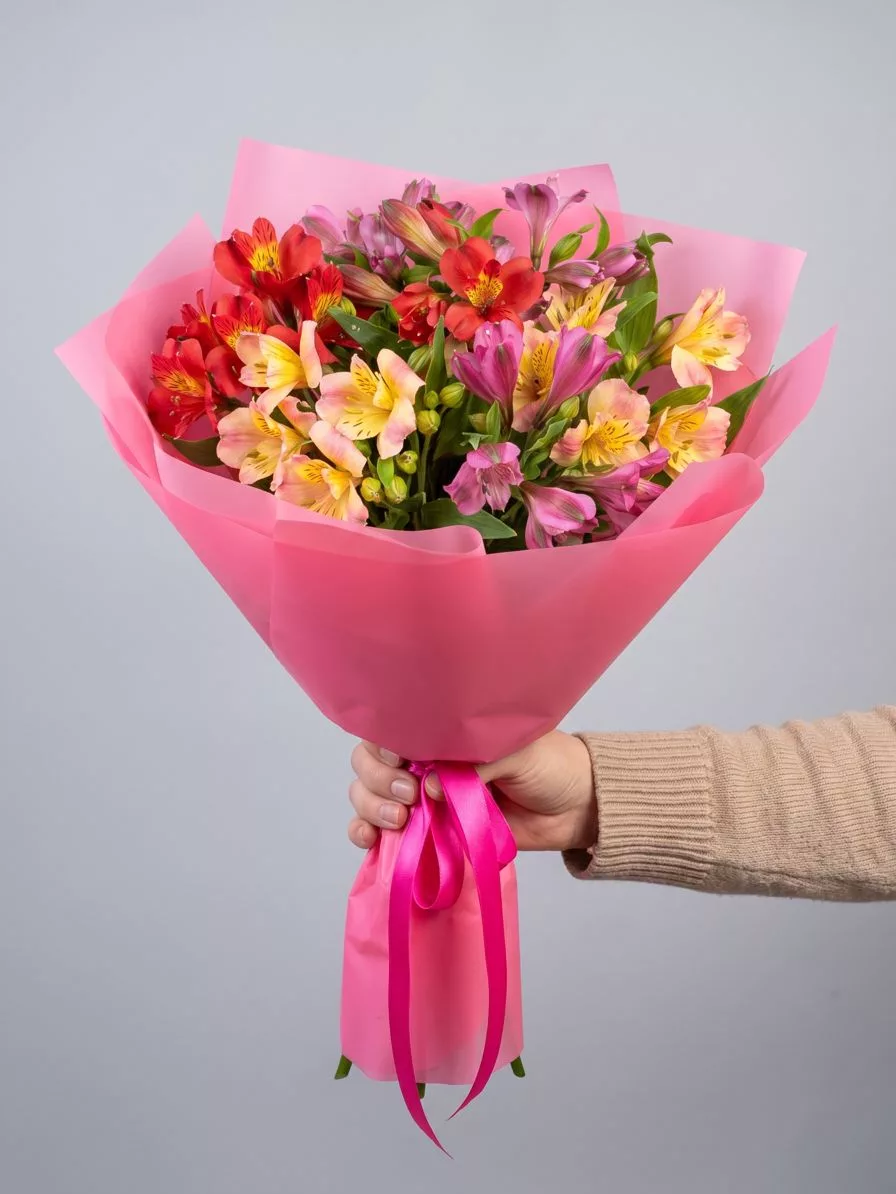
Not every flower that looks beautiful in a Saint Petersburg studio window is a good candidate for a 1,000-kilometre journey to Omutninsk. Varieties we consistently recommend for this route include standard roses in bud form — not fully open blooms — because a tight bud survives transit and opens beautifully over the following two days. Alstroemeria is another reliable choice: the stems are firm, the florets are small and protected, and the variety lasts ten to fourteen days in a vase with proper care. Chrysanthemums, both spray and single-headed, are excellent travellers and are available year-round, making them a practical anchor for mixed bouquets. Eustoma, also called lisianthus, is a good middle-ground option — it is more delicate than chrysanthemum but hardier than garden roses, and the ruffled petals hold their shape well when packed correctly. We are more cautious with fully open garden roses, peonies in full bloom, and anemones, all of which have softer petals that compress and bruise during packaging and handling. Orchid stems — particularly cymbidium — travel well because the blooms are waxy and structured, but they add cost and are better suited for milestone occasions. When in doubt, ask for a bouquet built around alstroemeria and standard roses with seasonal greenery: it arrives looking intentional, not like a compromise.
What Customers in Omutninsk Most Often Get Wrong When Ordering
The single most common mistake is treating Omutninsk delivery like a city-centre order and expecting a two-hour turnaround. We see this constantly: a customer places an order at three in the afternoon hoping flowers will arrive by six for a birthday dinner, and then calls us frustrated when that timeline is not possible. The second frequent issue is an incomplete recipient address — a street name without a building number, or a building number without an apartment number in a multi-entrance block. Couriers cannot guess, and calling the recipient to ask for their own address ruins the surprise entirely. A third mistake is ordering flowers that are already open — some customers specifically request fully bloomed roses because they photograph well in the product images, but an open rose that has already peaked in Saint Petersburg will be past its best by the time it reaches Omutninsk. Order buds. The fourth issue is not mentioning that the recipient is at work during the day. If flowers are going to an office, confirm that someone at reception will accept the delivery; if they are going to a home address and the recipient works until six, note that in the order so the courier does not attempt delivery at noon. Small logistical details like these make the difference between a delivery that lands perfectly and one that requires a second attempt.
How to Write the Order Details So Nothing Goes Wrong
A well-written order has five elements: the full delivery address including postal code, the recipient's mobile number that is switched on and answered, the preferred delivery date with a realistic time window, a note about any access requirements, and your own contact number in case we need to reach you before dispatch. The postal code matters more than many customers realise because Omutninsk shares district-level codes with surrounding villages, and a missing or wrong code can route a package incorrectly at the logistics stage. The recipient's phone number should be a number the recipient actually picks up from unknown callers — many people in Russia screen calls from numbers they do not recognise, so if the person you are sending to does this, mention it and we will send an SMS first. For the time window, give us a two-to-three-hour range rather than a single exact minute: traffic and road conditions on the approach to Omutninsk vary, and a rigid one-minute window creates unnecessary anxiety on both sides. If the delivery is a surprise, note that explicitly so the courier does not mention the sender's name when calling ahead. Finally, if you are adding a card message, write it in the notes field in full — do not assume we will guess the wording from the occasion. We print exactly what you write, so a complete sentence is better than a fragment.
Caring for Flowers After Delivery in Omutninsk
Once the bouquet arrives, what the recipient does in the first thirty minutes determines how long the flowers last. The stems should be cut at a diagonal angle — about two centimetres from the bottom — using a sharp knife rather than scissors, which crush the vascular tissue and reduce water uptake. The cut should happen under running water or while the stem is submerged, because air bubbles entering the stem block hydration immediately. Remove any leaves that fall below the waterline in the vase, as submerged foliage rots quickly and contaminates the water with bacteria that shorten the life of every stem in the arrangement. Change the water every two days and re-trim the stems each time. Keep the bouquet away from fruit bowls — ripening fruit emits ethylene gas, which accelerates petal drop in roses and causes tulips to age faster than they should. Direct sunlight and radiators are the other main enemies: a cool room, ideally between sixteen and twenty degrees Celsius, is the best environment. Roses and alstroemeria kept in these conditions will last seven to ten days easily. Chrysanthemums often go fourteen days or more. If the flowers arrive slightly wilted from the journey, do not discard them immediately: re-cut the stems deeply, place them in cool water in a dark room for two hours, and in most cases they will recover fully. This is normal after long-distance transit and not a sign of poor quality.
Ordering flowers to Omutninsk is straightforward once you understand the timeline and choose varieties suited to the route. Plan for next-day delivery, write a complete address, pick flowers that travel well — roses in bud, alstroemeria, chrysanthemums — and tell us anything unusual about the delivery situation in the notes field. The bouquet will arrive in good condition if the order details are solid on your end and the recipient knows to bring it indoors immediately. We have been sending flowers across Russia long enough to know which details matter and which ones customers only wish they had mentioned earlier. We deliver bouquets across Russia in 1–2 hours.
Frequently asked questions
Can you deliver flowers to Omutninsk on the same day I order?
Same-day delivery to Omutninsk is not the standard option because of the distance from Saint Petersburg. Orders placed before noon on a weekday are typically dispatched the same day and arrive the following day. For time-sensitive occasions, place your order at least two days ahead and specify the required date in the order notes.
What happens to flowers if it is very cold in Omutninsk when they arrive?
Bouquets are packed in insulated wrapping for cold-weather transit. The critical moment is after delivery: the recipient should bring the flowers indoors immediately and not leave them in an unheated entrance or outside a door. Even fifteen minutes at minus fifteen degrees can bruise rose petals and weaken tulip stems beyond recovery.
Which flowers last longest after delivery to Omutninsk?
Chrysanthemums consistently last the longest — often twelve to fourteen days with proper care. Alstroemeria follows at ten to fourteen days. Standard roses in bud form reach seven to ten days. Avoid ordering fully open blooms for long-distance delivery, as they will already be past their peak when they arrive.
Do I need to be home to receive the delivery, or can someone else accept it?
Someone must be present to accept the bouquet — flowers cannot be left outside a door safely, especially in extreme temperatures. A family member, colleague or building receptionist can accept the delivery on the recipient's behalf. Note any alternative recipient in your order so the courier knows who to hand the bouquet to.
Can I include a card message with the bouquet, and will it be in Russian or English?
Yes, card messages are included at no extra charge. Write your message exactly as you want it printed in the order notes field — we print it verbatim. You can write in Russian or English; both are handled without changes. If you leave the field blank, no card is added, so make sure to fill it in if the message matters.
Ready to send a bouquet?
Pick a city, choose the flowers, and we will hand them over with a photo confirmation.
Choose a city →