
Flower Delivery in Osa: Zones, Timing and What to Expect
Customers calling from Osa often ask the same first question: can you really get here in time? The answer depends on which part of the city you are in, what you order, and when you place the request. This article breaks down exactly how delivery to Osa works — zones, realistic windows, which flowers travel well on that route, and what details to confirm before you pay.
Where Osa Sits on the Delivery Map
Osa is a small city in Perm Krai, sitting on the left bank of the Kama River roughly 110 kilometres south of Perm. That geographic position matters for flower delivery because it places Osa in a zone served by road routes through Perm, and the condition of those roads changes noticeably between summer and late autumn. The city itself is compact — the historic centre, the riverside districts and the newer residential blocks on the outskirts all fall within a manageable radius, which means that once a courier is in Osa, reaching almost any address does not add significant time. What adds time is the leg between Perm and Osa, which typically runs between one hour forty minutes and two hours twenty minutes depending on season and traffic at the Kama bridge crossings. When you place an order, the dispatch team calculates from the moment the bouquet leaves preparation, not from the moment you click confirm, so factor in fifteen to twenty minutes of assembly time for standard compositions and up to forty minutes for large arrangements with tropical elements. Addresses in the central streets around Lenina and Oktyabrskaya are straightforward. Addresses in the private housing sector on the city's southern edge occasionally need a phone call from the courier to confirm the exact lane, so include a mobile number that is switched on at delivery time.
Bouquets we can deliver



Realistic Delivery Windows and How to Use Them
The honest answer on timing for Osa is that same-day delivery is achievable when the order arrives before noon local Perm time. Orders placed between 08:00 and 11:30 typically reach the recipient in the afternoon, between 14:00 and 17:00. Orders placed between 12:00 and 15:00 land in the early evening window, roughly 18:00 to 21:00. Orders placed after 16:00 are best scheduled for the following morning, and that is not a limitation to work around — a morning delivery of fresh roses or spray chrysanthemums is often more appreciated than a late-night knock on the door. If you need a precise time rather than a window, say a birthday dinner at 19:00, communicate that clearly in the order notes and the team will build backwards from that moment to set dispatch. Russian recipients generally expect the courier to call roughly fifteen minutes before arrival, so if the person receiving the flowers does not know about the delivery — a surprise, in other words — put a second contact number in the order, either a neighbour or a building manager, rather than the recipient's own phone. That is a common arrangement here and couriers handle it without issue. Avoid scheduling delivery to office addresses in Osa after 17:30 on weekdays; most administrative buildings close promptly and the courier will be left at a locked door.
Which Flowers Survive the Road to Osa
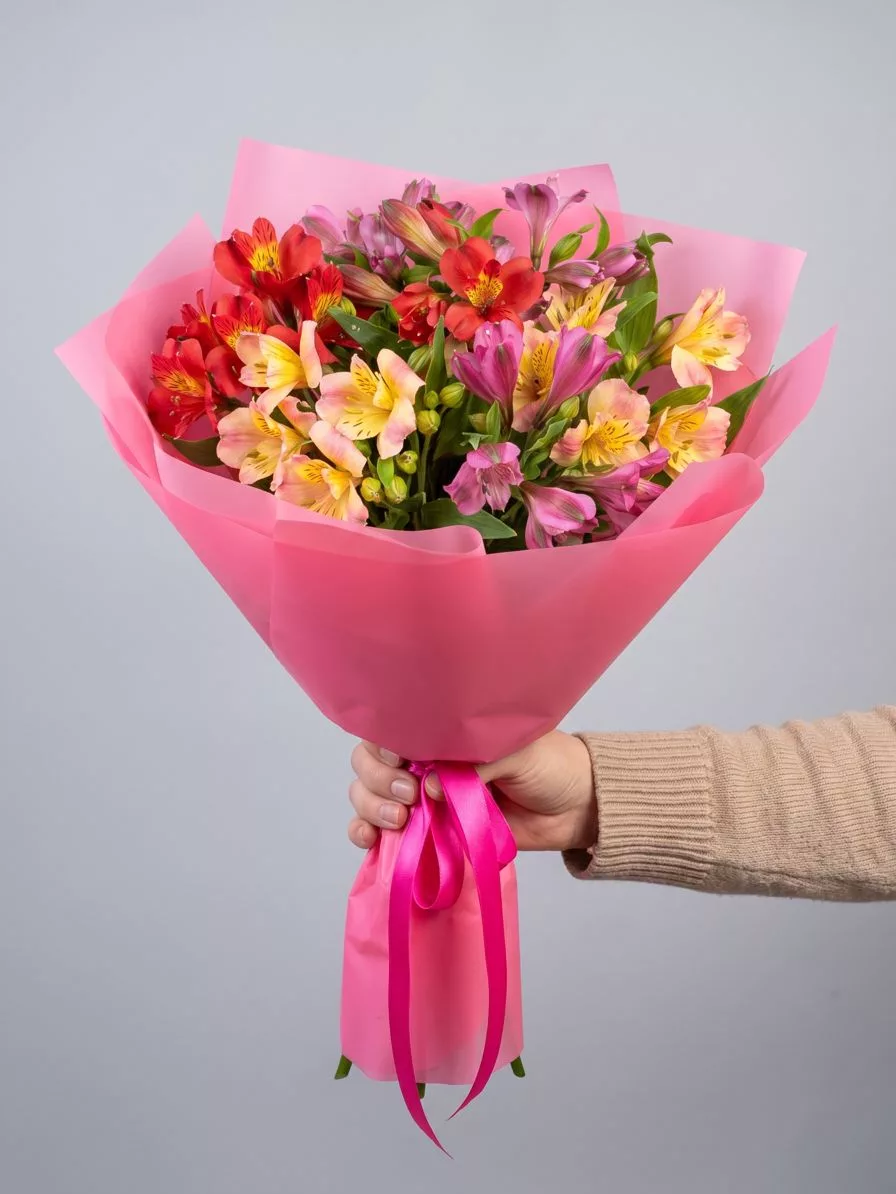
The Perm–Osa route is not extreme by Russian standards, but it is long enough that flower choice matters. Roses in standard grades — 50 cm and 60 cm stems — travel well when the car is temperature-controlled and the bouquet is wrapped correctly. Ecuadorian roses with their dense heads are particularly reliable; varieties like Explorer, Red Naomi and Mondial hold shape over two-plus hours without wilting if the ambient temperature inside the vehicle stays between four and eight degrees Celsius. Spray roses are a strong choice for mixed bouquets heading to Osa because their multiple small heads distribute any minor road vibration without bruising a single prominent bloom. Alstroemeria is another dependable traveller — it arrives looking almost exactly as it left, and it continues opening for several days after delivery, which recipients appreciate. Gerbera daisies are more sensitive: their stems are hollow and they bruise where packaging presses against the head, so if you want gerberas, ask for them to be boxed rather than wrapped in paper. Tulips in season — roughly November through April for the best Dutch stock — handle the journey acceptably but should be ordered in bud stage, not open, because they continue to open in the warm car and will be fully extended by arrival. Hydrangea heads are heavy and prone to wilting if the water supply is interrupted even briefly, so they are better suited to box arrangements than hand-tied bouquets for this route. Chrysanthemums, both single-headed and spray varieties, are the most forgiving of all and are a sensible anchor for any long-distance composition.
Seasonal Considerations for Osa Orders
Perm Krai has a pronounced continental climate, and Osa reflects that fully. Winters are cold enough — regularly minus fifteen to minus twenty-five Celsius in January and February — that unprotected flowers left on a doorstep for even ten minutes can suffer frost damage. In winter, always arrange for the recipient to be home or provide a sheltered drop point. The shop packages winter deliveries in insulated kraft boxes with a thermal lining, but that protection is designed for transit, not for standing outside. Summer in Osa brings the opposite problem: July and August temperatures can push above thirty degrees, and a bouquet sitting in a warm car without climate control degrades fast. All vehicles used for summer deliveries run continuous cooling, but if you are ordering for an outdoor event — a garden party or a riverside celebration — time the delivery to arrive no more than one hour before the flowers are needed and keep them in a cool indoor space until then. Spring, from late March through May, is when tulip and ranunculus availability peaks and prices are most competitive; this is a good window to order larger compositions. Autumn, particularly September and October, brings excellent dahlia and lisianthus stock. Lisianthus — sometimes sold under the name eustoma — is a particularly good autumn choice for Osa deliveries because it is robust, long-lasting and looks expensive without the price point of premium roses. Always mention the delivery date when ordering seasonal varieties because stock levels shift week by week and the florist team can suggest the best available option for your specific day.
Packaging That Makes It to Osa Intact
A bouquet that looks perfect leaving Saint Petersburg can arrive creased, tilted or damp if it is not packaged for a two-hour road journey. The standard approach for Osa deliveries is a structured outer layer of corrugated kraft or a rigid box, with the stems held in a water-retaining floral foam or a sealed water tube for longer stems. Paper wrapping alone is not sufficient for this distance — it compresses, shifts and allows heads to knock against each other on uneven road sections. When you place an order, you can specify box presentation or hand-tied bouquet presentation; for Osa, box presentation is generally the safer choice for delicate compositions. If the order includes a glass vase, it travels separately in bubble wrap inside the same box, and the flowers are placed inside the vase on arrival by the courier — that is standard practice and takes about two minutes. Ribbon and decorative elements are secured before departure, not added at the door, so the presentation the recipient sees is the presentation that was assembled in the shop. Cards and notes are placed inside a sealed envelope tucked into the packaging, not attached to the outside where they can detach or get wet. If you want the card to remain hidden from the courier — for a surprise — you can write the message during checkout and it is printed and sealed without the driver reading it. Mylar balloons can accompany flower orders to Osa; latex balloons are not recommended for winter deliveries because cold air causes them to deflate.
What to Check Before Confirming Your Order
Three things cause the most problems with Osa deliveries and all three are avoidable at the ordering stage. First, the address: Osa has streets with similar names and some addresses in the private housing sector use lane designations that do not appear in standard map databases. Write the full address including the district or microdistrict name if you know it, and if the building has a gate code or an intercom number, include it. Second, the recipient's phone number: it needs to be a number that is switched on and answered, not a work line that goes to voicemail after hours. If the delivery is a surprise, re-read the section above about using a secondary contact. Third, the timing request: if you write a window in the notes but the system records a default time, call to confirm that a human has read your note. The team does read order notes, but a phone confirmation on the same day takes thirty seconds and removes any ambiguity. Beyond those three, check that the variety you want is actually in stock for your delivery date — the website shows availability in real time, but popular items like garden roses or peonies in season can sell out by mid-morning. If you are ordering more than three days in advance, the florist can reserve specific stems for your order, which is worth asking about. Finally, if the recipient has any known allergies — particularly to lily pollen, which is significant and well documented — note that in the order and the team will either remove stamens or substitute a different variety entirely.
Typical Bouquet Sizes and What They Contain
Customers ordering to Osa for the first time often ask what a standard bouquet actually looks like in person, because photographs vary so much between shops. A small composition — the entry-level option — typically contains between five and seven stems, usually a mix of one focal flower such as a rose or a gerbera and two or three complementary varieties like waxflower, pittosporum or eucalyptus. It sits in the hand comfortably and is appropriate for a thank-you gesture or a casual birthday. A medium composition runs from nine to fifteen stems and is the most commonly ordered size for birthdays and anniversaries in Russia; it has enough volume to look substantial in a vase without being unwieldy to carry. A large composition starts at nineteen stems and often includes a structural element — branches of eucalyptus, tall snapdragons or ornamental grasses — that gives it height and presence. For Osa deliveries, large compositions are almost always sent in a box rather than hand-tied, because the structure holds better in transit. Mono-bouquets — a single variety repeated across all stems — are popular for roses, tulips and ranunculus; twenty-five red roses or thirty-one tulips are classic choices in Russia, and the odd number is traditional here rather than a quirk. If you are unfamiliar with Russian gifting customs, odd numbers of flowers are given to the living and even numbers are reserved for memorial occasions, so stick to odd counts for celebratory deliveries. The florist team applies this automatically, but it is useful to understand why.
Ordering flowers to Osa is straightforward once you understand the route, the timing windows and which varieties hold up over two hours of road travel. Place your order before noon for same-day delivery, choose robust varieties like Ecuadorian roses, spray chrysanthemums or alstroemeria, provide a complete address with a working phone number, and let the team know if there are any timing constraints around the recipient's schedule. The flowers that leave the shop are the flowers that arrive — the packaging and temperature control on this route are built around that guarantee. We deliver bouquets across Russia in 1–2 hours.
Frequently asked questions
Can I order flowers to Osa for delivery the same day?
Yes, same-day delivery to Osa is available for orders placed before noon local Perm time. The bouquet typically arrives in the afternoon or early evening depending on when the order is confirmed. Orders placed after 16:00 are better scheduled for the following morning to guarantee freshness and a reasonable delivery hour for the recipient.
What happens if nobody is home when the courier arrives in Osa?
The courier calls the recipient's number before arrival. If there is no answer, a second attempt is made and the dispatcher contacts you as the sender. Providing a secondary contact number — a neighbour or building manager — when you order removes this problem entirely. The bouquet is never left unattended outside in cold or hot weather.
Are there any flowers I should avoid ordering for delivery to Osa in winter?
Open hydrangea heads and fully open tropical flowers like anthuriums are more vulnerable to cold transit. Roses, chrysanthemums, alstroemeria and spray roses all handle winter delivery well when packaged correctly. The shop uses insulated boxes for cold-weather orders, but the recipient should be available to receive the bouquet promptly rather than leaving it outside.
Can I include a gift alongside the flowers — chocolates or a soft toy?
Yes, small accompanying gifts can be added to the order and travel in the same box as the flowers. Chocolates, small plush toys and greeting cards are the most common additions. Heavy or fragile items may need separate packaging; mention what you want to include when ordering and the team will confirm whether it can travel with the bouquet safely.
Why does the Russian tradition use odd numbers of flowers?
In Russian custom, even numbers of flowers are associated with memorial occasions, so celebratory bouquets are always made with an odd count — five, seven, eleven, twenty-five and so on. This is applied automatically to every order, but it is worth knowing if you are specifying an exact stem count yourself, so you do not accidentally request an even number for a birthday or anniversary delivery.
Ready to send a bouquet?
Pick a city, choose the flowers, and we will hand them over with a photo confirmation.
Choose a city →