
Flower Delivery in Polyarny: Zones, Timing and What to Expect
Polyarny sits on the Kola Peninsula above the Arctic Circle, and almost every week someone calls us surprised that fresh flowers can actually arrive there in good condition. They can — but the logistics, the variety choices and the packaging all work differently than they do in central Russia. Here is what you need to know before you place an order.
Where We Deliver in Polyarny and the Surrounding Area
Polyarny is a closed military town, which is the first thing customers need to understand before ordering. Formally it belongs to the ZATO Aleksandrovsk administrative unit, which also covers Gadzhiyevo and Snezhnogorsk on the same peninsula. Delivery addresses within Polyarny itself are accepted, but the recipient must be registered there or have a valid pass, because the town has a checkpoint system — couriers cannot simply drive through the gate without clearance. When you place an order, note in the comments field whether the recipient is a resident or a visitor with a temporary pass, and give us the exact street and building number including any korpus suffix, because the numbering in military towns is non-standard and a wrong building adds significant delay. We cover the central residential blocks, the area near the cultural centre and the dock-side streets closest to Olenya Bay. Gadzhiyevo and Snezhnogorsk are treated as separate delivery zones and require their own order, not an add-on to a Polyarny delivery. If you are sending flowers to someone in the naval base area specifically, state that clearly: access procedures differ and we need to plan the courier route accordingly. The key practical point is that we do not guess at access — we ask you directly, and if you are unsure, call us before completing the checkout so we can confirm feasibility for your specific address rather than discover the problem when the courier is already at the gate.
Bouquets we can deliver



Delivery Timing: What the Arctic Schedule Actually Looks Like
Five Flowers advertises one-to-two-hour delivery across Russia, and that window holds for Saint Petersburg and most large cities. For Polyarny the honest picture is different. The town is roughly 1,400 kilometres from Saint Petersburg by road and there is no direct daily freight flight that carries perishables on a guaranteed schedule. Flowers ordered for Polyarny travel by a combination of air cargo to Murmansk and then ground courier onward to the peninsula. The practical minimum from order confirmation to delivery at the door is 24 hours for standard orders, and 48 hours is a safer planning figure if you want the bouquet to arrive in peak condition rather than having been held at a transit point. Orders placed before noon Saint Petersburg time on a weekday have the best chance of reaching Murmansk on the same-day cargo flight, which means delivery in Polyarny the following morning. Orders placed on Friday afternoon or over the weekend follow Monday's flight schedule, so weekend surprise deliveries need to be ordered by Thursday at the latest. We state the realistic window at checkout and in your confirmation message — if the timing shown does not match your event date, contact us immediately rather than assuming it will resolve itself. Polar winter also shortens the ground courier window in the final leg: daylight is limited, road conditions on the peninsula deteriorate quickly after snowfall, and we build a weather buffer into winter estimates that we do not need in summer. Summer orders, by contrast, are often faster because the White Nights period brings more frequent cargo connections into Murmansk.
Which Flowers Survive the Journey to the Kola Peninsula
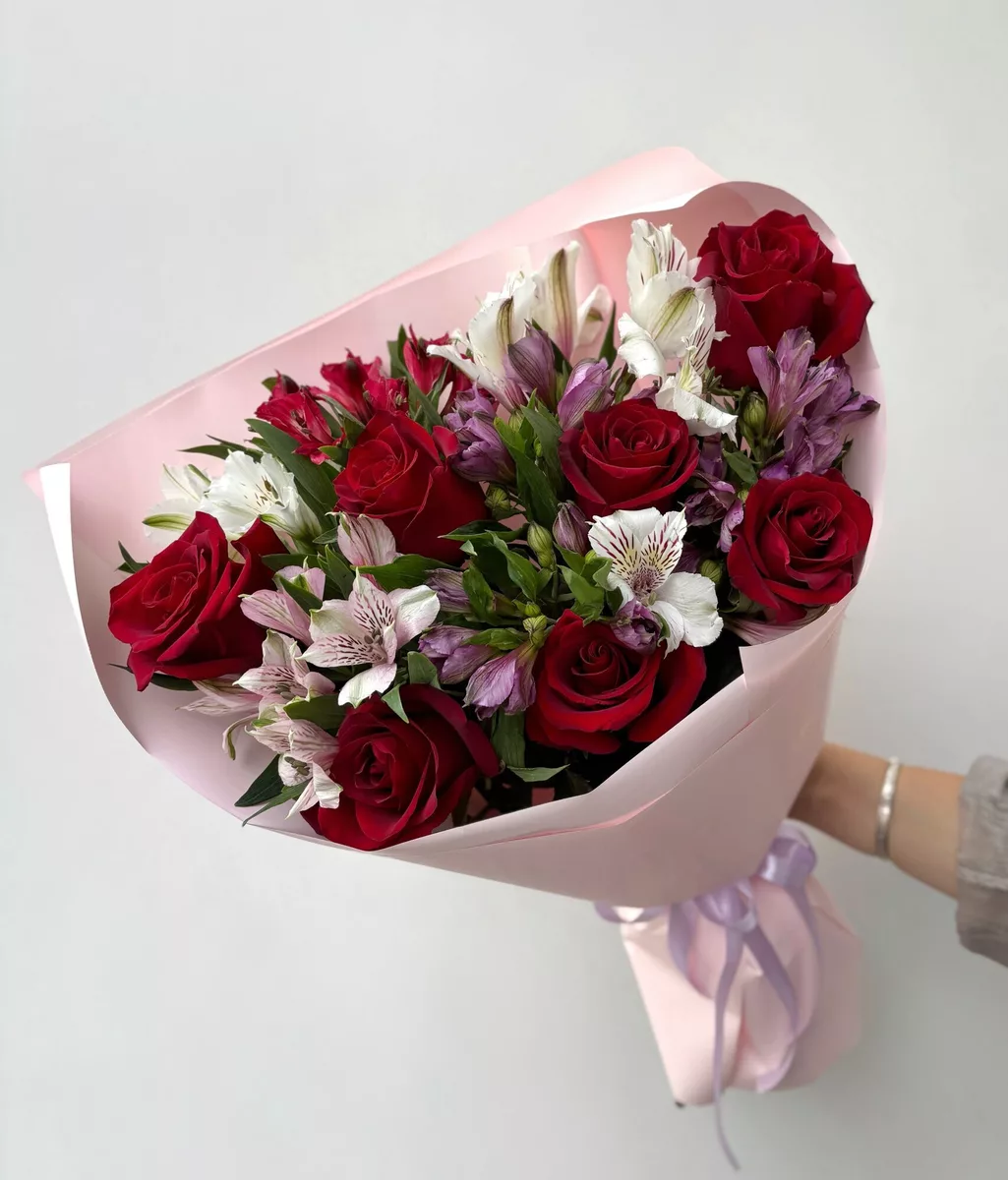
The transit from Saint Petersburg to Polyarny exposes flowers to cargo holds, cold loading docks, and the final open-air leg on the peninsula where January temperatures regularly fall below minus 20 Celsius. Not every variety handles that combination. Spray chrysanthemums are the most reliable traveller we stock: their stems are woody enough to resist vibration damage in transit, and the florets are tight enough that they do not bruise against packaging. Standard chrysanthemum disbuds in white and yellow are equally robust. Among roses, the varieties with tighter, higher-petalled heads — typically the garden-style or high-centred cultivars rather than open flat roses — survive cold transit better because there is less exposed petal surface to freeze or bruise. Alstroemeria is another strong choice: the buds travel closed and open gradually over several days once the recipient has them in water, which means even a 48-hour transit results in a bouquet that looks fresh on arrival and continues to develop for a week. Gerberas are the variety we most often have to talk customers out of for long cold-weather deliveries: the large flat heads are vulnerable to freezing at the petals' edges and to bruising from vibration, and a gerbera that looks fine in the box can show brown petal tips within hours of being unwrapped. Tulips in winter travel well if ordered in bud, poorly if they have already opened. Lilies in bud are excellent — they arrive closed, open in the warmth of the recipient's home, and the scent is at its best when the flower opens naturally rather than being forced. We will tell you honestly at the order stage if your chosen variety is a poor match for current temperatures.
Packaging for Sub-Zero Temperatures: What We Do Differently
Standard bouquet packaging is designed to protect flowers from mechanical damage and to look presentable. For Polyarny in autumn and winter we use a different approach that prioritises thermal protection above aesthetics, and customers sometimes ask why their bouquet arrives wrapped differently than the photos on the site show. The outer layer is an insulated foil sleeve that reflects cold back away from the stems and petals. Inside that we use kraft paper in multiple layers rather than a single decorative wrap, because layered paper traps air and slows temperature transfer significantly better than a single sheet of cellophane. The water source at the stem ends is a sealed hydrogel sachet rather than an open water tube, because open tubes can freeze solid in cargo holds and split, soaking the packaging and chilling the stems through direct contact with ice. We do not use decorative ribbon ties on the outer wrap for winter Polyarny orders because ribbon conducts cold to the stems at the contact points. The recipient will find the decorative elements — ribbon, secondary wrapping, any greeting card — inside the insulated outer layer, protected. We ask customers not to unwrap the bouquet immediately on receipt if they have come in from outside: bring the bouquet indoors, let it sit in the packaging for ten minutes to allow the flowers to adjust to room temperature before unwrapping. Opening cold packaging directly into warm dry indoor air causes rapid condensation on petals, which accelerates decay. This single step — ten minutes of patience — extends bouquet life by a noticeable margin and is the most common thing we wish customers knew in advance.
Caring for Flowers After Delivery in a Northern Climate
Apartments in Polyarny, like most Russian northern-city housing, are heated aggressively in winter. Central heating systems in Murmansk Oblast run from October through May and maintain indoor temperatures of 22 to 25 Celsius, sometimes higher near radiators. That warmth is good for people and bad for cut flowers, which last longest between 15 and 18 Celsius. The single most effective thing a recipient can do is keep the bouquet away from the radiator and away from the window — the window is cold, the radiator is hot, and the space between them creates a temperature oscillation that stresses flowers more than either extreme alone. A kitchen table away from the heating panel, or a hallway that is slightly cooler than the main rooms, is the right placement. Water management matters more in dry heated air than it does in summer: top up the vase daily rather than every two or three days, and recut the stems at an angle every second day to keep the cut surface open and absorbing. Chrysanthemums and alstroemeria will last 10 to 14 days with this care in a northern apartment. Roses in the same conditions last 6 to 9 days depending on the variety and how far open they were on arrival. Lilies last 7 to 10 days and continue to open bud by bud, which means a lily bouquet that arrives with three open flowers and four buds will still be producing new blooms on day five. Removing the yellow pollen anthers from open lily flowers before the pollen drops prevents staining on fabric and prolongs the flower's own display life.
Ordering for Military Addresses and Pass-Controlled Zones
This is the section most customers skip and then call us about after the fact. ZATO Aleksandrovsk, the administrative entity that includes Polyarny, operates under rules that apply to all closed administrative territorial formations in Russia. A courier delivering to a ZATO address must either be registered there, have an issued pass, or be meeting the recipient at the checkpoint where the recipient personally receives the delivery and signs for it. We cannot send a courier through the checkpoint unaccompanied on a standard delivery run. The practical solution we use most often is checkpoint handoff: the courier arrives at the main checkpoint, calls the recipient, and the recipient comes to the gate to collect the bouquet. This works smoothly and adds roughly 15 to 20 minutes to the delivery process, but it requires the recipient to be reachable by phone and available to come to the gate. If you are sending flowers as a surprise and the recipient does not know to expect a call, the surprise element is partially lost — the phone call from the checkpoint reveals that something is coming even if not what. For recipients who are residents and can meet at the gate, this is not a problem. For recipients who are visiting personnel with temporary access, we need to know in advance so the courier can coordinate timing. Please put all of this information in the order comments field at checkout: whether the recipient is a resident or visitor, whether checkpoint handoff is expected, and a reliable phone number for the recipient. Orders with incomplete address information for ZATO zones are held until we can confirm details, which affects your delivery window.
Common Mistakes When Ordering Flowers to Polyarny
The most frequent error is treating Polyarny like a standard Russian city and selecting same-day delivery at checkout without reading the regional timing note. Same-day delivery is not available for Polyarny from Saint Petersburg regardless of when you order, and selecting it creates an order that we have to manually correct and reconfirm with you, which costs time. The second common mistake is choosing flowers by photo rather than by transit suitability. Peonies photograph beautifully and customers order them year-round, but peonies are highly sensitive to cold and vibration and do not survive the Polyarny transit in winter in acceptable condition. We will flag this at order review, but if you order late at night through the automated system without reading the variety note, the flag may not reach you until morning. The third mistake is providing a building number without a korpus number in towns where buildings have sub-numbers. In Polyarny, as in most Soviet-era military settlements, a single street address can cover three or four physically separate buildings distinguished only by their korpus designation. Korpus 1 and Korpus 3 on the same street can be 200 metres apart, and the courier cannot guess. The fourth mistake is ordering for a date and then not being reachable on that date. For checkpoint handoffs especially, if the recipient does not answer the courier's call, the bouquet cannot be delivered and must be held, which in cold weather means it waits in the courier vehicle and deteriorates. Finally, customers sometimes order without accounting for Russian public holidays, when cargo flight schedules to Murmansk are reduced. Check the calendar before ordering around New Year, Orthodox Christmas in early January, and May holidays — add an extra day to your planning window for those periods.
Polyarny is one of the more demanding destinations we deliver to, and we would rather give you an accurate picture upfront than a pleasant promise that does not hold at the checkpoint gate or in minus-twenty cargo conditions. The flowers we recommend for this route — chrysanthemums, alstroemeria, lilies in bud, robust-headed roses — are not a compromise selection: they are genuinely beautiful and they arrive in the condition they left us. Plan your order 48 hours ahead of the occasion, give us complete address and access information, and the delivery will go smoothly. We have done this route enough times to know exactly where the problems arise and how to avoid them. We deliver bouquets across Russia in 1–2 hours.
Frequently asked questions
Can you deliver flowers directly inside Polyarny, or only to the checkpoint?
For most orders we use a checkpoint handoff, where the recipient meets the courier at the gate. Full in-town delivery is possible if the recipient provides advance pass documentation and we can confirm access. Note this requirement clearly in your order comments, and we will contact you to arrange the right method for your specific address.
What is the minimum notice I need to give for a Polyarny flower delivery?
Order at least 48 hours before the occasion to be safe. Orders placed before noon on a weekday can reach Polyarny the following morning via same-day cargo to Murmansk. For dates around major Russian public holidays — New Year, early January, May — add an extra day because cargo flight frequency to Murmansk is reduced during those periods.
Will the flowers freeze during delivery in winter?
We use insulated foil sleeves, layered kraft paper and sealed hydrogel stem sachets for all Polyarny winter orders. These measures keep flowers above freezing through the cargo hold and ground courier stages. Ask the recipient to let the bouquet warm indoors for ten minutes before unwrapping — opening cold packaging straight into warm dry air causes condensation that damages petals.
Can I order peonies or sunflowers for delivery to Polyarny?
Peonies are not recommended for the Polyarny route in autumn or winter because they are highly sensitive to cold and vibration. Sunflowers travel better but still carry risk in sub-zero conditions. We will tell you at order review if your chosen variety is unsuitable and suggest a comparable alternative that handles the transit reliably.
Does the same delivery process apply to Gadzhiyevo and Snezhnogorsk?
Gadzhiyevo and Snezhnogorsk are separate delivery zones within ZATO Aleksandrovsk and each requires its own order. They share the same transit route through Murmansk and the same checkpoint access considerations as Polyarny. Do not add them as secondary addresses on a Polyarny order — place individual orders and note the access details for each address separately.
Ready to send a bouquet?
Pick a city, choose the flowers, and we will hand them over with a photo confirmation.
Choose a city →