
Flower Delivery in Slavgorod: Zones, Timing and Prices
Customers ordering flowers to Slavgorod from us ask the same three questions every time: will they arrive fresh, how long does it actually take, and which bouquets survive a long haul without looking tired by the time they reach the door. These are exactly the right questions, and this article answers all of them with the kind of detail that saves you from an embarrassing delivery.
Where We Deliver in Slavgorod and How the Zone System Works
Slavgorod sits in the Altai Krai region of Western Siberia, and deliveries there operate on a zone model that divides the city into central and peripheral sectors. The central zone covers the area around Lenin Street, the main market square and the residential blocks closest to the city administration building. Peripheral zones extend toward the industrial districts on the eastern edge and the private housing estates to the south, where street numbering can be inconsistent and courier navigation takes longer. When you place an order, the system asks for a full address including the apartment or house number, the entrance code if there is one, and a contact phone number for the recipient. This matters more in Slavgorod than in larger cities because many buildings share similar names or are located on streets with duplicate numbering inherited from Soviet-era planning. If the address is incomplete, the courier holds at the nearest confirmed point and calls ahead, which adds time. Delivery to private houses in the outer zones requires the gate to be unlocked or someone to be physically present, since flowers cannot be left unattended in cold weather without risk of frost damage. Slavgorod winters are serious — temperatures regularly drop below minus twenty Celsius — so every delivery in the cold season is packed with insulating kraft wrap and a thermal sleeve to protect stems and petals during the final stretch from the vehicle to the door.
Bouquets we can deliver



Typical Delivery Timing from Order to Door
The standard delivery window for Slavgorod is longer than for Saint Petersburg itself, and customers need to plan around that honestly. For same-day delivery, orders placed before noon local Slavgorod time have the strongest chance of arriving within the same calendar day. Orders placed in the afternoon are processed for next-day morning delivery, which in practice means the bouquet leaves our Saint Petersburg facility packed and refrigerated, travels overnight, and is handed to the local courier for the final leg in the morning. The total transit time from our shop floor to a Slavgorod address typically runs between twenty-four and thirty-six hours depending on the day of the week and whether there are public holidays affecting logistics. Russian public holidays — New Year week in early January, International Women's Day on March 8th, and Victory Day in early May — are the three periods when demand spikes sharply and delivery slots fill fast. If you are ordering for March 8th specifically, which is the single busiest flower-giving day in Russia and carries enormous cultural weight, place your order at least three days in advance. Women's Day is not a minor occasion here: it is the day when practically every woman in the country receives flowers, and logistics across all of Russia tighten dramatically in the forty-eight hours surrounding it. Booking early is not caution — it is the only reliable approach.
Which Flowers Travel Best to Slavgorod
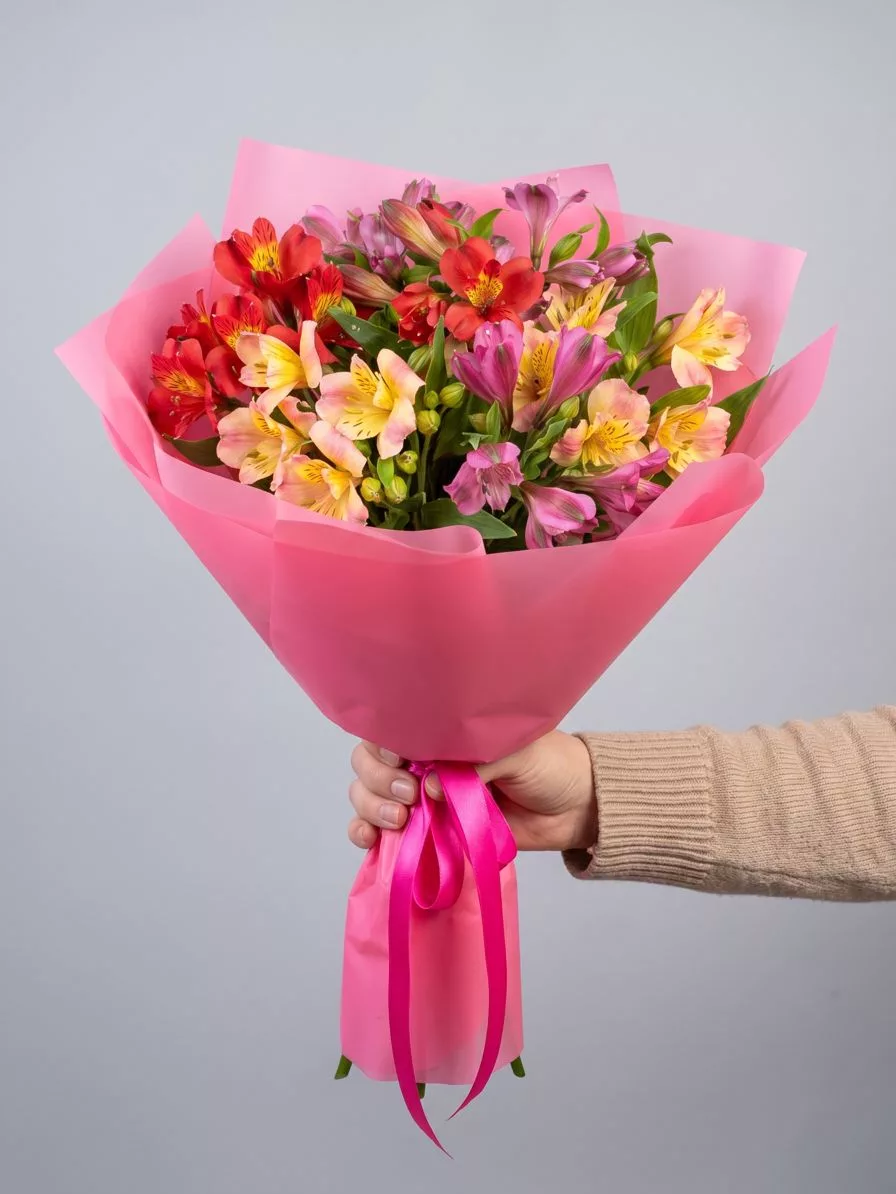
Not every flower in our catalogue is equally suited to a long refrigerated journey, and being honest about that is part of our job. Roses are the most reliable long-haul cut flower when the stems are properly conditioned and the buds are cut at the right stage — tight enough that they will not open fully during transit but advanced enough that they will bloom naturally within a day of arrival. We use Dutch and Ecuadorian roses for these orders, varieties selected for stem strength and vase longevity rather than just appearance in the shop. Chrysanthemums, both spray and single-headed, are excellent travellers: their cellular structure holds water efficiently and they are highly tolerant of temperature fluctuation within a refrigerated range. Alstroemeria is another strong choice — the stems are robust, the flowers last well over a week in a vase, and the colour range is wide enough to build a complete bouquet without supplementary flowers. Eustoma, sometimes called lisianthus, travels well if the buds are not yet fully open and the packaging keeps them upright. What we actively steer customers away from for Slavgorod deliveries are open tropical flowers like anthuriums in their most delicate varieties, and any arrangement built primarily around garden flowers such as sweet peas or anemones, which bruise easily and lose structure in transit. Tulips are manageable in cold months but require careful handling at the receiving end — they continue to grow after cutting and will lean toward any light source within hours of unpacking.
Seasonal Considerations for Slavgorod's Climate
Slavgorod has a sharply continental climate, meaning the temperature swings between seasons are extreme and this directly affects how flowers are packaged and delivered throughout the year. In winter, from November through March, the main risk is frost damage during the transfer between the heated delivery vehicle and the recipient's building. Even five minutes of exposure to minus fifteen or minus twenty Celsius can blacken rose petals and collapse tulip stems irreversibly. Our winter packaging uses a double-layer thermal wrap around the bouquet, and couriers are instructed not to leave flowers on doorsteps or in unheated entrance halls. In summer, the risk reverses: Slavgorod summers can push above thirty Celsius, and flowers left in a warm vehicle or a sunny entrance for even a short period will wilt rapidly. Summer deliveries use gel ice packs inside the packaging and are routed to avoid midday heat where possible. Spring and autumn are the most straightforward seasons logistically, but spring in Siberia can be deceptive — a warm forecast can shift to frost overnight in April, and we treat spring orders with the same cold-weather precautions until the region has reliably cleared its last frost date, which in Slavgorod is typically late April to early May. Customers ordering in these transitional months should note the current local temperature at time of order, since our team adjusts packaging specifications based on the destination forecast, not the Saint Petersburg weather.
What to Include in Your Order for a Smooth Delivery
The single most common reason a Slavgorod delivery runs into trouble is incomplete recipient information, and it is entirely avoidable. The address field needs a street name, building number, apartment or house number, and — critically — the entry code for the building intercom if there is one. Many Slavgorod residential buildings have coded entry panels, and without the code the courier cannot reach the apartment floor. The recipient's mobile phone number is mandatory, not optional: the courier calls ahead roughly thirty minutes before arrival so the recipient can be at home or arrange for someone else to accept the delivery. If the recipient is at a workplace, include the organisation name and the floor or office number. For surprise deliveries where you do not want the recipient to know in advance, note this in the order comments and provide your own phone number as the primary contact — the courier will call you instead and you can coordinate the handover. The card message, if you want one, should be written in the order form rather than left as a verbal instruction in a chat message, because the printed card is prepared at our Saint Petersburg facility before the order ships. Keep the message concise: a card that fits on a standard florist's tag, roughly two to four short sentences, is easier to read and more likely to be kept by the recipient. If you are sending flowers to someone who does not speak Russian, writing the card message in English or another language is completely fine — just type it exactly as you want it to appear.
Bouquet Sizes and What They Look Like on Arrival
Customers sometimes expect a bouquet to arrive looking exactly as it does in the product photograph, and it is worth explaining the small differences that are normal and those that are not. A bouquet photographed in full bloom in the shop will arrive with slightly tighter buds after a refrigerated journey — this is intentional, not a defect. Roses cut at the half-open stage will reach full bloom within twelve to twenty-four hours of being placed in fresh water at room temperature. The stems should be recut at an angle with a clean knife before placing in a vase, removing about two centimetres from the bottom, and the water should be changed daily. This is standard care practice in Russia and produces noticeably longer vase life. Regarding size: our bouquet descriptions specify stem count, and that count is what you receive. A bouquet of nineteen roses contains nineteen stems — Russian flower-giving tradition strongly favours odd numbers for celebratory occasions, and even numbers are reserved for mourning, so we follow this convention by default unless you specify otherwise. If you are ordering for a birthday, anniversary, or professional achievement, odd-numbered bouquets are the culturally correct choice and our catalogue is built around this. Larger arrangements — twenty-five, thirty-five or fifty-one stems — are popular for significant birthdays and professional milestones. The physical volume of a fifty-one stem rose bouquet is substantial, roughly the size of a large watermelon, and the recipient will need a wide-mouthed vase or bucket to support it properly.
Checking Your Order Status and Handling Problems
Once an order is placed and confirmed, you receive a tracking reference that lets you follow the order through its stages from packing to dispatch to local delivery. If you notice an error in the address after placing the order, contact us immediately — corrections made within the first two hours of order placement can usually be applied before the bouquet is packed. Corrections attempted after packing or dispatch are harder to action and may not be possible for same-day orders. If a delivery is delayed beyond the confirmed window, the first step is to check whether the recipient's phone is reachable, since the most frequent cause of a missed delivery slot is an unanswered call from the courier. A second delivery attempt is scheduled automatically in most cases, but this adds time. If the flowers arrive in a condition that does not meet reasonable expectations — stems broken in transit, petals blackened by frost, or the wrong bouquet entirely — photograph the issue immediately on receipt and contact our customer service with the order number and the images. We assess these cases individually and the resolution depends on the nature of the problem. Frost damage during extreme cold snaps is the most common weather-related issue in Slavgorod deliveries, and our packaging standards are designed to prevent it, but customers in particularly remote outer-zone addresses during severe cold should consider scheduling delivery for a time when someone can receive the order directly at the door rather than relying on a building entrance or mailroom.
Ordering flowers to Slavgorod is straightforward when you know what the distance and the climate require. Choose varieties built for travel, give us a complete address with the intercom code, plan ahead for major holidays, and make sure the recipient's phone is on. The bouquet that leaves our shop in Saint Petersburg is packed to arrive looking like a gift, not like a journey — and with the right information on your order form, that is exactly what it does. We deliver bouquets across Russia in 1–2 hours.
Frequently asked questions
Can I order flowers for same-day delivery in Slavgorod?
Same-day delivery to Slavgorod is available for orders placed before noon local Slavgorod time. Because of the distance from Saint Petersburg, same-day fulfilment depends on the logistics slot being open. Orders placed in the afternoon are scheduled for next-morning delivery, which is the more reliable option for time-sensitive occasions.
What happens to flowers during Slavgorod's winter cold?
Every winter order is packed with a double-layer thermal wrap and a protective kraft sleeve. Couriers are instructed to complete the handover directly at the door rather than leaving bouquets in unheated entrance areas. Temperatures below minus fifteen Celsius can damage unprotected flowers within minutes, so our cold-season packaging is non-negotiable regardless of bouquet size.
Why do Russian bouquets always have an odd number of flowers?
Odd numbers are used for celebratory and affectionate occasions in Russian tradition, while even numbers are associated with mourning. This convention is widely observed across Russia, including in Slavgorod. Our catalogue defaults to odd stem counts — one, three, five, seven, nine, eleven, nineteen, twenty-five and so on — unless you specifically request otherwise.
Which flowers should I avoid ordering for a long delivery to Slavgorod?
Avoid arrangements built primarily around delicate open tropical flowers, garden flowers like sweet peas or anemones, or any variety described as fragile in the product notes. Roses, chrysanthemums, alstroemeria and eustoma are the most reliable choices for long refrigerated transit and will arrive in good condition when packaged correctly.
What should I do if the recipient is not home when the courier arrives?
The courier calls the recipient's phone approximately thirty minutes before arrival. If there is no answer, a second attempt is scheduled. To avoid a missed delivery, provide a reliable mobile number and let the recipient know a delivery is coming — even without revealing the sender. For surprise gifts, give your own number as the courier contact and coordinate the handover yourself.
Ready to send a bouquet?
Pick a city, choose the flowers, and we will hand them over with a photo confirmation.
Choose a city →