
Flower Delivery Timing: Order to Doorstep in 1–2 Hours
The question we hear most at the counter and on the phone is simple: how long will it actually take? Not the marketing answer — the real one. The honest answer is that most deliveries across Saint Petersburg land within one to two hours of order confirmation, but that window depends on three things working together: what you ordered, where it is going, and what time of day you placed the order. This article walks through each factor so you can plan around them rather than be surprised by them.
The Basic Timeline from Confirmation to Courier Departure
When your order is confirmed — meaning payment is processed and the florist has acknowledged the request — the clock starts. The first stage is assembly, which for a standard bouquet of roses, spray chrysanthemums or alstroemeria typically takes fifteen to twenty-five minutes. These are stems that are kept pre-conditioned in cold storage at around four to six degrees Celsius, cut to length and arranged quickly because the florist knows the proportions by heart. A more complex order involving peonies, ranunculus or garden-style mixed bouquets with seasonal foliage takes longer because the stems need individual attention and the arrangement has no fixed template. Expect thirty to forty minutes of assembly for anything described as a designer or author bouquet. After assembly the bouquet is wrapped, labelled and handed to the courier. The courier then spends a few minutes loading it safely into the vehicle — flowers travel upright in a purpose-built holder to prevent stem breakage and petal bruising. From the moment the courier leaves the shop, delivery time depends entirely on distance and traffic. In central Saint Petersburg districts like Tsentralny or Petrogradsky, the drive is often under twenty minutes. In outlying districts like Primorsky or Nevsky, add another fifteen to thirty minutes. The full chain from confirmed order to doorbell is therefore most often sixty to ninety minutes, and rarely exceeds two hours under normal conditions.
Bouquets we can deliver



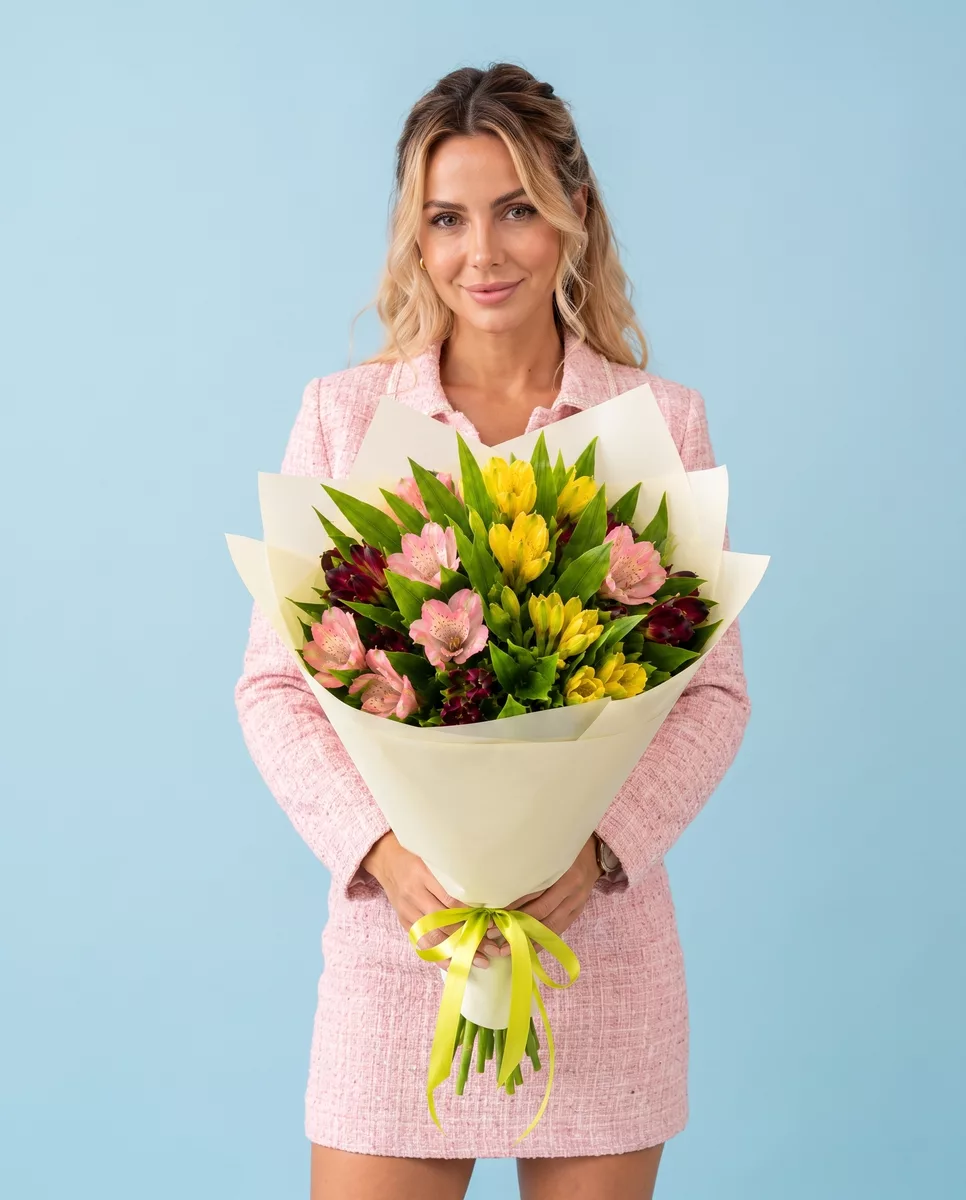
Which Bouquets Are Ready Fastest and Which Take More Time
Not every bouquet moves at the same pace, and knowing this helps you choose realistically when time is short. Mono bouquets — a single variety repeated throughout — are the fastest to assemble. A bouquet of twenty-five red Freedom roses or fifteen white Avalanche roses can be cut, conditioned and wrapped in under twenty minutes because there are no colour-matching decisions and no complex layering. Spray roses and standard chrysanthemums in single colours are equally quick. These are the right choice when you need delivery in the shortest possible window. Mixed bouquets with three or more varieties slow things down because the florist must balance stem heights, bloom sizes and colour weight. A bouquet combining garden roses, eucalyptus, lisianthus and ranunculus might look effortless in a photograph but requires careful hand-positioning of each stem. Assembly time here is closer to thirty-five to forty-five minutes. Seasonal flowers add another variable. Peonies, for example, are available in Saint Petersburg from roughly late April through June. When they are in stock they are popular and sell fast, so if you order them after midday on a weekend there is a real chance the shop has only partially opened buds left, which the florist will need to assess before confirming your order. Tulips in winter are flown in from the Netherlands and Ecuador and are almost always available, but they are temperature-sensitive and need extra wrapping in cold weather below minus five Celsius, which adds a few minutes to preparation. Always specify your deadline when ordering a complex bouquet — the florist can then tell you honestly whether the timing works.
How Saint Petersburg Geography Affects Your Delivery Window
Saint Petersburg is a large city that stretches across islands, rivers and a sprawling mainland. The historic centre sits on a cluster of islands separated by the Neva and Fontanka rivers, and crossing those rivers during peak hours adds meaningful time to any route. A delivery from the shop to Vasilyevsky Island, for example, involves at least one bridge crossing. During morning rush hour between eight and ten, or evening rush between five and seven, that crossing can add fifteen to twenty minutes compared to the same route at noon. Deliveries to the centre — Admiralteysky, Tsentralny, Petrogradsky — are the fastest because road distances are short and the courier often covers them in fifteen to twenty minutes. The Vyborg and Kalininsky districts on the northern mainland are moderately fast. The southern districts, particularly Moskovsky and Frunzensky, and the far eastern districts like Nevsky and Krasnogvardeysky, sit further from most shop locations and add time. For addresses in Pushkin, Peterhof or Kronstadt — historic satellite towns that many Saint Petersburg residents and visitors stay in — delivery is treated as a separate zone and the timeline extends accordingly. It is worth being specific about the full address including building number and entrance number when you order. Russian apartment buildings often have multiple entrances numbered separately, and a courier who arrives at entrance one when the recipient is at entrance four loses ten minutes finding the right door. That small detail genuinely affects whether your delivery lands at the one-hour mark or the two-hour mark.
Time of Day and Day of Week: When the Window Widens
Flower shops in Russia follow a rhythm that most customers outside the country do not expect. The busiest ordering periods are not Monday mornings — they are Friday afternoons, Saturday mornings and the days immediately before public holidays. In Russia, holidays like International Women's Day on the eighth of March, Valentine's Day and New Year create demand spikes that are genuinely extreme. On the eighth of March it is common for a single shop to process ten times its normal daily order volume. During these periods the one-to-two-hour window can stretch to three or four hours even for simple bouquets, simply because every florist is assembling at full speed and every courier is already on a route. The practical advice is to order by nine in the morning on high-demand days if you need delivery before noon, or to schedule the delivery for the evening when the morning surge has passed. On ordinary weekdays, the calmest ordering windows are between ten in the morning and two in the afternoon. Orders placed then are assembled and dispatched quickly because the florists have time and couriers are available. Late-evening orders — placed after nine at night — depend on whether the shop operates a night delivery service. Five Flowers delivers late, but assembly time does not shrink just because it is quiet: a ranunculus bouquet still takes as long to arrange at eleven at night as it does at noon. If you are ordering for a specific time, place the order at least ninety minutes before that time on a normal day, and two to three hours before on a holiday or weekend.
What Happens to Flowers During the Delivery Journey
Flowers are living things and they respond to conditions during transit in ways that affect how they look when they arrive. Temperature is the biggest factor. Roses and lisianthus are comfortable between four and eighteen degrees Celsius. Below zero, petals on open roses bruise and turn translucent at the edges within minutes of exposure. Above twenty-five degrees, stems dehydrate rapidly and blooms that were tight in the shop can open fully during a forty-minute drive in a warm car. In summer, Saint Petersburg can reach twenty-eight to thirty degrees Celsius in July and August, and the courier vehicle heats up quickly. The shop addresses this by wrapping bouquets in insulating paper layers and, for longer routes, using cooled vehicles. In winter, which in Saint Petersburg can mean minus fifteen to minus twenty Celsius from December through February, the outer wrapping becomes critical. A tulip bouquet without adequate insulation can arrive with drooping stems because the cells in the stems freeze and lose structural integrity. When you receive a bouquet that has been in cold weather and the stems feel soft, place it immediately in room-temperature water — not cold water — and give it thirty minutes before judging the result. Most stems recover. The courier is also trained to carry bouquets upright rather than horizontal. Horizontal transport causes water to pool at one end of the stem and starves the bloom end. This sounds like a small detail but it is the difference between a bouquet that lasts seven days and one that lasts four.
Tracking Your Order and Communicating with the Courier
Once the courier leaves the shop, customers in Russia typically receive updates by SMS or messenger — WhatsApp and Telegram are both widely used and expected. The message usually contains the courier's name and a contact number. If you need to redirect a delivery or give access instructions for a gated building or a building with a code lock, this is the moment to do it. Russian apartment buildings very commonly have a door code or an intercom system, and if the courier cannot get past the entrance they will call the recipient. It is worth knowing that in Russia it is completely normal and expected for a courier to call the recipient directly when they are five to ten minutes away. This is not considered intrusive — it is standard practice and helps the recipient be ready at the door rather than making the courier wait in a stairwell. If the bouquet is a surprise and you do not want the recipient called in advance, say so explicitly when you place the order. The florist will note it and the courier will wait at the door rather than calling. For deliveries to offices, specify the floor, company name and the name of the person at reception if your recipient works in a large building. Office buildings in Saint Petersburg's business districts often have security desks that require the visitor — in this case the courier — to state a specific name and destination before being allowed entry. A vague address loses five to ten minutes at the security desk and occasionally results in the courier being turned away entirely.
What to Check Before You Confirm the Order
A few minutes spent checking details before you confirm saves the most common causes of delayed or failed delivery. Start with the address: write the full postal address including street, building number, apartment or office number, and entrance number if the building has more than one. In Saint Petersburg, buildings on major streets like Nevsky Prospekt or Ligovsky Prospekt can have multiple wings and dozens of entrances. Next, confirm the recipient's phone number is correct. A single transposed digit means the courier cannot reach anyone when they arrive. Check the delivery time window you have requested against the current time: if it is already one in the afternoon and you need delivery by two, call the shop rather than ordering online so a florist can confirm whether that window is achievable given current order volume. If you are sending flowers to a hotel, include the hotel name and the guest's name as it appears on the booking — hotel reception staff in Russia will not release a delivery to a room number alone. If the recipient is at a dacha — a country house outside the city — clarify whether that address falls within the delivery zone, because routes beyond the city boundary require a separate arrangement and a longer timeline. Finally, double-check the flower selection itself. If you have chosen peonies in November, the shop will likely substitute them or contact you to discuss alternatives, because peonies are genuinely not available in Russia in autumn. Knowing this in advance means you can choose an available variety like spray roses, freesia or ornithogalum rather than waiting for a call.
The one-to-two-hour window is real and achievable on most days for most addresses across Saint Petersburg, but it is built on a chain of small conditions all working correctly: the right bouquet chosen for the time available, a complete and accurate address, a reachable recipient and a realistic gap between when you order and when you need the flowers to arrive. Mono bouquets of roses or chrysanthemums move the fastest. Complex mixed arrangements need more lead time. Holidays and Friday afternoons need the most. Give the shop the full picture when you order — variety preferences, timing, any access details — and the florist can work the chain from their end so that what lands on the doorstep looks exactly like what you had in mind. We deliver bouquets across Russia in 1–2 hours.
Frequently asked questions
Can I get flowers delivered within one hour in Saint Petersburg?
Yes, for central districts and straightforward bouquets — a single-variety rose or chrysanthemum arrangement — one hour from confirmation is realistic on a normal weekday outside peak hours. Place the order before two in the afternoon for the best chance. Complex mixed bouquets or addresses in outlying districts need closer to ninety minutes to two hours.
What if I need the flowers delivered at an exact time, not just within a window?
Specify the exact time in the order comments and place the order at least two hours before that moment on a regular day, three hours on a weekend or holiday. The florist times assembly so the courier departs with enough buffer for traffic. For very precise timing — a ceremony or a meeting — call the shop directly to confirm.
Do flowers arrive in good condition after sitting in a delivery vehicle?
Yes, provided the wrapping is appropriate for the temperature. In winter below minus five Celsius, bouquets are insulated with extra paper layers. In summer heat, cooled vehicles are used for longer routes. Place the bouquet in water immediately on arrival and trim a centimetre from each stem at a diagonal — this restores hydration quickly after any transit stress.
What happens if the recipient is not home when the courier arrives?
The courier calls the recipient. If there is no answer, the courier waits a short time and calls again, then contacts the sender. The bouquet is not left unattended outside a door in cold or hot weather because temperature damage accumulates quickly. Arrange a reliable contact number for the recipient or authorise a neighbour to accept the delivery.
Does delivery timing change on Russian public holidays?
Yes, significantly. The eighth of March, Valentine's Day and New Year are the most affected. Order volume multiplies and both assembly and courier routes take longer. Order by nine in the morning for midday delivery on those dates, or schedule for the evening. The shop remains open but realistic timing expectations on peak days start at two to three hours.
Ready to send a bouquet?
Pick a city, choose the flowers, and we will hand them over with a photo confirmation.
Choose a city →