
Flowers from Ecuador: What Makes Ecuadorian Roses Special
Ecuador is one of the world's largest growers of cut flowers, and it is best known for its roses: large heads, long straight stems and unusually saturated colours. These qualities come from the farms' location high in the Andes, almost exactly on the equator, where roses grow slowly in strong sunlight, steady day length and cool nights.
In our Saint Petersburg shops, customers often ask for "Ecuadorian roses" by name, usually meaning tall, big-headed roses for an anniversary or a proposal. Below we explain what sets these flowers apart, which varieties people mean when they ask for them, how to tell a premium rose by eye, and how to care for one so it opens fully and stays beautiful as long as possible.
Why Ecuador grows such remarkable roses
Most Ecuadorian rose farms sit at around 2,500-3,000 metres above sea level in the Andean valleys north and south of Quito. At that altitude, near the equator, the sun is intense and the day lasts close to twelve hours all year round, while nights are cool. Roses grow more slowly than in a warm lowland greenhouse, and that slower growth produces thicker stems, larger buds and more petals.
Strong ultraviolet light deepens pigments, which is why Ecuadorian reds look velvety and almost black at the edges, and why pinks and oranges are so vivid. The stable climate also means the same quality is available in every season, including deep winter in the northern hemisphere, when demand for roses peaks around Valentine's Day and 8 March.
Stem length is the feature people notice first. Ecuadorian roses are commonly grown to 50-90 cm, and premium lines reach 100-120 cm. Heads of 5-7 cm in height are typical for the best varieties, noticeably larger than a standard garden or short-stem rose.
Popular Ecuadorian rose varieties
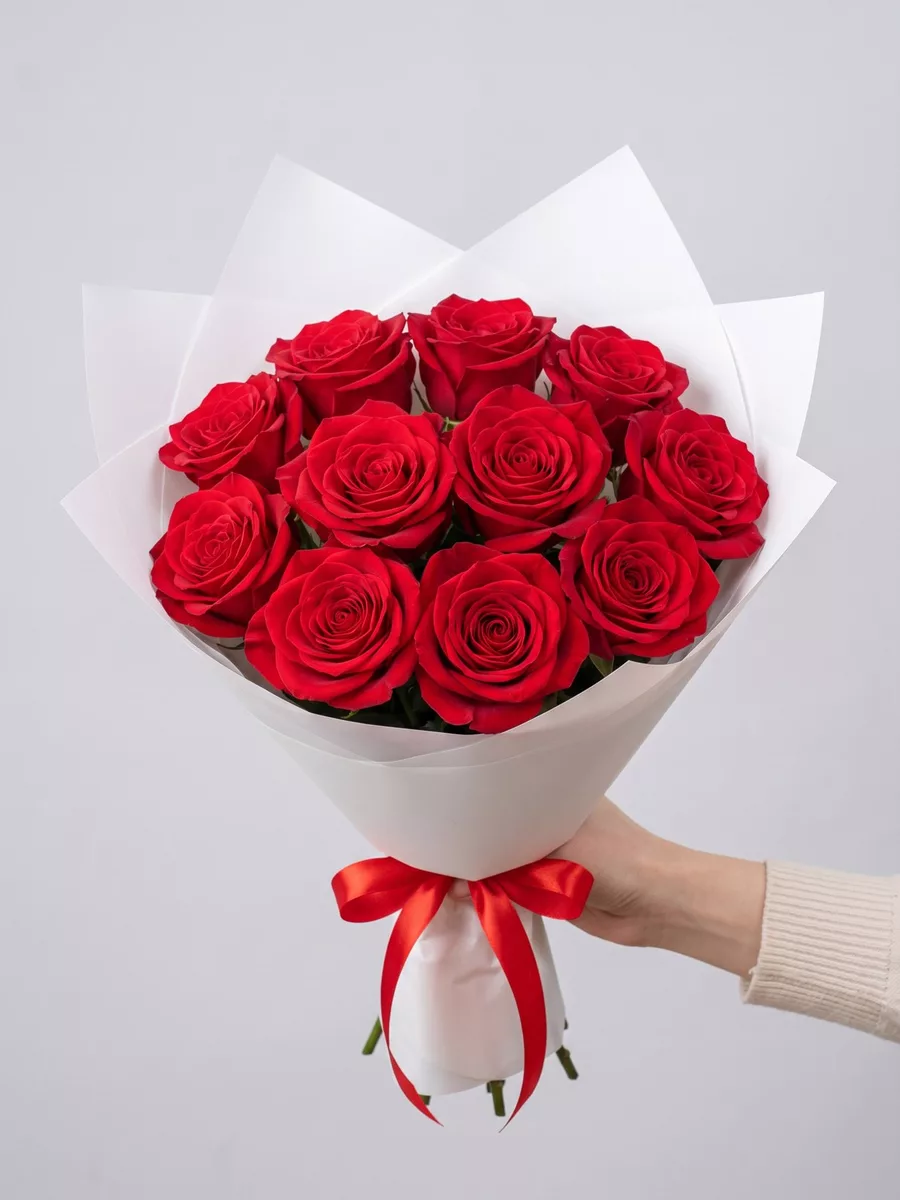
Freedom is the best-known red rose of Ecuador: a deep, classic red with a large head and a firm, upright stem. When customers ask for "red roses from Ecuador", this is very often the variety they have seen. Explorer is another dark red, with a slightly more velvety tone and a wider open bloom.
Among light varieties, Playa Blanca and Mondial are widely used for weddings and elegant bouquets; Mondial is a large cream-white rose with a hint of green in the outer petals. Vendela is an ivory rose with a soft, rounded head. Pink Floyd is a vivid hot pink, and Country Blues or Deep Purple are chosen when someone wants a lilac or mauve bouquet.
Variety names matter less to the recipient than colour and size, but they help when you want to repeat a bouquet that was a success. If you have a particular rose in mind, describe the colour, the head size and the stem length you want; our article on roses in Russia: varieties, lengths and colours explains how these are usually described.
Bouquets we can deliver



How to recognise a premium rose
Look at the head first. A good long-stem rose has a tall, tight bud that feels firm when you press it gently at the base. Soft or spongy heads mean the flower is older or has lost water. The petals should be clean, without dark edges or brown spots, and the colour even all the way to the tips.
Next, check the stem and leaves. The stem should be straight, thick and green, not wrinkled or darkened near the cut. Leaves should be firm and glossy. A few outer petals that look slightly damaged or uneven are normal: these are guard petals that protect the bud during transport, and florists often leave one or two in place until the rose is in the vase.
Finally, consider the proportions. A very long stem with a small head looks unbalanced, while a big head on a short stem can droop. Classic Ecuadorian roses are prized precisely because the head and stem are in proportion, which is why they look so striking in large mono-bouquets of 25, 51 or 101 stems.
Caring for long-stem roses at home
Unwrap the bouquet as soon as it arrives and put it in water within an hour. Use a tall, heavy vase that supports at least half the stem length, filled with cool water. Remove all leaves that would sit below the waterline, then cut 2-3 cm from each stem at a 45-degree angle with a sharp knife or secateurs. With thick rose stems, a clean cut matters more than anything else.
Change the water every one or two days and re-cut the stems every two to three days. Keep the vase away from radiators, direct sun and fruit; in a warm city apartment in winter, a cooler room or windowsill away from the heating can add several days of life. Remove guard petals once the rose starts opening.
Large-headed roses open slowly over two to four days, so a bouquet that looks tight on arrival will change and fill out. With regular care, long-stem roses often stay attractive for a week or more. If a head droops on the first day, it has usually taken in air: lay the whole rose in cool water for an hour, re-cut under water and return it to the vase.
Choosing roses as a gift for someone in Russia
For a romantic occasion, red remains the classic choice, but many customers now order cream, pale pink or a mix of soft tones for a mother, a grandmother or a colleague. Remember the Russian custom: for gifts, choose an odd number of flowers if the bouquet has fewer than about fifteen stems. Large counts such as 25, 51 or 101 are acceptable as they are.
Height plays a role in how a bouquet feels when it is handed over. Roses of 50-60 cm are comfortable to carry and fit an ordinary vase. Stems of 80 cm and more look spectacular but need a tall, heavy vase, which is worth keeping in mind when the recipient is an older relative in a small apartment. Ask yourself where the bouquet will stand before choosing the length.
Browse the catalogue for rose bouquets and mono-bouquets. If you are looking for a specific colour, size or stem length, or are unsure what will suit the occasion, call 8 (812) 507-67-05 and the florist will help you choose.
How delivery works
Pyat Tsvetov has been working since 2011 and has three of its own flower shops in Saint Petersburg: on Ilyushina Street, on the Obvodny Canal Embankment and on Srednerogatskaya Street. We deliver flowers across Russia. City delivery costs 500 RUB; for remote districts and suburbs, the operator confirms the price when confirming the order. In Saint Petersburg delivery works around the clock.
In large cities you can choose express delivery 1-2 hours after the order is confirmed, an exact time (plus or minus 30 minutes), a window of 09-12, 12-15, 15-18 or 18-21, or a pre-order 1-30 days ahead. The courier calls the recipient about 15 minutes before arriving. If the recipient is not at home, we agree a second delivery the same day or hand the bouquet to a neighbour or concierge with your consent. Full details are on the delivery and payment page.
Delivery is anonymous by default, and a card with your text is free. Payment is online by bank card, SBP or Yandex Pay, and foreign bank cards are accepted through Robokassa, which is convenient when ordering from abroad.
Frequently asked questions
Why are Ecuadorian roses so big?
They grow at high altitude near the equator, with strong sunlight, a steady twelve-hour day and cool nights. Slow growth in these conditions gives thick stems, large buds and deep colour.
How long do Ecuadorian roses last in a vase?
With fresh water, regular re-cutting and a cool spot, long-stem roses often stay attractive for a week or more. Large heads open gradually over the first few days.
What is the most popular red rose from Ecuador?
Freedom is the best-known red variety, with a large classic-red head and a straight stem. Explorer is another popular dark red.
Why do some outer petals look damaged?
These are guard petals that protect the bud during transport. They are normal and can be removed once the rose is in water and starts to open.
Can I pay for flowers in Russia with a foreign card?
Yes. Foreign bank cards are accepted through Robokassa, and you can also pay by Russian bank card, SBP or Yandex Pay.
Ready to send a bouquet?
Pick a city, choose the flowers, and we will hand them over with a photo confirmation.
Choose a city →