
Flowers for an Award Ceremony: Podium, Winners and Table Centrepieces
Every week someone calls us the morning of their company awards night asking whether we can pull together twenty winner bouquets, a podium arrangement and eight table centrepieces by six in the evening. Sometimes we can, sometimes we cannot, and the difference almost always comes down to one thing: how early the order was placed and how clearly the brief was written. This article covers what actually goes into flowers for internal corporate recognition events in Russia — the formats that work on a stage, the varieties that survive a four-hour ceremony without a bucket of water, and the numbers you need to give your florist before they can say yes.
What Russian Corporate Award Nights Actually Look Like
Internal corporate awards in Russia — often called «корпоратив с церемонией» or simply a recognition evening — follow a fairly consistent format: a seated dinner or standing cocktail reception, a stage or podium area where managers present awards, and round or rectangular tables for twenty to two hundred guests. Flowers appear in three distinct places: on or beside the podium, in the hands of winners as they receive their awards, and at the centre of each guest table. Each location has different requirements for stem length, arrangement height, water access and how long the flowers need to hold their shape without any care at all. The podium arrangement is seen from ten to thirty metres away under stage lighting, which is usually warm and drying. Winner bouquets are held for photographs, handed back and forth, and sometimes left on a table for two hours before the winner goes home. Table centrepieces sit under ambient restaurant lighting at eye level and need to stay presentable from six in the evening until midnight or later. Understanding these three contexts before you order prevents the most common mistake: choosing the same flower and the same format for all three situations, which never works well for any of them.
Bouquets we can deliver



Podium Arrangements: Size, Structure and Varieties That Read from a Distance
A podium arrangement needs to be visible from the back row, which means it should be either very tall — above the speaker's waist — or very wide, flanking the lectern on both sides as matching floor pieces. Tall arrangements are typically built on a stand or a heavy vase and use structural flowers with strong stems: gladioli, lisianthus, large-headed chrysanthemums, and branches of eucalyptus or ruscus for volume. Roses work well here only in bunches of fifteen or more per arrangement; a single dozen roses on a podium looks sparse under stage lighting. Hydrangea is popular for podium work because one stem fills a lot of visual space and the flower holds without water for four to five hours in a cool room, though it wilts noticeably if the venue is above twenty-two degrees Celsius. Peonies are requested constantly for this spot but present a timing problem: they open fast under warm lights and may look overblown within two hours. If the client insists on peonies, we advise ordering them one day closed — tight bud stage — and delivering them the morning of the event so they are just beginning to open by showtime. White, cream, gold and corporate colours are the usual palette for Russian award ceremonies; avoid very dark burgundy or purple at a podium because those tones disappear under warm stage lights. Two flanking floor arrangements of sixty to eighty centimetres in height are the most practical format for most venues.
Winner Bouquets: What Holds Up During a Ceremony
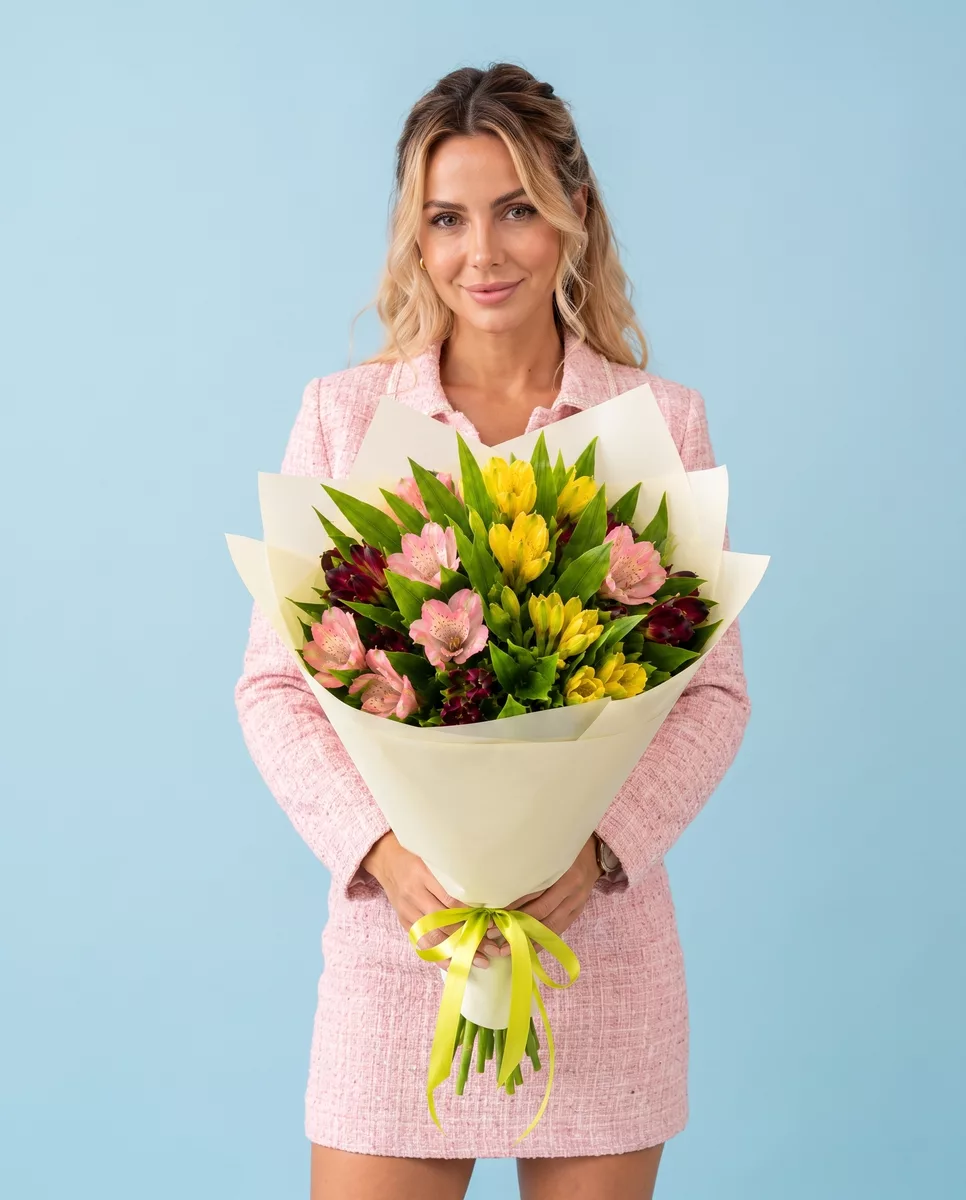
Winner bouquets are carried, photographed, set down on tables, picked up again and eventually taken home in a car or taxi. They need to survive three to five hours without water and without refrigeration. The varieties that consistently do this well are spray roses, alstroemeria, lisianthus, waxflower and statice — all of them low-maintenance, slow to wilt and resistant to handling. Standard large-headed roses are fine if the stems are properly conditioned, meaning they have been in water for at least twelve hours before assembly, but they will begin to droop at the neck after three hours in a warm room if the stems were cut the same morning. Avoid tulips entirely for winner bouquets at indoor ceremonies: they continue to grow after cutting, they bend toward light, and they collapse quickly without water. The size of a winner bouquet matters socially in a Russian context. A very small bouquet — under seven stems — reads as an afterthought and can feel dismissive to the recipient, especially for a senior award. A round bouquet of eleven to fifteen stems, wrapped in kraft or solid matte paper with a ribbon in the company's brand colour, is the standard that works across most corporate cultures in Russia. If there are multiple award categories, some clients order different bouquet sizes for different levels of award, which is a practical way to signal hierarchy without changing the flower variety.
Table Centrepieces: Height, Footprint and Longevity
Table centrepieces for award dinners fall into two formats: low and wide, sitting below the sightline so guests can see each other across the table, or tall and narrow on a thin stem or column so the arrangement clears the sightline entirely. Low arrangements are typically thirty to forty centimetres tall and work well with garden roses, ranunculus, lisianthus and seasonal greenery. Tall arrangements use the same flowers but are elevated on a glass cylinder or metal stand to sixty to ninety centimetres, leaving clear space between the table surface and the base of the arrangement. Both formats are used at Russian corporate events; the choice usually depends on the table shape and the formality of the event. Round tables almost always get low centrepieces because conversation happens across the full circle. Long rectangular tables often use a series of low vases or a single tall central piece. The practical concern for table flowers is longevity: the arrangement goes in at four or five in the afternoon and needs to look fresh at eleven at night. Flowers in water in a cool venue — under twenty degrees — will hold well. Chrysanthemums, alstroemeria and lisianthus are the most reliable for long evenings. Ranunculus is beautiful but sensitive to heat; if the venue runs warm, it will open fully and begin to drop petals by the end of dinner. Ask your florist to condition all table flowers in water for at least twenty-four hours before the event and to deliver them already arranged in their vases, not as loose stems.
Colour and Corporate Identity: Working with Brand Guidelines
Many Russian companies have a brand colour guide and want the flowers to match it. This is a reasonable request but comes with real constraints that are worth understanding before you brief your florist. Flower colour is not like print or paint: there is no Pantone match, and dye lots vary between growers and between seasons. Red roses range from bright scarlet to deep burgundy depending on the variety and the week of delivery. If your brand red is a specific warm tomato red, the closest rose variety will be Red Naomi or Explorer, but neither is guaranteed to arrive in the exact shade you see on a screen. Blue flowers are almost entirely unavailable as natural cut flowers; delphinium and muscari offer blue-adjacent tones but not a true corporate blue. For blue brands, florists typically use white flowers with blue ribbon, blue packaging paper or blue vases rather than blue flowers. White and green palettes are the easiest to execute precisely and look authoritative on a stage. Gold tones — amber spray roses, golden chrysanthemums, yellow ranunculus — photograph well and are frequently used for achievement-themed events. If your company uses two brand colours, choose one as the dominant flower colour and the second as the foliage, ribbon or wrapping colour. Send your florist a reference photograph of your brand palette at least a week before the event, not on the day of delivery.
Timing, Delivery and Temperature: The Logistics That Decide Everything
Flowers for a corporate ceremony need to arrive at the venue at least ninety minutes before guests do, and ideally two to three hours before, so that the florist or venue staff can arrange the centrepieces, position the podium pieces and check that everything looks right in the actual lighting of the room. A delivery that arrives thirty minutes before doors open does not leave enough time to fix problems. In Saint Petersburg and across Russia, we deliver within one to two hours of order confirmation for standard bouquets, but large ceremony orders — ten or more centrepieces plus podium arrangements — require a confirmed booking at least three to five days in advance to allow time for sourcing, conditioning and assembly. Temperature during transport and at the venue is the most frequently underestimated factor. Flowers deteriorate faster above twenty-two degrees Celsius. Many Russian event venues in winter are overheated; many in summer have air conditioning that is either too cold or too warm. Ask the venue coordinator for the expected room temperature and share that information with your florist. If the room will be above twenty-two degrees for more than four hours, avoid ranunculus, tulips and open peonies entirely and lean on chrysanthemums, alstroemeria and lisianthus. Refrigerated transport matters most for the winner bouquets, which will be handled and displayed without water. Flowers that have been in a warm delivery van for an hour before a five-hour ceremony are already at a disadvantage before the first award is presented.
What to Check Before You Confirm a Ceremony Flower Order
Before you sign off on a ceremony flower order, go through this checklist with your florist. First, confirm the exact number of winner bouquets and whether any categories get a different size or format. Second, confirm the number of tables and the table shape so the centrepiece format is correct. Third, confirm the delivery address, the name of the venue contact who will accept the delivery, and the access time — many event venues in Russia do not allow vendor deliveries during the main entrance hours of a building. Fourth, confirm whether the florist is providing vases for the centrepieces or whether the venue supplies them; this is a common miscommunication that leaves centrepieces without containers on the day. Fifth, confirm the colour palette in writing with a reference image, not just a verbal description. Sixth, ask explicitly what happens if a specific flower is unavailable on the delivery date due to supply issues — what is the agreed substitution? Seventh, confirm the conditioning period: flowers should be in water for at least twenty-four hours before a long event. Eighth, if the event runs past midnight, check whether any flowers need to be transported home by winners and whether the bouquets are wrapped in a way that makes them easy to carry in a coat check or a taxi. A written brief with all eight points answered is the single most reliable way to get ceremony flowers that look right from the podium photograph to the last table at the end of the night.
Ceremony flowers are a logistics problem as much as an aesthetic one. The varieties that look beautiful in a florist's cooler are not always the varieties that hold up under stage lights for five hours, and the bouquet size that feels generous in a shop can look small on a stage in front of two hundred colleagues. Getting it right means placing the order early, giving your florist the room temperature, the table count, the delivery window and the brand colours in writing, and choosing varieties — lisianthus, alstroemeria, chrysanthemum, spray roses — that are honest about what they can do rather than varieties that require perfect conditions to behave. Five Flowers delivers ceremony orders across Russia with the same day turnaround that works for a birthday bouquet, but the ceremony orders that go smoothly are always the ones where the brief arrived three days before, not three hours before. We deliver bouquets across Russia in 1–2 hours.
Frequently asked questions
How far in advance should I order flowers for a corporate award ceremony?
For a single winner bouquet we can deliver same day, but a full ceremony order — podium arrangements, multiple winner bouquets and table centrepieces — needs at least three to five days notice. This allows time to source the right quantities, condition the flowers in water, and assemble everything before the delivery window. Last-minute ceremony orders risk substitutions you did not plan for.
Can flowers be made to match our company brand colours exactly?
Close matches are possible for most warm and neutral brand palettes. True blue, bright orange and very specific reds are the hardest to match precisely because natural flower colour varies by variety and season. Send a reference image of your brand palette when you order, and discuss substitutions for any colour that cannot be sourced reliably. Ribbon and packaging colour can reinforce brand identity where flower colour cannot.
Which flowers last longest at an indoor ceremony without water?
Alstroemeria, spray roses, lisianthus, waxflower and statice are the most reliable for events where flowers will be out of water for three to five hours. Standard large-headed roses hold well if properly conditioned but begin to droop at the neck after three hours in a warm room. Avoid tulips and open peonies entirely for winner bouquets at long indoor events.
What is a reasonable number of stems for a winner bouquet at a Russian corporate event?
Eleven to fifteen stems in a round hand-tied bouquet is the standard that reads as generous and appropriate across most Russian corporate contexts. Fewer than seven stems can feel token, especially for a senior award. If you have multiple award tiers, ordering different sizes for different categories is a practical and socially legible way to reflect the hierarchy without changing the flower choice.
Do we need to provide vases for table centrepieces, or does the florist supply them?
This needs to be agreed in writing before the order is confirmed. Some florists include vases in the centrepiece price; others expect the venue to supply them. If the venue is not providing vases and the florist is not including them, centrepieces arrive as loose arrangements with nowhere to go. Clarify this point explicitly when you confirm the order, and specify the vase style if it matters for your event aesthetic.
Ready to send a bouquet?
Pick a city, choose the flowers, and we will hand them over with a photo confirmation.
Choose a city →