
Ordering Flowers for a Russian Business Conference: Stage, Welcome Bouquets and Speaker Gifts
Every week someone calls us the morning of their event because the flowers they ordered from a generic supplier arrived wilted, the wrong colour, or simply never showed up. Organising flowers for a professional conference in Russia is not complicated, but it has specific rules around quantity, variety, timing and presentation that differ from a wedding or a birthday order. This article covers the three main flower moments at a Russian business event — stage decoration, welcome bouquets for VIP guests, and speaker gifts — and tells you exactly what to order, when to place the request, and what to double-check before you confirm.
Why Conference Flowers Follow Different Rules Than Event Flowers Generally
A conference is a working environment, not a celebration, and Russian business culture reflects that clearly. Flowers at a professional event signal respect and status rather than festivity, so the choices that work at a birthday — large mixed bouquets in bright mixed colours, balloon-style arrangements — look out of place on a conference stage. Clients who organise their first Russian corporate event often ask for sunflowers or bright gerberas because they look cheerful; what they actually need are structured, tall arrangements in white, cream, or a single brand colour that read well from twenty metres away and do not distract from the speaker. The second misunderstanding is scale. A stage arrangement for a hall of two hundred people needs to be substantial — typically sixty centimetres or taller at the focal point — or it simply disappears visually. A small vase of roses that would look generous on a dining table looks like an afterthought next to a podium. The third issue is longevity. Conference days run eight to twelve hours, often in rooms with aggressive air conditioning or, in older venues, with inconsistent temperature. Varieties that hold well under those conditions — lisianthus, chrysanthemum, alstroemeria, spray roses — are not the most glamorous names on a menu, but they are what actually survives the full programme without drooping by the afternoon panel.
Bouquets we can deliver



Stage Decoration: What Actually Works in a Russian Conference Hall
The standard stage setup for a Russian business conference involves two floor arrangements flanking the podium, sometimes a low horizontal arrangement along the front edge of the stage, and occasionally greenery panels or arch elements for events with a strong visual identity. For the flanking arrangements, tall stems are essential — delphinium, gladiolus, and eremurus all give vertical height without needing complex construction. White or ivory is the safest base for any stage because it photographs cleanly and does not clash with projected slides or branded backdrops. If the organiser has brand colours, a florist can layer in one accent colour using lisianthus, ranunculus, or spray roses. Greenery choices matter more than most clients expect. Eucalyptus is popular and travels well, but ruscus and pittosporum hold their shape longer under conference lighting, which generates more heat than it appears to. The horizontal front-of-stage piece, if requested, should be low enough that it does not block the audience's sightline to the speakers' feet — a mistake we see at roughly one in three events where clients design this themselves without checking the stage height. Delivery timing for stage decoration should target two to three hours before the first session. This gives the florist time to arrange on-site, gives the venue time to finish its own setup around the flowers, and still keeps the arrangements fresh for an evening networking reception if the programme runs that long. Always confirm with the venue that there is a service entrance the florist can use, because carrying tall arrangements through a hotel lobby during check-in is a genuine logistical problem.
Welcome Bouquets for VIP Guests: Russian Protocol You Need to Know
In Russian business culture, presenting a bouquet to a distinguished guest — a keynote speaker arriving from abroad, a government official, a company founder — is a standard gesture of welcome, not an unusual flourish. The bouquet is typically presented at the entrance or in a dedicated reception area, usually by a hostess or a senior representative of the organising company. For foreign organisers this can feel unfamiliar, but skipping it when Russian counterparts expect it reads as a slight. The key rules for welcome bouquets are straightforward. First, keep the count of flowers odd — three, five, seven, nine stems or clusters — because even numbers are associated with mourning in Russian tradition and will be noticed immediately by Russian guests. This applies whether you are ordering a single stem presentation or a full bouquet. Second, avoid all-yellow arrangements for formal presentations; yellow flowers carry an association with separation or ill intent in popular Russian belief, and while younger urban Russians are less superstitious about this, the risk of causing offence is real enough that it is not worth taking. White, red, pink, and mixed arrangements with green accents are all appropriate. Third, size the bouquet to the occasion. A welcome bouquet for a keynote speaker should be substantial — twenty-five to thirty-five stems of roses or peonies in season — rather than a token handful. Roses are the default choice and the safest: they are universally understood as a mark of respect, they hold well at room temperature for several hours, and they photograph well for press coverage.
Speaker Gifts: Choosing Flowers That Survive the Rest of the Day
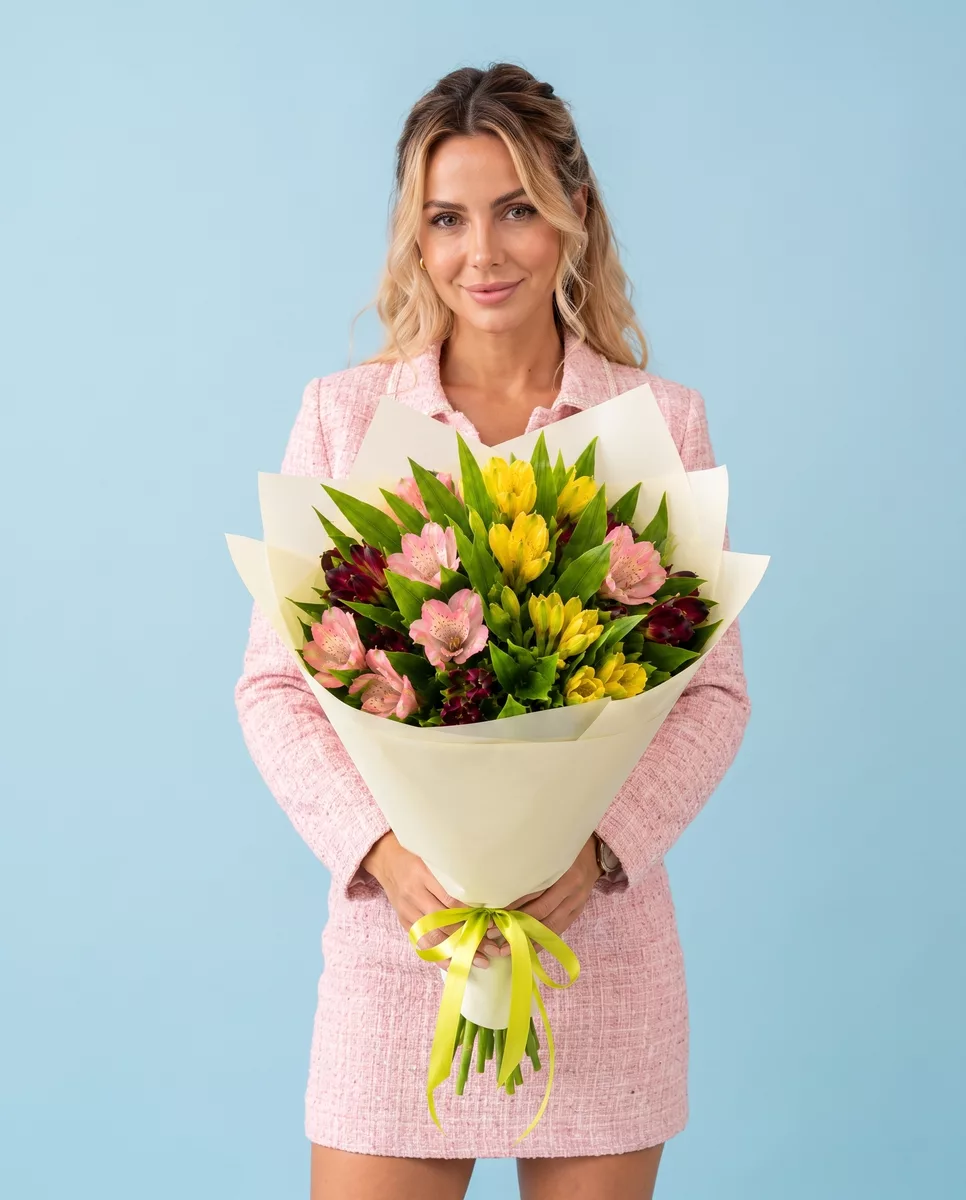
Speaker gifts are presented on stage, usually immediately after a session ends, and then the speaker carries them for the rest of the conference — through networking breaks, lunch, corridor conversations, and sometimes directly into a taxi to the airport. This means the bouquet needs to be compact, self-contained, and robust. A large loose arrangement that requires two hands and a vase is not a speaker gift; it is an inconvenience. The practical format is a hand-tied bouquet wrapped tightly in paper or fabric, with a water-retaining base — either a small water capsule or a damp cotton wrapping inside the stem end — so the flowers survive three to five hours without any care. Roses, alstroemeria, and lisianthus are the standard choices for exactly this reason. Peonies work beautifully in season (late May through July in Russia) but open quickly in warm rooms, so they are a risk for morning presentations where the speaker will carry them all day. Chrysanthemums are extremely durable but carry a strong association with cemetery visits in Russian culture, so they should not appear in speaker gifts or welcome bouquets at all — this is one of the most common mistakes made by organisers sourcing flowers without local knowledge. The size of a speaker gift bouquet is typically smaller than a welcome bouquet: fifteen to twenty-one stems is appropriate and manageable. If the conference has multiple speakers across two days, order all speaker gifts in a consistent style — same palette, same wrapping — so that no individual speaker receives something visibly more or less impressive than another.
Colours, Branding and What to Avoid at a Professional Event
Many conferences now arrive with a visual identity — a specific palette from the organiser's brand guidelines — and the expectation that flowers will match. This is entirely achievable, but it requires the order to be placed with enough lead time for the florist to source correctly. White and cream are always available. Blush pink, burgundy, and deep red are reliably available year-round in Saint Petersburg and most major Russian cities. Bright orange, lavender, or a very specific corporate blue are harder: blue flowers do not exist naturally, so blue-themed arrangements rely on hydrangeas in the right seasonal shade, delphinium, or scabiosa, none of which can be guaranteed to hit a Pantone reference exactly. When a client sends a brand colour and asks for an exact match, the honest answer is that floristry works in ranges, not hex codes. The practical approach is to identify the closest natural flower colour, confirm it with a sample image, and build the arrangement around that. Greenery is often underestimated as a branding tool. Dark green ruscus or eucalyptus gives arrangements a corporate, structured feel. Lighter, airier greenery like fern or asparagus fern softens the look toward something more social. For a financial services conference, the former; for a creative industry event, the latter. One colour to handle carefully at any Russian professional event is red on its own. A single-colour red bouquet reads as romantic in Russian cultural shorthand, not professional. Red works well as part of a mixed arrangement but should not be the only colour in a speaker gift or welcome bouquet.
Timing, Temperature and How Far Ahead to Place the Order
The single most common reason conference flowers disappoint is late ordering. For an event of one hundred guests or more, the flower order should be confirmed at least five days in advance — seven to ten days for events requiring specific colours, unusual varieties, or large quantities of a single stem type. This is not about the florist's convenience; it is about the wholesale supply chain. Flowers come into Saint Petersburg from the Netherlands, Ecuador, Kenya and domestic growers on specific days, and a variety that is not in stock on Wednesday cannot reliably be sourced by Friday morning. Temperature is the other operational factor that organisers rarely think about. Flowers are stored and transported at four to eight degrees Celsius and need to be kept away from direct sunlight, heating vents, and open windows once they arrive at the venue. A conference room that is being set up with doors open in February will be fine; the same room in July with afternoon sun through south-facing windows can reduce the lifespan of roses by half. When you brief the florist, mention the venue's orientation and whether the main hall has air conditioning or relies on natural ventilation in summer. For multi-day conferences, arrangements prepared on day one will need refreshing or replacing for day two. This is not a failure of quality; it is simply the biology of cut flowers. Build this into the budget and the delivery schedule from the start, and brief the venue coordinator so they know a second delivery is planned and do not treat it as a surprise.
What to Check When Placing Your Conference Flower Order
Before you confirm the order, run through five practical checks. First, confirm the exact delivery address including the service entrance, the name of the venue contact who will receive the flowers, and their mobile number. Conference venues are large buildings with multiple entrances, and a delivery driver who cannot reach anyone on the day will not wait. Second, confirm the setup time — when the florist can enter the hall to arrange — separately from the delivery time. These are not the same thing, and the difference matters when the venue has a hard changeover schedule. Third, specify the disposal plan. Who removes the arrangements at the end of the event? If the venue expects the florist to collect, that is an additional trip that needs to be costed and scheduled. If the organiser wants to distribute bouquets to guests at the end, that changes how the arrangements are constructed. Fourth, check the stem count on every bouquet against the odd-number rule for any bouquet being presented to an individual Russian guest. This takes thirty seconds and prevents an embarrassing moment on stage. Fifth, confirm payment and invoicing details in advance if the event is being organised through a corporate entity — many Russian companies require a formal invoice and cannot pay by card on delivery. Getting the paperwork agreed before the event means the florist arrives focused on the flowers rather than chasing an accounts department. These five checks take ten minutes and resolve the majority of problems we see on conference days.
Ordering flowers for a Russian business conference is a practical exercise in planning ahead, choosing the right varieties for the conditions, and understanding a small number of cultural conventions — odd stem counts, no chrysanthemums in gifts, caution with single-colour red or all-yellow arrangements — that are easy to follow once you know them. The rest is logistics: delivery timing, venue access, temperature management, and a clear brief that specifies which flowers go where and who receives them. Get those details confirmed a week before the event and the flowers will do their job without becoming a problem. We deliver bouquets across Russia in 1–2 hours.
Frequently asked questions
How far in advance should I order flowers for a large conference in Russia?
Place the order at least five days before the event, and seven to ten days if you need specific colours or large quantities of one variety. Flowers arrive from wholesale suppliers on fixed schedules, so varieties not in stock midweek cannot be reliably sourced by the weekend. Late orders often result in substitutions you did not plan for.
Why can't I use chrysanthemums in speaker gifts or welcome bouquets?
Chrysanthemums are strongly associated with cemetery visits and mourning in Russian culture. Presenting them as a gift at a professional event will be noticed and interpreted negatively by Russian guests and colleagues, regardless of how the flowers are arranged. Use roses, lisianthus, alstroemeria, or spray roses instead — all hold well and carry no negative associations.
Does the odd-number rule for bouquets really matter at a corporate event?
Yes, it matters to Russian guests and colleagues, and it is easy to follow. Even numbers of flowers are associated with mourning in Russian tradition. Count the stems or clusters in any bouquet being presented to an individual person and make sure the total is odd — five, seven, nine, eleven. Mixed arrangements for tables or stages are not subject to this rule.
What flowers survive a full conference day in an air-conditioned hall?
Lisianthus, alstroemeria, spray roses, and ruscus greenery are the most reliable choices for long days in climate-controlled rooms. Standard roses and peonies are fine for morning presentations but may need water by afternoon. Avoid flowers with large open petals and thin stems if the room temperature fluctuates or if speakers will carry bouquets for several hours.
Can flowers be matched to our company's brand colours?
Floristry works in colour ranges rather than exact colour codes. White, cream, blush, burgundy, and deep red are available year-round. Lavender, orange, and specific shades of blue are possible but cannot be guaranteed to match a Pantone reference precisely. Share your brand palette early and a florist can confirm the closest available match with a sample image before you commit.
Ready to send a bouquet?
Pick a city, choose the flowers, and we will hand them over with a photo confirmation.
Choose a city →