
Flower Delivery to Several Offices at Once: One Order, Many Addresses
Corporate clients ask us the same thing every March and November: can you send roses to the director in Nevsky district, spray chrysanthemums to the accounting team on Vasilyevsky Island, and a mono-bouquet of tulips to the HR manager across town, all billed as one order and all arriving within the same two-hour window? The answer is yes, and the mechanics are simpler than most clients expect once you understand how address routing, bouquet assembly and timing actually work.
Why Companies Order Flowers for Several Offices at Once
The two peak moments for multi-address corporate flower orders in Russia are 8 March, International Women's Day, and 23 February, Defender of the Fatherland Day. On both dates it is standard practice for a company to gift every employee, and a business with offices spread across a city cannot rely on one person running bouquets around by hand. November 4th, New Year's corporate events and company anniversaries create the same logistical need. Clients who come to us have usually tried solving this problem by placing separate orders under separate names, which creates chaos: different delivery windows, mismatched ribbon colours, invoices that the accounting department cannot reconcile into one payment. The correct approach is a single order with a structured address list, one consolidated invoice and one point of contact managing all confirmations. We see orders ranging from three addresses to forty-plus locations within a city. The bouquets do not have to be identical across all stops. A director might receive a hand-tied arrangement of garden roses and eucalyptus while department teams receive wrapped bunches of alstroemeria or standard spray roses. What matters is that every bouquet is specified at the order stage so assembly can be batched and couriers dispatched on a coordinated schedule. The earlier the order is placed before the target date, the more flexibility exists for variety selection and routing.
Bouquets we can deliver



How to Structure Your Address List Before You Call or Write
Before contacting the shop, prepare a spreadsheet or even a plain text list with four columns: recipient name, full street address including floor and office number, phone number, and the specific bouquet or budget assigned to that stop. Russian office buildings frequently have multiple entrances marked by letters — entrance A, entrance B — and couriers who arrive at the wrong entrance lose ten to fifteen minutes, which cascades across every subsequent stop. The office number and floor are not optional details. Security desks in large business centres will not call up a courier without a specific recipient name and office number, and many buildings in Saint Petersburg and Moscow require the courier to be registered at the front desk before entering. If a recipient is not at their desk, the bouquet cannot simply be left in a corridor due to building rules, so a mobile number is essential for same-day coordination. Confirm with your internal contact whether recipients know a delivery is coming. Surprise deliveries to offices work well when the recipient is definitely present, but on busy dates like 8 March the office may be operating a reduced staff schedule. Noting expected working hours for each address — for example, the warehouse office closes at 16:00 while the central office runs until 19:00 — lets the shop schedule courier routes so no stop is attempted at a closed door. A clean list submitted at order placement reduces back-and-forth by half.
Choosing Different Bouquets for Different Recipients in One Batch
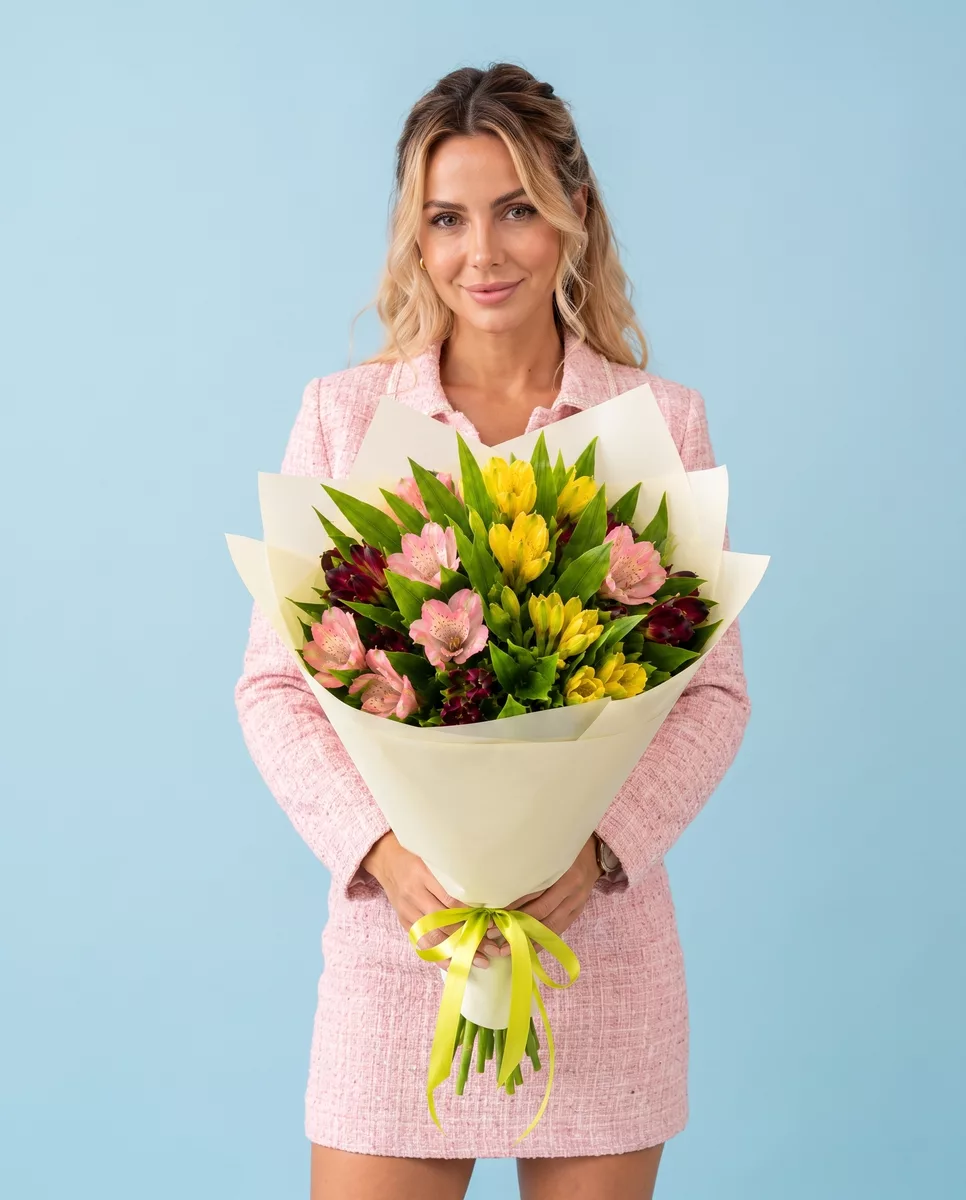
Multi-address orders do not require a single uniform bouquet, but mixing too many varieties across a large order increases assembly time and the risk of substitution if a specific flower is short on the day. A practical approach used by experienced corporate clients is to define two or three tiers. A senior tier might feature large-headed garden roses such as David Austin varieties, ranunculus in season, or premium peonies when available May through June. A standard tier might use spray roses, alstroemeria, or lisianthus, which are available year-round and hold well during transit across multiple stops. A third tier for large team deliveries might be a wrapped single-variety bunch of tulips or standard chrysanthemums, which are cost-efficient and visually clean. Seasonal availability matters more than most clients realise. Tulips are at their best and most affordable January through April. Peonies have a short window. Hydrangeas are available year-round but their price fluctuates. When placing an order for a future date, ask which varieties are confirmed in stock for that week rather than assuming the website photo reflects the exact current inventory. Ribbon and packaging can be standardised across all tiers so the visual identity of the delivery reads as one corporate gesture even when bouquet sizes differ. Specify whether you want the company name or a printed card included, and whether each card should carry a personalised message or a single standard text. Printing individual cards per recipient adds time to assembly but is frequently worth it for senior recipients.
Timing Windows and What Affects Them Across Multiple Stops
A single-address delivery within central Saint Petersburg typically completes within one to two hours of dispatch. A multi-address run is not simply that time multiplied by the number of stops. Courier routing is planned to cluster addresses geographically, so four offices in the Petrogradsky district can be completed in a shorter total window than two offices on opposite ends of the city. When placing a multi-address order, specify whether all deliveries must arrive simultaneously or whether a sequence is acceptable. Simultaneous arrival at ten locations requires multiple couriers dispatched at the same time, which needs to be arranged in advance and is not always possible with less than 24 hours notice. Sequential delivery — all stops completed within a four-hour window — is more common and logistically straightforward. Traffic in Saint Petersburg and Moscow is a real variable. Nevsky Prospekt and the Garden Ring in Moscow experience significant congestion from 08:00 to 10:00 and again from 17:00 to 20:00. Scheduling deliveries for 11:00 to 15:00 on a weekday gives the most reliable results. On 8 March the entire city is in elevated delivery demand; orders placed that morning for same-day multi-address runs are very difficult to fulfil. Orders placed by the evening of 7 March with confirmed addresses and bouquet specifications are manageable. For large corporate runs of ten or more addresses, placing the order two to three days ahead is the professional standard.
Temperature, Transit and Keeping Flowers Fresh Across a Long Run
Flowers in transit face a different environment from flowers sitting in a cold-room. A courier vehicle in summer in Saint Petersburg can reach interior temperatures that shorten vase life noticeably if the journey is long. For multi-stop runs this is a genuine concern because a bouquet assembled at 09:00 and delivered at 14:00 after five stops has been out of water for five hours. Standard practice is to wrap stems in wet cotton or use water-retaining packaging for longer runs, and the shop should be doing this without being asked. It is worth confirming this when placing a large order. The varieties most tolerant of transit stress are spray roses, chrysanthemums, alstroemeria, and lisianthus — all of which have firm petals and low water sensitivity over a four-to-six hour window. Garden roses and ranunculus are more sensitive; they are fine for shorter runs but on a ten-stop city-wide delivery in July, a hardier variety is a more reliable choice. Tulips in warm weather open quickly out of cold storage, so a tulip bouquet assembled at 09:00 may look noticeably more open by the time it reaches stop eight. If tulips are specified for a long summer run, ask the shop to keep them refrigerated until the latest possible assembly time. Recipients in Russian offices generally put flowers into a vase immediately upon receipt, which rehydrates the stems, but the first impression at handover matters for a corporate gift.
Payment, Invoicing and What Russian Accounting Departments Need
Russian companies working with suppliers require specific document formats for internal accounting. A private individual can pay by card and be done with it, but a legal entity typically needs a schyot — a proforma invoice — issued to the company's legal name and INN, the tax identification number. After delivery, a closing document called an akt is required to confirm the service was rendered, and this is what the accounting department uses to process the expense. When placing a multi-address corporate order, have the company's full legal name, INN, and KPP ready. KPP is a subsidiary code used by companies with multiple registered subdivisions. Without these details the shop cannot generate the correct documents, and the order may need to be placed as a personal payment, which creates problems for expense reporting. VAT treatment depends on the shop's tax regime, so ask at the order stage whether VAT is included in the quoted price or added on top. For budget planning purposes, get a written quote specifying the cost per bouquet, delivery charge per address, and any surcharge for same-day or peak-date service. On 8 March, surcharges are standard across the industry. A consolidated invoice covering all addresses and all bouquets in one line or itemised by address — whichever your accounting department prefers — should be requested at order placement, not after delivery. Requesting it retroactively causes delays.
What to Check Before Confirming a Large Multi-Address Order
Run through this list before you confirm any multi-address corporate flower order. First, verify that every address includes the building entrance letter, floor, office number and a working mobile number for the recipient. Second, confirm the delivery window for each address and flag any offices that close early or have restricted access hours. Third, check that the varieties specified are in confirmed stock for your target date, not just listed on the website. Fourth, if the order includes more than five addresses, confirm whether the shop can dispatch multiple couriers simultaneously or whether delivery will be sequential, and get a realistic total window for completion. Fifth, agree on packaging uniformity — same ribbon colour, same card format — so the delivery reads as one organised corporate action rather than a series of random bouquets. Sixth, confirm the document package: schyot before delivery, akt after, VAT status, and the legal entity details the documents will be issued to. Seventh, establish one named contact person at your company and one contact at the shop who will handle any real-time issues on the delivery day, such as a recipient not answering their phone or a building requiring advance registration. On high-volume dates like 8 March, problems at one stop can delay subsequent stops if there is no clear escalation path. A corporate order placed with all of this confirmed in writing runs smoothly in the vast majority of cases; the orders that go wrong are almost always missing one of these seven points.
Multi-address corporate flower delivery is a routine service when both sides prepare properly. The shop needs clean address data, confirmed bouquet specifications, legal entity details and enough lead time to batch assembly and route couriers efficiently. The client needs realistic expectations about timing windows, seasonal variety availability and the document flow that Russian accounting departments require. Placed two to three days ahead with a complete address list, a well-structured corporate order can put fresh flowers on desks across an entire city within a single working morning, with one invoice and zero logistical chaos. We deliver bouquets across Russia in 1–2 hours.
Frequently asked questions
Can each address in a corporate order receive a completely different bouquet?
Yes. You specify the bouquet or budget tier per address at order placement. In practice, defining two or three tiers rather than a unique arrangement for every stop makes assembly faster and reduces the risk of stock shortages on the day. Confirm variety availability for your target date when placing the order.
How far in advance do I need to place a multi-address order for 8 March?
For ten or more addresses, two to three days before 8 March is the professional standard. Orders placed on the morning of 8 March for same-day multi-stop delivery are very difficult to fulfil because courier capacity and flower stock are both under peak pressure. Evening of 7 March with a confirmed address list is the realistic minimum.
Will all offices receive their flowers at exactly the same time?
Simultaneous arrival at all locations requires multiple couriers dispatched at once and must be arranged in advance. Sequential delivery — all stops completed within a three-to-four-hour window — is more common. When you place the order, specify whether simultaneous or sequential delivery is required so routing can be planned accordingly.
What documents does the shop provide for a company paying as a legal entity?
A schyot, which is a proforma invoice issued to your company's legal name and INN, is provided before delivery. After delivery, a closing akt confirms the service was rendered. Have your INN and KPP ready at order placement. Ask at that stage whether VAT is included in the quoted price or added separately.
What happens if a recipient is not at their desk when the courier arrives?
The courier will call the mobile number provided for that recipient. This is why a working mobile number for each address is required, not optional. If the recipient cannot be reached and the building does not allow the bouquet to be left, the stop is flagged immediately so your company contact can coordinate a re-attempt or alternative handover.
Ready to send a bouquet?
Pick a city, choose the flowers, and we will hand them over with a photo confirmation.
Choose a city →