
Corporate Flower Orders for Russian National Holidays: Dates, Volumes and Pre-Booking
Every year the same three dates flatten our order queue like nothing else: 23 February, 8 March and the New Year window from 28 December through 1 January. Corporate clients — HR managers, office administrators, procurement officers — tend to call us four days before the holiday and discover that the roses they wanted are already spoken for, the delivery slots are gone and the only thing left is to apologise to sixty colleagues. This guide maps those peak dates precisely, tells you which varieties hold up under volume pressure, and explains the pre-booking mechanics that actually guarantee delivery across Russia.
Why Russian Holiday Dates Hit Flower Supply So Hard
Russia has two national holidays where flowers are a workplace expectation rather than a personal gesture. On 23 February, Defender of the Fatherland Day, companies give flowers and small gifts to male employees — a tradition that surprises many international managers who assume flower-giving is exclusively feminine. On 8 March, International Women's Day, every woman in the office receives flowers, which means a single company of 200 employees can generate 130 to 160 individual bouquets in one morning. New Year adds a third wave: decorative arrangements for reception desks, boardrooms and client gifts shipped across Russia before offices close. These three peaks are not spread across the calendar — 23 February and 8 March fall within thirteen days of each other in late winter, which is already the hardest season for flower logistics. Dutch auction prices for roses and tulips spike sharply in the two weeks before 8 March because Russian demand is large enough to move European wholesale markets. Growers in Ecuador and Kenya schedule cuts specifically for this window, but the lead time from farm to Saint Petersburg warehouse is eight to twelve days, which means stock arriving too late for 8 March cannot be redirected. Corporate clients who treat these dates as ordinary orders — booking a week out, specifying varieties loosely, paying on delivery — consistently end up with substitutions or delays. Understanding the supply chain pressure is the first step toward avoiding it.
Bouquets we can deliver



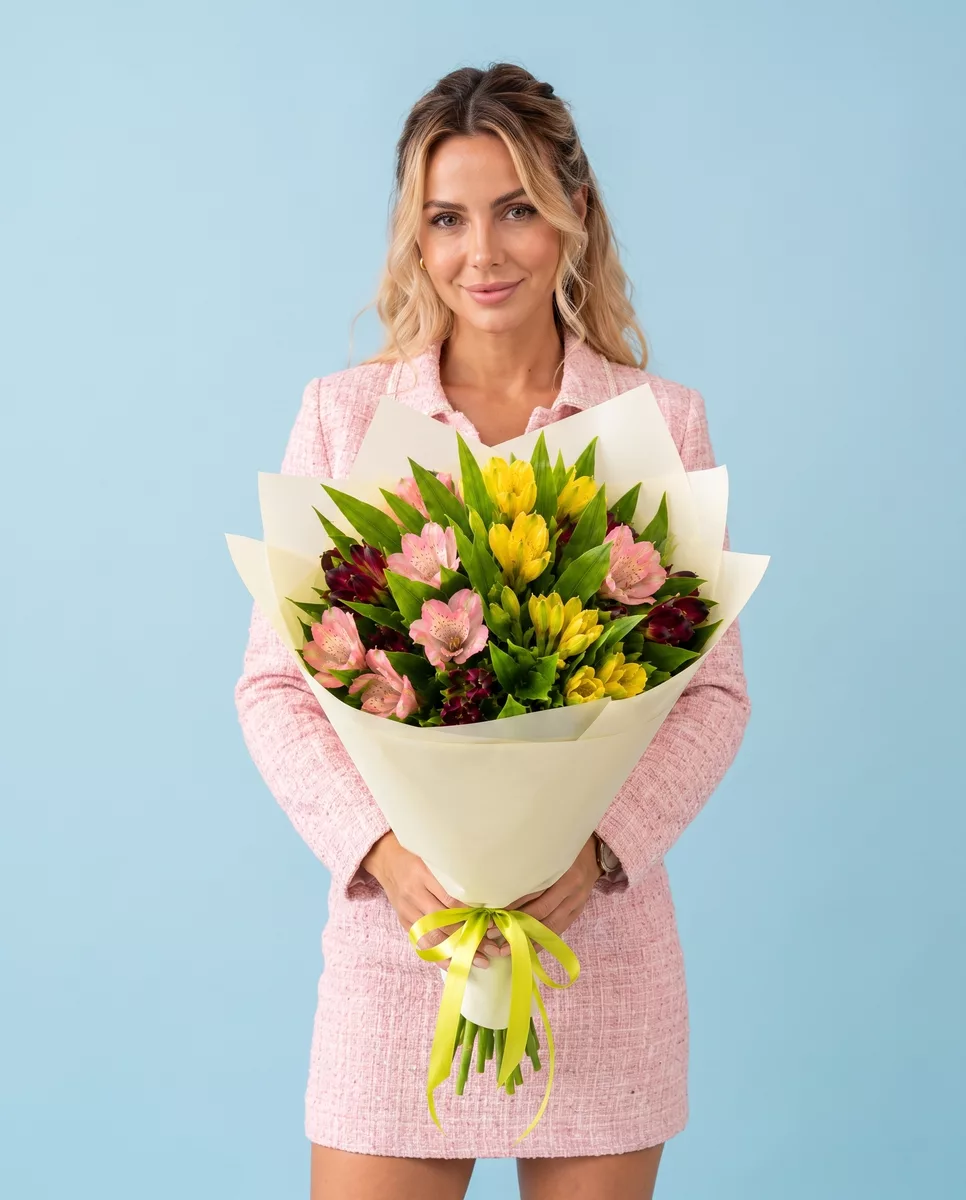
8 March: The Largest Single Corporate Flower Event in Russia
No other date in the Russian calendar moves as many flowers as 8 March. The holiday is a public day off, so deliveries must be completed on 7 March or, for companies that prefer a morning surprise, in the earliest slots on 8 March itself. The problem with 8 March morning delivery is that every other company has the same idea, which compresses hundreds of orders into a four-hour window. The varieties that perform best at volume are spray roses — particularly varieties like Majolica and Lydia — because they are compact, travel well in cool vans at two to six degrees Celsius and look substantial even in a modest five-stem arrangement. Standard large-head roses such as Explorer and Red Naomi are the sentimental choice but require careful cold-chain handling and lose petals faster if the office is warm. Tulips are popular for 8 March and arrive in good condition from Dutch growers throughout February, but they open quickly in heated offices — within six to eight hours at twenty-two degrees — so they suit morning delivery better than afternoon. For a corporate order of fifty or more bouquets, we recommend specifying a single variety and colour rather than mixing, because mixed bouquets require individual assembly time that multiplies across large quantities. Practical pre-booking rule: submit your full order — exact count, variety preference, delivery address list — by 20 February at the latest. Orders received after 25 February are accepted subject to availability, and variety substitution becomes likely after that point.
23 February: Smaller Volume, Different Varieties, Same Urgency
Defender of the Fatherland Day is constitutionally a holiday honouring military service, but in contemporary office culture it functions as a general men's day. Most companies give flowers to male colleagues alongside a token gift — a small plant, a potted succulent, or a single-stem arrangement. The scale is typically smaller than 8 March because not every company participates equally, but the orders that do come in tend to be concentrated in the same two-day delivery window: 22 February for offices that want pre-holiday delivery, or the morning of 23 February itself. Because men's arrangements are less codified by tradition, there is more room to work with interesting material: chrysanthemum varieties like Zembla and Bacardi hold extremely well at room temperature, alstroemeria lasts ten to fourteen days after cutting, and potted kalanchoe requires no water management at all. These are practical choices for recipients who may not have a vase at their desk. The complication in 2024 and 2025 is that 23 February falls close enough to 8 March that growers and wholesalers are already managing their pre-March inventory, and some premium rose varieties are intentionally held back for the larger holiday. If your company orders flowers for both dates, combining them into a single pre-booking placed in early February gives you better variety access and often allows consolidated delivery planning. Submit your 23 February order no later than 10 February to guarantee the varieties you want rather than whatever remains after larger retail demand is satisfied.
New Year Window: Decorative Orders and Long-Distance Delivery
The New Year corporate flower window runs from approximately 25 December through 30 December, when offices across Russia close for the extended public holiday that runs from 1 through 8 January. Corporate orders in this period are different in character from the spring holidays: instead of individual bouquets for each employee, companies typically order decorative arrangements for public spaces — reception counters, conference tables, director's offices — plus gift bouquets for key clients and partners delivered to addresses across Russia. This is where long-distance delivery planning becomes critical. Five Flowers delivers across Russia within one to two hours in Saint Petersburg and to other cities on a scheduled basis, but the New Year period compresses available delivery slots because courier capacity is reduced as staff take holiday leave. Flower varieties for New Year arrangements lean toward structural, long-lasting material: amaryllis, hypericum berry branches, white chrysanthemums and eucalyptus. Poinsettia plants are decoratively appropriate but must be kept above fifteen degrees Celsius during transport — a genuine challenge when outdoor temperatures in Saint Petersburg and Moscow drop to minus ten or lower in late December. For multi-city corporate deliveries, we need the full recipient address list and contact numbers at least two weeks before your required delivery date, because routing across time zones — Russia spans eleven of them — requires advance scheduling. Orders placed after 20 December for New Year delivery are processed subject to courier slot availability, and some distant destinations may not be reachable before 30 December if booking is left that late.
How to Structure a Corporate Pre-Order That Actually Works
The single most common mistake corporate clients make is submitting an approximate order — 'around sixty bouquets, something nice, roses probably' — and expecting us to fill in the details. At volume, every unspecified variable becomes a problem. Variety substitutions happen when the requested flower is unavailable; size inconsistencies appear when 'medium bouquet' is interpreted differently across a large batch; delivery failures occur when addresses are submitted as a spreadsheet column without floor numbers or recipient phone contacts. A functional corporate pre-order has five components: exact quantity, specific variety and colour, stem count per bouquet, complete delivery addresses with recipient names and mobile numbers, and a confirmed delivery window expressed in hours rather than 'morning' or 'afternoon.' For orders above thirty bouquets, we also ask for a single company contact who can approve last-minute substitutions by phone — this avoids the situation where we cannot reach anyone and must make the call ourselves. Payment terms for corporate clients are agreed in advance; pre-payment or a confirmed purchase order is required before we commit stock. The pre-booking window we recommend is six weeks before 8 March, four weeks before 23 February, and three weeks before New Year. These are not conservative estimates — they reflect the actual point at which wholesale stock for peak varieties is allocated. A pre-order placed within these windows can specify Explorer roses, Mondial roses, Avalanche roses or premium tulip varieties by name. An order placed ten days before 8 March will be offered whatever is available.
Delivery Logistics Across Russia: What Corporate Clients Need to Know
Corporate orders frequently involve delivery to multiple cities simultaneously — a Saint Petersburg headquarters may want flowers sent to branch offices in Moscow, Kazan, Novosibirsk and Vladivostok on the same date. This is logistically manageable but requires understanding how our delivery system works across distance. For Saint Petersburg addresses, we deliver within one to two hours of order confirmation, and on peak days we operate extended hours to cover early-morning corporate slots. For deliveries to other Russian cities, we use scheduled courier dispatch with confirmed arrival windows, and the lead time required increases with distance. Vladivostok, seven time zones east of Saint Petersburg, requires the most advance planning because the time difference means a 'same day' delivery in local time may need to depart Saint Petersburg the previous day. Temperature management is non-negotiable for winter deliveries. Roses and tulips must be kept between two and eight degrees Celsius during transport; anything above twelve degrees accelerates opening, and anything below zero causes cell damage that shows as translucent, water-soaked petals within twenty-four hours. Our vans are temperature-controlled, but corporate clients receiving flowers in unheated lobbies or having them accepted by building security in cold entrance halls should brief their staff on immediate placement in a warm interior. For multi-city orders, we require the full address list with city, street, building, office number and recipient mobile number. Partial address lists submitted close to the holiday date are the leading cause of failed delivery attempts, which cannot be rescheduled during peak periods.
Varieties That Hold Up Under Corporate Volume and Office Conditions
Not every flower that looks beautiful in a boutique arrangement is suitable for corporate volume delivery. The criteria for corporate flowers are different: they must withstand transport in batches, open predictably in office temperature conditions, last a minimum of five to seven days without specialist care, and look consistent across a large number of identical bouquets. Roses remain the dominant corporate flower, and among them the varieties with the best vase life under office conditions are Avalanche, which is a creamy white with dense petals, and Explorer, a deep red that holds colour without browning at the petal edges for up to eight days. Mondial, a classic soft pink, is a reliable mid-range option. For companies wanting something beyond roses, alstroemeria is the most practical alternative — it lasts twelve to fourteen days after cutting, tolerates mild temperature variation, and comes in white, yellow, pink and orange. Eustoma, also called lisianthus, adds visual complexity to arrangements and lasts well, but it is more fragile in transit and not ideal for orders above fifty units. Chrysanthemums — particularly the large single-head varieties — are robust, long-lasting and available in volume throughout winter. They are sometimes perceived as old-fashioned, but varieties like Anastasia and Zembla have a clean, modern appearance that works well in corporate contexts. Avoid flowers with very short vase life for corporate orders: garden roses open within two days in a warm office, sweet peas are too fragile for batch transport, and anemones wilt quickly if water is not refreshed daily — a realistic problem in a busy office.
The pattern we see every year is predictable: companies that pre-book in the windows described above get exactly what they ordered, delivered on time, to every address on their list. Companies that wait until the final week get what is available, when a slot opens up, with apologies from us that we genuinely mean but cannot translate into roses. Russian national holidays are fixed dates — 8 March and 23 February do not move — and the supply chain for premium cut flowers runs on a calendar that is equally fixed. Booking early is not a precaution; it is the only way to exercise real choice over varieties, quantities and delivery timing across a country as large and logistically complex as Russia. We deliver bouquets across Russia in 1–2 hours.
Frequently asked questions
How far in advance should a company book flowers for 8 March?
Submit your full order — exact quantity, variety, delivery addresses — by 20 February at the latest. Premium varieties like Avalanche and Explorer roses are allocated to pre-orders first. Orders received after 25 February are accepted subject to availability, and substitution of varieties becomes increasingly likely as the date approaches.
Can Five Flowers deliver corporate orders to multiple Russian cities on the same date?
Yes, but multi-city orders require the complete address list with city, street, building, floor, office number and recipient mobile number submitted at least two to three weeks before the required delivery date. Cities in eastern time zones need the most lead time due to the time difference with Saint Petersburg.
What flowers are best for male colleagues on 23 February?
Chrysanthemum varieties like Zembla, alstroemeria and potted kalanchoe are practical choices — they last well without a vase, suit desk placement and require minimal care. Single-stem arrangements or compact potted plants work better in an office setting than large bouquets for recipients who may not expect flowers.
How should offices store flowers received in bulk on a peak delivery day?
Place bouquets immediately in cool water in a room away from direct heating vents. Tulips open within six to eight hours at normal office temperature, so distribute them quickly. Roses and alstroemeria are more tolerant of delay but should not sit in an unheated lobby or near a window in winter temperatures.
Is it possible to order identical bouquets for a large team to ensure consistency?
Yes, and for orders above thirty bouquets we recommend specifying a single variety and colour precisely for this reason. Mixed arrangements introduce assembly variability that becomes visible when fifty bouquets are laid out side by side. Provide the variety name, stem count and any colour restrictions when placing the pre-order.
Ready to send a bouquet?
Pick a city, choose the flowers, and we will hand them over with a photo confirmation.
Choose a city →