
Flowers for a Russian Woman vs. a Russian Man: Different Rules?
Every week someone calls the shop and asks a version of the same question: does it matter that the recipient is a man? The short answer is yes, but not in the way most people expect. Russian gifting culture does apply different logic to bouquets depending on gender, and if you order the wrong size or the wrong flower for the wrong person, you will notice the reaction immediately. This article lays out what those differences actually are, variety by variety and occasion by occasion, so you can place an order with confidence.
Why Gender Still Shapes Bouquet Choices in Russia
Russia has one of the highest per-capita flower consumption rates in Europe, and a large share of that volume moves on eight specific dates: New Year, Valentine's Day, Defender of the Fatherland Day on February 23rd, International Women's Day on March 8th, and a handful of professional holidays. The calendar itself encodes gender. February 23rd is officially the men's holiday, March 8th is the women's holiday, and florists see the difference in order data every year without exception. On February 23rd the average bouquet ordered for a man runs smaller in stem count and leans toward strict geometric shapes. On March 8th the average bouquet ordered for a woman runs larger, rounder, and includes more mixed varieties. These are not marketing inventions. They reflect real purchasing behaviour that has been consistent for at least two decades in the Russian market. Understanding why this pattern exists helps you decide when to follow it and when to break it deliberately. The core reason is social expectation: a Russian woman receiving flowers in a professional or romantic context expects a gesture that reads as generous, which in flower terms means visible volume and variety. A Russian man receiving flowers, which happens less frequently, is often given something that reads as precise and purposeful rather than abundant. Neither rule is absolute, but both are real enough to affect your order.
Bouquets we can deliver



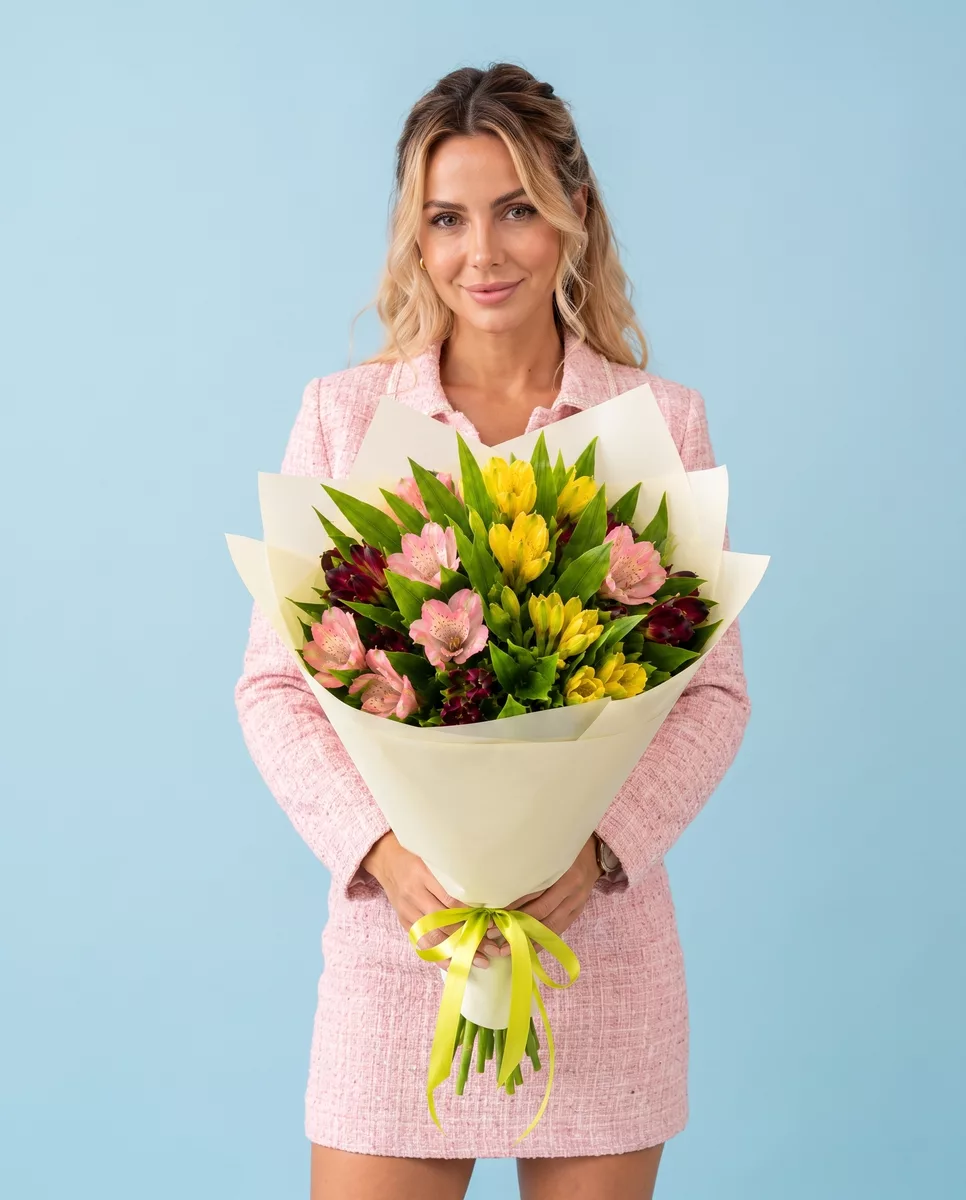
Classic Bouquets for Women: Varieties and Stem Counts That Work
The most requested bouquet for a Russian woman remains the rose arrangement, and the variety matters more than most buyers realise. Garden roses with a cupped head, such as David Austin-style varieties, read as romantic and personal. Standard spray roses in pastel shades read as friendly and appropriate for colleagues or teachers. Long-stemmed single-colour roses in red or deep burgundy read as explicitly romantic and are almost never sent to a professional contact. Peonies are the second most requested flower for women from May through July when they are in season and available fresh. Outside that window, florists substitute ranunculus or garden roses for a similar layered look. Eustoma, also sold as lisianthus, is a reliable filler that adds volume without overpowering the main flower, and it holds well in a warm apartment for five to seven days. A bouquet intended for a woman in a Russian context typically starts at eleven stems for a casual occasion and moves to nineteen or twenty-five for a birthday or anniversary. Odd numbers are the rule in Russia for living flowers given to living people, and even numbers are reserved for mourning, so this is not a detail to ignore. Mixing three to five varieties is common for women's bouquets and is considered a sign of care and effort rather than indecision. White, pink, peach, and lilac colour palettes are the safest choices across age groups.
What to Send a Russian Man and What to Avoid
Flowers for men in Russia are still a relatively new mainstream habit, but they have become genuinely normal over the past ten years, particularly for birthdays, professional achievements, and February 23rd. The mistake buyers make most often is ordering a feminised bouquet and assuming the man will not notice. He will notice, and so will everyone around him. The varieties that work well for men are those with a strong, defined structure: anthuriums, tropical heliconias in season, sunflowers, alstroemerias in deep orange or burgundy, and single-variety arrangements of chrysanthemums in large pompom form. Proteas have become increasingly popular in men's bouquets over the last three years because their architectural shape reads as bold rather than delicate. Colour is the most important variable. Deep red, dark burgundy, orange, yellow, white, and forest green work well. Pale pink, lavender, and baby blue are the shades that cause the most discomfort for male recipients in a Russian context, not because of any universal rule but because of local association. Stem counts for men's bouquets tend to be lower, often seven, nine, or eleven stems, with the emphasis on quality and freshness of each individual stem rather than overall mass. A tight, clean arrangement of nine premium anthuriums makes a stronger impression than a loose mixed bouquet of twenty-five stems in soft colours. Delivery timing matters too: a morning delivery to an office on a birthday lands very differently from an evening delivery to a home.
Colour Rules: What Russians Actually Follow
The even-number rule gets all the attention, but colour carries just as much meaning in Russian flower culture and is less often explained to foreign buyers. Red roses sent to a woman signal romantic intention clearly and should not be sent to a female colleague unless that intention is deliberate. Sending red roses to a man's mother or grandmother, however, is completely appropriate and is actually a traditional gesture of deep respect. White flowers for women are associated with purity and elegance and work for weddings, graduations, and formal congratulations. Yellow flowers carry a complicated reputation in Russia: older generations sometimes associate yellow with separation or bad luck, but this belief has weakened significantly among people under forty, and yellow tulips on March 8th are now one of the top five most ordered items in the country. For men, yellow sunflowers and yellow chrysanthemums are accepted without any negative association. Orange is a safe, energetic choice for both genders and reads as celebratory without romantic overtones. Purple and violet shades, particularly in eustoma and orchids, are popular for women in their thirties and forties and are considered sophisticated rather than mournful in a gifting context. The key practical point is that colour choice should be matched to the relationship and the occasion, not just to the recipient's gender. A romantic partner gets different colours than a respected teacher, regardless of gender.
Occasion Matters More Than Gender in Several Cases
There are moments when the occasion overrides gender as the primary factor in bouquet design. A graduation bouquet, for example, follows fairly similar logic for a young woman and a young man: the emphasis is on volume, festivity, and longevity, since the flowers will be photographed and carried around for several hours. Chrysanthemums, alstroemerias, and spray roses are workhorses in graduation arrangements because they do not wilt quickly even in warm outdoor conditions. A work anniversary or professional achievement gift follows its own rules too. In a Russian office context, the bouquet should be impressive enough to be noticed by colleagues but not so personal that it creates awkwardness. For both men and women in professional settings, single-variety arrangements in a clean colour palette are the most reliable choice. A mono-bouquet of white eustoma or a structured arrangement of premium spray roses in a single shade reads as respectful and tasteful. Birthday bouquets for women over sixty in Russia often lean toward gladioli, dahlias in season, or large-headed chrysanthemums rather than roses, because these varieties carry a sense of grandeur that resonates with that generation's aesthetic. For men over sixty, the same logic applies: chrysanthemums and gladioli are considered appropriately serious rather than frivolous. Knowing the recipient's age and the nature of your relationship with them will always sharpen your order more than any gender rule alone.
Size, Packaging, and Presentation Differences
Packaging in Russian flower culture is taken seriously, and the wrapping signals as much as the flowers themselves. Bouquets for women are most commonly presented in round kraft paper wrapping, soft fabric, or open European-style with the stems wrapped and the blooms exposed. Ribbon, dried botanicals as accents, and decorative greenery like eucalyptus or ruscus are standard additions for women's arrangements and are expected at higher price points. For men, the packaging tends to be cleaner and more minimal. A simple kraft wrap in a dark shade, a box arrangement, or a straight-sided cylindrical vase arrangement reads as considered rather than over-decorated. Box bouquets, where flowers are arranged in a hat box or rectangular box, have become popular for men precisely because the format feels less traditionally feminine while still delivering visual impact. The size question is where buyers most often underspend for women and overspend for men. A bouquet for a Russian woman at a birthday should be large enough that she cannot carry it in one hand without effort. A bouquet for a Russian man at a birthday should be compact enough that he can hold it comfortably without looking overwhelmed by it. These are not rigid measurements but they reflect a real social dynamic that Russian recipients understand immediately. When ordering for delivery, always specify whether the recipient is at home or at a workplace, because the florist will adjust the packaging to suit the context.
Ordering Across Russia: What to Check Before You Confirm
Delivery to a different city introduces variables that do not exist when you order for your own neighbourhood. Flower freshness depends on how far the stems have travelled before they reach the local warehouse, and certain varieties handle transit better than others. Chrysanthemums, alstroemerias, and spray roses are the most resilient and arrive in good condition even after a long delivery route. Eustoma and ranunculus are moderately resilient. Garden roses and peonies are the most sensitive and should only be ordered when you are confident they are in season and available locally fresh. When ordering a bouquet for a Russian man in a city you are not familiar with, stick to structured varieties that hold their shape: anthuriums, tropical flowers, or a clean chrysanthemum arrangement. These will look intentional and sharp even if the delivery window stretches slightly. For a woman's bouquet in a distant city, confirm with the shop that the specific varieties you want are in stock that day and not substituted without notice. A good florist will tell you honestly what is available and what the freshness situation looks like. Temperature is the other factor: in summer, flowers in cities like Krasnodar or Rostov-on-Don face heat stress that does not exist in Saint Petersburg. Delivery timing in hot weather should target morning or evening windows, and the recipient should be told to put the bouquet in water within the first thirty minutes. These details apply equally regardless of whether you are sending to a man or a woman.
The honest answer to the original question is that gender does affect bouquet choice in Russia, but it works as one variable among several rather than the only rule. The occasion, the relationship, the recipient's age, the city, and the season all shape the final order at least as much as gender does. What the gender dimension actually tells you is where to start: larger and more mixed for women, smaller and more structured for men, with colour choices that match the relationship rather than a general palette. If you are ordering from outside Russia and are not certain about the details, describe the recipient and the occasion to the florist directly. A working florist who knows the current stock and the local delivery conditions will always give you more useful advice than any general rule. We deliver bouquets across Russia in 1–2 hours.
Frequently asked questions
Is it really unusual to send flowers to a man in Russia?
It used to be uncommon but it is now fully normal, especially for birthdays and February 23rd. The key is choosing varieties and packaging that suit a man's context: structured flowers, clean wrapping, and a compact size. Anthuriums, sunflowers, and chrysanthemums are safe starting points that will not cause any awkwardness.
Why do Russian florists insist on odd numbers of stems?
Even numbers of flowers are associated with mourning in Russian tradition and are brought to funerals. Odd numbers are for living recipients and living celebrations. This rule is taken seriously across all age groups and regions, so always confirm your stem count is odd before finalising any order for a Russian recipient.
Are yellow flowers really considered bad luck in Russia?
This belief exists among older generations and in some regional communities, but it has weakened considerably among people under forty. Yellow tulips are now among the most ordered flowers on March 8th. If the recipient is over sixty or you are uncertain about their views, it is safer to choose a different colour to avoid any unintended message.
What is the most reliable bouquet to send a Russian woman for her birthday when I am ordering from abroad?
A mixed arrangement of spray roses, eustoma, and eucalyptus in a pink or peach palette with nineteen or twenty-five stems is the most consistently well-received choice. These varieties travel well, hold freshness for five to seven days indoors, and read as generous and personal across all age groups and regions.
How far in advance should I order flowers for delivery in a Russian city I do not know well?
Order at least three to four hours before the desired delivery time for standard bouquets. For specific varieties like peonies or garden roses, order the day before and confirm availability directly with the shop. Same-day delivery within one to two hours is possible for in-stock arrangements, but rare varieties may require advance notice to source fresh.
Ready to send a bouquet?
Pick a city, choose the flowers, and we will hand them over with a photo confirmation.
Choose a city →