
Graduation Flowers in Russia: What to Send After the Diploma Ceremony
Every June and late December, the same question lands in our chat dozens of times a day: what do you actually send someone who just walked off a graduation stage in Russia? The answer depends on whether it is a school vypusknoj or a university diploma ceremony, how far the venue is from the recipient, and whether you want the flowers to survive three hours of photographs in a warm hall. This article covers all of it plainly, with real varieties and real timing.
What Russian Graduation Celebrations Actually Look Like
Russian school graduation, called vypusknoj, happens in late May or June and is a serious formal event: graduates dress in evening wear, there is a ceremony inside the school, then a banquet, and often an all-night celebration ending at dawn by the water. University diploma ceremonies are more varied — some faculties hold them in large auditoriums, others in small department halls, and the timing spreads across June and July for spring graduates, or January for those finishing mid-year. Both occasions involve photographs, speeches and a lot of standing around in warm indoor spaces, which matters enormously for flower choice. Senders from outside Russia often underestimate how warm Russian June can be indoors: ceremony halls are rarely air-conditioned, and bouquets sit on tables or are held for hours. The social expectation is that flowers are given in person at the ceremony or delivered to the home immediately after, not the following day. If you are sending from another city, the window between the ceremony ending and the graduate arriving home is your delivery target. Missing that window means flowers arrive when the recipient is already at the banquet and will not be seen until midnight or later, when they are tired and the flowers have been sitting in a warm entrance hall. Understanding the schedule before you order is the single most useful thing a remote sender can do.
Bouquets we can deliver



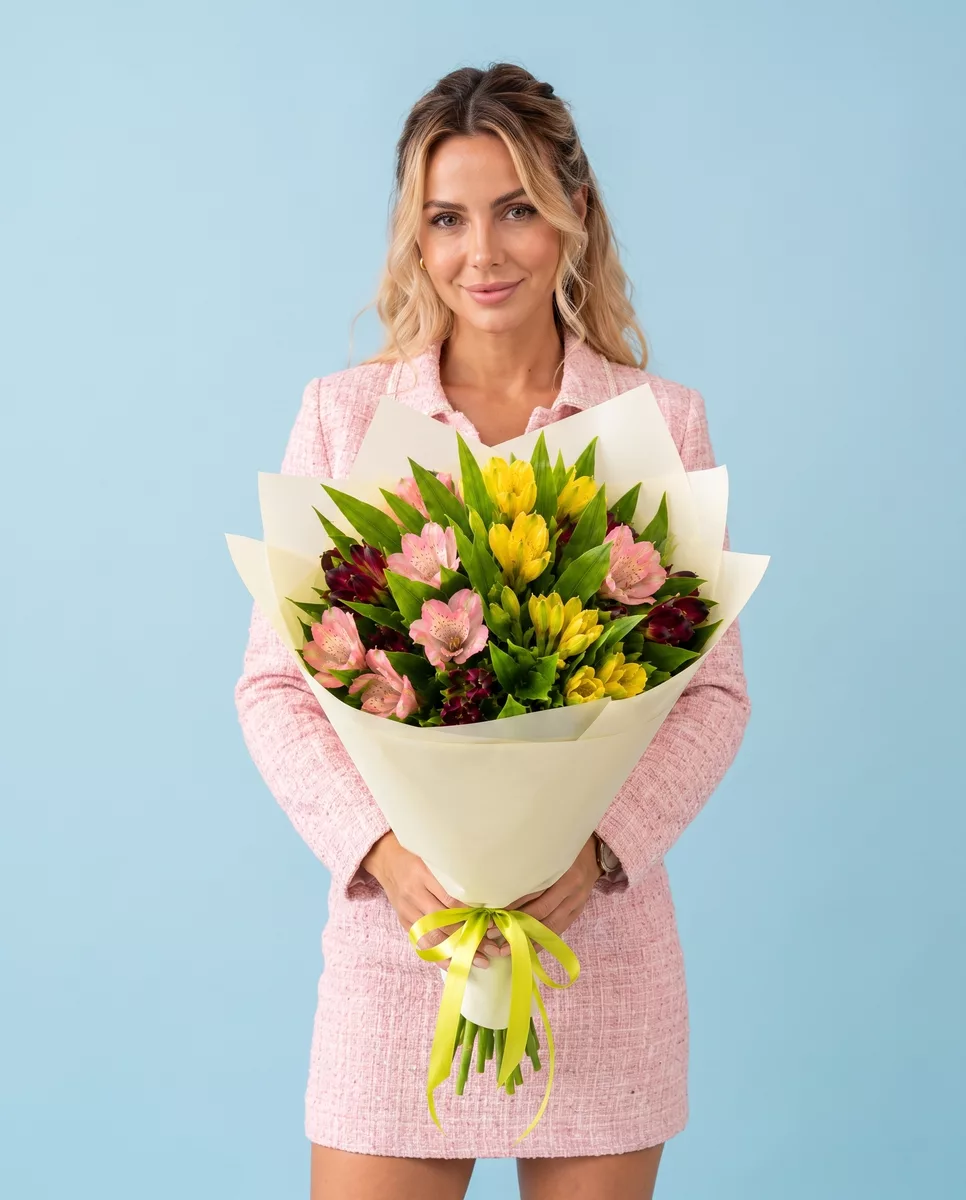
Which Flowers Actually Survive a Russian Graduation Day
The core problem with graduation flowers is heat and handling. A bouquet gets carried from a car, held during a two-hour ceremony, placed on a banquet table, carried again, and finally put in water many hours after it left our cooler. Roses are the standard choice and they hold up well if you select the right varieties: large-headed garden roses wilt faster than standard high-stem Kenyan or Ecuadorian roses, which are bred for transport endurance. Among specific varieties, Explorer roses, Avalanche roses and Red Naomi hold their shape reliably in warm conditions for six to eight hours without water. Chrysanthemums are extremely robust and hugely popular at Russian graduations, particularly spray chrysanthemums in white, yellow and pale green — they genuinely last all day. Alstroemeria is another practical choice: the buds continue opening after cutting, the stems are strong, and the price point allows for generous volume. Gerberas look spectacular in photographs but wilt within two to three hours without water, so they are only appropriate if delivery goes directly to a home address where the recipient can put them straight into a vase. Tulips and peonies are seasonal and beautiful but both are heat-sensitive and drop petals quickly in warm rooms. If the ceremony is outdoors or in an air-conditioned venue, the range opens up considerably. Always ask when placing your order: our florists will ask about the venue type specifically because it changes what we recommend.
Bouquet Sizes and Compositions for School Versus University
Russian school graduation bouquets tend to be large and visually dramatic. The cultural expectation at vypusknoj is abundance: mono-bouquets of 51 or 101 roses are genuinely common, as are large mixed arrangements featuring roses, eustoma, matthiola and decorative greenery. White and red are traditional school graduation colors, though pastel palettes with soft pinks, creams and lilacs have become very popular over the past several years, particularly for female graduates. The bouquet is often as tall as the graduate and is meant to be photographed, so structure and visual impact matter as much as flower choice. University graduation has a slightly different tone. The bouquet is still important, but the setting is more adult and professional. Compact, well-structured arrangements of 25 to 35 stems are more common than the towering school-graduation displays. Roses combined with eucalyptus, brunia or dried elements photograph well and feel appropriate for someone entering professional life. Male graduates in Russia do receive flowers — this surprises many international senders — and for men, dark red roses, burgundy calla lilies or structured arrangements in deep tones are appropriate and appreciated. If you are sending to a graduate you do not know well, a round bouquet of 25 white or cream roses is universally correct for both school and university occasions. Adding a small card with a personal message is standard practice and our team can include a printed card with any order.
Timing Your Delivery: The Hours That Matter Most
Russian school graduation ceremonies typically begin at 7 or 8 in the evening and run until 10 or 11 pm, after which graduates move to a banquet or outdoor celebration. University ceremonies are almost always daytime events, usually between 10 am and 2 pm. For school graduation, the ideal delivery window is either before the graduate leaves home to get ready, which means before 5 pm, or directly to the ceremony venue if you have a confirmed address. Delivering to a venue requires that someone is there to receive the order: we need a full address and a contact phone number, and the recipient or a family member must be reachable. For university ceremonies, delivery to the venue during the event works well because graduates are stationary and family members are present. Delivery to the home address one to two hours after the ceremony ends is the safest option if you are uncertain about the venue logistics. One common mistake is ordering delivery for the evening of a daytime ceremony, assuming the graduate will be home. In reality, post-ceremony lunches and family gatherings often run until 6 or 7 pm, and the flowers sit in the entrance hall. For January graduates, timing is simpler: ceremonies are shorter, the weather is cold so flowers are not stressed by heat, and home delivery within two hours of the ceremony is straightforward. Always specify the ceremony time in your order comments so we can schedule dispatch correctly.
What to Write on the Card: Russian Graduation Customs
Graduation cards in Russia are more formal than in many Western countries. The most common phrase is pozdravlyayu s okonchaniyem, which translates roughly as congratulations on completing your studies, followed by wishes for success in the chosen profession or future path. If you are sending in English, a short sincere message is perfectly appropriate and will be appreciated as personal rather than generic. Avoid anything that sounds like a farewell — Russian graduation culture focuses entirely on what comes next, not on what is ending. Phrases like wishing you a bright future, congratulations on your diploma, and proud of everything you have achieved all land well. If the graduate is entering a specific field, mentioning it briefly makes the card feel personal. For school graduates, acknowledging the years of work is appropriate. For university graduates, focusing on the professional path ahead is more fitting. Our card service prints the message exactly as you write it, so there is no need to translate into Russian unless you want to: many recipients, particularly younger graduates, read English comfortably, and a card in the sender's own language feels genuine. Keep the message under 60 words for print clarity. If you are sending on behalf of a company to a colleague's child, a more formal tone is appropriate: brief, warm and without personal details the sender might not know. The card is included in the delivery at no additional cost and is placed inside the packaging before the courier leaves our shop.
Ordering for a Delivery Address You Are Not Sure About
A significant share of graduation flower orders come from people who know the city but not the exact address: a parent ordering for a child studying in Saint Petersburg, a relative in another country, an employer sending to a graduate they have only met online. The most important information we need is a working phone number for the recipient or someone at the delivery address. If the recipient is at a ceremony, the best approach is to give us a family member's number so we can coordinate entry to the building. Russian apartment buildings require either a door code or someone to buzz the courier in, and without contact we cannot complete the delivery. If you only have the graduate's number and they will be at a ceremony with their phone on silent, note this in the order and give us a two-hour delivery window starting from when the ceremony ends. We will call 20 minutes before arrival to confirm. For venue deliveries, we need the full address including building number, any specific entrance information, and the name of the event or faculty so our courier can locate the right hall. Saint Petersburg has several large universities with multiple buildings across different addresses — Polytechnic University, SPbGU, the Herzen University and others each have multiple campuses, so specifying the faculty or department building is essential. When in doubt, ask us: our operators know the major university campuses and can often suggest the correct building based on the faculty name alone.
Packaging and Presentation for Russian Graduation Bouquets
Presentation is taken seriously at Russian graduations. A bouquet that arrives loosely wrapped or in plain paper will look underdressed next to the elaborate arrangements other guests bring. Our graduation bouquets are wrapped in layered kraft and decorative paper with ribbon, and large bouquets include a water capsule at the stem ends to extend freshness during delivery and the ceremony itself. The water capsule is a small sealed bag of water attached to the cut stems inside the wrapping: it adds roughly two to three hours of hydration and makes a real difference for roses and eustoma in warm conditions. For very large mono-bouquets of 51 or 101 stems, we use a structured cone wrap that allows the graduate to hold the bouquet without stems slipping. If you are ordering a bouquet to be delivered to a venue and then carried for several hours, mention this when ordering: we adjust the wrapping to be more secure and easier to grip. Box arrangements, where flowers are presented in a decorative hat box or flower box, have become popular for home delivery because they do not require a vase immediately and look striking in photographs. They are practical for recipients who will be moving between locations during the day. Balloon additions, soft toy additions and candy inclusions are available and genuinely popular for school graduation gifts, less so for university. If you want to add something, our operators can advise what works visually with the specific bouquet you have chosen rather than guessing from a website thumbnail.
Graduation flowers in Russia are not a small gesture — they are a visible, photographed part of a significant day, and the wrong choice or wrong timing can mean a beautiful bouquet arrives to an empty apartment or wilts before the ceremony ends. The practical decisions are straightforward once you know the schedule: confirm the ceremony time, choose varieties that hold up without water, match the bouquet scale to the occasion, and give us a contact number that someone will actually answer. We deliver across Saint Petersburg within one to two hours and can coordinate directly with family members on the ground when the sender is in another city or country. We deliver bouquets across Russia in 1–2 hours.
Frequently asked questions
Can I order graduation flowers for delivery to a university ceremony venue in Saint Petersburg?
Yes. We need the full building address including faculty or department, a contact phone number for the recipient or a family member present at the venue, and the approximate ceremony time. Large university campuses have multiple buildings, so specifying the faculty helps our courier find the right entrance without delay.
What is the most practical flower for a Russian school graduation bouquet that lasts all evening?
Spray chrysanthemums and high-stem roses such as Avalanche or Explorer are the most reliable choices for a long evening. Both handle warm indoor conditions without water for six to eight hours. We add a water capsule to stem ends for orders going to ceremony venues, which extends freshness further.
Do male graduates in Russia receive flowers at graduation?
Yes, giving flowers to male graduates is entirely normal and expected in Russia. Dark red roses, burgundy calla lilies or structured arrangements in deep, rich tones are the most common choices. A bouquet of 25 deep red roses is a safe and well-received option for a male graduate at either school or university level.
How far in advance should I place a graduation flower order?
For standard delivery, same-day orders placed before 3 pm are handled without issue. For large bouquets of 51 or 101 stems, or for venue delivery requiring specific timing coordination, ordering the day before gives us time to prepare the arrangement properly and confirm logistics with you.
Is it appropriate to send flowers to a Russian graduation if I am outside Russia and cannot attend?
Completely appropriate and common. Many graduation bouquets we deliver are ordered by family members abroad or in other Russian cities. A card in English is fine and often appreciated as personal. Provide a local contact number for the recipient or their family and we handle the rest from our end.
Ready to send a bouquet?
Pick a city, choose the flowers, and we will hand them over with a photo confirmation.
Choose a city →