
New Year Flowers in Russia: Beyond the Christmas Tree
Most people outside Russia are surprised to learn that flowers are a bigger part of Russian New Year than Christmas. The holiday on 31 December and 1 January is the main gift-giving occasion of the year, and a bouquet — often handed over at midnight or left at the door before guests arrive — is as expected as a bottle of champagne. If you are ordering for the first time, or ordering from abroad for someone in Russia, the customs, the varieties and the delivery windows are all different from what you might assume.
Why Flowers at New Year and Not at Christmas
Russia celebrates Orthodox Christmas on 7 January, but that date is quiet and largely religious. The secular celebration — the one with the decorated tree, the gifts, the family dinner and the toasts — happens on the night of 31 December into 1 January. This is Novy God, literally New Year, and it functions exactly as Christmas does in most Western countries. Flowers fit into this because Russian gift culture has always treated a bouquet as a complete, standalone present rather than a decoration. You do not bring flowers to put on a table; you bring them for the person. A woman receiving guests on New Year's Eve expects flowers from her husband, her adult children, and often from close male friends. A hostess receiving a dinner party will almost certainly get a bouquet at the door. This means demand spikes sharply on 30 and 31 December, not on 25 December, which catches many international customers off guard when they try to plan ahead. The florist's busiest stretch of the entire year is the 48 hours before midnight on 31 December. Knowing this changes everything about how you should time your order, which varieties you should request, and how far in advance you need to confirm the delivery slot. The Christmas tree itself — called yolka — is decorated with ornaments and tinsel, not flowers, so the two traditions run parallel rather than competing.
Bouquets we can deliver



Red Roses: Why They Dominate the New Year Season
Red roses are the single most ordered flower for Russian New Year, and the reasons are practical as much as symbolic. Red reads as festive against the white and silver of a decorated apartment, it photographs well in the dim light of a New Year's table, and it is universally understood as a serious, generous gesture. The variety matters more than most customers realise. For New Year orders we work primarily with large-headed Ecuadorian roses — Freedom, Explorer and Red Naomi are the varieties that hold up best in cold transit and still open fully in a warm room within 24 hours of delivery. Kenyan roses are smaller-headed and open faster, which makes them better for same-day gifts but riskier if you are ordering for delivery on 30 December to be presented on the 31st. Stem length is another real variable: 60 cm stems are the standard for a New Year bouquet; 80 cm stems are used for premium arrangements and require a taller vase, which not every recipient has. Odd numbers are the rule for living recipients in Russia — 11, 15, 19, 25 roses are all common counts for New Year gifts. Even numbers are associated with mourning and will alarm a Russian recipient even if the giver had no idea. This is not a superstition you can talk your way around; just order odd. Ribbon colour and wrapping paper should lean warm — burgundy, gold, deep green — rather than white or pale pink, which feel too bridal for a winter celebration.
Amaryllis: The Underused New Year Flower Worth Knowing
Amaryllis — the large-bulbed flower sold as Hippeastrum in botanical terms — is the second flower that Russian florists associate strongly with New Year, though it is far less known among customers ordering from outside the country. A single stem carries two to four trumpet-shaped blooms in deep red, white, or striped varieties, and the scale of the flower is genuinely dramatic: one stem in a tall vase makes an impression that twenty carnations cannot. The most popular varieties for New Year are Red Lion for solid deep red, Minerva for red with a white star centre, and Charisma for a softer pink-red. All three are available as cut stems rather than bulbs, which means they arrive ready to display rather than requiring weeks of growth. Amaryllis is cold-sensitive and should not be left in unheated hallways or car boots for more than twenty minutes in a Russian winter, so delivery timing and handoff conditions matter. The blooms last seven to ten days in a cool room, which makes amaryllis an excellent choice for someone who will be travelling immediately after New Year and wants the flowers to still be alive when they return. One practical note: amaryllis stems are hollow and need to be cut at an angle and placed in deep water — at least 10 cm — immediately on arrival. Including care instructions with the bouquet is something we do automatically for this flower. Combining three amaryllis stems with eucalyptus and a few spray roses produces one of the most requested New Year arrangements in our shop.
Other Varieties That Work in a Russian January
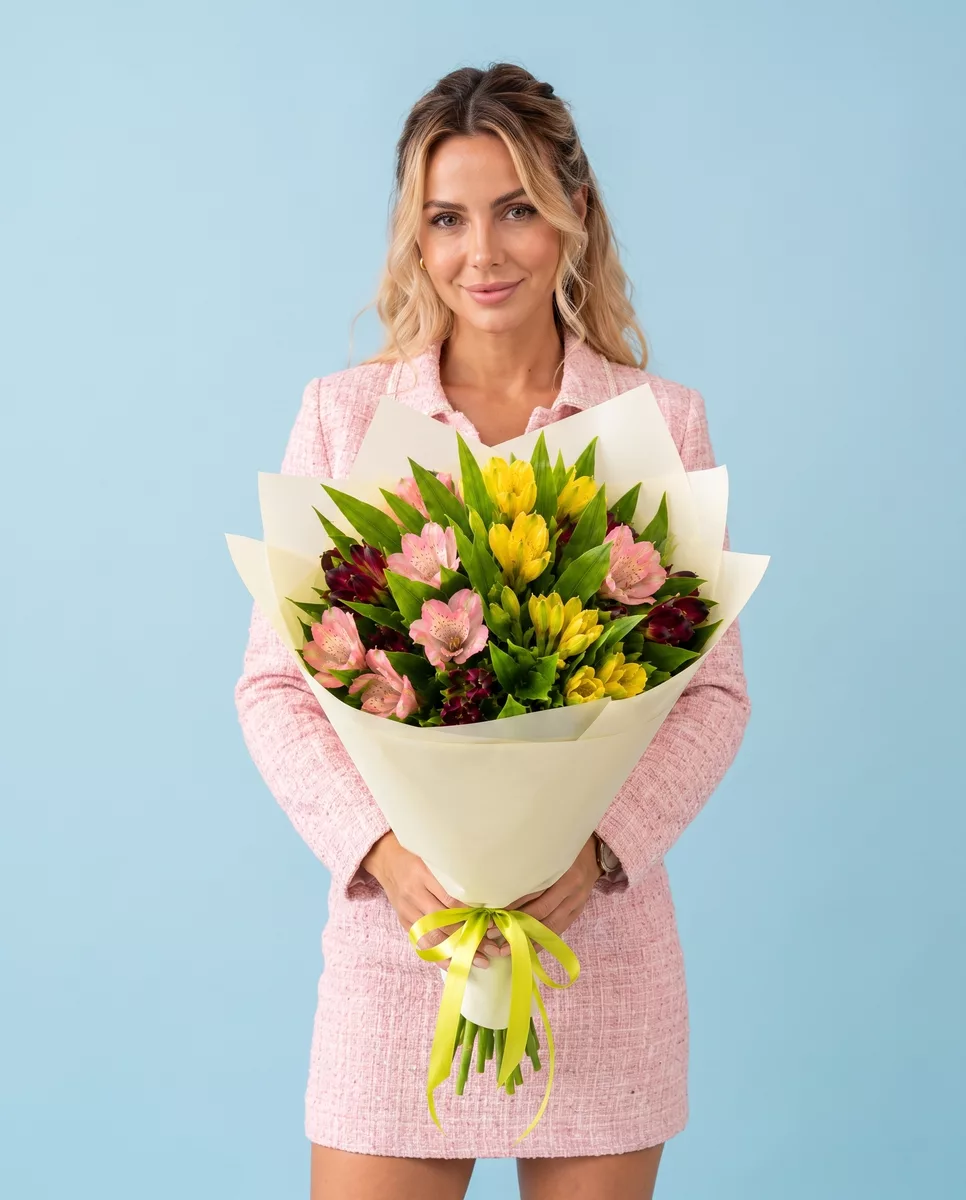
Beyond roses and amaryllis, several other flowers perform reliably in the New Year window and are worth considering depending on budget and recipient preference. Alstroemeria is the most durable cut flower available in winter and holds for two weeks with basic care; it is inexpensive relative to roses and works well as a filler or a standalone bouquet for a colleague rather than a close family member. Chrysanthemums — specifically the large-headed santini and single-stem varieties — are abundant in December and hold colour well in cold transit, though they carry a strong association with autumn funerals in some regions of Russia, so we generally steer customers toward other options for New Year unless specifically requested. Tulips arrive from Dutch growers starting in late December and are enormously popular: they are associated with the coming of spring even in the middle of winter, and a large bunch of red or white tulips is a cheerful, unambiguous gift. The catch is that tulips open very fast in a heated apartment — within 12 hours of delivery — so they are best ordered for same-day or next-morning delivery rather than a day in advance. Hypericum berries in red or orange add texture and a festive look to any mixed bouquet and hold for two weeks. Eucalyptus, both the silver-dollar and the seeded varieties, is used heavily in New Year arrangements for its grey-green colour and its clean scent, which works well in a room already full of pine and candles. Asking your florist to combine one hero flower with two supporting elements almost always produces a more balanced result than a mono-bouquet for a celebration context.
Scheduling Delivery Around 31 December
The single biggest mistake customers make is treating 31 December as a normal delivery day and ordering on the morning of the 31st. By 10 a.m. on New Year's Eve, delivery slots in central Saint Petersburg are typically full, and outlying districts fill by early afternoon. The practical rule is to place your order by 28 December if you want a specific two-hour delivery window on the 31st, or by the 29th at the latest if you are flexible about timing within that day. Delivery on 30 December is significantly less pressured and works well for gifts to people who will be hosting on the evening of the 31st — the flowers have time to open and be arranged before guests arrive. If you are ordering from abroad and there is a time zone difference, add several hours to your mental calculation of when the florist's working day ends. Our team works extended hours from 27 December through 1 January, but the order intake closes earlier than on a normal trading day because the packing and dispatch work begins before dawn. For delivery to cities outside Saint Petersburg, the logistics window is tighter: orders for New Year delivery to Moscow, Kazan, Novosibirsk or other cities should be confirmed by 27 December to guarantee arrival before midnight on the 31st. Providing a phone number for the recipient is not optional for New Year orders — couriers encounter locked building entrances, guests who have moved to a different address for the holiday, and recipients who have already left for a dacha. A working contact number resolves all of these in minutes.
What to Check Before Confirming a New Year Order
There is a short checklist that experienced customers run through before finalising a New Year flower order, and it prevents almost every common problem. First, confirm the delivery address is where the recipient will actually be on the delivery date — many Russians spend 31 December at a family home outside the city or at a dacha, not at their registered apartment. Second, check whether the building has a doorman or a coded entrance, and include that information in the order notes; a courier standing outside a locked building on New Year's Eve with no way to call ahead will leave after two attempts. Third, specify whether the delivery should be a surprise — if so, we coordinate with someone inside who can receive the flowers without alerting the recipient, but we need a contact name and number for that person. Fourth, confirm the flower count is odd. Fifth, if you are sending alcohol alongside the flowers — a common New Year combination — note that alcohol delivery has separate regulations and time windows that differ from flower delivery. Sixth, for premium orders with amaryllis or large-format arrangements, confirm the recipient has a vase tall enough: amaryllis needs at least 40 cm of depth. Finally, review the card message carefully. New Year cards in Russia typically use the phrase S Novym Godom, meaning Happy New Year, and include a wish for health, happiness and success in the coming year. A card that says Merry Christmas will confuse a Russian recipient receiving it on 31 December, since the occasions are genuinely separate in the Russian calendar.
Caring for New Year Flowers in a Russian Winter Apartment
Russian apartments in winter present a specific challenge for cut flowers: central heating runs continuously from October through April and keeps indoor temperatures between 22 and 25 degrees Celsius, which is significantly warmer than the 18 to 20 degrees at which most cut flowers last longest. This means flowers delivered in January will open faster and decline sooner than the same flowers delivered in May, and recipients should know this rather than being surprised. The best position for a New Year bouquet is away from the radiator and away from the window — the window is cold enough to cause petal damage in hard frost conditions, and the radiator dries the stems. A table in the centre of the room, or on a kitchen counter away from the stove, works well. Water should be changed every two days and the stems re-cut at an angle each time — this is the single most effective thing a recipient can do to extend vase life. For roses, removing the lower leaves that would sit below the waterline prevents bacterial growth that shortens vase life significantly. Amaryllis stems should not be re-cut because the hollow stem will fill with water and rot; instead, change the water daily and keep the vase full. Tulips prefer cold water and will last longer if the vase is placed in a cool room overnight. Including a sachet of flower food with the delivery is something we do as standard for all New Year orders; it contains a biocide and a small amount of sugar that together extend vase life by three to four days compared to plain tap water.
Russian New Year is a flower holiday in a way that surprises most people encountering it for the first time. The demand is real, the customs around variety, count and timing are specific, and the window for ordering without stress is shorter than it looks on a calendar. Red roses in odd numbers, amaryllis in deep red, tulips for same-day delivery, and a confirmed delivery slot booked by the 28th of December — these are the practical anchors of a successful New Year flower order. The cold outside and the heat inside create conditions that reward a little extra care, both in choosing varieties that travel well and in giving recipients the information they need to keep the flowers alive through the holiday. We deliver bouquets across Russia in 1–2 hours.
Frequently asked questions
Is it appropriate to send flowers on 1 January rather than 31 December?
Yes, and it is increasingly common. Many people prefer a morning delivery on 1 January as a New Year greeting after the celebration, when the recipient is home and relaxed. Tulips and single-variety rose bouquets work well for this timing since they are fresh and cheerful for a daytime gift. Delivery slots on 1 January are less pressured than on the 31st.
Can I order a bouquet with an even number of flowers for a Russian recipient?
We strongly advise against it. Even numbers of flowers are associated with mourning in Russian culture and will alarm most recipients regardless of the giver's intention. The rule applies to the main flowers in the bouquet; filler stems and greenery are not counted. Odd numbers — eleven, fifteen, nineteen, twenty-five — are all appropriate for a New Year gift.
How far in advance should I order New Year flowers for delivery outside Saint Petersburg?
For cities across Russia, place your order by 27 December at the latest. Logistics to distant cities require additional lead time, and New Year demand compresses the available window significantly. Providing the recipient's phone number is essential for out-of-city delivery so the courier can coordinate building access and confirm the recipient is present.
Which flowers last longest in a warm Russian apartment during the New Year holiday?
Alstroemeria and hypericum berries are the most durable, lasting up to two weeks with basic care. Among the popular New Year choices, amaryllis holds for seven to ten days and large-headed Ecuadorian roses last five to seven days if the stems are re-cut and the water is changed every two days. Tulips are the shortest-lived at two to four days in a heated room.
What should I write on the card for a Russian New Year bouquet?
The standard greeting is S Novym Godom, meaning Happy New Year. A typical message adds wishes for health, success and happiness in the coming year. Avoid writing Merry Christmas on a card delivered on 31 December or 1 January — Russian Christmas falls on 7 January and is a separate, quieter occasion. We can print the card in Russian if you provide the text or ask us to compose a standard greeting.
Ready to send a bouquet?
Pick a city, choose the flowers, and we will hand them over with a photo confirmation.
Choose a city →