
Pink Flowers in Russia: A Safe Choice for Almost Any Occasion
Every week customers call us with the same question: is pink too romantic, too casual, too something? The short answer from the shop floor is no. Pink sits in a uniquely comfortable position in Russian gifting culture — it reads as warm without being intense, celebratory without being loud, and personal without crossing into territory that might feel awkward between colleagues or distant relatives. It is the colour we recommend most often when a customer is unsure, and it almost never causes a problem.
Why Pink Works Across Russian Gifting Culture
In Russia, flower colour carries real social weight. Red is read as romantic and almost exclusively reserved for partners. White is formal and occasionally associated with solemn occasions. Yellow has shed much of its old superstition among younger generations but still makes some recipients uncomfortable. Pink occupies none of those loaded positions. It is seen as friendly, generous and appropriate whether the recipient is a teacher, a grandmother, a colleague celebrating a promotion, or a friend marking a birthday. This is not marketing language — it is what customers report back to us after deliveries. Russian gifting etiquette also tends to favour odd numbers of stems, and pink flowers happen to photograph and arrange beautifully in groups of five, seven, nine or eleven, which are the counts we sell most of. The colour reads consistently well at every price point too: a small pink spray rose bouquet looks considered and intentional, while a large arrangement of garden roses or peonies in dusty pink registers as genuinely impressive. One practical note for anyone ordering from outside Russia: the cultural associations around flower colour here are stronger than in many Western European countries, so defaulting to pink when you are uncertain is genuinely sound advice rather than a vague platitude. We have delivered pink bouquets to corporate offices, school events, hospital wards for non-serious visits, and housewarming parties without a single complaint about the colour choice.
Bouquets we can deliver



The Most Popular Pink Varieties We Stock Year-Round
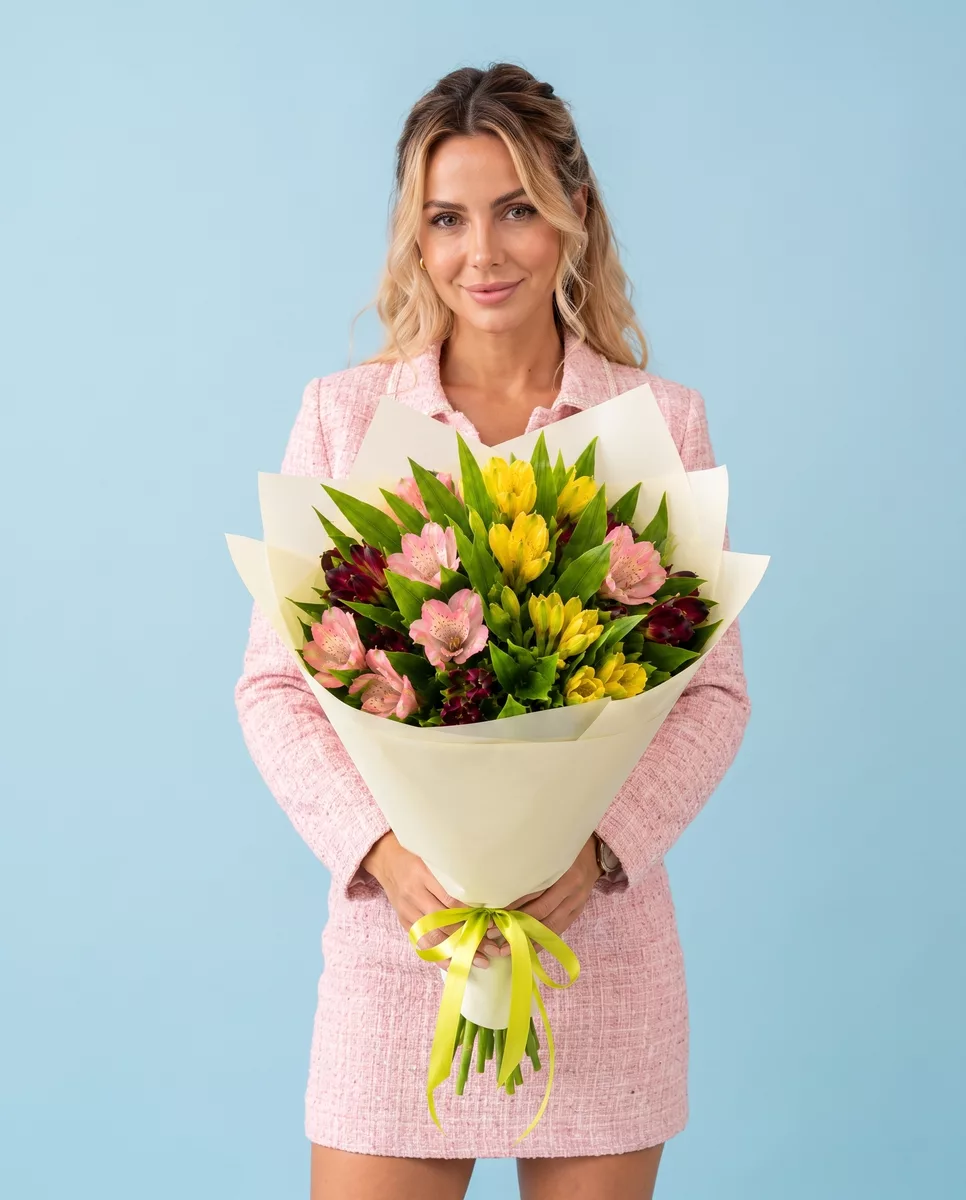
Rosa is the backbone of any pink selection, and within roses the varieties we move most consistently are spray roses in salmon and blush tones, large-headed garden-style roses in deep pink, and standard hybrid tea roses in medium pink. Spray roses hold up particularly well in transit because each stem carries multiple smaller blooms, so even if one head loses a petal in the box, the arrangement looks full on arrival. Eustoma, known abroad as lisianthus, is our second most-requested pink flower. It has a ruffled, almost peony-like appearance and a vase life of ten to fourteen days, which makes it a strong choice when the recipient will not have someone to refresh water daily. Chrysanthemums in pink — both the large single-headed and the multi-stem spray varieties — are workhorses that we use to add volume without inflating cost significantly. Alstroemeria in pink and coral tones is another reliable year-round option; it is tougher than it looks, tolerates temperature variation during delivery better than most, and opens gradually over a week, giving a slow-burn effect that customers appreciate. Carnations deserve a mention here even though they carry an unfair reputation in some markets. In Russia they are not considered cheap or old-fashioned in the way some Western customers assume. Pink carnations specifically are a standard and respected choice, and their durability — up to three weeks in a vase with fresh water — makes them genuinely practical.
Seasonal Pink Flowers and When to Order Them
Peonies are the most sought-after pink flower in Russia and the one we get the most questions about. The season runs roughly from late May through June, occasionally stretching into early July depending on growing conditions. During those weeks we stock coral peonies, pale blush peonies and deep magenta varieties. Outside that window we do not sell peonies, because the imported alternatives that travel long distances are consistently disappointing in texture and vase life — we would rather tell a customer the truth than deliver a wilted product. Ranunculus in pink and peach tones arrive in late winter and early spring, typically February through April. They are delicate and need to be kept away from heat and direct sunlight after delivery, which is worth telling recipients in a note. Tulips are a major spring staple from February through April; pink tulips in particular — varieties like Apricot Beauty and Pink Impression — are fast movers because they suit the March 8th holiday period when demand is at its annual peak. Hydrangeas in pink are available for a longer stretch, roughly from spring through early autumn, and their large flower heads make them efficient for filling out mixed arrangements. In winter, from November through February, the pink palette narrows to roses, eustoma, carnations, alstroemeria and chrysanthemums, but those five categories together give enough variety to build a strong bouquet. Ordering in winter requires no special timing adjustment for pink specifically, but we do recommend placing orders before noon for same-day afternoon delivery during cold months, as couriers take slightly longer routes in icy conditions.
Pink Bouquet Sizes and What They Signal
Bouquet size is taken seriously in Russian culture in a way that surprises some international customers. A small bouquet of five or seven stems is a perfectly appropriate and warm gesture for a casual occasion — a thank-you to a neighbour, a small birthday acknowledgement, a get-well visit. It does not read as stingy if the flowers are fresh and well-presented. A medium bouquet of eleven to fifteen stems is the most common choice for birthdays, work anniversaries and name days, which are celebrated widely in Russia. Name days follow the Orthodox calendar and vary by name, so if you are ordering for a Russian recipient and want to check whether their name day is approaching, it is worth a quick search — many Russians consider it as meaningful as a birthday. A large bouquet of nineteen to twenty-five stems or more signals a significant occasion: a major anniversary, a graduation, a retirement, or simply that the sender wants to make a strong impression. Pink scales well at every size because the colour does not become overwhelming the way red can in large quantities. One mistake we see regularly is customers ordering a small bouquet with a request to make it look large. Florists cannot do that with five stems regardless of how they are arranged. If the visual impact matters, commit to the stem count. Another common error is requesting peonies in January — see the seasonal section above — or asking for garden roses when only standard hybrid teas are available. Being specific about varieties is good, but always ask whether the variety is currently in stock before building expectations around it.
Occasions Where Pink Is Particularly Well-Suited
March 8th, International Women's Day, is the single largest flower holiday in Russia. It dwarfs Valentine's Day in terms of volume and social significance. Almost every woman in a man's life receives flowers that day — mothers, wives, girlfriends, colleagues, teachers, neighbours. Pink is the dominant colour of the holiday because it threads the needle between the romantic (red) and the impersonal (white or yellow). We start receiving March 8th orders in late February and strongly recommend placing them at least three to five days in advance; same-day delivery on March 8th itself is not guaranteed due to volume. Teacher's Day, celebrated on October 5th, is another occasion where pink flowers are the standard. Students and parents bring bouquets to school, and the expectation is a neat, medium-sized arrangement rather than anything elaborate. Pink spray roses or pink chrysanthemums work well here because they are sturdy enough to survive being carried in a schoolbag or on public transport without collapsing. Birthdays are year-round and the most common order we receive. Pink suits recipients of almost any age for a birthday — it is one of the few colours that works for a five-year-old and an eighty-year-old without adjustment. Promotions and professional milestones are occasions where some customers hesitate over pink, worrying it is too soft for a corporate context. In practice, a structured bouquet of pink roses or eustoma in a neutral wrap looks entirely professional and is received warmly by both male and female colleagues in Russian office culture.
What to Check Before You Place a Pink Flower Order
The first thing to confirm is whether the specific variety you want is in season and in stock. This sounds obvious but is the source of the majority of disappointed customers. If you have your heart set on peonies in November, no amount of advance ordering will help — they simply are not available at a quality worth sending. Call or message us to confirm current stock before finalising your choice. The second check is delivery timing. We deliver within one to two hours across Saint Petersburg and to addresses across Russia, but timing windows vary by destination. For cities outside Saint Petersburg, we ship cut flowers in temperature-controlled packaging, and the recipient should be home or available to receive the bouquet and put it in water promptly. Leaving flowers in a warm hallway for several hours after delivery significantly shortens vase life, particularly for delicate varieties like ranunculus or open-headed roses. Third, check the water temperature in the vase. This is the single most common care mistake we hear about. Roses and most other cut flowers should go into room-temperature water, not cold and not warm. Cold water slows water uptake; warm water encourages bacterial growth. Re-cutting stems at a forty-five-degree angle before placing them in the vase adds another few days of life. Fourth, confirm that the bouquet wrapping suits the occasion. A casual kraft paper wrap reads differently from a structured box or a fabric wrap. We can adjust packaging on request, and it is worth specifying if the flowers are being delivered directly to the recipient rather than picked up by the sender. A well-packaged bouquet arriving at a door makes a stronger first impression than a loose bunch.
Caring for Pink Flowers After Delivery
Vase life varies significantly by variety, and knowing what to expect helps recipients avoid thinking the flowers were poor quality when they are simply behaving normally. Roses in good condition last seven to ten days with proper care. Eustoma and carnations regularly reach twelve to fifteen days. Tulips are shorter — five to seven days — and they continue to grow after being cut, which surprises people who expect them to stay the height they arrived at. Alstroemeria opens gradually and can last up to two weeks if water is changed every two days. Peonies, when they arrive as tight buds, take one to three days to open fully depending on room temperature; a warmer room speeds opening, a cooler room extends vase life once they are open. The most important care steps apply to all pink varieties equally: change the water every two days, re-cut stems each time, keep the bouquet away from direct sunlight and away from fruit bowls, as ripening fruit releases ethylene gas that accelerates petal drop. Radiators and heating vents are the enemy of cut flowers in Russian winters — a room that is heated to twenty-two or twenty-three degrees Celsius will shorten vase life noticeably compared to a cooler room at eighteen degrees. If a recipient is going to be away for a day or two, putting the bouquet in a cool room or even an unheated hallway overnight buys extra time. These are not complicated steps, and including a short care note with the delivery — which we can add on request — means the recipient has the information they need without having to search for it.
Pink flowers are not a compromise or a fallback — they are a deliberate and well-understood choice in Russian gifting culture that works across occasions, age groups and relationships with a consistency that almost no other colour matches. The key is pairing the right variety with the right season, choosing a stem count that matches the occasion's weight, and making sure the recipient knows how to care for what arrives. Whether you are ordering a small bouquet of spray roses for a colleague or a large arrangement of garden roses for a significant birthday, pink will land well. Order early for major holidays, confirm seasonal availability before committing to a specific variety, and specify delivery timing clearly — those three habits will make every order straightforward. We deliver bouquets across Russia in 1–2 hours.
Frequently asked questions
Is pink an appropriate colour for male recipients in Russia?
It depends on the relationship and the shade. Deep pink or coral tones in a structured bouquet are generally well-received by men in professional or celebratory contexts. Pale blush pink is less common as a gift for men but not inappropriate. If you are uncertain, a mixed arrangement where pink is one element rather than the sole colour is a safe middle ground.
Can I order peonies in pink outside of May and June?
No. Peonies have a defined growing season and we do not stock imported off-season peonies because the quality does not meet our standard. If you want a similarly full, lush pink flower outside peony season, we recommend large-headed garden-style roses or eustoma, both of which have a comparable visual weight and are available year-round.
How far in advance should I order pink flowers for March 8th?
At least three to five days before the holiday. March 8th is the busiest single day in the Russian flower calendar, and same-day delivery slots fill completely. Ordering by March 3rd or 4th gives you the best choice of varieties and a confirmed delivery window. Leaving it to March 7th means limited options and no guarantee of timing.
Do pink flowers need any special care in cold Russian winters?
The main risk in winter is temperature shock during the last few metres of delivery — going from a heated courier bag into a cold doorway. Recipients should bring the bouquet inside immediately and let it adjust to room temperature before unwrapping. Keep flowers away from radiators, which dry the air and accelerate wilting. Water temperature should be room temperature, not cold from the tap.
What pink flower lasts the longest in a vase?
Carnations consistently outlast other pink varieties, reaching twelve to eighteen days with regular water changes. Eustoma is a close second at ten to fourteen days. Roses average seven to ten days. Tulips are the shortest at five to seven days. If the recipient travels frequently or is unlikely to change water regularly, eustoma or carnations are the most practical choice.
Ready to send a bouquet?
Pick a city, choose the flowers, and we will hand them over with a photo confirmation.
Choose a city →