
Roses by Colour: A Quick Russian Etiquette Reference
Customers call us every week with the same panic: they have ordered red roses for a colleague's work anniversary and someone has just told them that was a romantic gesture, not a professional one. Russian flower etiquette around rose colour is genuinely specific, and it catches people out — especially those ordering from outside Russia or sending a bouquet to someone whose cultural expectations they are not sure about. This breakdown goes colour by colour, names the varieties we actually stock and ship, and flags the mistakes we see most often so your bouquet lands exactly the way you intend it.
White Roses: Purity, Respect and the Occasion People Misread
White roses carry the strongest symbolic weight of any colour in Russian culture, and that weight cuts in two directions. On one side they signal purity, sincerity and deep respect — which makes them entirely appropriate for weddings, graduations, a newborn's arrival or a formal thank-you to a teacher or mentor. On the other side, some older Russians associate white flowers broadly with solemnity, so a recipient over sixty may pause if white roses arrive without context. The safest move is to pair white roses with a short handwritten note that names the occasion plainly. Among the varieties we work with most, Avalanche and White Naomi are the workhorses — both have large, dense heads that open slowly and hold their shape for five to seven days when kept at eight to ten degrees Celsius and re-cut every two days. Mount Everest is a taller, more architectural stem that suits structured, minimal arrangements rather than garden-style clusters. A common ordering mistake is requesting white roses in tight bud form, assuming they will open beautifully at the recipient's home. Buds that are too closed — still showing green at the tip — may never open fully indoors, especially in centrally heated Russian apartments where the air is very dry in winter. We check opening stage before packing, but if you are ordering for same-day delivery in cold months, mention that the recipient has a warm flat so we can send stems at a slightly more advanced stage.
Bouquets we can deliver

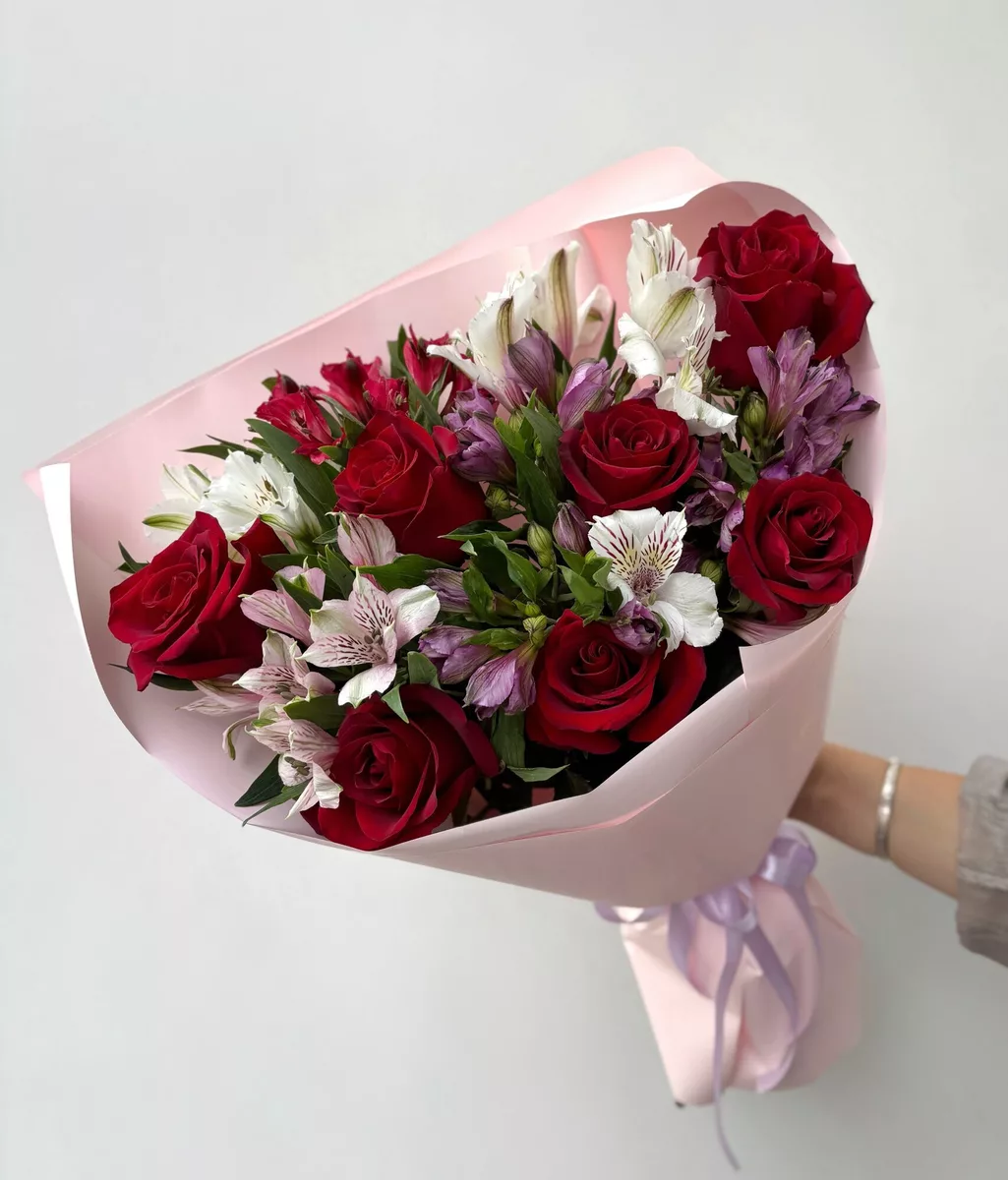

Red Roses: Romance, Intensity and Why Count Matters More Than You Think
Red roses are unambiguous in Russian culture: they read as romantic love, passion and serious personal feeling. Sending them to a business contact, a teacher or a relative you are not close to creates awkwardness that the recipient will feel even if they say nothing. Within romantic contexts, though, red roses are the single most requested flower we handle, and the number of stems carries its own message. An odd number — seven, eleven, fifteen, twenty-five — is the Russian standard for a living gift. An even number is reserved for mourning, and this rule is taken seriously enough that a bouquet of ten red roses will genuinely unsettle some recipients. We see this mistake most often from customers ordering from Western Europe or North America where even numbers in bouquets are unremarkable. The variety question matters for red roses more than almost any other colour because the range in quality is wide. Explorer and Red Naomi both have deep, true crimson tones and strong necks that do not droop when the head opens. Freedom is a slightly lighter, more scarlet red that photographs well but fades faster than the darker varieties. For delivery across Russia's distances, Red Naomi is the most resilient — it is bred for long vase life and handles temperature variation in transit better than thinner-petalled options. Keep red roses away from direct sunlight and fruit bowls; ethylene gas from ripening fruit accelerates petal drop significantly.
Pink Roses: The Widest Social Range of Any Colour
Pink is the most socially flexible rose colour in Russia, which is exactly why customers sometimes underestimate it. Light pink — the blush and cream-pink range — reads as gentle affection, care and warmth without romantic intensity, making it appropriate for mothers, grandmothers, close female friends, children's events and get-well arrangements. Deeper pinks, moving toward fuchsia and hot pink, carry more energy and are often chosen for birthdays and congratulations where white feels too formal and red too loaded. This range means you can send pink roses to almost anyone without causing confusion, provided you match the shade to the relationship. Varieties in this range include Sweet Avalanche, a large-headed blush rose with exceptional longevity, and Aqua, a soft lilac-pink that sits between pink and lavender and suits customers who want something less expected. Lovely Rhodos is a strong mid-pink that works well in larger, fuller bouquets. One timing point worth knowing: pink roses, particularly the lighter varieties, are more sensitive to heat than red or white. In summer, when delivery vehicles move through Saint Petersburg's warmest weeks or when a bouquet crosses southern Russian cities, light pink petals bruise and brown at the edges faster than darker colours. We pack them with additional cool padding in warm months, but if you are ordering for delivery to a city that is significantly warmer than Saint Petersburg on a given day, mention it so we can adjust accordingly.
Yellow Roses: The Colour with the Most Contested Reputation
Yellow roses are the colour we get the most questions about, and the questions almost always come from people who have heard the old Russian saying that yellow flowers mean separation or betrayal in a relationship. That association is real and it persists among older generations and in more traditional regions of Russia. Sending yellow roses to a romantic partner — especially early in a relationship — can land badly enough to require an explanation. However, the picture is more nuanced than a flat prohibition. Among younger urban Russians, particularly in Moscow and Saint Petersburg, yellow roses are increasingly read simply as cheerful and energetic, associated with friendship, new beginnings and congratulations. The safest application is a professional or friendly context: a colleague's promotion, a friend's new job, a housewarming. If you are uncertain about the recipient's age or background, mixing yellow roses with white or cream stems softens the colour's standalone impact and shifts the reading toward warmth rather than provocation. Variety-wise, Sunmaster is a clear, saturated yellow with a strong stem and good vase life. Gelbe Dot is a softer, butter-yellow that suits mixed arrangements better than solo bouquets. Both varieties need slightly cooler storage than red roses — around six degrees Celsius — because yellow petals show heat stress earlier. A customer mistake we see regularly is ordering an all-yellow bouquet for a grandmother without knowing her views; it is worth a quick call to check before confirming that order.
Orange and Coral Roses: Energy, Enthusiasm and the Underused Option
Orange and coral roses occupy a gap in Russian etiquette that works strongly in their favour: they carry none of the weight of red, none of the ambiguity of yellow, and they read as enthusiastic, celebratory and warm. In practice, this makes them excellent for birthdays, sports achievements, creative milestones and any occasion where you want to convey genuine excitement without romantic implication. They are also one of the better choices for mixed-gender professional settings — a team celebration, for instance — because the colour reads as energetic rather than personal. Coral sits closer to pink on the spectrum and softens the reading slightly; it is a common choice for younger recipients and creative professionals. True orange reads bolder and suits recipients who have an expressive personal style. Among varieties, Lambada is a vivid orange with a compact, high-petalled head that holds its shape well. Versilia moves between coral and salmon depending on the light, which makes it versatile for mixed bouquets. Vuvuzela is a strong orange-red that some customers use as a warmer alternative to classic red without the romantic coding. One practical note: orange roses are often less available in deep winter than in spring and summer because some varieties are seasonally dependent. If you are planning an order in January or February, check availability a day ahead rather than assuming the full orange range is in stock — we will always tell you what we have and suggest the closest alternative if a specific variety is short.
Dark Pink, Burgundy and Deep Red Roses: Depth, Sincerity and Formal Occasions
Dark pink shading into burgundy and very deep red represents a different register from bright red — less about passion and more about depth of feeling, sincerity and long-standing respect. In Russian culture, deep burgundy roses are often chosen for significant anniversaries, for expressing gratitude to someone who has done something genuinely important, or for formal occasions where bright red would feel too showy. They are also frequently requested for milestone birthdays — fiftieth, sixtieth — where the recipient is being honoured rather than romanced. The darker the rose, the more formal and weighty the gesture tends to read, so matching the depth of colour to the gravity of the occasion is worth thinking about. Varieties in this range include Black Baccara, which is the darkest rose we regularly stock — a very deep burgundy that appears almost black in low light and suits dramatic, architectural arrangements. Tess is a rich, velvety burgundy with a strong fragrance, which is relatively rare among commercially grown roses. Cardinal is a deep crimson-burgundy that sits between classic red and true burgundy and is often used when a customer wants more intensity than red without the full formality of near-black tones. Dark roses need careful temperature management: they show bruising less visibly than light colours, which can lead customers to assume they are hardier than they are. In fact, Black Baccara in particular is sensitive to ethylene and should be kept away from other flowers that are already opening, as well as from fruit. Vase life at eight to ten degrees with clean water and a fresh cut every two days runs to around six to eight days for most dark varieties.
The practical takeaway from all of this is that rose colour in Russia is not decoration — it is communication, and the recipient reads it whether or not you intended a message. Getting the colour right is the single biggest variable in whether a bouquet is received the way you hoped. White for respect and sincerity, red for romance with an odd stem count, pink for flexibility across almost any relationship, yellow with awareness of the recipient's background, orange and coral for celebration without romantic weight, and dark burgundy for depth and formality. Variety choice and temperature handling are what determine whether that colour still looks the way it should when the bouquet arrives — which is where the florist's job begins rather than ends. Доставим букет по России за 1–2 часа.
Frequently asked questions
Is it really true that even numbers of roses are inappropriate in Russia?
Yes, and it is taken seriously enough that it affects how a bouquet is received. Even numbers of flowers are associated with mourning in Russian tradition, so a gift of ten or twelve roses can unsettle a recipient even if they do not say so. Stick to odd numbers — seven, eleven, fifteen, twenty-five — for any celebratory or affectionate occasion. This applies to roses and to most other cut flowers.
Can I send yellow roses to a Russian colleague for a work achievement?
Yes, in a professional context yellow roses are generally safe, particularly for colleagues who are younger or based in major cities where the older association with separation has faded. If you are unsure of the recipient's background or age, mixing yellow with white or cream roses reduces any risk. Avoid yellow roses as a standalone romantic gesture, especially if you do not know the person well.
Which rose variety lasts longest when delivered across a long distance in Russia?
Red Naomi and Avalanche — in red and white respectively — are bred specifically for long vase life and handle temperature variation in transit better than many other varieties. Both have dense, high-petalled heads that open slowly. For any long-distance delivery, re-cutting stems at an angle and keeping them at eight to ten degrees Celsius in clean water extends vase life noticeably regardless of variety.
Are dark burgundy roses like Black Baccara suitable for a birthday?
Yes, particularly for milestone birthdays where you want to convey genuine respect and depth of feeling rather than a light celebratory tone. Black Baccara suits recipients who appreciate drama and formality in a bouquet. It is less appropriate for children's birthdays or casual celebrations where bright colours read better. Pair it with deep green foliage or white blooms rather than lighter pastels, which clash with its intensity.
Why do light pink rose petals sometimes arrive with brown edges?
Light pink varieties are more heat-sensitive than dark ones, and petal edges bruise when roses are exposed to temperatures above fifteen degrees Celsius for extended periods during transit or packing. It is not a freshness issue with the original stem — it is a handling issue. When ordering light pink roses for delivery to warmer cities or during summer months, mention the destination conditions so the bouquet can be packed with appropriate cooling.
Ready to send a bouquet?
Pick a city, choose the flowers, and we will hand them over with a photo confirmation.
Choose a city →