
Flower Delivery to Asha from Abroad: Zones, Timing and What to Prepare
Asha is a small industrial town in the Chelyabinsk Oblast, sitting in the southern Urals roughly 1,400 kilometres east of Moscow. Senders calling from Germany, the United States or Israel almost always ask the same first question: can you actually get fresh flowers there the same day? The honest answer is yes, with the right preparation. What follows is everything a sender outside Russia needs to know — varieties that survive the Ural climate, how to place an order across time zones, what Russian recipients expect, and the mistakes that turn a good intention into a wilted bunch.
Geography and Delivery Timing for Asha
Asha sits on the western slope of the Southern Urals, close to the border between Chelyabinsk and Bashkortostan oblasts. The town has about 25,000 residents, a compact street grid, and addresses that follow a standard Russian format of street name, building number, and apartment number. Delivery within Asha itself typically takes one to two hours from the moment the order is confirmed and the bouquet is assembled. The critical variable for international senders is the time-zone gap. Asha runs on Yekaterinburg Time, which is UTC plus five, with no daylight saving adjustment. That means a sender in London placing an order at 9 a.m. local time is already looking at 2 p.m. in Asha, which is still well inside the working delivery window. A sender in New York at 9 a.m. Eastern is reaching us at 5 p.m. Asha time, which is close to the edge of same-day delivery. Orders placed before noon Asha time almost always go out the same day. Orders that arrive in the afternoon can usually still be fulfilled if the recipient is home in the evening. The single most important thing an international sender can do is place the order early in their own morning, before starting work, rather than waiting until evening when the time difference has already eaten the delivery window. We ask for a confirmed phone number for the recipient because our courier calls ahead — this is standard practice across Russia and not something to skip.
Bouquets we can deliver



What Asha's Climate Means for Flower Choice
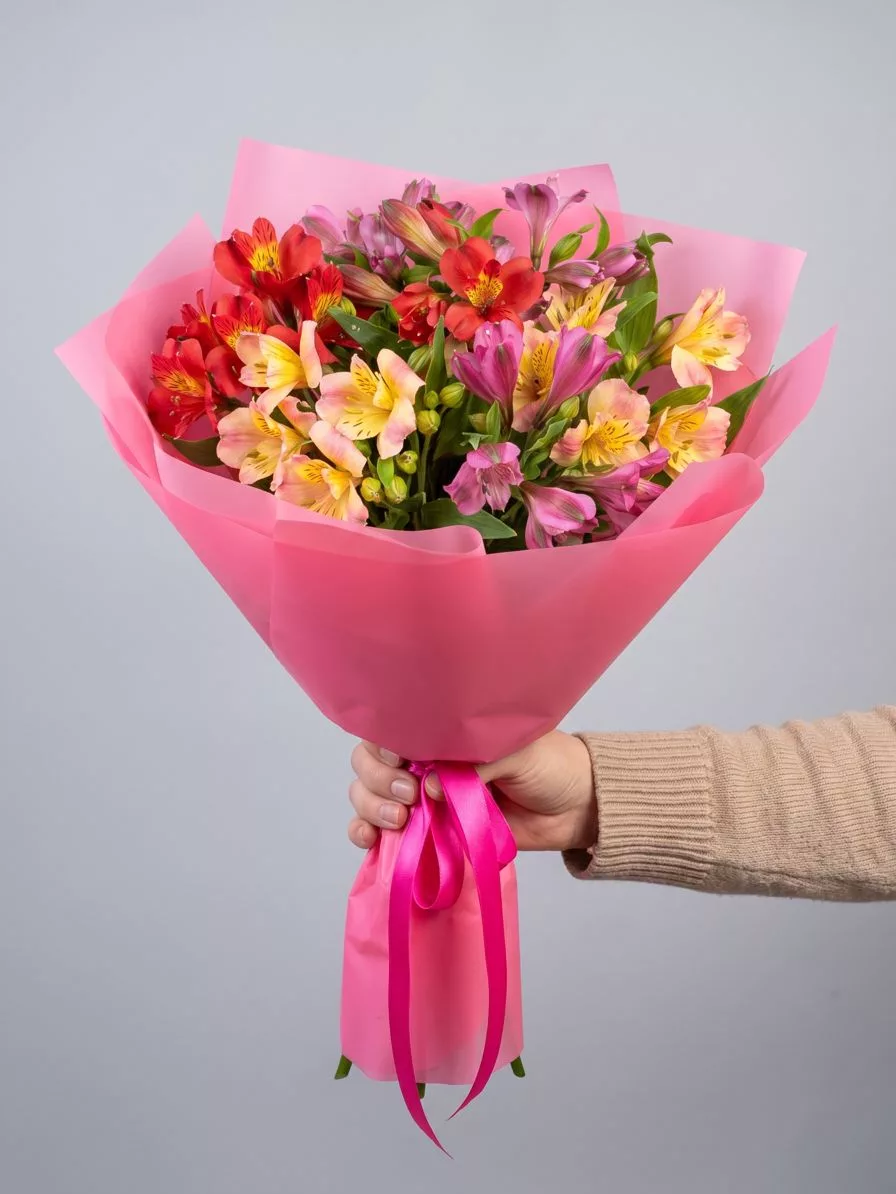
The Southern Urals have a sharply continental climate. Winters are long and genuinely cold, with January averages well below minus fifteen Celsius and occasional drops past minus thirty. Summers are short but warm, reaching into the high twenties. This matters for flower selection because bouquets travel from our Saint Petersburg warehouse and must survive both the logistics chain and, in winter, the final walk from the delivery vehicle to the recipient's door. Roses are the backbone of Asha deliveries year-round. Ecuadorian long-stem varieties — Grand Prix, Explorer, Red Naomi — hold their petals well in cold and do not bruise easily during transit. Dutch spray roses such as Bombastic or Lydia work well in mixed arrangements and add volume without adding fragility. In spring, from late March through May, tulips from Dutch growers are extremely popular and hold up well because they are cut tight and open gradually after delivery. Chrysanthemums, both single-headed santini types and large disbud varieties, are reliable across all seasons because they are robust and long-lasting. In summer, lisianthus and alstroemeria are good choices — both travel well and last ten days or more in a vase. What to avoid in deep winter: open garden roses with thin petals, tropical birds of paradise if the recipient lives above the third floor with a long exposed stairwell, and any arrangement built around hydrangea, which wilts quickly if it hits frost even briefly. In summer, peonies are available and popular but must be ordered when in season, typically May through July.
How to Place an Order from Outside Russia
The process is straightforward but has a few points that trip up international senders every time. First, the recipient's address must be written in Russian or transliterated clearly enough that our dispatcher can match it to a real street. Asha uses street names like ulitsa Lenina, ulitsa Mira, and prospekt Uralskiy — if you are not sure of the exact spelling, give us the name in Latin letters and we will verify it. Second, the recipient's phone number must be a working Russian mobile number in the format plus-seven followed by ten digits. We cannot call a foreign number to coordinate delivery. If your recipient has a Russian SIM card, that is the number to provide. If they only have a foreign number, ask them to be available near their door at the agreed time and note this in the order comments. Third, payment from abroad is handled by card through our international payment page, which accepts Visa and Mastercard issued outside Russia. Some European cards have been blocked for Russian transactions since 2022 — if your card declines, try a card issued in a different country or use a digital wallet. Fourth, write your card message in the order form in whatever language you like. We will print it on a card attached to the bouquet. If you write in English, the card will read in English — many recipients in Asha appreciate a message in the sender's own language as it feels more personal. Fifth, always double-check the delivery date in Asha local time, not your own time zone, before confirming.
Typical Bouquets That Work Well for Asha Recipients
Russian flower culture in smaller Ural cities leans toward full, generous arrangements rather than minimalist European-style single-variety bunches. A bouquet of fifteen or twenty-one roses in a single strong colour — deep red, bright coral, or clean white — reads as a serious, respectful gift and is universally understood. Odd numbers are traditional in Russia for gifts to the living; even numbers are associated with mourning and should be avoided. This is not a superstition you need to explain to the sender, but it is one the florist applies automatically when building the arrangement. For birthdays, a mixed bouquet combining roses with alstroemeria, decorative greens like ruscus or pittosporum, and a few spray chrysanthemums is a practical and well-received choice because it lasts well in an apartment and does not require any special care from the recipient. For anniversaries or romantic occasions, a mono-bouquet of premium long-stem roses in a kraft paper wrap is the most traditional choice. Tulip bouquets — twenty-five or fifty stems — are enormously popular for Women's Day on March 8th, which is the single busiest delivery day of the year in Russia. If you are sending around that date, order at least three to four days in advance because demand is extreme. For a thank-you or congratulatory gift without a specific occasion, a round hatbox arrangement filled with garden roses or spray roses is a format that photographs beautifully and is increasingly popular with younger recipients in Russian cities. The hatbox travels well and does not require a vase, which matters in small apartments.
Russian Gifting Customs a Foreign Sender Should Know
A few customs are worth knowing so you do not accidentally send the wrong signal. Yellow flowers carry a complicated reputation in Russian popular culture — some people associate them with separation or bad luck, while younger generations do not attach any meaning to them at all. If you are sending to someone over fifty or to a more traditional household, it is safer to choose another colour unless yellow is specifically requested. White flowers are appropriate for any celebratory occasion and are not restricted to weddings or funerals as they sometimes are in Western Europe. Red roses are the standard romantic choice and carry no ambiguity. As mentioned, even numbers of flowers should be avoided for gifts. Thirteen is not considered unlucky in Russian culture the way it is in some Western countries, so a bouquet of thirteen roses is perfectly fine. It is common in Russia for the recipient to receive a call or message from the sender on the same day as the flowers arrive — the bouquet opens the conversation rather than replacing it. If you are in a very different time zone and cannot call, a warm written message on the card matters more than it might in other cultures. Russians tend to keep flowers until they are completely spent rather than throwing them out early, so a long-lasting variety is genuinely appreciated. Finally, tipping the courier is not expected but is warmly received — if you want to add a tip, you can note it in the order and we will pass it along.
What Can Go Wrong and How to Prevent It
The most common problem with international orders to Asha is an unreachable recipient. Our courier calls before arriving, and if no one picks up after two attempts, the delivery is held and rescheduled. This adds a day and sometimes means the flowers are less fresh on the second attempt. The fix is simple: tell the recipient a bouquet is coming, even if you want to keep the contents a surprise. You do not have to say who it is from. Just say something is being delivered and they should answer calls from unknown numbers that day. The second most common problem is an incomplete address. Asha has several residential areas with similar street names, and an address without a building number or apartment number cannot be delivered. If you are not certain of the recipient's exact address, ask them directly before placing the order. The third issue is payment failure. Cards issued in the EU and UK sometimes decline on Russian merchant accounts. Have a backup payment method ready. The fourth issue is seasonal unavailability. If you have seen a specific flower in a photo and want to replicate it exactly, check with us first — some varieties are only available for a few weeks a year. We will always suggest the closest available alternative, but it is better to confirm before the order is placed than to be surprised by a substitution. Finally, orders placed with very short notice — under two hours before a specific event time — carry real risk. Build in at least three to four hours of buffer if the delivery must coincide with a party, dinner, or celebration.
Seasonal Calendar for Ordering Flowers to Asha
January and February are reliable months for roses, chrysanthemums, and carnations. Tulips begin appearing in good quality from late January onward as Dutch greenhouse production peaks. February 14th sees a moderate spike in orders from abroad, but the real Russian peak is March 8th — Women's Day — which is a national holiday treated with the same commercial intensity as Valentine's Day in Western countries. Every woman in Russia expects flowers on March 8th, and if your recipient is female, sending flowers that day is never wrong. April and May bring locally grown tulips and the first peonies from southern growing regions. Peonies are available through June and sometimes into early July depending on the year. Summer months from June through August offer the widest variety: lisianthus, eustoma, sunflowers, alstroemeria, and a full range of premium roses. September is excellent for dahlias and late-season roses, and the quality of imported Dutch stems is high because cool temperatures reduce transit stress. October through December see the return of a more limited palette — roses, chrysanthemums, and spray varieties dominate. Poinsettias are available from late November for New Year's gifting, which in Russia is celebrated on January 1st with the same weight as Christmas in Western countries. The New Year period — roughly December 28th through January 2nd — is another high-demand window when advance ordering is strongly recommended. Russian Orthodox Christmas falls on January 7th and is observed quietly in most households; flowers are not a standard gift for that date but are not inappropriate either.
Ordering flowers to Asha from abroad is entirely practical once you account for the time-zone arithmetic, have a confirmed Russian phone number for the recipient, and choose varieties suited to the season and the Ural climate. The town is small enough that our couriers know it well, and a correctly placed order with a complete address and reachable recipient almost always delivers within the promised window. The florist's advice is always the same: place the order in your morning, not your evening, choose a robust variety over a delicate one if you are sending in winter, and leave a real message on the card — it matters more than the size of the bouquet. We deliver bouquets across Russia in 1–2 hours.
Frequently asked questions
Can I order flowers to Asha if I don't speak Russian?
Yes. Our order form and dispatcher communication are available in English. Provide the recipient's address in Latin letters if needed and we will verify the Russian spelling before dispatch. Your card message can be written in any language and will be printed exactly as you write it.
What is the latest time I can place a same-day order to Asha?
Orders confirmed before approximately noon Asha time — UTC plus five — are reliably fulfilled the same day. Orders arriving in the early afternoon can often still go out for an evening delivery. Anything received after 5 p.m. Asha time is scheduled for the following morning unless you have arranged for a late-evening delivery window in advance.
Why should I avoid even numbers of flowers in a Russian bouquet?
In Russian tradition, even numbers of flowers are associated with mourning and are brought to funerals. Odd numbers are used for all celebratory and romantic occasions. This is a widely observed convention across generations and regions. Our florists automatically apply this rule when building arrangements, so you do not need to calculate it yourself.
My card was declined when trying to pay. What should I try next?
Some European and British cards are blocked from processing payments to Russian merchants due to sanctions restrictions introduced in 2022. Try a card issued in a different country — US-issued Visa and Mastercard cards currently work reliably. Digital wallets linked to non-European accounts are another option. Contact our dispatcher by email if you continue to have trouble and we will find a solution.
Do I need to tell the recipient the flowers are coming?
You do not have to reveal who is sending or what is in the bouquet, but we strongly recommend telling the recipient to expect a delivery and to answer calls from unknown numbers that day. Our courier calls ahead before arriving. If there is no answer after two attempts, delivery is postponed and the flowers may lose a day of freshness before the second attempt.
Ready to send a bouquet?
Pick a city, choose the flowers, and we will hand them over with a photo confirmation.
Choose a city →