
Flower Delivery to Gvardeysk from Abroad: Zones, Timing and Varieties
Gvardeysk sits in the Kaliningrad region, which means it is geographically separated from mainland Russia — and that one fact changes almost everything about how a sender abroad should plan a flower order. Customers calling us from Germany, the UK, Israel or the United States often assume the process is identical to sending flowers to Moscow or Saint Petersburg. It is not. The city is small, the delivery window is real, and the choice of varieties matters more than it does in a large metropolitan centre where stock is replenished daily. This article covers what you actually need to know before you place the order, so the bouquet arrives fresh and on time.
Where Gvardeysk Is and Why It Matters for Delivery
Gvardeysk is a small city of roughly 13,000 people located about 35 kilometres east of Kaliningrad, the regional capital. The Kaliningrad region is an exclave: it shares borders with Poland and Lithuania but has no land connection to the rest of Russia. This geography means that flower stock reaching Gvardeysk travels a different supply chain than flowers going to, say, Kazan or Novosibirsk. Transit times from major wholesale hubs are longer, and the assortment available on any given day is narrower. When you are ordering from abroad, you should factor this in from the start rather than expecting the same same-day variety availability you might find in a city of one million. The city itself is compact, which is actually an advantage once the flowers are in the region: a courier can reach most addresses within the city limits in under thirty minutes from the Kaliningrad base. What takes time is the regional leg, not the last-mile delivery. Senders from Europe sometimes assume that being geographically close to Kaliningrad means faster or cheaper delivery — proximity of the sender's country to the exclave is irrelevant, because the order is processed and dispatched from our Saint Petersburg operation and coordinated through the regional network. Understanding this from the outset prevents the most common misunderstanding we hear from international customers: that a sender in Berlin should somehow get faster service than a sender in Toronto. They get the same process.
Bouquets we can deliver



Realistic Delivery Windows When Ordering from Outside Russia
Five Flowers delivers fresh flowers across Russia within one to two hours for orders placed in time, and Gvardeysk is within that service geography. However, when you are placing the order from abroad, the clock starts not when you decide to send flowers but when the order is confirmed and payment is cleared. International card transactions occasionally require additional verification, and that step alone can add twenty to forty minutes. The practical advice is to order at least three hours before you want the flowers to arrive, not one. If you are ordering across time zones — say, from Los Angeles in the evening your time — be precise about what time it is in Kaliningrad, which runs on Moscow time, UTC plus three. A sender in California at 8 p.m. is looking at 7 a.m. the next day in Gvardeysk, which is before our delivery operations begin for that day. The earliest reliable delivery window starts at 8 a.m. Kaliningrad time, and the latest same-day order we can take is typically placed by 8 p.m. Kaliningrad time. Orders placed outside those hours are scheduled for the next available slot, which we confirm with the sender by email or messenger. Same-day delivery to Gvardeysk is genuinely possible, but it requires the order to land in our system during working hours in the Moscow time zone. That is the single most common timing mistake international senders make, and it is entirely avoidable with a quick time-zone check before you start the order form.
Which Varieties Hold Up Best for Gvardeysk Deliveries
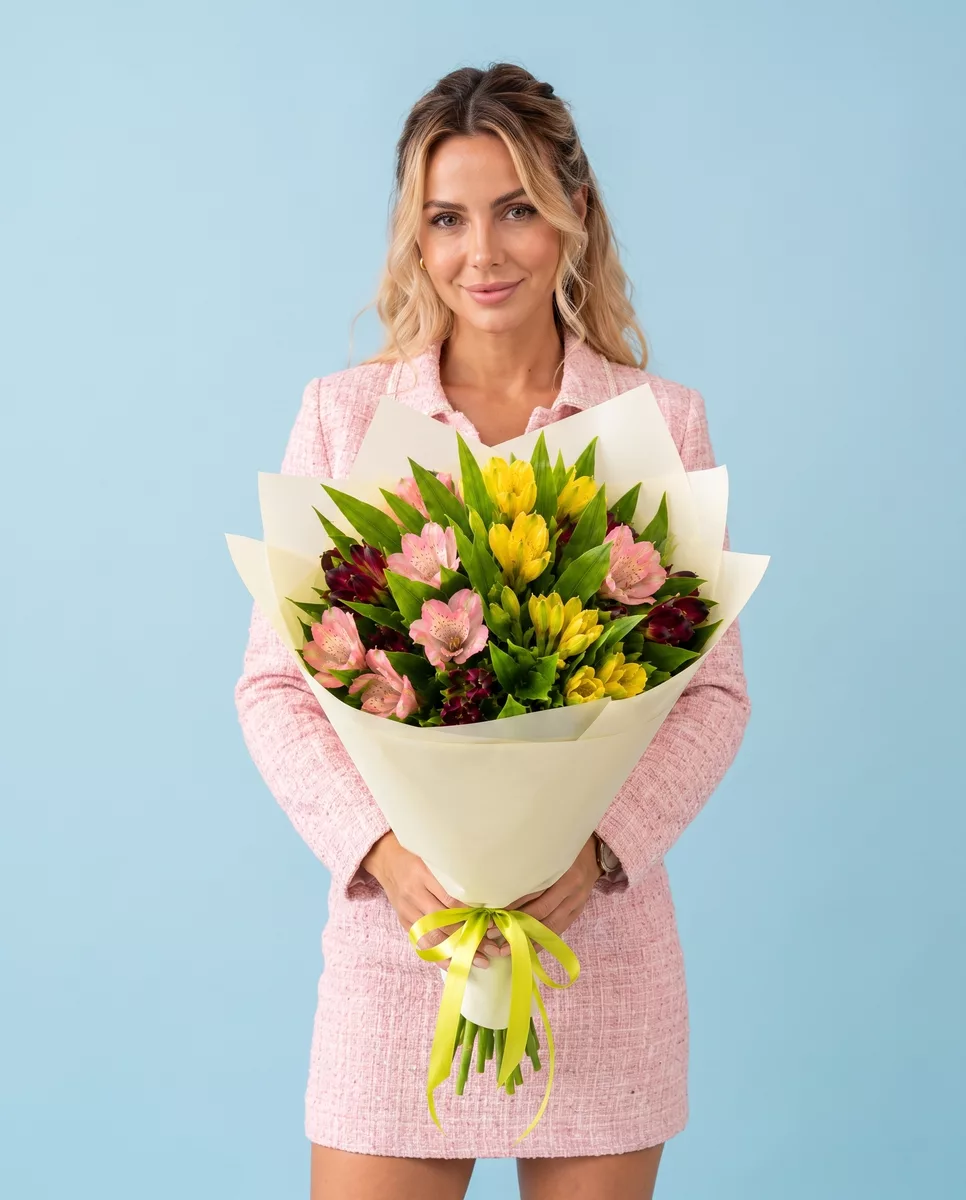
Because the supply chain for the Kaliningrad exclave involves additional transit compared to central Russian cities, variety selection matters more than usual. You want flowers that are robust enough to handle the journey without wilting, and that will still look presentable for two to five days after delivery. Roses are the safest choice: a classic spray of garden roses or large-headed varieties such as Explorer or Avalanche hold their form well in transit conditions. Chrysanthemums — both the single-headed santini type and the larger disbud varieties — are exceptionally hardy and arrive in good condition even after a long regional journey. Alstroemeria is another reliable option: it is compact, long-lasting, and tolerates temperature variation better than, for example, garden ranunculus or sweet peas, which are beautiful but fragile. Eustoma, sometimes sold as lisianthus, is a popular choice in Russian floristry and travels reasonably well when cut at the right stage — buds that are just beginning to open rather than fully bloomed flowers. Tulips are seasonal: in winter and early spring they are plentiful and arrive firm; in summer heat they wilt faster and are a riskier choice for a city like Gvardeysk where the final leg of delivery is in warmer ambient temperatures. Hydrangeas look impressive but require very careful handling of water during transit, and we advise against them as a standalone choice for long-distance regional orders. When in doubt, a mixed bouquet built around roses and chrysanthemums with seasonal greenery is the most dependable option for a sender who cannot verify local stock in advance.
Seasonal Temperatures and What They Do to Flowers in Transit
The Kaliningrad region has a maritime climate, which means winters are milder than in most of Russia but summers can be genuinely warm and humid. For flower delivery, this creates two distinct problem seasons. In summer, from June through August, ambient temperatures in Gvardeysk regularly reach 22 to 28 degrees Celsius, and a bouquet sitting unrefrigerated in a courier vehicle for even forty minutes will show stress — petals soften, stems begin to droop, and roses in particular start to open faster than intended. We package flowers for warm-weather transit with insulating wrapping and ice packs where necessary, but the recipient should be informed to place the bouquet in water immediately upon arrival and keep it away from direct sunlight and heating vents. In winter, the risk flips: temperatures in January and February average around zero to minus five Celsius, and unprotected flowers can sustain frost damage during the short walk from the courier vehicle to the door. Tulip stems blacken at the tips when frozen even briefly. We use thermal packaging for cold-weather deliveries, but the recipient should unwrap the bouquet promptly and let it acclimatise at room temperature for fifteen minutes before trimming the stems and placing them in water. Spring and autumn are the most forgiving seasons for flower delivery in this region — temperatures are moderate, humidity is reasonable, and most varieties arrive in excellent condition. If you are planning a flower gift for a specific occasion and have flexibility on the date, late April, May, September and October give the best results for variety and condition.
How to Fill in the Delivery Address Correctly from Abroad
Address formatting is one of the most frequent sources of delay in international orders, and Gvardeysk presents a specific challenge because the city was known as Tapiau before 1946, and some older residents or non-Russian mapping tools may use variant spellings or the historical name. When filling in the order form, use the Russian spelling Gvardeysk in Cyrillic if the form accepts it, or the transliteration Gvardeysk in Latin characters — not Gvardeisk, not Guardeysk, and certainly not Tapiau. The region field should read Kaliningradskaya oblast, not just Kaliningrad, because Kaliningrad is also the name of the regional capital city and the two are sometimes confused. Include the full street name, building number, apartment number if applicable, and the entrance number for multi-entrance Soviet-era apartment blocks — these are common in Gvardeysk and a missing entrance number can add fifteen to twenty minutes to the delivery while the courier locates the right door. The recipient's mobile phone number is not optional. Our courier will call ahead in Russian, so if the recipient does not speak Russian, it is worth noting in the order comments that the recipient prefers to be contacted by text message or that a neighbour or family member who speaks Russian will be available. Providing a second contact number — a relative or colleague who can receive the call — is a practical solution many international senders use. A precise address with a working phone number is the single most reliable way to ensure the delivery completes on the first attempt.
Payment, Currency and What International Senders Should Expect
Ordering from outside Russia means you will be paying in a foreign currency, and the transaction goes through an international payment gateway. Most major credit and debit cards are accepted, including Visa and Mastercard issued in European countries, the United States, Israel and other markets we regularly serve. Some Russian-issued cards and certain regional bank cards from sanctioned institutions will not process, but this is relevant to the recipient, not the sender abroad. The price you see on the order form is displayed in Russian roubles, and your bank will convert at its current exchange rate at the moment of transaction. Exchange rates fluctuate, so the rouble amount you see today may translate to a slightly different figure in euros or dollars by the time you check your statement — this is normal and not an error. If your card is declined on the first attempt, the most common reasons are: your bank's fraud detection flagging an unfamiliar Russian merchant, a spending limit set on international transactions, or a temporary gateway issue. Trying again after a few minutes, or using a different card, resolves the problem in most cases. We do not store card details. Once payment is confirmed, you receive an order confirmation by email with the order number and the estimated delivery window. If you do not receive this email within ten minutes of completing the payment step, check your spam folder before assuming the transaction failed — our confirmation emails occasionally land in spam filters set up by corporate email systems, particularly those used by senders in Germany and the United States.
Card Messages, Russian Customs and What to Write
A handwritten card accompanies every bouquet we deliver, and this is where international senders sometimes need a little guidance on Russian customs. In Russia, flowers are given for a wide range of occasions — birthdays, name days, professional anniversaries, school graduations, promotions, visits, and simply as a gesture of affection with no occasion at all. There is no strong cultural association between specific flower colours and specific meanings the way there is in some Western European traditions, so you do not need to worry that red roses signal something different from pink ones. What does matter is the number of flowers in a bouquet: an even number of stems is traditionally associated with funerals, so bouquets for living recipients are always assembled with an odd number — five, seven, eleven, fifteen and so on. We follow this convention automatically, but if you are ordering a custom arrangement and specifying stem counts, keep odd numbers in mind. The card message can be written in any language — we print it exactly as you submit it. If you write in English, the recipient will receive an English message, which is fine and often appreciated as something personal and distinctive. If you would like the message in Russian but do not write Russian yourself, you can submit it in English and note in the order comments that you would like a translation — we will do our best to render the sentiment accurately. Keep the message warm and direct: Russian recipients respond well to specific, sincere words rather than generic phrases, and a short personal sentence means more than a long formal greeting.
Sending flowers to Gvardeysk from abroad is straightforward once you understand the geography of the Kaliningrad exclave, the Moscow time zone, and the importance of a precise delivery address with a working phone number. The city is fully within our delivery area, the varieties available are real and reliable, and the process from order to doorstep works the same way it does for any other Russian city — it just requires a little more attention to timing and address detail from a sender who cannot make a quick phone call in Russian to sort out a last-minute question. Get those three things right — time zone, address, phone number — and the bouquet will arrive fresh. We deliver bouquets across Russia in 1–2 hours.
Frequently asked questions
Can I order flowers to Gvardeysk from a country outside Russia on the same day?
Yes, same-day delivery to Gvardeysk is possible if your order is placed and payment is confirmed before 8 p.m. Kaliningrad time, which runs on Moscow time UTC plus three. Check the time difference carefully before ordering — a sender in Western Europe is two hours behind Kaliningrad, and a sender on the US East Coast is eight hours behind.
What happens if the recipient is not home when the courier arrives in Gvardeysk?
The courier will call the recipient's mobile number before arriving. If there is no answer, they will attempt delivery once more and then contact you as the sender. Providing a second local contact number in the order comments — a neighbour or family member — significantly reduces the chance of a missed delivery, especially if the recipient is elderly and may not always have their phone to hand.
Are there flower varieties I should avoid ordering for Gvardeysk in summer?
Tulips and open-headed hydrangeas are the most heat-sensitive options and are harder to guarantee in peak summer condition during the Kaliningrad region's warmer months. Roses, chrysanthemums, alstroemeria and eustoma are more reliable choices from June through August. If you want tulips specifically, late autumn through early spring is the better window for this city.
Can the card message be written in a language other than Russian?
Absolutely. We print the card message exactly as you submit it, in any language. English, German, Hebrew and other languages are common among our international customers. If you would like the message translated into Russian, note this in the order comments and we will provide a translation before the bouquet is prepared.
Why does the bouquet always have an odd number of flowers?
In Russian tradition, even numbers of stems are associated with funerals and mourning, so gifts for living recipients are always assembled with an odd number — five, seven, eleven, fifteen and so on. We follow this convention automatically for every bouquet we prepare. If you specify a custom stem count, choose an odd number to stay within accepted custom.
Ready to send a bouquet?
Pick a city, choose the flowers, and we will hand them over with a photo confirmation.
Choose a city →