
Sending Flowers to Katav-Ivanovsk from Abroad: What You Need to Know
Most calls we get from senders outside Russia start the same way: someone in Berlin or Toronto wants to surprise a relative in Katav-Ivanovsk and has no idea whether it is even possible, how long it takes, or which flowers survive the trip. Katav-Ivanovsk is a small industrial town in the Chelyabinsk Oblast, set in the southern Urals at roughly 600 metres above sea level. The climate is continental and sharp — winters drop well below minus twenty, summers are short and warm. That geography shapes every decision about what to order, when to order it, and what to write on the card.
Where Katav-Ivanovsk Sits and Why Geography Matters for Flowers
Katav-Ivanovsk sits on the Katav River in the Ural Mountains, about 200 kilometres west of Chelyabinsk. The town has roughly 17,000 residents, a single central district, and no large commercial flower infrastructure of its own. For a sender abroad, this means the logistics chain is longer than it would be for Moscow or Saint Petersburg, and the temperature window for safe transport is narrower. From October through March, outdoor temperatures regularly fall below minus fifteen degrees Celsius. Roses, gerberas and tropical stems like strelitzia are vulnerable to cold shock during the final stretch of delivery — even a short exposure to freezing air while a courier moves from a vehicle to a building entrance can cause petal blackening on thin-petalled varieties. Chrysanthemums, spray roses and alstroemeria handle the cold considerably better because their cell structure is denser and less prone to ice crystal damage. In summer, the opposite problem appears: Katav-Ivanovsk can reach plus thirty-five in July, which accelerates wilting in tulips and ranunculus if transit time is not managed tightly. Knowing the current local temperature before you confirm your order is not optional — it is the first practical step. Any experienced florist handling Ural deliveries will factor seasonal conditions into which stems they cut and pack for that specific town. When you place an order from abroad, give the shop the recipient's full street address including the apartment number and the building entrance code if there is one, because Katav-Ivanovsk residential blocks often have intercoms and a missed delivery in cold weather means the bouquet waits outside.
Bouquets we can deliver

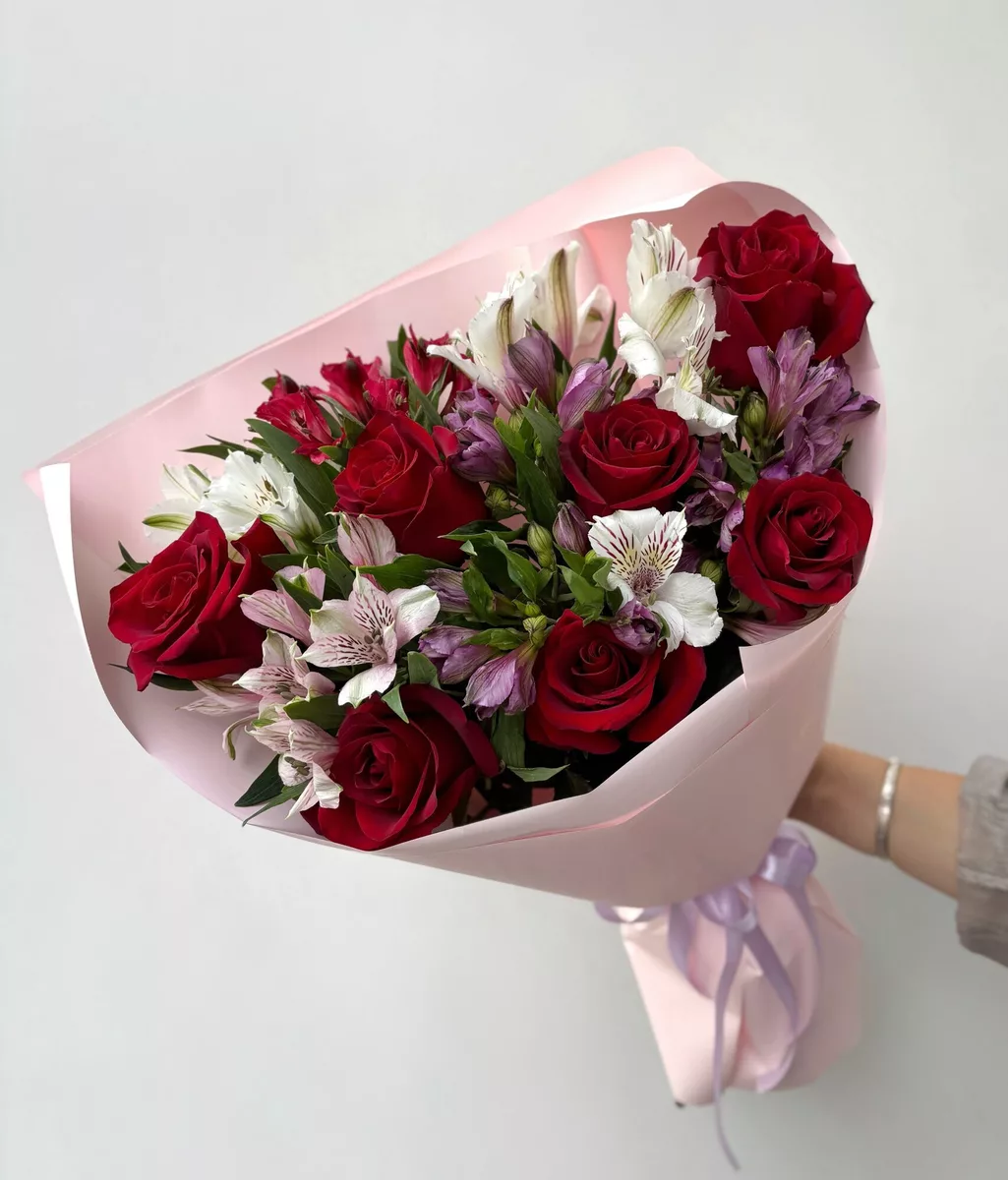


How Delivery from Saint Petersburg Reaches Katav-Ivanovsk
Five Flowers is based in Saint Petersburg and delivers across Russia, including to Chelyabinsk Oblast. Katav-Ivanovsk is not a same-day courier city in the way that Moscow or Yekaterinburg are. The standard window for this destination is one to two days from order confirmation, and the final leg uses a regional courier network operating out of Chelyabinsk or Ufa. This is the single most important timing fact for a sender abroad: if you want flowers to arrive on a specific date — a birthday, an anniversary, a name day — place your order at least 48 hours in advance. Cutting it to 24 hours is possible but carries risk, especially around major Russian holidays when courier capacity tightens sharply. The busiest dates are 8 March (International Women's Day), 14 February, and 1 September, when schoolchildren receive bouquets on the first day of the academic year. Around those dates, order three to four days ahead. Payment from abroad is straightforward: international bank cards including Visa and Mastercard are accepted through the shop's online checkout. You will receive an order confirmation by email in Russian and English, and a courier notification is sent to the recipient's Russian mobile number when the bouquet is on its way. If the recipient does not have a mobile number you can reach, leave a landline or ask the shop to call ahead using the address details. One common mistake from international senders is writing the delivery address in Latin script — always provide the Russian Cyrillic address or ask the shop to transliterate it correctly, because courier labels are printed in Russian.
Which Varieties Survive the Ural Climate Best
Choosing the right stems for Katav-Ivanovsk is not about aesthetics alone — it is about what arrives in presentable condition after a multi-stage journey through varying temperatures. In winter, the most reliable choices are spray chrysanthemums, standard chrysanthemums in white or yellow, alstroemeria in any colour, carnations, and hypericum berries used as filler. These varieties tolerate cold corridors, unheated vehicle compartments during loading, and brief outdoor exposure without visible damage. Roses can be included in winter bouquets but should be garden-type or spray roses with tightly closed buds rather than fully open hybrid tea varieties, which bruise easily. Eustoma, also called lisianthus, is a good mid-season choice — its layered petals are more resilient than they look, and it holds water well in a vase. In spring and early summer, tulips travel well to the Urals provided they are sent in bud stage, not open. Peonies are available from late May through June and are enormously popular with Russian recipients; they are robust enough for this route if the outdoor temperature is below plus twenty-five at both ends of the journey. In summer, gerberas are risky for long-distance delivery because their stems are hollow and they wilt quickly without water. Sunflowers, on the other hand, are surprisingly durable and remain a favourite for birthdays in the region. Avoid orchid stems, anthuriums, and bird of paradise for Katav-Ivanovsk deliveries in any season — they are tropical varieties that do not tolerate temperature fluctuation above a narrow band.
Bouquet Formats That Make Sense for This Destination
A sender abroad often asks whether a large, dramatic arrangement or a modest hand-tied bouquet is more appropriate for a recipient in a small Ural town. The honest answer is that Katav-Ivanovsk apartments are typically compact, and a massive arrangement in a heavy ceramic vase is impractical both to deliver and to keep. The most requested formats for this destination are hand-tied bouquets of 15, 21 or 25 stems, which arrive wrapped in kraft paper and ribbon, ready to place in any standard vase the recipient already owns. A 15-stem bouquet of spray chrysanthemums with eucalyptus is a solid everyday choice. A 21-stem mixed bouquet combining alstroemeria, carnations and seasonal greenery covers most birthday and anniversary occasions without overcomplicating the order. If the occasion is significant — a milestone birthday, a graduation, a major anniversary — 35 to 51 stems is appropriate, and combining two or three compatible varieties gives the bouquet visual weight without adding fragility. Boxed flowers in hat boxes are popular in larger Russian cities but are less practical for Katav-Ivanovsk because the box adds bulk during the final courier leg and offers no structural advantage over well-wrapped kraft paper for hardy varieties. Potted plants are not recommended for this route: soil adds weight, roots dry out during transit, and a pot that tips during transport ruins both the plant and the packaging. Stick to cut flowers in a hand-tied format and specify that the stems should be cut at an angle and wrapped with a water sachet at the base — this keeps them hydrated during the final hours of delivery.
Writing the Card: Russian Customs a Foreign Sender Should Know
A card message is not a small detail in Russian flower-giving culture — it is read carefully and often kept. If you are sending from abroad and writing in English, the shop can include your message as written, but many recipients in Katav-Ivanovsk, particularly older generations, read Russian more comfortably than English. It is worth providing your message in both languages or asking the shop to translate a short text. Keep the card text specific: the recipient's name, the occasion, and a personal line. Generic phrases like 'with love' without a name or occasion can confuse a recipient who may not immediately know who sent the flowers, especially if the delivery arrives as a surprise. Russian naming conventions use the patronymic — a middle name derived from the father's first name. Addressing someone as Irina Alexandrovna rather than just Irina is considered respectful and warm, particularly for recipients over 40. If you know the recipient's full name including patronymic, include it in the card address field when ordering. One cultural note that surprises many foreign senders: an even number of flowers in a bouquet is traditionally associated with mourning in Russia, so bouquets are almost always made in odd numbers — 11, 15, 21, 25, 35, 51. Reputable Russian florists follow this automatically, but if you are specifying a custom stem count, choose an odd number. Yellow flowers carry no negative meaning in Russian culture despite a persistent myth to the contrary — yellow tulips, yellow roses and yellow chrysanthemums are all given freely and received warmly across Russia.
Timing Your Order Around Russian Holidays and Local Events
Russia follows a specific public holiday calendar that directly affects flower delivery capacity and pricing. The dates that cause the sharpest demand spikes are 8 March, which is the biggest flower-giving day of the year by a wide margin, 14 February, 23 February (Defender of the Fatherland Day, when men receive gifts), and 1 September. Around 8 March, the entire Russian flower supply chain operates under pressure: wholesale prices rise, popular varieties sell out days in advance, and courier slots fill quickly. If you are sending for 8 March from abroad, place your order by 4 or 5 March at the latest. For 1 September, which is the traditional first day of school and a major occasion for giving flowers to teachers, order by 28 August. New Year in Russia is celebrated on 1 January with the same intensity that Christmas carries in Western Europe, and flower orders for 31 December and 1 January are heavy — plan accordingly. Beyond national holidays, Katav-Ivanovsk observes standard Russian civic dates. Name days, called imeniny, are personal celebrations tied to the Orthodox calendar and are sometimes more important to the recipient than their birthday. If you know the recipient observes their name day, confirm the date carefully — the Orthodox name day calendar differs from the Western Catholic one even for shared saint names. Finally, note that Russia uses the Gregorian calendar for civil purposes, so dates align with the international standard, but the Orthodox Christmas falls on 7 January rather than 25 December, and some families observe both dates.
What to Check Before Confirming Your Order from Abroad
Before you click confirm on a flower order to Katav-Ivanovsk from outside Russia, run through a short checklist that experienced senders use to avoid the most common problems. First, verify the recipient's address is complete in Russian Cyrillic: street name, building number, apartment number, and entrance code if applicable. An incomplete address is the leading cause of failed deliveries in small Russian towns. Second, confirm the recipient's Russian mobile number — this is the primary contact method for couriers, and without it, a missed delivery becomes difficult to resolve remotely. Third, check the current temperature forecast for Katav-Ivanovsk on the delivery date using any standard weather service; if it is below minus ten, discuss with the shop which varieties are safest for that day. Fourth, confirm your payment method works for international transactions — some cards require a one-time authorisation for purchases to Russian merchants, and a declined payment delays the order without notification unless you check your email promptly. Fifth, read the confirmation email carefully: it will state the expected delivery window, the bouquet composition, and the card text exactly as it will be printed. If anything is wrong, corrections are easiest to make within the first hour after ordering. Finally, if the occasion is time-sensitive — a birthday that falls on a specific hour, for instance — communicate that clearly in the order notes. Couriers in smaller cities like Katav-Ivanovsk often work morning and afternoon windows, and an early-morning delivery can sometimes be arranged with advance notice but not at the last minute.
Sending flowers to Katav-Ivanovsk from abroad is entirely achievable when you plan around the town's geography, the Ural climate, and the Russian calendar. The practical steps are straightforward: order 48 hours ahead for regular dates, three to four days ahead for major holidays, choose cold-tolerant varieties in winter and durable stems in summer, write the card in Russian if you can, and always provide a complete Cyrillic address with a working mobile number for the recipient. The florists who handle this route regularly know which stems travel well on a two-day journey through continental temperatures, and a brief conversation at the point of ordering — even by email — will get you a bouquet that arrives looking as though it was assembled that morning. We deliver bouquets across Russia in 1–2 hours.
Frequently asked questions
Can I pay for a Katav-Ivanovsk delivery using a non-Russian bank card?
Yes, international Visa and Mastercard payments are accepted through the shop's online checkout. Some issuing banks flag first-time purchases to Russian merchants and require a quick authorisation by the cardholder. Check your email after payment to confirm the transaction went through, and contact your bank in advance if you know your card has international restrictions.
How many days in advance should I order for an 8 March delivery to Katav-Ivanovsk?
Order by 4 March at the absolute latest, and ideally by 3 March. The 8 March holiday is the highest-demand flower date in Russia by a significant margin. Courier slots to smaller Ural cities fill faster than to major cities because capacity is more limited. Popular varieties like tulips and roses sell out at wholesale level several days before the holiday itself.
Is it true that yellow flowers are inappropriate to send in Russia?
No, this is a persistent myth with no basis in modern Russian practice. Yellow roses, yellow tulips and yellow chrysanthemums are given and received freely across Russia for birthdays, anniversaries and everyday occasions. The florists at Five Flowers include yellow stems in arrangements regularly without any concern from recipients. What does matter is the odd-number rule: always send an odd number of stems.
What happens if the recipient is not home when the courier arrives in Katav-Ivanovsk?
The courier will call the recipient's mobile number before arriving and again on arrival. If there is no answer, the courier will typically wait a short time and attempt a second call. If the recipient remains unreachable, the shop will contact you using the sender details from the order. Providing an accurate mobile number for the recipient is the single most important step to prevent a missed delivery.
Can I write the card message in English if the recipient does not read English well?
You can write in English and the message will be printed as given, but for recipients in Katav-Ivanovsk who are more comfortable in Russian, it is worth providing a Russian translation alongside your English text. The shop can assist with translating short personal messages if you explain the occasion and the key sentiment you want to convey. Specify this request in the order notes at checkout.
Ready to send a bouquet?
Pick a city, choose the flowers, and we will hand them over with a photo confirmation.
Choose a city →