
Flower Delivery to Kem from Abroad: Zones, Timing and Order Details
Kem is a small city in the Republic of Karelia, roughly 500 kilometres north of Saint Petersburg, sitting close to the White Sea coast. Senders calling from Finland, Germany, Israel or the United States often assume that ordering flowers to a remote Russian city works the same way as ordering to Moscow. It does not, and the differences are specific enough that a wrong assumption about timing or address format can turn a birthday bouquet into a missed delivery. Here is what you actually need to know before you place the order.
Why Kem Is Different from Ordering to a Major Russian City
Most international senders have experience sending flowers to Saint Petersburg or Moscow, where same-day delivery windows are wide and courier routes are dense. Kem operates on a different scale entirely. The city has a population of around 12,000 people, which means courier logistics are planned in tighter daily windows rather than on-demand dispatch every hour. When you place an order for Kem from abroad, the delivery timeline is calculated from the moment the order is confirmed and paid, not from the moment you first contact the shop. This distinction matters because international bank transfers or card authorisations from foreign-issued cards can add 15 to 40 minutes to the confirmation process, and that time counts against the same-day cutoff. The city's geography also plays a role. Kem is spread along the Kem River and has several distinct residential districts, so an incomplete address — a street name without a building number, or a building number without an apartment number — sends the courier to a dead end. Senders from abroad frequently write addresses in Latin script assuming the shop will transliterate them; it is faster and safer to ask the recipient to send you their address in Cyrillic and copy it directly into the order form. If you cannot do that, write the address in Latin and note that transliteration is needed — the shop's operators will handle it, but flag it explicitly so no time is lost. Karelia also has colder average temperatures than central Russia for most of the year, which affects which flowers travel well.
Bouquets we can deliver



Delivery Timing: What the 1–2 Hour Window Means for Kem
Five Flowers delivers fresh flowers across Russia within 1 to 2 hours, and that standard applies to Kem when orders are placed within the active delivery window for that region. For a city the size of Kem, the practical delivery window runs from mid-morning to early evening, with the last orders for same-day delivery accepted several hours before the final courier run. Senders in Western Europe are typically 2 to 3 hours behind Moscow time, and senders in North America are 7 to 10 hours behind. This means that what feels like a reasonable mid-afternoon order from Berlin or New York can arrive at the shop after the cutoff for same-day Kem delivery. The safest approach is to order at least one full day in advance, targeting delivery for the morning or early afternoon of the recipient's special day. If you are ordering for a birthday at noon Kem local time, placing the order the evening before from your time zone is the reliable move. Do not rely on same-day ordering from a significantly different time zone unless you have confirmed the current cutoff with the shop directly. One more timing factor: Kem observes Moscow time, which is UTC+3 and does not shift for daylight saving, since Russia abolished seasonal clock changes. When you calculate the order window, use Moscow time as your reference, not the time zone of the nearest major European city. Getting this arithmetic right once saves a conversation with the recipient explaining why the flowers arrived the next morning.
Which Flowers Survive the Journey to Kem in Good Condition
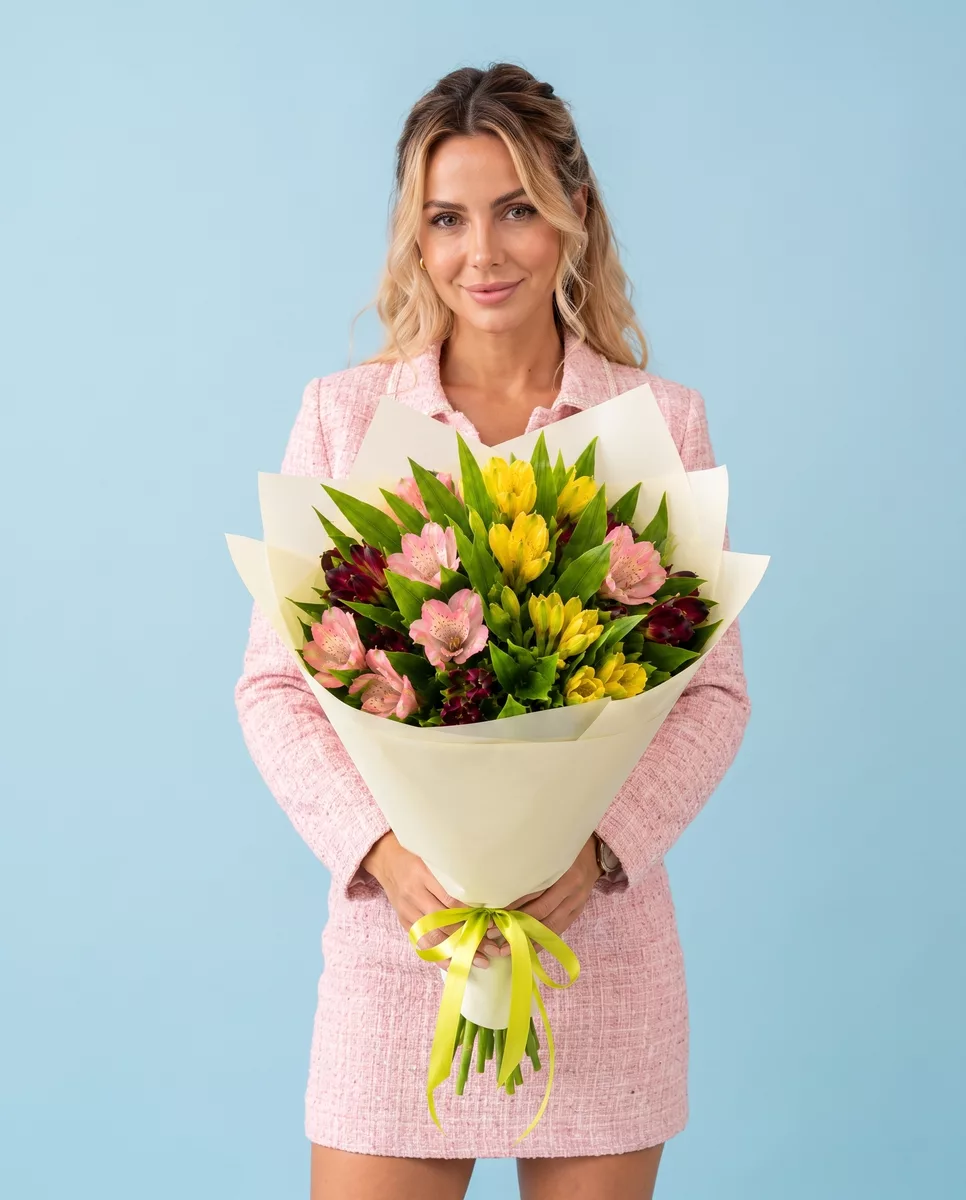
Karelia's climate is cold and humid for most of the year, with temperatures in Kem regularly dropping below zero from October through April and staying cool even in summer. This is actually an advantage for flower longevity in transit, because cold air slows the cellular processes that cause petals to degrade. The varieties that perform best in these conditions are roses, particularly large-headed varieties like Explorer and Avalanche, which have dense petal structures that resist bruising and cold shock. Chrysanthemums, both spray and single-stem, are exceptionally robust and arrive in Kem looking nearly identical to how they left the workroom. Alstroemeria holds well in cold transit and offers a wide colour range, making it practical for mixed bouquets. Eustoma, also called lisianthus, is another reliable choice: its layered petals are less fragile than they appear, and it opens gradually after delivery, giving the recipient several days of development to enjoy. What does not travel as well to Kem in colder months is tropical or thin-petalled material: anthuriums can show cold damage at temperatures below 10 degrees Celsius, and garden roses with very open blooms can arrive with bruised outer petals if the courier route is long. Tulips in spring are fine — they are cold-tolerant by nature — but they open fast in a warm apartment, so they suit recipients who will put them in water immediately. When in doubt, ask the shop to build the bouquet around roses and chrysanthemums: these are the workhorses of long-distance Russian delivery for a reason.
What Address Information You Must Have Before You Order
This is the section where most international orders run into problems. Russian addresses follow a specific format that differs from Western conventions, and missing one element makes delivery impossible or significantly delayed. A complete Kem address includes the street name, building number, apartment number if it is a residential building, and the recipient's full name and phone number. The building number in Russia can include a corpus designation — written as korpus or abbreviated as k — which indicates a secondary structure within a numbered plot. If your recipient lives at building 14, korpus 2, apartment 37, all three of those numbers matter. Writing only building 14 sends the courier to the wrong entrance of the wrong structure. The recipient's phone number is not optional: couriers in Kem call ahead to confirm they are at the right address, and without a working Russian mobile number the delivery stalls. If your recipient uses a Russian SIM card, that number is what you need. If they rely on a messenger app like WhatsApp or Telegram linked to a foreign number, note that in the order comments so the courier knows to call via the app rather than a standard call. The street name should be in Cyrillic if at all possible. Common Kem street names include Prospekt Lenina, Ulitsa Engelsa and Ulitsa Primorskaya — if you recognise one of these, confirm the exact spelling with the recipient rather than guessing. Postcodes for Kem start with 186, and including the postcode speeds up internal routing even if it is not strictly required.
Payment from Abroad: Cards, Currencies and What to Expect
Paying for a Russian flower delivery from outside Russia involves a small number of friction points that are worth knowing about before you sit down to order. Five Flowers accepts international bank cards, but the authorisation process for cards issued outside Russia — particularly those issued in the United States, United Kingdom or European Union — can take longer than for Russian-issued cards. Some international cards are declined at the first attempt due to bank-side fraud filters; if this happens, the simplest fix is to call your card's issuing bank and pre-authorise an international transaction before you try again. The order total will appear in Russian rubles, and your card will be charged in rubles with your bank applying the exchange rate current at the moment of settlement. This means the amount in your home currency may differ slightly from what you see quoted, depending on your bank's conversion fee. There is no surcharge on the shop's side for foreign cards, but your own bank may apply a foreign transaction fee of 1 to 3 percent — check your card agreement. If your card is repeatedly declined, contacting the shop's support team to ask about alternative payment methods is the right move; do not place multiple failed attempts in quick succession, as this can trigger a temporary block on your card. Once payment is confirmed, you will receive an order confirmation, and from that point the delivery clock starts. Keep the confirmation reference number: it is what you quote if you need to check delivery status or make a change to the order.
Russian Flower Customs an International Sender Should Know
Flower-giving customs in Russia have a few specific conventions that are worth understanding so your bouquet lands the way you intend it. The most important one for international senders is the odd-number rule: bouquets given as gifts in Russia traditionally contain an odd number of stems. Even numbers of flowers are associated with funerary contexts, so a bouquet of twelve roses or ten tulips reads as inappropriate for a birthday or celebration. When you order, the shop builds bouquets according to this convention by default, but if you are requesting a custom arrangement, specify an odd stem count. The second convention is colour. White flowers are used at weddings and are perfectly appropriate as gifts, but all-white arrangements can carry a formal or ceremonial weight in some contexts. For a birthday or anniversary, a mix of colours or a single strong colour like red, coral or yellow reads as festive. Yellow flowers have a mixed reputation in Russian popular culture — some people associate them with separation — but this varies strongly by generation and region, and in Karelia it is not a firm rule. If you want to be safe, avoid a purely yellow bouquet for a romantic occasion and mix yellow with white or orange instead. Including a card message is standard and warmly received. If you write the message in English and your recipient reads English, that is fine; if you want the message in Russian, you can write it in English in the order notes and ask the shop to translate it into Russian for the card. Keep the message short — two or three sentences — so it fits the card format.
What to Do If Something Goes Wrong with the Delivery
Remote deliveries to smaller Russian cities occasionally hit complications: a recipient who stepped out, a building entrance that is locked, a phone number that goes to voicemail. Knowing in advance how to handle these situations keeps a minor problem from becoming a failed delivery. The most effective preventive measure is to tell the recipient that flowers are coming, even if you want the specific bouquet to be a surprise. Knowing to expect a courier call means the recipient will pick up an unfamiliar number rather than ignoring it. If the recipient is at work, confirm their workplace address is reachable by courier and that someone can accept the delivery on their behalf. If the first delivery attempt fails because the recipient is unreachable, the courier will contact the shop and you will be notified. At that point you have the option to reschedule for a different time or address. Rescheduling is straightforward as long as the flowers are still fresh, which for roses and chrysanthemums means a window of several hours in proper storage. What you should not do is wait passively after receiving a failed-delivery notification: the sooner you respond with updated instructions, the better the flowers will look on the second attempt. If the bouquet arrives damaged — a rare event, but it happens with delicate varieties in cold weather — photograph it immediately and contact the shop with the order reference number and the photos. Claims handled within two hours of delivery are resolved fastest. The shop's standard practice is to assess the situation and arrange a replacement or partial refund depending on the nature of the damage.
Sending flowers to Kem from abroad is entirely manageable once you account for the time zone arithmetic, have a complete Cyrillic address ready, and choose varieties that travel well in Karelian temperatures. The practical checklist is short: order at least a day ahead from a distant time zone, confirm the recipient's full address including corpus and apartment number, use a phone number the courier can actually reach, and build the bouquet around roses, chrysanthemums or alstroemeria if you want certainty about arrival quality. The odd-number convention and the colour considerations take thirty seconds to apply and mean the bouquet reads exactly as you intended when it arrives at the door. We deliver bouquets across Russia in 1–2 hours.
Frequently asked questions
Can I order flowers to Kem on the same day from a European country?
It depends on the time when you place the order relative to Moscow time, which is UTC+3. If you are ordering from Western Europe in the morning your local time, same-day delivery to Kem is often possible. Ordering after early afternoon your time usually means the order arrives the following day. Confirm the current cutoff with the shop before assuming same-day service is available.
What happens if my recipient is not home when the courier arrives in Kem?
The courier will call the recipient's phone number provided in the order. If there is no answer after attempts to reach them, the shop will contact you to arrange a new delivery time or an alternative address. Flowers are held in proper conditions during this window. Responding quickly to the shop's notification gives the best chance of the bouquet arriving in full condition.
Do I need to write the address in Russian, or is Latin script acceptable?
Cyrillic is strongly preferred because it eliminates ambiguity in street names and building designations. If you can get the address directly from your recipient in Cyrillic and paste it into the order form, do that. If you can only provide a Latin-script version, note this clearly in the order comments so the shop's operators can transliterate it accurately before dispatching the courier.
Are there flowers I should avoid sending to Kem in winter?
Tropical varieties like anthuriums and birds of paradise are sensitive to temperatures below 10 degrees Celsius and can show cold damage during transit in Karelian winters. Fully open garden roses with many loose outer petals are also more vulnerable to bruising in cold courier conditions. Roses with tight or semi-open heads, spray chrysanthemums, alstroemeria and eustoma are all reliable choices in cold weather.
Can I include a card message in English, or should it be in Russian?
If your recipient reads English comfortably, an English message is perfectly fine and will be printed on the card as written. If you want the message in Russian, write it in English in the order notes and ask the shop to translate it. Keep the message to two or three sentences so it fits the card format. The shop's team handles translation requests regularly for international senders.
Ready to send a bouquet?
Pick a city, choose the flowers, and we will hand them over with a photo confirmation.
Choose a city →