
Flower Delivery to Pochep from Abroad: Zones, Varieties and What to Prepare
Pochep is a small town in Bryansk Oblast, and every week we take orders for it from people calling or messaging from Germany, Israel, the United States and the Gulf states. The questions are almost always the same: will the flowers actually arrive fresh, what varieties survive the journey, and what information does the sender need to provide from overseas. This article answers all of that in the order it actually matters when you are sitting outside Russia and trying to organise a delivery.
Why Pochep Requires More Planning Than a Major City
Pochep has a population of around 17,000 people and sits roughly 130 kilometres southwest of Bryansk city. It is not a logistics hub, which means delivery windows are narrower than in Moscow or Saint Petersburg, and the sender needs to account for that from the very first step. When customers abroad assume that a small Russian town works like ordering to the centre of a European capital, the order almost always runs into trouble — wrong timing expectations, addresses that are incomplete, or a recipient who is not home during the only available window. The town itself is laid out simply, but street numbering in older residential districts can be inconsistent, and some apartment buildings share entrance codes that residents consider obvious but never think to mention. The practical consequence for a sender abroad is that you need to collect more address detail than you would for a city delivery: full street name, building number, apartment number, entrance number if the building has more than one stairwell, and the door code if there is one. Without these, the courier cannot complete delivery even if the flowers are already in Bryansk Oblast. We ask for all of this at the order stage, and if you are messaging us from a different time zone, it is worth having the recipient's phone number ready too, because a quick call to the door is sometimes the only way to complete the handover on the first attempt.
Bouquets we can deliver



Delivery Windows and Time Zones: What Senders Get Wrong
Pochep operates on Moscow Time, which is UTC plus three hours. That sounds straightforward, but customers in Los Angeles, Toronto or Tel Aviv regularly place orders without converting the time, and then wonder why the delivery did not arrive at what they consider midday. A sender in California at 8 a.m. is already looking at 7 p.m. in Pochep — the working day for the recipient may already be over, and if it is a weekday, they may have left the office or gone out for the evening. The safest approach is to choose a delivery window that falls between 10 a.m. and 6 p.m. Pochep time, and to place the order at least the evening before by Moscow Time. Same-day delivery to Pochep is possible when the order arrives early enough in the morning Moscow Time, but it is not guaranteed, and for international senders dealing with time zone arithmetic, next-day scheduling is almost always the more reliable choice. Another common mistake is ordering for a specific minute rather than a window. We offer two-hour delivery windows, and for a town like Pochep that is the realistic precision. Promising a recipient that flowers will arrive at exactly 3 p.m. creates unnecessary pressure and, when the delivery lands at 3:40 p.m., disappointment that has nothing to do with the actual quality of the bouquet. Book a window, confirm it with the recipient if the occasion allows for it, and the delivery lands cleanly.
Which Varieties Hold Up for Pochep Delivery
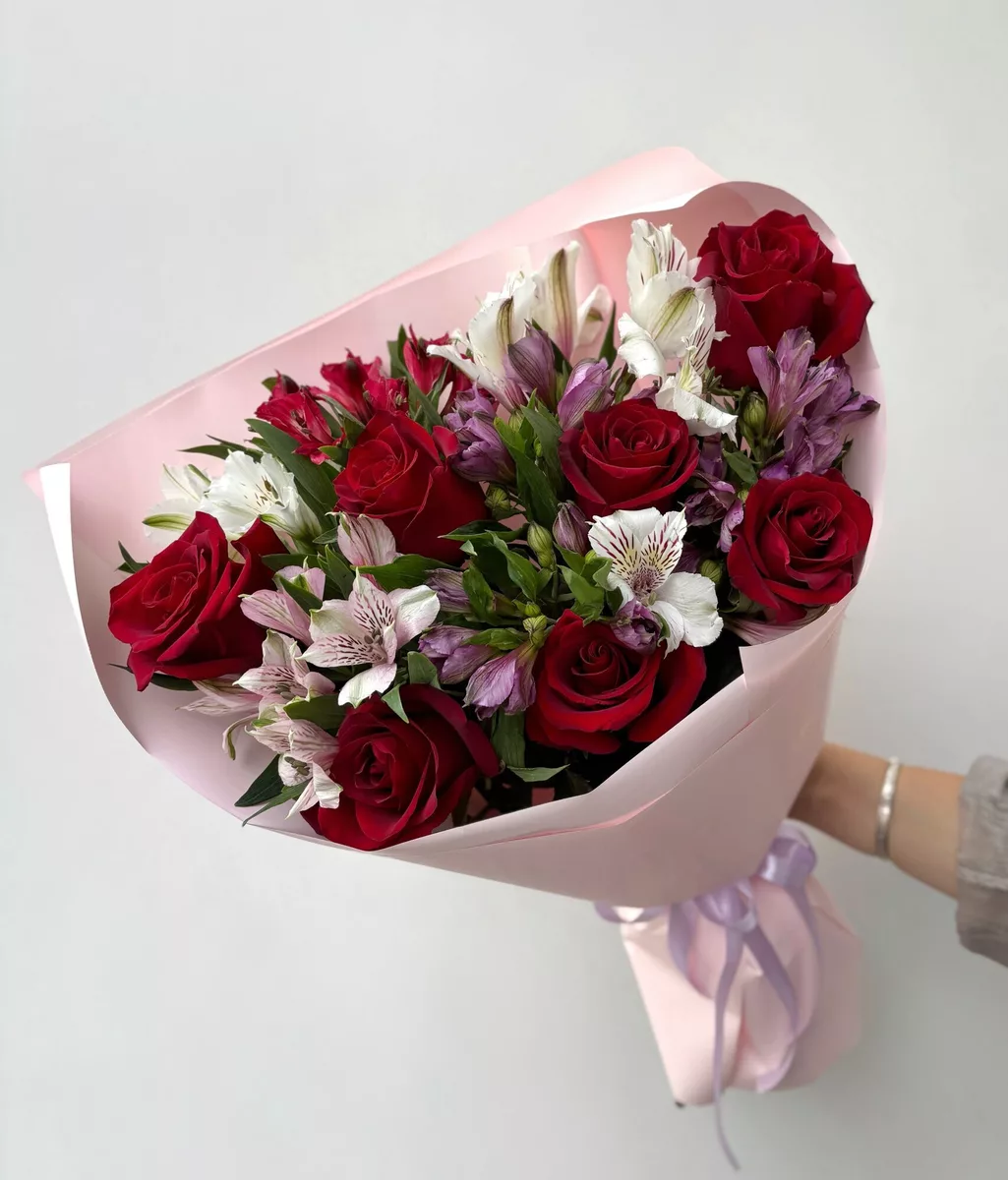
The question of variety is not decorative — it is logistical. Flowers that reach Pochep have already been cut, conditioned, and transported, and the ones that arrive looking sharp are the ones that were chosen with that journey in mind. Roses are the most reliable choice for this route: varieties with dense petal structure such as Avalanche, Explorer and Red Naomi hold their form well across temperature changes and do not bruise easily during transit. A standard bouquet of 25 stems in one of these varieties is what we recommend when the sender is uncertain. Chrysanthemums, both spray and single-headed, are another strong option — they have a long vase life, are not sensitive to minor temperature fluctuation, and the blooms do not shed petals under vibration. Alstroemeria works well in mixed bouquets because it is naturally robust and the buds continue opening after delivery, which means the recipient sees the arrangement improve over the following two days rather than decline. Flowers to avoid for this route include garden roses with very open blooms, which bruise against packaging; ranunculus in warm months, because they wilt quickly above 18 degrees Celsius; and large-headed peonies outside their natural season of May and June, when forced greenhouse peonies often lack the stem strength to stay upright. Tulips are fine in winter and early spring but become unreliable in summer heat. When you place an order, our florists will confirm which varieties are in stock that day and suggest substitutions if your first choice is not available.
Seasonal Temperatures and What They Mean for Your Order
Bryansk Oblast has a continental climate with cold winters and warm summers. In January and February, outdoor temperatures in Pochep regularly drop below minus 15 degrees Celsius, and flowers in transit need to be wrapped and insulated correctly to prevent freeze damage. We use thermal packaging during cold months, but the sender should know that a bouquet left in an unheated entrance lobby for more than twenty minutes in deep winter will suffer regardless of how it was packed. This is why we ask for a recipient phone number for winter deliveries — the courier calls ahead so the recipient can come down immediately rather than leaving the flowers in the cold. In July and August the situation reverses: daytime temperatures in Bryansk Oblast can reach 30 degrees Celsius, and cut flowers deteriorate quickly in heat. Deliveries during hot months are scheduled for morning windows where possible, and varieties are chosen for heat tolerance. Roses and chrysanthemums perform better in summer than lilies or lisianthus, which wilt faster in high temperatures. The shoulder seasons — April, May, September and October — are the most straightforward for flower delivery because temperatures are moderate and the risk of either frost damage or heat stress is low. If you are planning a delivery for a birthday or anniversary and have flexibility on the date, choosing a cooler part of the week in summer or avoiding a forecast cold snap in winter will improve the result. We track local weather for Bryansk Oblast and flag issues when we see them at the order stage.
What a Sender Abroad Needs to Provide at the Order Stage
International senders often underestimate how much information is needed before the order can be confirmed, and the gaps cause delays that feel frustrating but are entirely avoidable. The minimum we need is the recipient's full name, the complete delivery address including entrance and apartment number, the recipient's Russian mobile number, and a delivery window in Moscow Time. Beyond that, the message card text needs to be provided in a form we can print — if you are writing in a language other than Russian, that is completely fine, we will print the card exactly as you write it, but please check spelling carefully because we print what we receive. Payment from abroad is processed by card through our website, and the most common issue is that some international cards are declined by Russian payment processors due to sanctions-related restrictions introduced after 2022. If your card does not go through, the practical solution is to use a card issued in a country whose banks still process Russian transactions, or to ask a contact inside Russia to pay on your behalf and reimburse them. We cannot take payment over messaging apps or by bank transfer from foreign accounts. Once payment is confirmed, you receive an order number and can track status through our website. We send a confirmation message when the flowers are handed to the recipient, which is the moment most senders abroad are waiting for.
Bouquet Sizes and Occasions Common in Pochep
Russian flower-giving culture has its own logic, and senders from outside Russia sometimes choose a size or format that reads differently to the recipient than intended. Odd numbers of stems are traditional for celebratory occasions — a bouquet of 15, 25 or 51 roses is a standard gift for a birthday, anniversary or professional milestone. Even numbers of stems are associated with mourning in Russian tradition, so a bouquet of 10 or 20 roses will be noticed by the recipient and may cause confusion even if it was chosen for purely aesthetic reasons. This is not a strict rule that everyone follows, but it is widespread enough that we always default to odd numbers unless a customer specifically requests otherwise. For a birthday in Pochep, a bouquet of 25 mixed roses with gypsophila or ruscus greenery is a safe and well-received choice. For a teacher's day, which falls on 5 October and is taken seriously in Russian schools, chrysanthemum bouquets are extremely common — a large spray chrysanthemum arrangement in white or yellow is practically a standard gift in that context. For a new baby, white or pale pink arrangements are typical, and small bouquets of 11 or 15 stems are appropriate rather than large showpiece arrangements. For an anniversary, roses in red or cream in quantities of 25 or 51 read as a serious and considered gift. If you are unsure what is appropriate for the occasion, describe it to us when placing the order and we will suggest a format that fits.
What to Do If the Delivery Cannot Be Completed
Failed first attempts happen most often when the recipient is not at the address, the door code is wrong, or the phone number provided does not connect. For senders abroad, this is particularly stressful because you are in a different time zone and cannot easily intervene in real time. The best prevention is to give the recipient a heads-up that something is coming, even if you want to keep the specific contents a surprise. Telling someone that a package will arrive on Tuesday afternoon means they arrange to be home; not telling them means the courier finds a locked door. If the first delivery attempt fails, we hold the bouquet and attempt redelivery. However, cut flowers do not wait indefinitely — roses and chrysanthemums in a conditioned environment hold well for 24 to 36 hours, but after that point the quality declines and we cannot guarantee the bouquet will arrive in the condition it left us. If redelivery is needed, we contact the sender by the messaging channel they used to place the order. For customers in very different time zones, this may mean a message arrives while they are asleep, which is why we recommend leaving a secondary contact — either a Russian-based contact who can respond faster, or a note authorising us to reattempt delivery at our discretion. We do not leave bouquets with neighbours or in building lobbies without explicit instruction from the sender, because cut flowers left unattended deteriorate quickly and the gesture loses its effect entirely.
Sending flowers to Pochep from abroad is straightforward when the preparation is solid: a complete address, the recipient's mobile number, a realistic delivery window in Moscow Time, and a variety suited to the season. The town is small but reachable, and the most common problems — failed delivery, disappointed recipients, wilted flowers — trace back to information gaps rather than distance. Get the details right at the order stage, and the bouquet lands the way you intended it to. We deliver bouquets across Russia in 1–2 hours.
Frequently asked questions
Can I order flowers to Pochep from outside Russia without a Russian phone number?
Yes. You do not need a Russian phone number to place the order — we accept orders via our website and international messaging. However, you must provide the recipient's Russian mobile number so the courier can reach them at the door. Without a working local contact number for the recipient, completing delivery in a small town like Pochep becomes significantly harder.
How far in advance should I order flowers to Pochep from a foreign country?
Ordering the day before the occasion is the most reliable approach for international senders. This gives time to resolve any payment issues, confirm the address details, and schedule a morning delivery window. Same-day delivery is possible if the order is placed early in the morning Moscow Time, but time zone differences make this difficult to manage from abroad without careful planning.
Will my international bank card work for payment on the Five Flowers website?
Cards from many Western countries are declined by Russian payment processors due to restrictions introduced after 2022. Cards issued in countries whose banks still process Russian transactions generally work. If your card is declined, the practical option is to ask someone inside Russia to pay and reimburse them, or to use a card from a different issuing country.
What flowers are not suitable for delivery to Pochep in summer?
In July and August, when Bryansk Oblast temperatures can exceed 30 degrees Celsius, avoid ranunculus, open-bloom garden roses, and large peonies. These varieties deteriorate quickly in heat. Roses with dense petal structure, chrysanthemums, and alstroemeria are better choices for summer delivery because they tolerate temperature variation without wilting rapidly during transit.
Can I write the message card in English or another foreign language?
Yes, we print the card exactly as you write it, in any language. Please check your spelling carefully before submitting, because we reproduce the text as provided. If you want a transliteration into Russian or a translation, mention that when placing the order and we will arrange it, but the default is to print your original text without changes.
Ready to send a bouquet?
Pick a city, choose the flowers, and we will hand them over with a photo confirmation.
Choose a city →