
How to Send Flowers to Russia from Canada: What You Need to Know
Every week someone calls us from Toronto or Vancouver trying to sort out a bouquet for a mother in Saint Petersburg or a colleague in Moscow, and the questions are almost always the same: will the flowers arrive fresh, how do I pay from abroad, and what address format do you actually need. The answers are straightforward once you know how Russian flower delivery works on the ground, so here is everything a sender in Canada needs before placing that order.
Why Time Zones Are the First Thing to Sort Out
Saint Petersburg runs at UTC+3, which puts it eight hours ahead of Toronto and eleven hours ahead of Vancouver. That gap catches a lot of Canadian senders off guard. If you want flowers delivered at 11 a.m. on a Thursday in Saint Petersburg, you need to place the order by 3 a.m. Toronto time on that same Thursday at the latest, and earlier is always safer. Most mistakes happen when someone places an order at 9 p.m. in Canada thinking they have plenty of time, not realising it is already 5 a.m. the next day in Russia and the delivery window they wanted has closed. We work seven days a week and deliver across Saint Petersburg within one to two hours of order confirmation, but that clock starts ticking in Saint Petersburg time, not yours. The safest approach is to order the evening before your Canadian time, which lands the request in our morning queue and gives us full flexibility on the Russian side. For same-day delivery to other Russian cities we cover, factor in an extra buffer because routing outside Saint Petersburg adds coordination time. Write down the recipient's local time for the occasion, convert it, and work backwards from there — that single step prevents the majority of timing problems we see from international senders.
Bouquets we can deliver
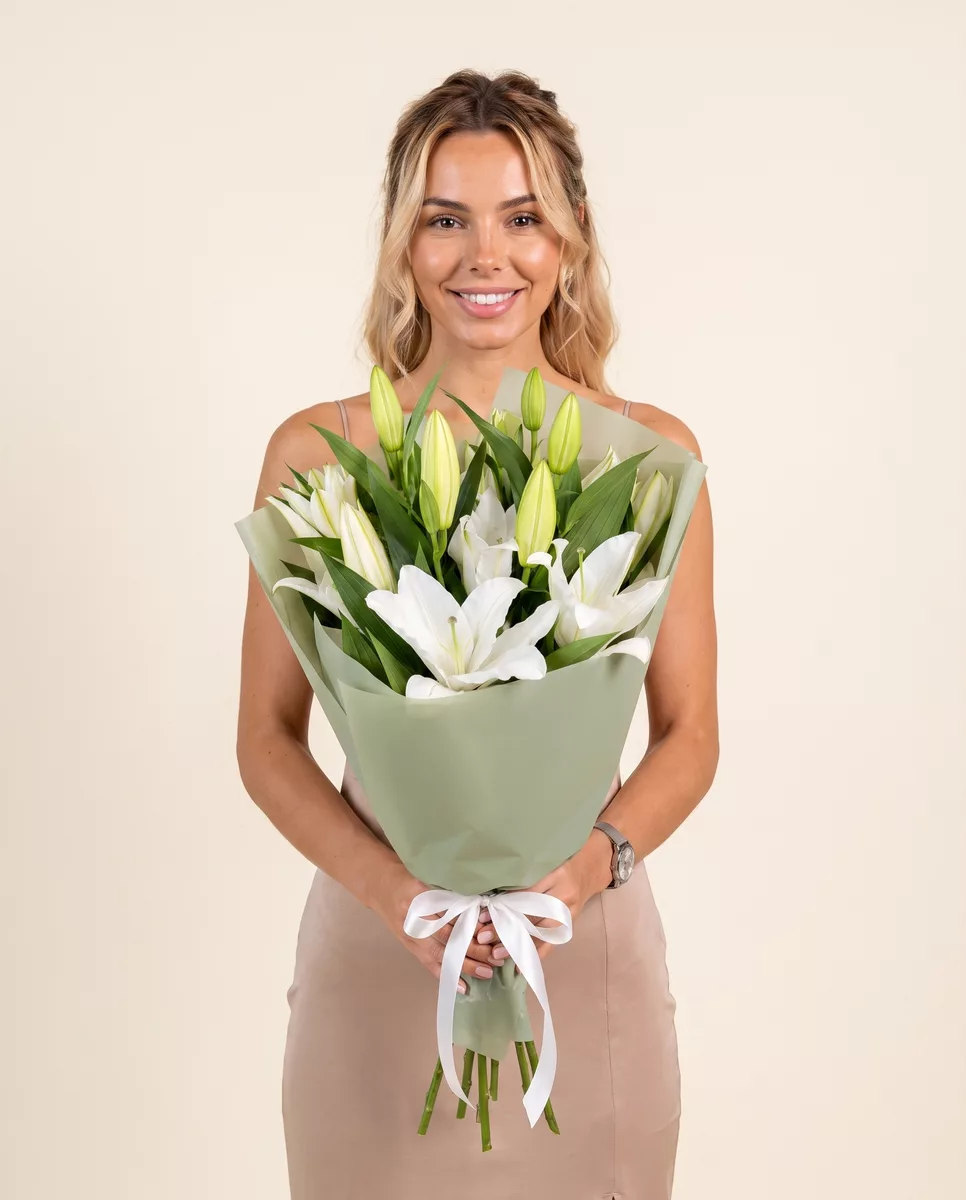
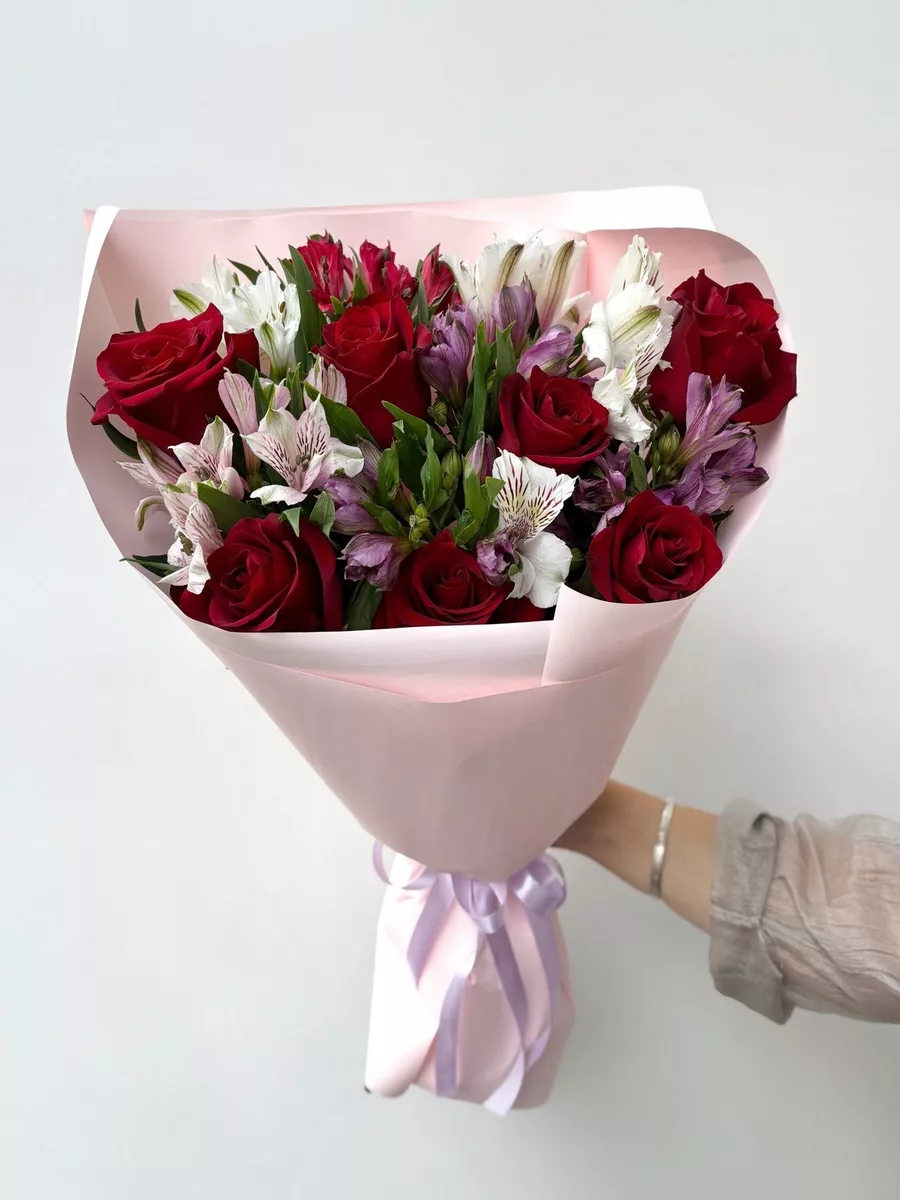


Which Flowers Actually Travel Well Through an Online Order
When you are ordering remotely from another continent, variety choice matters more than it does for a walk-in customer, because you cannot inspect the stems yourself. Roses are the most reliable backbone of any bouquet ordered from abroad: David Austin garden roses, spray roses, and standard large-head varieties like Explorer or Avalanche hold their structure well and look as good on delivery as they did when cut. Ranunculus and lisianthus are excellent secondary flowers for spring and early summer orders because they open gradually and give the recipient several days of bloom rather than peaking on arrival day. Tulips are popular in Russia and genuinely beautiful, but they are seasonal — strong from January through April, then largely unavailable or inconsistent in quality from June onward. Peonies follow a similar pattern, peaking in May and June in Russia. Chrysanthemums are a common choice for autumn orders and are extremely long-lasting, which makes them practical for recipients who travel or work long hours. One variety to avoid requesting by name if you are unsure of the season is the garden hydrangea: it wilts quickly in warm weather and is best ordered between September and March when temperatures in Saint Petersburg stay cool. If you are not certain what is in season, simply tell us the occasion and the colour palette and we will build something appropriate from what is freshest that day.
How to Write a Russian Address So Delivery Does Not Fail
Russian addresses follow a specific order that is different from Canadian convention, and a wrongly formatted address is the single most common reason a delivery is delayed or returned. The correct sequence runs from largest to smallest: country, then city, then street name, then building number, then apartment or office number. A typical Saint Petersburg address looks like this: Saint Petersburg, Nevsky Prospekt, 10, apartment 45. The word for apartment is kvartira, abbreviated kv., and for office it is ofis. Building complexes sometimes have a corpus number, which is a secondary building identifier written after the main number with a slash or the abbreviation k — for example, building 10, corpus 2, apartment 45. If you have the address only in English transliteration, that is fine for us, but make sure the apartment number is included because we deliver to the door, not to the building entrance. Many Canadian senders forget that Russian apartment buildings have an intercom system at the entrance door, so it is very helpful to include the intercom code or confirm that the recipient will be reachable by phone. Always provide the recipient's Russian mobile number in the format +7 followed by ten digits — our courier will call ahead of arrival, and a working number is not optional, it is how the delivery is coordinated on the ground.
Payment from Canada: What Works and What Does Not
Paying for a flower delivery in Russia from a Canadian bank account has become more complicated since 2022, and we want to be direct about this rather than let you discover it at checkout. Standard Visa and Mastercard issued by Canadian banks do not process transactions with Russian merchants in most cases due to the suspension of card network operations in Russia. This means you cannot simply enter your RBC or TD card details and expect it to go through the way it would on an international shopping site. The methods that do work for international clients ordering with us include payment via PayPal where available, cryptocurrency transfers, and in some cases cards issued by banks in countries that maintain normal payment infrastructure with Russia — for example, cards from Turkish, UAE, or Armenian banks. If you have a family member or friend in Russia who can pay on the ground and you reimburse them separately, that is also a clean solution many of our Canadian clients use. When you contact us to place an order, tell us upfront that you are paying from Canada and we will walk you through the current options that work without wasting your time on methods that will fail at the processing stage. The situation is genuinely inconvenient and we understand that, but being clear about it upfront means your order gets confirmed quickly rather than stalling at the payment step while the delivery window closes.
What Russian Recipients Expect and a Few Cultural Notes
Russia has a strong flower culture and recipients generally know their flowers well, so a thoughtful bouquet is genuinely appreciated rather than just politely received. A few customs are worth knowing if you are not familiar with them. Flower count matters: even numbers of flowers are traditionally associated with funerals in Russia, so bouquets are assembled in odd numbers — five, seven, eleven, fifteen stems and so on. This is not a rigid rule that causes offence if broken, but it is the norm and we follow it automatically. Wrapping style is also important: Russian bouquets are typically presented with substantial paper or fabric wrapping that forms part of the visual gift, not just protective packaging, so the presentation is taken seriously. If the recipient is a woman receiving flowers from a man, red roses remain the classic and most understood gesture regardless of what trends are doing elsewhere. For professional occasions — a colleague's work anniversary, a teacher's day gift — mixed bouquets with chrysanthemums, alstroemeria, or lisianthus in restrained colours read as polished and appropriate. Teacher's Day falls on October 5th in Russia, International Women's Day on March 8th is the biggest flower occasion of the year by volume, and February 14th has grown significantly in popularity over the past decade. If you are ordering around March 8th from Canada, place your order at least 48 hours ahead in Saint Petersburg time — demand is extremely high and early orders get priority in the delivery schedule.
What to Check Before You Confirm the Order
Before you hit confirm on any international flower order, run through a short checklist that will save you a follow-up call. First, confirm the recipient's full address including apartment number and corpus if applicable, and double-check the city — Russia is large and Saint Petersburg and Moscow are different cities that occasionally get confused in addresses copied from old correspondence. Second, provide the recipient's Russian mobile number in the +7 format and make sure it is active — a switched-off phone means a courier standing at a locked entrance with no way to complete the delivery. Third, decide whether the delivery should be a surprise or announced: if it is a surprise, we do not call ahead, but the recipient must be physically present at the address, otherwise the bouquet cannot be left and a redelivery has to be arranged. Fourth, specify the delivery time window in Saint Petersburg local time, not Canadian time, and confirm you have accounted for the time zone difference yourself rather than leaving it to us to interpret. Fifth, check what message you want on the card — we include a handwritten card with the bouquet and the text can be in English or Russian, whichever you prefer, up to a reasonable length. Finally, confirm your payment method before submitting so there is no gap between order placement and payment confirmation that eats into the delivery window. These six checks take three minutes and prevent almost every problem we see with international orders.
Sending flowers to Russia from Canada is entirely doable with the right preparation, and the recipients we deliver to are genuinely delighted when a bouquet arrives from across the world. The process comes down to three things: getting the time zone maths right before you place the order, having the complete address with apartment number and a working Russian phone number, and sorting out payment through a method that actually clears between Canada and Russia right now. Get those three elements in order and the rest — variety selection, wrapping, card message — we handle from the shop floor in Saint Petersburg. We deliver bouquets across Russia in 1–2 hours.
Frequently asked questions
Can I order flowers for delivery in Russia from Canada if I do not speak Russian?
Yes, entirely. We handle international orders in English regularly. Provide the address in Latin transliteration, the recipient's phone number in +7 format, and your card message in English — we will transliterate it or deliver it as written. The courier communicates with the recipient in Russian on your behalf.
How far in advance should I order from Canada for a specific delivery time?
Order at least 12 to 24 hours before the desired delivery time in Saint Petersburg local time. For high-demand dates like March 8th, 48 hours minimum is strongly recommended. Same-day delivery is possible if you place the order early enough in the Russian morning, but the time zone difference makes this tight from Canada.
What happens if the recipient is not home when the flowers arrive?
Our courier will call the recipient before arrival. If there is no answer and no one is at the address, the delivery cannot be completed and a redelivery must be arranged. To avoid this, either inform the recipient to expect a delivery at a certain time or provide a secondary contact number for someone who can accept the bouquet.
Are there flowers I should avoid ordering for a Russian recipient?
Avoid requesting out-of-season varieties by name — tulips outside January to April, peonies outside May to June — as quality drops sharply. Also avoid even-numbered stem counts, which carry funeral associations in Russian tradition. We automatically build bouquets in odd numbers, so this is handled if you leave the count to us.
Can I include a gift or chocolates with the flowers when ordering from Canada?
Yes, we can add boxed chocolates, macarons, or small gift items to the order. Specify what you would like when contacting us and we will confirm what is available for your delivery date and location. This is popular for birthdays and anniversaries where the bouquet alone feels like it needs something alongside it.
Ready to send a bouquet?
Pick a city, choose the flowers, and we will hand them over with a photo confirmation.
Choose a city →