
Flower Delivery to Tashtagol from Abroad: Zones, Varieties and Timing
Tashtagol sits deep in the Kemerovo region of western Siberia, and every week we take orders for it from senders in Germany, Israel, the United States and Kazakhstan. The questions are always the same: will the flowers survive the cold, how do I pay from a foreign card, and what time will the courier actually arrive? This article answers all of that in plain terms, with specific varieties, realistic delivery windows and the exact details you need to fill in when ordering remotely.
Where Tashtagol Is and Why Distance Matters for Your Order
Tashtagol is a small mining and ski town in the Mountainous Shoria area of Kemerovo Oblast, roughly 400 kilometres south of Kemerovo city. The town sits at altitude, surrounded by taiga, and its winters are long and genuinely cold — temperatures regularly drop below minus 25 Celsius from November through February, and even March can bring hard frosts. That geography shapes everything about flower delivery: transit time from the nearest large flower wholesale hub, storage conditions en route, and which varieties can realistically arrive in good condition. When you place an order from abroad, you are not just choosing a bouquet — you are choosing a bouquet that will travel through a cold chain across a serious distance. Senders who ignore this and order, say, open garden roses in January tend to be disappointed. The flowers are sourced from our Saint Petersburg base, where we hold stock in temperature-controlled rooms, and they are dispatched with cold packs appropriate to the season. Delivery within Tashtagol itself typically falls in a one-to-two-hour window once the courier has the order in hand, but you should account for the logistics leg from the regional hub to the town when choosing your delivery date. Ordering at least one full day ahead is strongly recommended for Tashtagol; two days ahead in winter is safer. The town is not isolated, but it is not a next-door suburb either, and treating it like one is the most common mistake senders make from abroad.
Bouquets we can deliver



Which Varieties Hold Up on a Long Cold Route
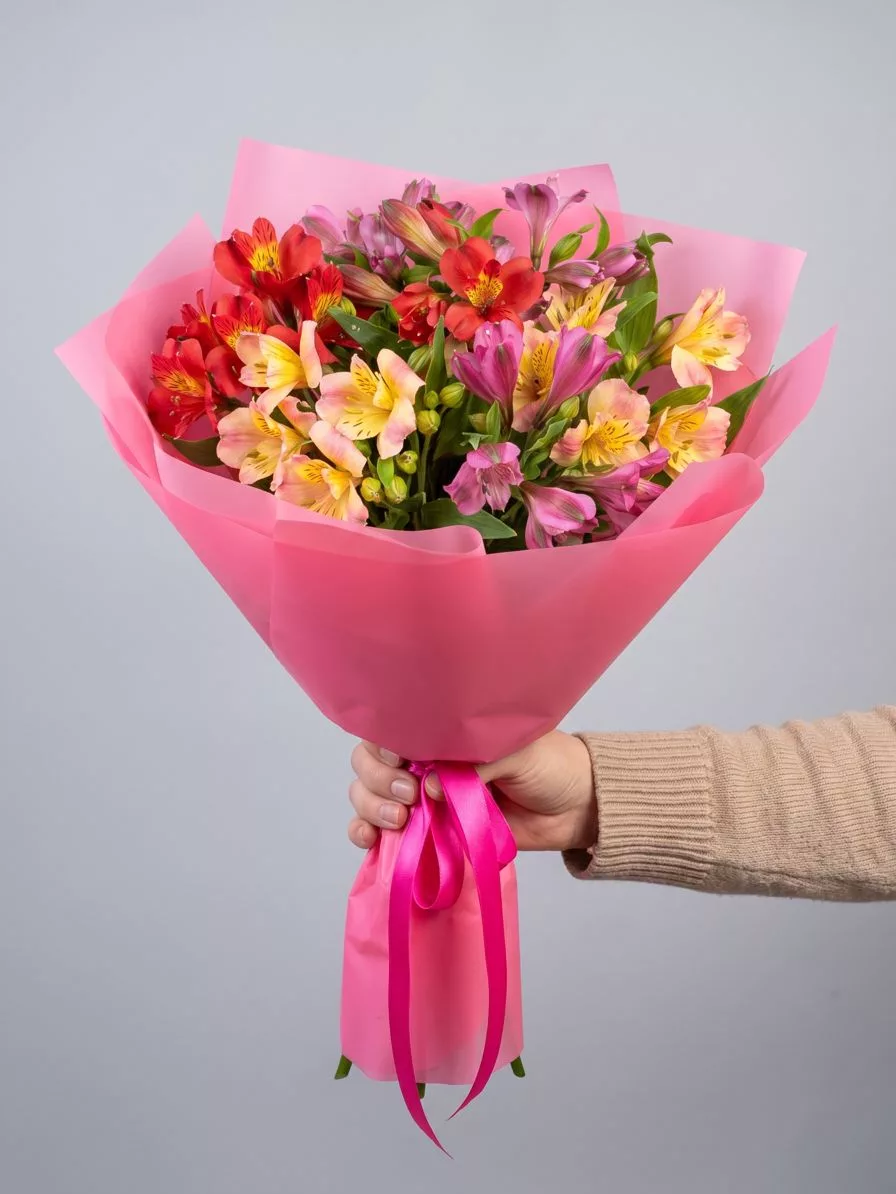
Not every flower that looks beautiful in a Saint Petersburg cooler will arrive in Tashtagol looking the same. The varieties that consistently perform well on longer Siberian routes are spray chrysanthemums, standard carnations, alstroemeria, waxflower, and single-stem lisianthus in bud. These are not consolation prizes — they are genuinely robust flowers that hold their form and colour through temperature fluctuation and extended transit. Spray chrysanthemums in particular are exceptional: varieties like Anastasia and Bacardi open slowly, resist bruising, and last ten days or more after delivery if the recipient trims the stems and keeps them away from heat sources. Alstroemeria travels flat and opens progressively, which actually works in its favour on a long route because buds arrive firm and colour develops over the following days at the recipient's home. Roses are the most requested flower from abroad, and we do send them to Tashtagol — but the selection matters. Tight-budded spray roses such as Lydia or Vivaldi are far better choices than large-headed garden varieties, which bruise at the outer petals during transit. Open peonies, ranunculus and anemones are not suitable for this route in any season; they are too fragile for the handling involved. Tulips work well in winter and early spring when they are in natural season and are sourced fresh, but avoid them in summer when the ambient heat during the last delivery mile becomes a problem. When in doubt, ask us to build the arrangement around chrysanthemums and carnations with seasonal greenery — it is an honest, durable combination.
Seasonal Timing: When to Order and What Changes by Month
The calendar affects Tashtagol deliveries more than most Russian cities because the climate swings are extreme. From November through March, the cold actually helps flowers survive transit — the challenge is protecting them from freezing rather than wilting, and we handle that with insulated packaging and gel cold packs rated to minus 10 Celsius. During this period, tight-budded roses, carnations and chrysanthemums travel reliably, and you can order with confidence if you give us two days' notice. April and October are transitional months where daytime temperatures vary widely, sometimes swinging 15 degrees in a single day. Orders placed for these months need to specify a morning delivery window, because afternoon temperatures can spike enough to stress flowers during the final courier leg. May through August is the warmest period, and while flowers do travel in summer, you should avoid varieties with high water content and fragile petals — hydrangeas, for example, are risky in July and August on this route. Summer is also when local wildflower combinations work well: solidago, tanacetum and statice are naturally heat-tolerant and add an appropriate regional character to a bouquet sent to someone in mountainous Shoria. September is often the best month for flower delivery to Tashtagol: temperatures are moderate, the wholesale supply of autumn varieties like lisianthus and spray chrysanthemums is excellent, and transit conditions are stable. If you have flexibility in choosing when to send, September and the period from late January through February are the most reliable windows.
How to Place an Order from a Foreign Country
Ordering from abroad is straightforward once you know what information to prepare. You will need the recipient's full name, their precise street address including apartment number and entrance code if applicable, and a working Russian mobile number for the courier to call on arrival. This last point trips up many international senders: Russian couriers call ahead before arriving, and if the number provided is a foreign one the recipient does not actively use, the delivery fails. Ask your recipient in advance to confirm which number they answer, and provide that number in the order form. Payment from foreign cards depends on your country of origin. Cards issued in the EU, UK and United States have faced processing restrictions in Russia since 2022, and the most reliable payment methods for senders in those countries are currently wire transfer, cryptocurrency or payment through intermediary services that your bank supports. Senders from Kazakhstan, Belarus, Armenia and Azerbaijan generally have no card issues. The order form on our site is in Russian, but the fields are standard — name, address, phone, delivery date and time, bouquet choice, and a card message. If you are not comfortable navigating Russian text, you can send us the order details by email or through the site's chat in English and we will process it manually. The card message can be written in any language; we print it as submitted. One practical note: if you are ordering as a surprise, do not have the recipient's phone number listed as your contact — use your own messaging app number or email so the courier's call does not give away the surprise.
Typical Mistakes Senders from Abroad Make
The single most common mistake is underestimating lead time. A sender in Tel Aviv or Frankfurt places an order at 11 p.m. their local time expecting same-day delivery in Tashtagol, not accounting for the time zone difference — Tashtagol is UTC plus 7, which is three hours ahead of Moscow and between four and six hours ahead of most European cities. By the time the order is received and processed, the delivery window has already closed. Always calculate the order time in Moscow time and add at least 24 hours for Tashtagol. The second mistake is choosing flowers based on what looks good in a photo rather than what travels well. We have covered varieties above, but the pattern is consistent: senders pick open garden roses or hydrangeas because they look impressive online, and then are surprised when the recipient describes petals that have bruised or wilted. Trust the florist's recommendation for the route. The third mistake is providing an incomplete address. Tashtagol has streets where building numbers include letters or fraction marks — for example, a building might be listed as 14a or 7/2. If the address is incomplete, the courier cannot deliver and the order is held. Get the full postal address from the recipient before ordering, not after. The fourth mistake is not writing a card message. Russian flower-giving culture places real importance on the written note — arriving with flowers and no card reads as impersonal. Even a short message in your own language means something to the recipient. Write one.
What the Recipient Should Know When the Bouquet Arrives
Recipients in Tashtagol who are not used to receiving flowers from a distance sometimes do not know how to handle a bouquet that has been in transit for several hours. The first thing to do is remove the packaging carefully — we wrap stems in damp paper and the outer layer is protective, not decorative. Once unwrapped, the stems should be cut at a diagonal under running water, removing about two centimetres, before placing the flowers in a clean vase with fresh cold water. This rehydrates the stems and removes any air locks that formed during transit. In winter, if the bouquet has been outside even briefly, let it warm at room temperature for 20 minutes before unwrapping — unwrapping frozen or very cold flowers in a warm room too quickly causes condensation damage to the petals. The vase should be kept away from radiators, which are running hard in Siberian winters, and away from direct sunlight. Tashtagol apartments are typically well-heated in winter, which actually shortens vase life compared to a cooler room — 18 to 20 Celsius is ideal for most cut flowers. Changing the water every two days and re-cutting the stems extends the display noticeably. Carnations and chrysanthemums will last 10 to 14 days with basic care; roses and lisianthus typically give 7 to 10 days. If the recipient notices any stems that look soft at the base on arrival, those should be removed immediately so they do not contaminate the water for the rest of the bouquet. These are simple steps, but recipients who follow them consistently get significantly better results than those who simply place the bouquet in water and leave it.
Card Messages and Flower Customs Worth Knowing
Russia has a set of flower customs that are worth understanding if you are sending from outside the country, because getting them wrong can create awkward moments for the recipient. The most important rule is the odd-number rule: bouquets given as gifts should contain an odd number of stems — 3, 5, 7, 11, 15, 25 and so on. Even numbers of flowers are associated with funeral and mourning contexts in Russian tradition, and while younger recipients in cities may not care strongly, in a town like Tashtagol where traditional customs are more observed, it matters. When you order from us, we automatically compose bouquets in odd numbers, so you do not need to calculate this yourself — but if you are specifying an exact stem count, keep it odd. Yellow flowers carry a mixed reputation in Russian popular belief: some people associate them with separation or bad luck in relationships, though this varies significantly by generation and region. If you are sending to someone you know well and they have no such concerns, yellow flowers are fine — sunflowers and yellow spray chrysanthemums are genuinely popular in Siberia. If you are unsure, a mixed palette avoids the question entirely. Red roses sent to a woman from a man carry a clear romantic meaning in Russian culture, which is exactly what most senders intend — but sending red roses to a female colleague or a relative can read as ambiguous. Pink roses, white lisianthus or a mixed seasonal bouquet are safer for non-romantic occasions. The card message should be warm but does not need to be elaborate — a sentence or two in your own language, or in Russian if you can manage it, is entirely appropriate and will be appreciated.
Sending flowers to Tashtagol from abroad is entirely achievable when you plan around the geography, the season and the logistics. The key points are: order at least 24 to 48 hours ahead in Moscow time, choose varieties suited to the route rather than the most photogenic option, provide a complete Russian address and an active local phone number, and write a card message. The cold Siberian climate is not the obstacle many senders fear — in winter especially, it actually preserves flowers well during transit. What matters is preparation, and most of the work happens before you click the order button. We deliver bouquets across Russia in 1–2 hours.
Frequently asked questions
Can I order flowers to Tashtagol if I live in the United States or Europe?
Yes. The main practical issue is payment, since many EU and US cards face processing restrictions in Russia. Wire transfer and certain intermediary payment services work reliably. You can also contact us by email in English and we will walk you through the available options for your specific country before you commit to an order.
How far in advance should I order for a specific delivery date in Tashtagol?
A minimum of 24 hours ahead, calculated in Moscow time, is required for Tashtagol. In winter months from November through February, 48 hours is safer to account for any logistics adjustments. For major dates like March 8th or Valentine's Day, order three to four days ahead — demand across Siberia spikes sharply and slots fill quickly.
Will flowers survive the Siberian cold during delivery?
Yes, with the right varieties and packaging. We use insulated wrapping and cold-rated gel packs for winter deliveries. Carnations, spray chrysanthemums and alstroemeria handle cold transit well. The risk in winter is freezing during the final outdoor leg, which we mitigate with packaging — the recipient should let the bouquet warm gradually before unwrapping if it has been outside.
What if the recipient is not home when the courier arrives?
The courier calls the recipient's phone before arriving. If there is no answer, the order is held and a second delivery attempt is arranged. This is why a working Russian mobile number is essential — if the number provided goes unanswered, delivery is delayed. Confirm with your recipient which number they actively use and provide that number in the order form.
Can the card message be in English or another language?
Yes. We print the card message exactly as you submit it, in any language. There is no requirement to write in Russian. If you would like us to translate a short message into Russian for the card, mention it when ordering and we will do that at no extra charge.
Ready to send a bouquet?
Pick a city, choose the flowers, and we will hand them over with a photo confirmation.
Choose a city →