
September 1 in Russia: How to Send Flowers to a Student from Abroad
Every year on September 1, Russian schools open their doors for Knowledge Day, and the one thing every student carries through the gate is flowers. If you are outside Russia and want to send a bouquet to a child, grandchild, niece, or friend starting a new school year, the tradition is real and the expectations are specific. A bunch of supermarket carnations dropped at the door will not do what you hope it will. This guide walks you through what Russians actually buy, what teachers expect, what schoolchildren carry in photographs, and how to get a fresh, correct bouquet delivered on time to any city in Russia.
What Knowledge Day Actually Is and Why Flowers Matter So Much
September 1 is a federal public holiday in Russia called Den Znaniy, Knowledge Day. Every school holds a formal assembly in the schoolyard or gymnasium, students line up by class, and teachers receive flowers from their pupils as a mark of respect at the start of the academic year. This is not optional or regional — it happens from Kaliningrad to Vladivostok, in village schools and city gymnasiums alike. The flower-giving moment is baked into the ceremony: first-graders traditionally carry the largest bouquets and are lifted onto the shoulders of older students to ring a hand bell, signalling the start of lessons. Photographs of this moment are among the most shared images of the Russian calendar year. For families abroad, the difficulty is that they cannot walk to a local market the morning of September 1 and hand flowers to a child themselves. What they can do is arrange a delivery timed for the morning of that day, so the student leaves home already holding a bouquet. Getting the timing right matters more than almost any other variable. Russian schools typically begin their ceremonies between 8:30 and 10:00 in the morning local time, so a delivery window of 7:00 to 9:00 is the practical target. Order at least two to three days in advance to guarantee that slot, and always specify the recipient's time zone, because Russia spans eleven of them.
Bouquets we can deliver



What Schoolchildren Carry: the Classic Bouquet for a Student
The bouquet a schoolchild brings to school on September 1 follows conventions that have barely shifted since Soviet times. Gladioli are the single most recognisable flower of this holiday — tall, upright stems in white, cream, pink, or red that photograph well and look substantial in a child's arms. A single stem of gladiolus can reach 80 to 120 centimetres, so a bouquet of five to seven stems is already a serious, visible gift. Chrysanthemums are the close second choice: spray chrysanthemums in white or yellow, or single large-headed varieties in the same palette. Asters, which bloom naturally in Russia through August and September, are considered the authentic seasonal flower of the holiday — small, daisy-like, in purple, lilac, white, and pink. A mixed bouquet of asters and spray chrysanthemums, wrapped in kraft paper with a ribbon, is what you see in the majority of school photographs. Roses are popular but sit slightly outside the traditional core for children; they are more common as teacher gifts. Sunflowers appear occasionally but are less formal. What you should avoid for a child's bouquet is anything associated primarily with adult occasions — orchids, anthurium, or tropical stems look out of place in a schoolyard lineup. Colours matter: white and yellow read as celebratory and clean, red is festive, purple and lilac are acceptable. Avoid all-white bouquets for this occasion, as white alone carries funereal associations in Russian culture. A well-assembled bouquet of seven aster stems mixed with five spray chrysanthemum branches, wrapped neatly, is exactly right.
What Teachers Expect: Flowers for an Educator on September 1
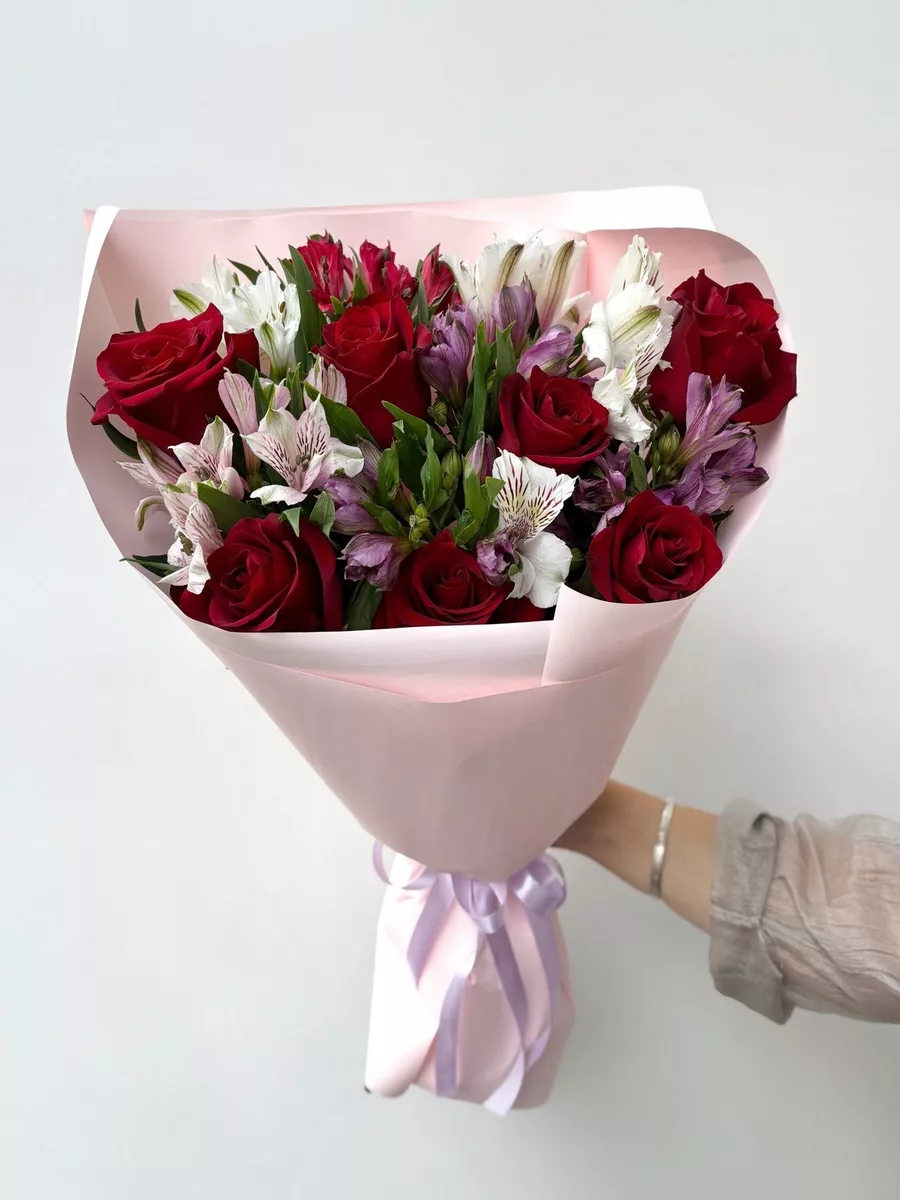
Teachers receive flowers from nearly every student in their class on Knowledge Day, which means they walk home carrying an armful of bouquets — sometimes fifteen or twenty. This fact shapes what makes a good teacher gift: it should be compact enough to hold alongside several others, fragrant but not overpowering, and long-lasting so it survives a full day of ceremony and then looks presentable in a vase at home. Roses are the standard teacher flower on September 1, and single-headed roses on long stems — 60 to 70 centimetres — are the most practical format. A bouquet of five, seven, or nine roses in red, white, coral, or cream is considered appropriate and respectful. Odd numbers are the Russian convention for living recipients; even numbers are reserved for mourning, so always order five, seven, nine, or eleven stems, never six, eight, or ten. Spray roses work well too and give more visual volume per stem. Eustoma, also sold under the name lisianthus, is an increasingly common teacher gift — the ruffled, poppy-like blooms in purple, white, and bicolour look expensive and hold well in water for seven to ten days under normal indoor temperatures. Alstroemeria is practical and long-lasting but considered a lower-tier gift by most Russian buyers, so use it as filler rather than the centrepiece. If you want to send something more substantial to a teacher who has been particularly important — a class supervisor, a music teacher, a mentor — a mixed arrangement of roses and eustoma in a box, rather than a hand-tied bunch, signals more thought and effort.
First Grade Is Different: Flowers for a Child Starting School for the First Time
First-graders, called pervoklasskniki, hold a special place in the Knowledge Day ceremony. The entire school typically gathers to welcome them, and their bouquets are expected to be the most prominent of the day. If you are sending flowers to a child beginning school for the first time, the bouquet should be larger and more structured than what an older student would carry. A hand-tied arrangement of nine to eleven stems — gladioli mixed with asters, or white roses with spray chrysanthemums — wrapped in layered paper with a wide satin ribbon, is the appropriate scale. The child will be photographed holding this bouquet, often for formal portraits that parents keep for decades. Consider the child's size: a seven-year-old carrying a bouquet of twelve tall gladioli stems needs the stems cut to roughly 60 centimetres so the flowers do not drag on the ground or block the child's face in photographs. When you place the order, mention that the recipient is a first-grader — a good florist will proportion the bouquet accordingly. Packaging matters more here than for any other September 1 order: the wrap should be neat, the ribbon tied properly, and the bouquet should arrive in a sleeve or box that protects it during delivery. First-graders typically leave for school between 8:00 and 9:00, so request delivery before 8:00 to be safe. If the school is in a city with a significant time difference from your location — Novosibirsk is four hours ahead of Moscow, Vladivostok is seven — calculate the local delivery time carefully before confirming the order.
Freshness, Temperature, and What Can Go Wrong
September is still warm across most of Russia — Moscow averages around 14 to 17 degrees Celsius in early September, while cities further south are warmer. Flowers standing in a hot entrance hall or left in a warm car deteriorate quickly. Gladioli are particularly sensitive: they continue opening from the bottom of the spike upward, and if they arrive already in full bloom, they will be past their best within two days. A good gladiolus bouquet for September 1 should arrive with the lowest two or three florets open and the rest still in bud — this is what to specify when ordering. Chrysanthemums are hardier and tolerate a wider temperature range, which is one reason they are so popular for this holiday. Roses need to arrive with petals firm and slightly closed; if they open fully in transit, they will not last the day looking their best. The most common mistake overseas buyers make is ordering too late. Florists assembling September 1 orders work through the night of August 31, and same-day capacity on September 1 itself is extremely limited. Orders placed on August 29 or 30 with a specified morning delivery window on September 1 are the ones that go smoothly. Orders placed on the morning of September 1 risk arriving after the ceremony has already finished. A second common mistake is providing an incomplete address — Russian addresses require the street, building number, apartment or flat number, entry code if there is one, and the recipient's phone number. Without the entry code, a courier cannot reach the door.
How to Place an Order from Outside Russia Without Making Mistakes
Ordering flowers for delivery inside Russia from abroad involves a few practical steps that are different from ordering domestically. Payment by international card is the first hurdle — confirm before completing the order that the shop accepts your card type or offers an alternative payment method. When you fill in the delivery address, write it exactly as the recipient has given it to you, including the city, district if relevant, street name, building number, corpus or section number if applicable, and apartment number. Russian apartment buildings often have multiple entrances, each with its own door code; ask the recipient for this in advance and include it in the order notes. The recipient's mobile number is essential — the courier will call ahead. Include your own contact number as a backup. In the order notes, write the occasion clearly: September 1, Knowledge Day, the name of the recipient, and any detail about whether they are a student or a teacher. If you know the recipient's school schedule or the time they typically leave for school, include that. Choose a delivery window that ends at least thirty minutes before they need to leave. If you are uncertain about local time, err on the side of earlier. For a message card, keep the text short and warm — Russian recipients appreciate a personal line, and even a simple phrase in Russian transliterated for you by a friend will be noticed. If you want to include a card message in English, that is entirely acceptable; many Russian families with relatives abroad expect exactly that. Confirm your order by checking the email receipt and verifying the delivery date shown is September 1, not a default date set by the system.
September 1 is one of the busiest single-day flower occasions in the Russian calendar, and the window for getting it right is narrow. A bouquet of gladioli or asters for a schoolchild, a hand-tied arrangement of roses or eustoma for a teacher, odd stem counts, morning delivery timed before the school ceremony, and an address complete down to the entry code — these are the details that determine whether your gift arrives looking the way it should or not at all. If you are sending from abroad, the distance is not the obstacle; the planning timeline is. Order two to three days ahead, specify the delivery window in local time, and the rest follows. We deliver bouquets across Russia in 1–2 hours.
Frequently asked questions
Can I send flowers to a Russian school directly rather than to a home address?
Delivery to a school address on September 1 is not practical — ceremonies begin early, buildings are crowded, and staff are occupied with the event. Deliver to the recipient's home address before they leave for school, ideally before 8:00 local time. Ask the recipient what time they typically depart and schedule delivery at least 30 minutes earlier to allow for any delay.
Why do Russians give flowers in odd numbers and does it really matter?
Yes, it matters. Even-numbered bouquets are associated with mourning in Russian custom and will be noticed immediately. Always order five, seven, nine, or eleven stems for a living recipient. This applies to roses, gladioli, and any single-variety bouquet. Mixed arrangements with many stems of different varieties are less rigidly counted, but for a clean, single-variety gift, odd numbers are non-negotiable.
Which flowers last longest if the recipient will be out at school all morning?
Spray chrysanthemums and alstroemeria are the most durable cut flowers for warm September conditions and will hold well for several hours without water. Gladioli in bud stage also travel well. Roses and eustoma need water within a few hours of delivery to stay fresh. If the bouquet will sit at home unattended until the recipient returns from school, chrysanthemums are the safest structural choice.
Is it appropriate to send flowers to a university student on September 1, or is this only for schoolchildren?
University students in Russia do celebrate September 1 informally, but the formal flower-giving tradition belongs to school, not higher education. Sending flowers to a university student is a warm gesture that will be appreciated, though it is not an expected custom. A smaller, more personal bouquet — roses, eustoma, or a seasonal mixed arrangement — suits this recipient better than the large gladiolus bouquets carried by schoolchildren.
How far in advance should I order to guarantee morning delivery on September 1?
Order by August 29 at the latest to secure a confirmed morning delivery slot on September 1. August 31 orders are possible but carry more risk as florist capacity fills quickly. Avoid placing orders on September 1 itself — by the time most overseas customers wake up and order, the morning delivery window in Russian cities has already closed or is fully booked.
Ready to send a bouquet?
Pick a city, choose the flowers, and we will hand them over with a photo confirmation.
Choose a city →