
Staff Appreciation Flowers: Gifting Employees in Russian Offices
Every week someone calls us from an HR department in a panic — a colleague's birthday was today, not tomorrow, and there are forty people in the office. Flower gifting for staff sounds simple until you are managing it at scale across a company with rotating birthdays, probation completions, five-year anniversaries and the occasional promotion that nobody announced until the morning it happened. This article is written for the person who owns that spreadsheet and needs flowers to arrive on time, look intentional, and not embarrass the company.
Why Russian Office Culture Treats Flowers as a Formal Signal
In Russian workplaces, flowers given by an employer carry a different weight than a card or a gift voucher. They are visible — the recipient carries them through the open office, and colleagues notice. That visibility is part of the point. When a company marks a five-year anniversary with a bouquet delivered to the desk, it signals to everyone present that tenure is recognised and that the organisation pays attention. Ignoring the birthday of a long-serving employee, by contrast, is remembered far longer than the day itself. This is not sentiment; it is office politics expressed through flowers. HR managers who have worked in Western companies sometimes underestimate this and treat flowers as optional decoration. They are not optional here. The custom also has specific rules that are worth knowing. An even number of flowers is associated with funerals and should never appear in a celebratory bouquet — always odd numbers: five, seven, nine, eleven stems. Yellow flowers carry an old association with separation and jealousy in the popular imagination, though this is softening among younger urban employees. Red roses given by an employer to a female employee can read as romantic rather than professional. The practical upshot is that a mixed seasonal bouquet in pinks, whites, and soft corals, built on an odd stem count, is the safest and most universally appreciated format for office gifting across all age groups and regions of Russia.
Bouquets we can deliver



Mapping Your Gifting Events: Birthdays, Anniversaries and Promotions
The first thing we ask any HR client is: what is your actual event list for the next three months? Most offices have three distinct trigger types. Birthdays are the most frequent and the most time-sensitive — they happen on a fixed date and cannot be moved. Work anniversaries, meaning the date an employee joined the company, are equally fixed but often overlooked until someone checks the HR system. Promotions are unpredictable; they happen when a decision is made, and the expectation is that recognition follows quickly, ideally the same day or the next morning. Each type demands a slightly different approach to ordering. Birthdays benefit from a standing monthly order placed in advance — you send us the dates and recipient names at the start of each month, and we schedule delivery accordingly. Work anniversaries are best handled the same way, but many companies do not track them systematically, which means the first step is an audit of your employee records. Promotions require a fast-order option: you need to be able to call or message before noon and have flowers at the office by early afternoon. For companies with more than twenty employees, trying to manage all three categories on an ad hoc basis leads to missed occasions, duplicate orders for the same person, and last-minute calls that are stressful for everyone. A simple shared calendar, even a basic spreadsheet synced across the HR team, prevents most of these problems. We work with several large Saint Petersburg offices on exactly this model and it functions reliably.
Choosing Varieties That Hold Up in Office Conditions
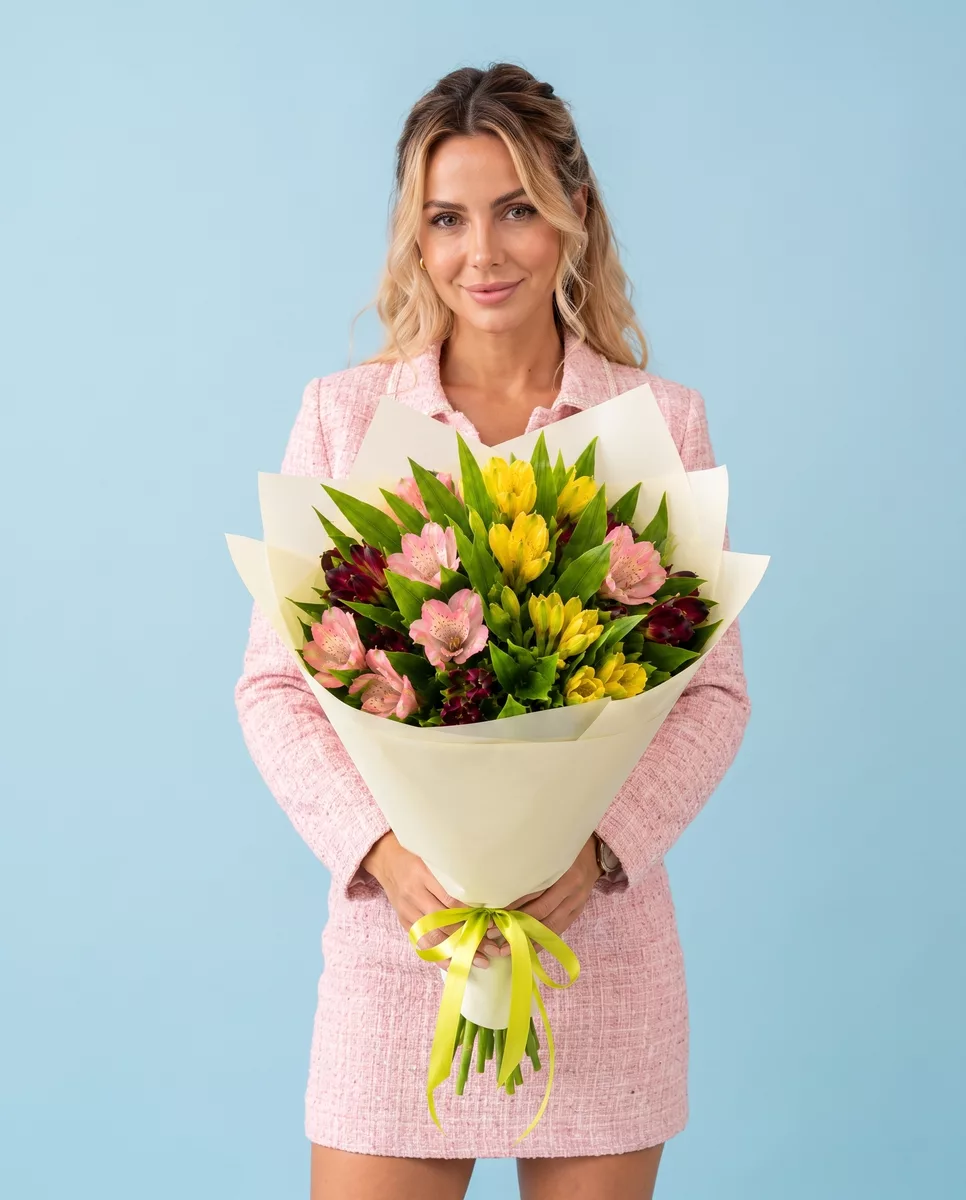
Office environments are hostile to flowers. The combination of dry heated air in winter, air conditioning in summer, and the fact that no one is going to change the water twice a day means you need varieties with genuine vase life rather than varieties that look impressive in a photograph. Chrysanthemums are the most durable cut flower available and hold well for ten to fourteen days in normal office conditions. Alstroemeria is close behind and offers a wide colour range. Spray roses — the small-headed variety that grows in clusters — last longer than standard hybrid tea roses and are less likely to droop by the end of the working day. Standard roses are fine if the recipient takes them home the same evening, which is the most common outcome for a birthday bouquet. Eustoma, also sold under the name lisianthus, has a soft, layered appearance that reads as premium and lasts well. Carnations have a poor reputation in some circles but are genuinely long-lasting and work well in mixed arrangements where they are not the dominant flower. For winter months between November and March, tulips arrive from Dutch growers and are popular, but they continue to grow after cutting and will lean dramatically within two days — fine for a birthday gift going home, less ideal for a desk arrangement meant to sit for a week. Orchid stems, particularly cymbidium, are excellent for senior promotions or long-service milestones where the occasion warrants something more structured and lasting.
Sizing Bouquets to the Occasion Without Overspending
The size of a bouquet communicates the significance of the occasion, and getting this calibration wrong in either direction creates awkwardness. A seven-stem bouquet is appropriate for a birthday in a team where everyone receives the same; it is modest enough not to single anyone out but substantial enough to be clearly intentional. A fifteen-stem or nineteen-stem bouquet signals a milestone — a five-year or ten-year anniversary, a significant promotion, or a farewell for a senior employee. Giving a nineteen-stem arrangement for every birthday in a fifty-person office is expensive and also dilutes the signal: if everything is large, nothing feels special. The practical approach most HR managers settle on is a tiered system. Standard birthdays receive a consistent mid-size bouquet, the same format for everyone at the same level. Work anniversaries at five, ten, and fifteen years receive progressively larger arrangements. Promotions to management receive a noticeably larger bouquet than a standard birthday, which reinforces the message without requiring a speech. When ordering for multiple recipients in the same month, ask about consistent presentation: same wrapper style, same ribbon colour, same general structure. This matters because in an open-plan office, three different bouquets arriving on the same day will be compared immediately. If one looks significantly more elaborate than another, the recipients will notice and so will their colleagues. Consistency is a form of fairness. We can hold a standard template for a company account so that every order matches without you having to re-specify it each time.
Delivery Logistics for Large Offices and Multi-Floor Buildings
Delivering to a business address is different from delivering to a home. The building may have a security desk that requires advance notice. The recipient may be in a meeting, on a call, or away from their floor. The office manager may want flowers delivered to reception so they can present them personally rather than having a courier walk through the open-plan area. We ask these questions before every corporate order because getting the logistics wrong wastes the gesture. If you want flowers delivered to reception for the HR manager to present, tell us that explicitly — we will hand to reception and note it on the delivery record. If you want them delivered directly to the recipient's desk as a surprise, we need a contact number for someone who can let the courier in and point them in the right direction. For offices in central Saint Petersburg, our standard delivery window is one to two hours from the moment the order is confirmed. For offices in other Russian cities we cover, timing depends on the local zone — ask us when you set up the account. Temperature matters in transit. In winter, flowers leaving a warm shop and entering a cold vehicle need to be wrapped correctly to avoid cold shock, which causes blackening on petals, particularly on roses and eustoma. In summer, a vehicle sitting in direct sun can reach temperatures that accelerate wilting significantly. We manage this in our own vehicles, but it is worth asking any florist you work with how they handle temperature in transit, because the answer tells you a great deal about how they operate.
Setting Up a Corporate Account for Recurring Orders
Ad hoc ordering works for small teams, but once you are managing flowers for more than fifteen employees, a corporate account is worth setting up. The practical benefits are straightforward. You agree on a standard bouquet format in advance, which means you do not have to brief the shop every time. Invoicing is consolidated monthly rather than per transaction, which simplifies accounting. You can place orders by message or email rather than calling each time, and there is a record of every delivery for internal reporting. When setting up an account, bring your event calendar for the next quarter. A good florist will flag conflicts — for example, if you have six birthdays in the same week, that is a production and delivery scheduling issue that needs to be planned, not handled on the day. Discuss your budget per occasion at the outset so the shop can maintain consistent quality within that range without checking back with you each time. Also clarify your policy on cards. In Russian office culture, a handwritten card accompanying a bouquet is standard and expected. Many companies personalise these with the employee's name and a note from the director or HR head. We can include a printed or handwritten card with every order; you supply the text when you place the order or maintain a standard template for birthdays versus anniversaries. One detail that catches people out: if your company has a policy of not revealing employee birthdays for privacy reasons, coordinate with us on how the delivery is announced, because a courier arriving with flowers is not subtle and the occasion will be obvious to anyone nearby.
Common Mistakes HR Managers Make with Office Flower Orders
The most common mistake is ordering too late. A same-day birthday order placed after two in the afternoon is manageable but puts pressure on the delivery window, and if the employee leaves the office at six, the margin for error is narrow. Orders placed the evening before or first thing in the morning give far more flexibility. The second mistake is assuming that all employees want flowers. Some do not, and a small number have allergies to specific pollen-heavy varieties such as lilies. Lilies are also strongly scented and can be disruptive in an enclosed office environment — we generally do not recommend them for desk delivery regardless of personal preference. Ask your team when you roll out a gifting programme whether anyone has allergies or prefers a different form of recognition. The third mistake is inconsistency. If senior employees receive large bouquets and junior employees receive nothing, or receive something visibly smaller, the gifting programme creates resentment rather than goodwill. Either gift consistently across levels or do not gift at all. The fourth mistake is forgetting men. In Russian offices, male employees receive flowers for birthdays and anniversaries as commonly as female employees. A mixed bouquet of chrysanthemums, alstroemeria, and greenery in neutral tones works well without reading as feminine. The fifth mistake is neglecting the card. Flowers without a personalised message feel impersonal at scale. Even a brief printed note with the employee's name and the specific occasion — not a generic congratulations — makes the gesture feel considered rather than automated. These are the details that determine whether a gifting programme builds loyalty or simply costs money.
Running a flower gifting programme for a Russian office is a logistics exercise as much as a gesture of goodwill. The variety choices, delivery timing, stem counts, and consistency across recipients all determine whether the programme lands as intended or creates awkward comparisons and missed occasions. The custom matters here — employees notice when their anniversary is acknowledged and they notice when it is not — so the mechanics of getting it right are worth investing in. A corporate account with a florist who understands office delivery, maintains consistent presentation, and can handle both scheduled orders and same-day requests gives HR managers one less variable to manage in an already full calendar. We deliver bouquets across Russia in 1–2 hours.
Frequently asked questions
How far in advance should we place orders for employee birthdays?
Placing the order the evening before or first thing in the morning of the birthday gives the best delivery window. Same-day orders placed before noon are manageable for central Saint Petersburg. Orders placed after two in the afternoon create tight margins, especially if the employee leaves the office by early evening. For recurring monthly birthdays, a batch order at the start of the month is the most reliable approach.
Are there flowers we should avoid sending to a Russian office?
Avoid even numbers of stems — this is strongly associated with funerals in Russian custom. Lilies are heavily scented and can trigger allergies in enclosed spaces, so we do not recommend them for desk delivery. Yellow flowers and red roses from an employer to a female employee can carry unintended associations, though this varies by age group. A mixed bouquet in pinks, whites, and corals on an odd stem count is the safest universal choice.
Do male employees in Russian offices typically receive flowers?
Yes, it is standard practice. Male employees receive flowers for birthdays and work anniversaries in most Russian offices. The bouquet style tends toward neutral tones — whites, greens, and mixed seasonal varieties — rather than the pinks and corals more common for female recipients. Chrysanthemums, alstroemeria, and spray roses in mixed arrangements work well and are widely accepted across age groups.
Can you deliver to multiple recipients in the same office building on the same day?
Yes. When several deliveries go to the same address, coordinate with us in advance so we can schedule them together efficiently. Let us know whether you want all bouquets handed to reception for internal distribution or delivered individually to each recipient. For open-plan offices, note that simultaneous arrivals will be visible to colleagues, so consistent bouquet sizing across recipients matters more than it might in a home delivery context.
What is the best bouquet format for a ten-year work anniversary compared to a standard birthday?
A ten-year anniversary warrants a noticeably larger arrangement than a standard birthday — fifteen to nineteen stems rather than seven to nine, with a more structured composition and a premium variety such as eustoma or orchid stems as a focal point. The visual difference signals that the occasion is significant. Keeping birthday bouquets consistently smaller means the anniversary arrangement communicates its meaning without requiring an explanation.
Ready to send a bouquet?
Pick a city, choose the flowers, and we will hand them over with a photo confirmation.
Choose a city →