
"Ty Delayesh Menya" in English: Meaning, Grammar and Card Use
"Ty delayesh menya" translates into English as "you make me". On its own the phrase is unfinished: in Russian it is almost always followed by an adjective, most often "ty delayesh menya schastlivym" or "schastlivoy", which means "you make me happy". It is a warm, slightly romantic phrase that people use in messages, songs and on cards with flowers.
Customers of our Saint Petersburg shops often ask us to check a phrase like this before it goes onto a card, especially when the sender learned it from a song or a translation app. Below we explain the grammar, the typical endings, how natural the phrase sounds to a Russian ear and what to write instead if you want something more idiomatic.
Word by word: what each part means
"Ty" is the informal "you", used with a partner, family, close friends and children. With a colleague, an older relative you are not close to or anyone you address formally, Russians use "vy" instead, and the verb changes to "delayete". A love phrase with "ty" is therefore personal by definition, and that is exactly the tone you want on a romantic card.
"Delayesh" is the second-person singular form of "delat", to do or to make. "Menya" is the accusative form of "ya", I, so it means "me". Put together, "ty delayesh menya" is a direct match for the English "you make me", and just like in English it needs a word after it to make sense.
The word that follows is an adjective in the instrumental case, which is why Russian endings change: "schastlivyy" (happy) becomes "schastlivym" when a man is speaking about himself and "schastlivoy" when a woman is. This is the most common mistake we see on cards written by foreigners: the ending must match the gender of the person who writes the card, not of the person who receives it.
Common endings and what they mean
The most popular version by far is "ty delayesh menya schastlivym / schastlivoy", you make me happy. Close behind are "ty delayesh menya luchshe", you make me better (here "luchshe" is an adverb and does not change with gender), and "ty delayesh menya silneye", you make me stronger, which is a popular line for a partner who has supported you through a hard year.
Other endings people ask about include "ty delayesh menya schastlivee" (you make me happier), "ty delayesh menya spokoynym" (you make me calm) and "ty delayesh menya samym schastlivym chelovekom na svete", you make me the happiest person in the world. The last one is long but very common on anniversary cards and in wedding speeches.
There is also a playful use: "ty menya smeshish" means "you make me laugh", and Russians say it with a different verb, not with "delayesh". Mixing the two is a classic translation-app error, and a recipient will understand it but notice that it sounds foreign.
Bouquets we can deliver



How natural the phrase sounds to a Russian
"Ty delayesh menya schastlivoy" is grammatically correct and every Russian understands it, but it carries a slight trace of English. It became common through translated songs, films and social media, so younger people use it freely while older recipients may find it a little bookish. On a card it reads as sweet and sincere, not as a mistake.
If you want the version a native speaker would say spontaneously, use "s toboy ya schastliv" (said by a man) or "s toboy ya schastliva" (said by a woman), which literally means "with you I am happy". Another very natural option is "ty moyo schastye", you are my happiness. Both are short, fit easily on a small card and sound warm to any generation.
For a mother, grandmother or friend, the romantic "ty delayesh menya" phrasing is less suitable. Here people write "spasibo, chto ty u menya yest", thank you for being in my life, or simply "lyublyu tebya", I love you, which in Russian is used freely within the family. We collected more short phrases of this kind in our article on "ty moyo vsyo".
Writing the phrase on a flower card
The card with your text is free with every order, and the message can be written in Russian transliteration, in English or in both. Many senders choose a two-line card: the Russian phrase first, then the English translation below it. This works well when the recipient is Russian and the sender is not, because it shows effort and removes any doubt about the meaning.
When you type the text in the order form, write the Russian words exactly as you want them and double-check the ending against the gender rule above: "schastlivym" if a man signs the card, "schastlivoy" if a woman does. Keep the message to two or three short lines; a card is small and a short phrase reads better than a long paragraph. Our guide on English card messages has practical examples and layouts.
Delivery is anonymous by default, so the courier does not name the sender. If you want the recipient to know who the flowers are from, sign the card with your name or a nickname only the two of you use. If you prefer to keep the surprise, leave the card unsigned and let the phrase speak for itself.
Which flowers suit a "you make me happy" message
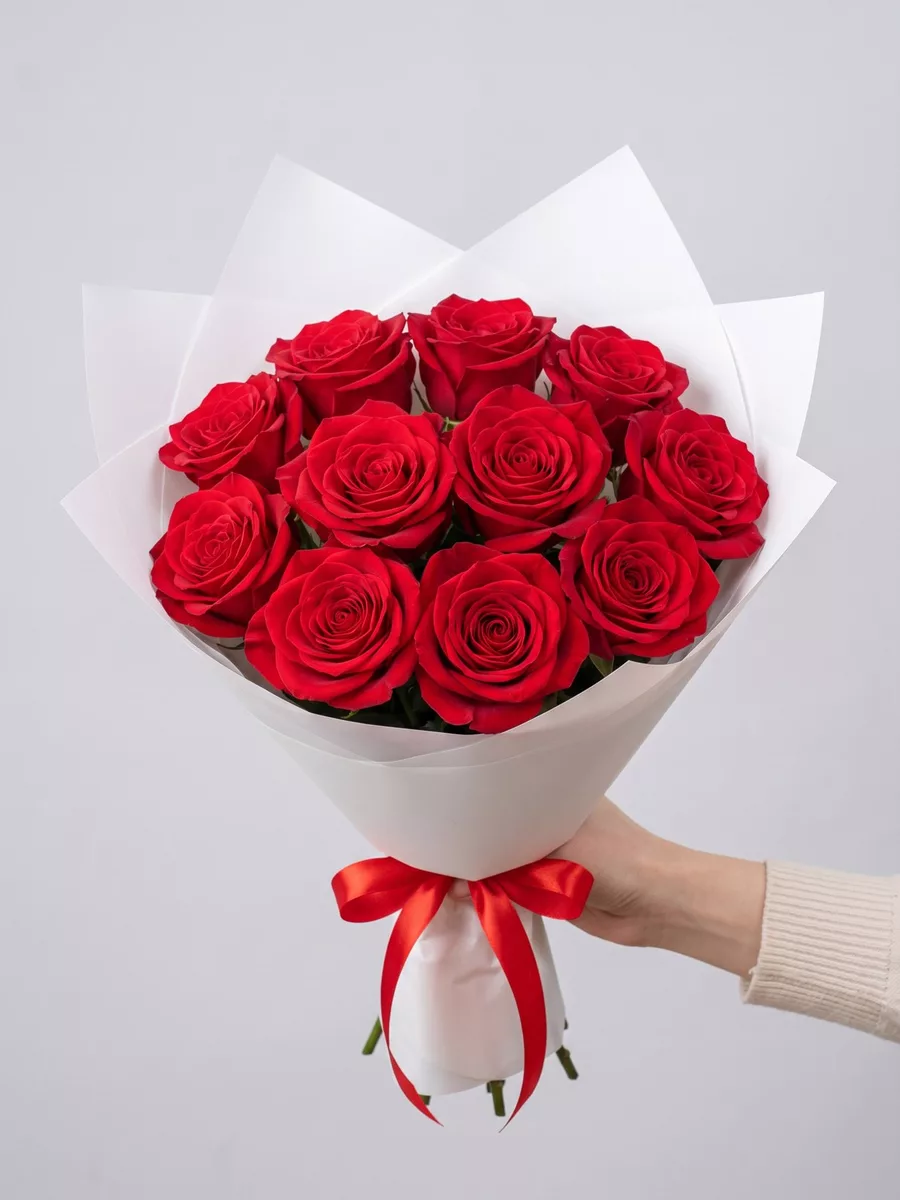
A romantic phrase pairs best with flowers that carry the same mood. Red roses are the classic choice for a partner and say love without any ambiguity. Pink and peach roses, peonies in early summer and eustoma feel softer and more tender, which suits a message about happiness rather than passion. In spring, a bouquet of tulips works beautifully with a light, joyful text.
In Russia the number of flowers in a celebratory bouquet must be odd, because even numbers are associated with funerals. This matters for small mono bouquets of roses or tulips, so if you are choosing stem by stem, pick 7, 11 or 15 rather than 10 or 12. In large mixed bouquets nobody counts, but the rule is still worth remembering.
For a first gesture, when you are not yet sure how the recipient will react, choose a medium bouquet in pastel colours and keep the card text gentle. A huge bouquet of red roses with a strong declaration can feel like too much too soon, while a softer combination lets the words do the work. You can browse ready compositions in our bouquets catalogue.
Ordering flowers with a card from abroad
Pyat Tsvetov has been working in Saint Petersburg since 2011 and has three of its own flower shops in the city, on Ilyushina Street, on the Obvodny Canal Embankment and on Srednerogatskaya Street. We deliver flowers across Russia. City delivery costs 500 RUB; for remote districts and suburbs the operator confirms the price when confirming the order. In Saint Petersburg delivery runs around the clock, so a bouquet can arrive late at night or early in the morning if that is part of the surprise.
In large cities express delivery takes 1-2 hours after the order is confirmed. You can also choose an exact time with a margin of plus or minus 30 minutes, a time window of 09-12, 12-15, 15-18 or 18-21, or place a pre-order 1-30 days ahead, which is useful for anniversaries and Valentine's Day. The courier calls the recipient about 15 minutes before arrival, and if the recipient is out, we agree a second delivery the same day or hand the flowers to a neighbour or concierge with your consent.
Payment is online on the site by bank card, SBP or Yandex Pay, and foreign bank cards are accepted through Robokassa. Details are on the delivery and payment page. If you have questions about the card text or the order, call us on 8 (812) 507-67-05.
Frequently asked questions
What does "ty delayesh menya schastlivoy" mean?
It means "you make me happy", said by a woman. A man would say "ty delayesh menya schastlivym".
Is "ty delayesh menya" a natural Russian phrase?
It is correct and widely understood, though it sounds slightly influenced by English. "S toboy ya schastliv" or "s toboy ya schastliva" is what many native speakers say spontaneously.
Can I write the card in transliterated Russian?
Yes. The card with your text is free, and you can write it in transliteration, in English or in both languages on two lines.
Will the recipient know who sent the flowers?
Only if you sign the card. Delivery is anonymous by default and the courier does not name the sender.
Which flowers go with a romantic card?
Red roses for a clear declaration, pink roses, peonies or eustoma for something softer. For happy occasions in Russia, keep the number of stems odd.
Ready to send a bouquet?
Pick a city, choose the flowers, and we will hand them over with a photo confirmation.
Choose a city →