
The Victory Flower: Red Carnations and Other Symbols of 9 May
In Russia the flower most strongly linked with Victory, and with Victory Day on 9 May, is the red carnation. It is laid at war memorials and the Eternal Flame, handed to veterans and worn as a symbol of remembrance, much as the poppy is in Britain. Red tulips and red roses are also common on 9 May, often tied with an orange-and-black St George ribbon.
In our Saint Petersburg shops the questions before 9 May are always practical: which flower, what colour, how many stems, and whether the rules are different for a veteran and for a memorial. This article answers them in the order customers usually ask, so you can choose a bouquet that is respectful and correct.
Why the carnation became the flower of Victory
The carnation has been tied to revolutionary and military symbolism in Russia since the early twentieth century, and in the Soviet era it became the official flower of state holidays. After the war it settled into the role of the main flower of 9 May. Its colour echoes the red of the Victory banner, and its long, straight stem and tough, frilled petals suggest endurance, which is exactly what the holiday commemorates.
There is also a practical reason the carnation took this place. It survives cold, wind and hours outdoors without wilting, which matters on a May morning at a parade or a cemetery. A tulip or a rose laid at a memorial fades quickly; a carnation still looks fresh the next day.
For many years carnations were seen as a formal, slightly old-fashioned flower, used mainly for official occasions. On 9 May that formality is an advantage: a red carnation is understood instantly by every generation, and no one will misread the message.
Other flowers you will see on 9 May
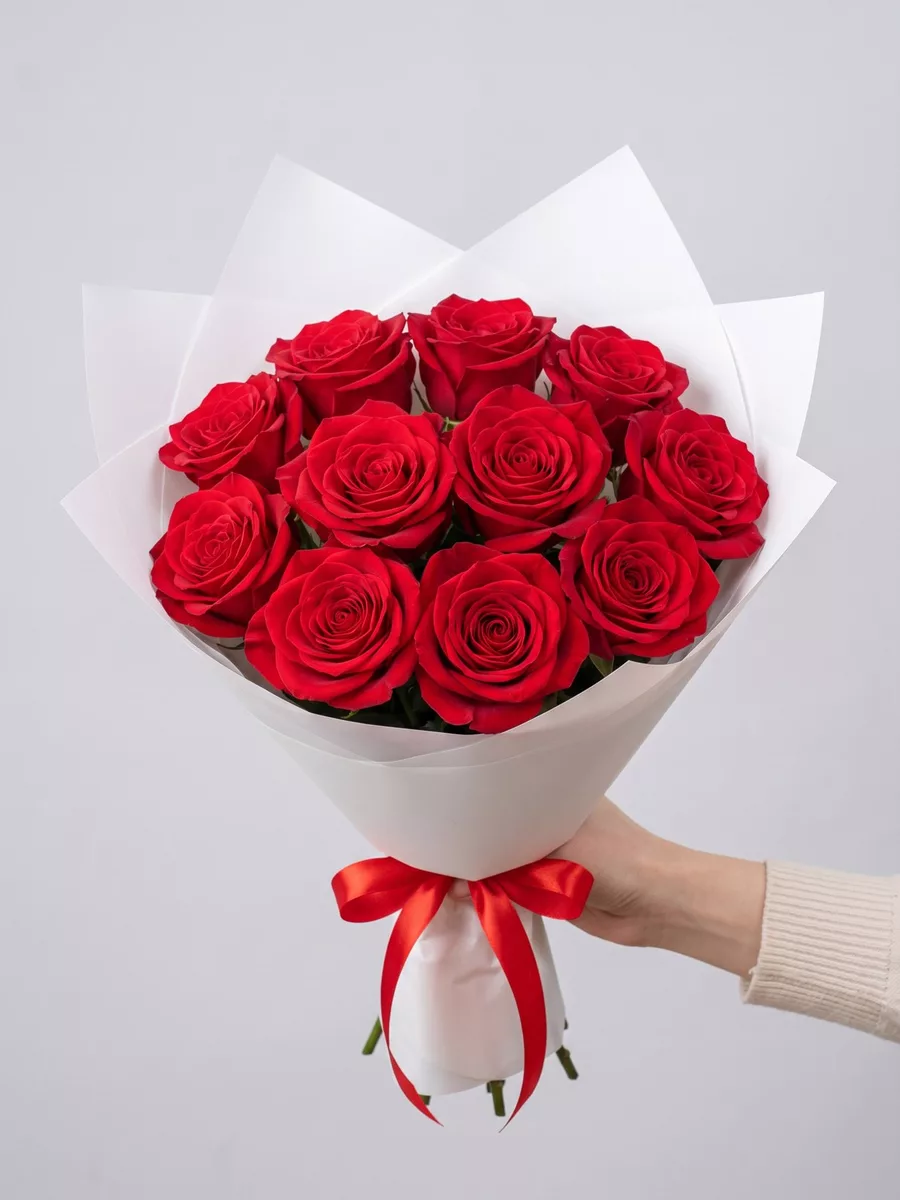
Red tulips are the second most common Victory Day flower. Their season coincides perfectly with early May, and in many families children bring tulips to great-grandparents and to the Immortal Regiment march. Red roses are used too, especially in bouquets for veterans and in compositions for official events.
White flowers have their own place. White carnations, chrysanthemums or roses are used to express mourning and remembrance of those who did not return, and they are often combined with red. Lilacs, which flower in May across central Russia, are an informal symbol of spring 1945 and appear in many family bouquets and war-era songs.
Bright mixed colours, yellow flowers and playful festive designs are best avoided for a memorial. A bouquet for a living veteran can be warmer and more varied, but the red-and-white palette remains the most appropriate choice. More detail on palettes is in our guide to Victory Day colour rules and etiquette.
Bouquets we can deliver



How many stems: veterans versus memorials
The number of flowers is the detail customers ask about most, and it is the one that matters. Flowers for a living person, including a veteran, are always given in an odd number: 3, 5, 7 or more. Flowers laid at a memorial, a grave or the Eternal Flame are given in an even number, usually 2, 4 or 6. Mixing these up is a serious etiquette mistake in Russia, so check the count before you order.
For a single gesture at a monument, two red carnations are the traditional and entirely sufficient choice. Families and delegations often bring larger even numbers or a wreath. For a veteran, a bouquet of five, seven or nine carnations or roses, tied with a St George ribbon, is the classic congratulation.
Wrapping also differs. A memorial bouquet is laid without much decoration, often with stems loose or in simple paper. A gift bouquet for a veteran can be wrapped neatly and accompanied by a card with words of gratitude.
What to write on a Victory Day card
For a veteran or an older relative, a short line of thanks is the most valued message. Common Russian phrases in transliteration are "S Dnyom Pobedy!", Happy Victory Day, and "Spasibo za Pobedu!", Thank you for the Victory. Many senders add the English translation underneath when the card goes from abroad.
For a family who will lay flowers at a memorial, the card can say "Pomnim. Gordimsya.", We remember. We are proud. It is short, dignified and fits the tone of the day. Avoid jokes, emojis and festive exclamations that you might use for a birthday.
The card with your text is free with every order. Delivery is anonymous by default and the courier does not name the sender, so sign the card if you want the family to know who remembered them.
Caring for carnations after 9 May
Carnations are among the longest-lasting cut flowers and can stay fresh for two weeks or more. Cut the stems at an angle just above or between the nodes, the swollen joints along the stem, because stems cut right through a node absorb water poorly. Remove any leaves that would sit below the waterline.
Use a clean vase with room-temperature water and change it every two to three days. Keep the bouquet away from radiators, direct sun and ripening fruit. If one stem starts to fade, remove it so it does not shorten the life of the others.
A bouquet given to a veteran often stands in a place of honour next to photographs and medals for days after the holiday, so good care matters. Tulips in the same bouquet keep growing in the vase and bend towards light; turning the vase daily keeps the composition tidy.
Ordering Victory Day flowers with Pyat Tsvetov
Pyat Tsvetov has worked in Saint Petersburg since 2011 and has three of its own flower shops in the city, on Ilyushina Street, on the Obvodny Canal Embankment and on Srednerogatskaya Street. We deliver flowers across Russia. City delivery costs 500 RUB; for remote districts and suburbs the operator confirms the price when confirming the order. In Saint Petersburg delivery is around the clock, which helps if you want the flowers to arrive early on the morning of 9 May.
Because demand is high on the days before the holiday, pre-ordering 1-30 days ahead is the sensible choice. You can also choose an exact time with a margin of plus or minus 30 minutes or a window of 09-12, 12-15, 15-18 or 18-21. In large cities express delivery takes 1-2 hours after the order is confirmed. The courier calls the recipient about 15 minutes before arrival; if nobody is home, we agree a second delivery the same day or hand the flowers to a neighbour or concierge with your consent.
Choose a bouquet in the catalogue and pay online by bank card, SBP or Yandex Pay; foreign bank cards are accepted through Robokassa. For questions about the order, call 8 (812) 507-67-05. We deliver bouquets across Russia in 1–2 hours.
Frequently asked questions
What is the Victory flower in Russia?
The red carnation. It is the main flower of Victory Day on 9 May and is laid at memorials and given to veterans.
How many flowers should I give a veteran?
An odd number, such as five, seven or nine. Even numbers are only for memorials and graves.
How many carnations are laid at a memorial?
An even number, most often two. Larger even numbers or a wreath are common for families and groups.
Can I give red tulips on Victory Day?
Yes. Red tulips are the second most popular 9 May flower and are in season in early May.
Is it appropriate to add a St George ribbon?
Yes, the orange-and-black ribbon is a traditional symbol of Victory Day and is often tied around bouquets for veterans.
Ready to send a bouquet?
Pick a city, choose the flowers, and we will hand them over with a photo confirmation.
Choose a city →