
Welcome Bouquet for a New Russian Business Partner: Varieties, Wording and Timing
The contract is signed, the handshake is done, and now someone in your team asks whether you should send flowers. In Russia, a bouquet delivered to a partner's office within the first week of signing is a recognised gesture of goodwill — not a formality but a concrete signal that you treat the relationship seriously. The mistake most foreign clients make is ordering whatever looks impressive on screen without thinking about count, colour or the card. This article gives you the practical side: which stems hold up in a Russian office in summer and winter, what numbers mean to a Russian recipient, and exactly what to write on the card.
Why Flower Count Matters More Than the Bouquet Size
Russian floral etiquette has one rule that catches almost every foreign sender off guard: even numbers of stems are reserved for mourning. A bouquet of ten roses or twelve tulips lands on a Russian director's desk as something associated with a funeral, not a celebration. This is not a superstition that educated business people ignore — it is genuinely noticed and commented on by recipients and their assistants. For a business welcome bouquet, the working numbers are seven, nine, eleven, fifteen or twenty-five stems. Seven is considered the most neutral and elegant for a first gift between organisations. Nine reads as generous. Eleven or fifteen suit larger arrangements where visual volume matters. Twenty-five is a statement piece appropriate when the contract itself is significant in value. The count applies to the dominant flower in the bouquet. If you are combining roses with spray chrysanthemums as filler, only the main stems are counted strictly. A professional florist will track this automatically, but if you are ordering online from outside Russia, it is worth specifying the number in the order notes rather than leaving it to the default quantity. One more practical point: Russian offices often have a front desk or reception area where deliveries are signed for. A bouquet that is too wide to carry through a standard door, or so tall it blocks the recipient's face during a photo, creates an awkward first impression. Compact, upright arrangements in the forty-to-sixty centimetre height range work better in office environments than sprawling garden-style designs.
Bouquets we can deliver



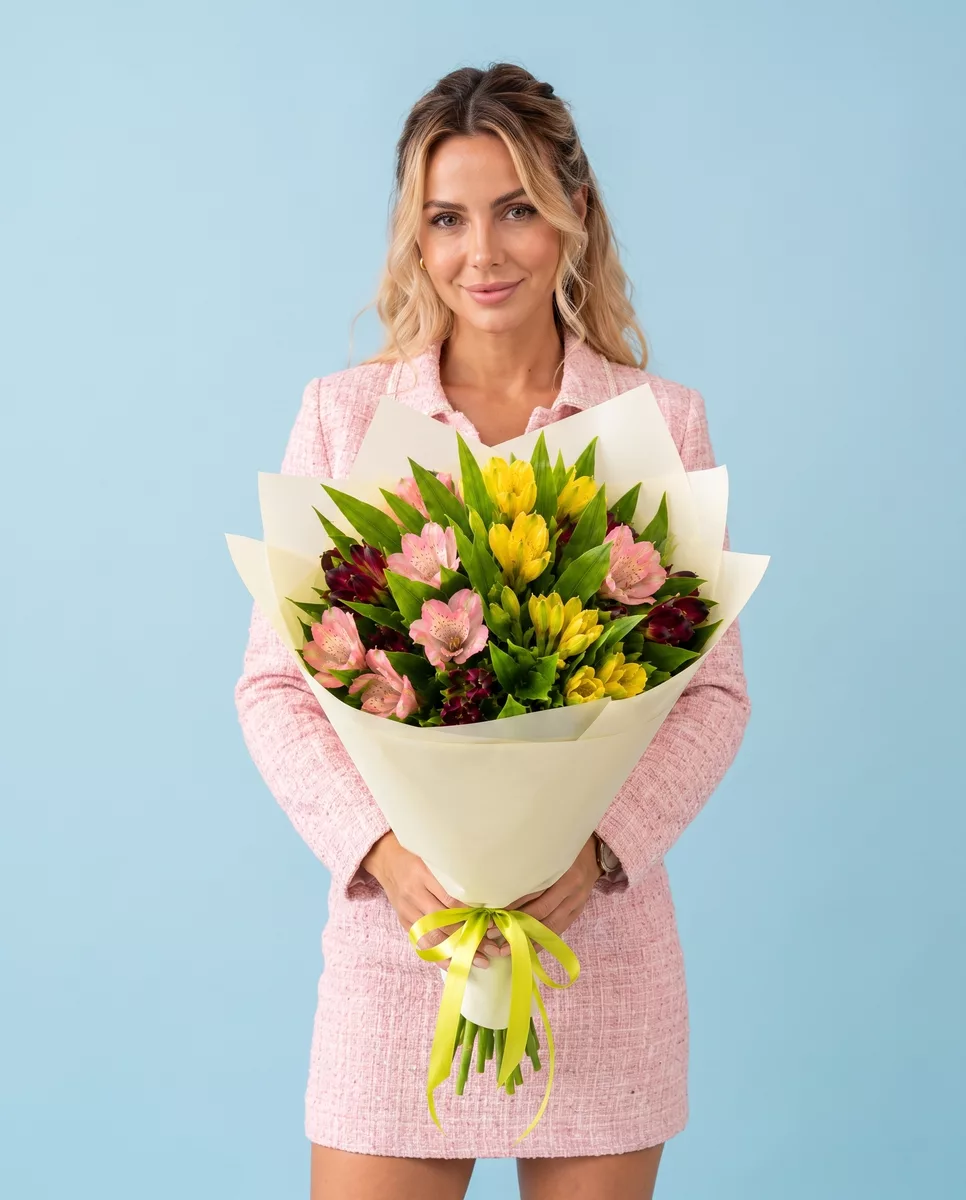
Colour Choices That Read as Professional in a Russian Context
White, cream, deep burgundy, coral and blush pink are the safest palette for a business welcome bouquet sent to a Russian partner. These colours read as respectful and intentional rather than romantic or funereal. Pure red roses are strongly associated with romantic love in Russia and, while not offensive in a business context, they can create mild awkwardness — particularly if the recipient is a woman and the sender is a man. If red is part of your company's brand identity and you want to reference it, mixing red with white or cream neutralises the romantic association and makes the bouquet read as corporate rather than personal. Yellow flowers carry a regional reputation for signalling separation or bad luck in some parts of Russia, though this belief is less consistent among urban professionals in Moscow and Saint Petersburg than it once was. To be safe with a new partner whose background you do not know well, avoid a predominantly yellow arrangement. Bright orange, deep violet and white combinations are increasingly popular in Saint Petersburg business gifting and photograph well for the social media posts that Russian companies routinely make when announcing new partnerships. For the flowers themselves: garden roses in cream or blush, white or burgundy spray roses, white lisianthus, white alstroemeria and deep-toned ranunculus all hold well in a heated Russian office, which in winter can reach twenty-two to twenty-four degrees Celsius. Avoid hydrangeas in summer deliveries if the office lacks air conditioning — they wilt within hours in heat and the drooping look undermines the gesture entirely.
Varieties That Survive a Russian Office Environment
Russian offices are not ideal for delicate flowers. Central heating runs at full power from October through April, keeping indoor temperatures between twenty and twenty-five degrees Celsius with low humidity. In summer, many offices in older Saint Petersburg buildings have no air conditioning. The flowers you choose need to be stem-hardy and slow to dehydrate. Garden roses, standard roses and spray roses are the most reliable choice year-round. A stem of garden rose in a variety like Keira, Juliet or David Austin-style blooms will hold its shape for five to seven days in a warm room if delivered in bud and kept in water. Lisianthus — sometimes called eustoma — is an underused option for business bouquets: it looks expensive, comes in white, violet and pale pink, and lasts well in warmth. Ranunculus in season, roughly February through May in Russia when imports from the Netherlands peak, add texture and hold up for four to five days. Alstroemeria is the most practical filler stem available — it lasts up to two weeks in water and tolerates heat better than almost any other cut flower. Avoid tulips for business deliveries unless you can confirm the office has a cool reception area; tulips continue to grow after cutting and can look floppy within twenty-four hours in a warm room. Peonies are beloved in Russia and make a strong impression, but their season is short — late May through June — and they dehydrate quickly. Outside that window, the quality of imported peonies drops noticeably and the price rises without the visual payoff.
Arrangement Styles That Work in a Business Setting
Russian business recipients generally prefer structured, upright arrangements over loose, wild-garden styles. A tight spiral hand-tied bouquet wrapped in craft paper or matte packaging looks intentional and formal without being stiff. Round bouquets with a domed profile — sometimes called pavé style — read as high-value and are popular for corporate gifting in Saint Petersburg because they photograph cleanly and fit neatly into a vase without rearranging. Avoid very asymmetrical or deconstructed arrangements for a first business gift. These styles are appreciated in creative industries and design studios, but in law firms, manufacturing companies, logistics businesses and financial organisations — sectors where many international partnerships are formed — they can read as careless rather than artistic. Monochromatic bouquets, meaning all stems in one colour family with tonal variation, are currently the strongest choice for professional gifting. A bouquet of nine cream and blush garden roses with white lisianthus and silver-green eucalyptus reads as considered and expensive without being showy. If your partner's company has a visible brand colour — you can usually find this on their website — a bouquet that references it subtly is a detail that gets noticed and remembered. Packaging matters more in Russia than many foreign senders expect. Flowers handed over in plain cellophane look like a supermarket purchase. Matte kraft paper, linen ribbon or a branded box with a lid all signal that the gift was ordered deliberately. Five Flowers uses structured packaging for all business orders, but it is worth mentioning in your order notes if you want a specific wrapping style or a ribbon in a particular colour.
What to Write on the Card: Wording That Lands Well
The card is the part of a welcome bouquet that Russian recipients read most carefully, and it is where foreign senders most often go wrong. Overly formal legal language — references to the contract number, the date of signing or the specific deal terms — makes the card feel like a business letter rather than a human gesture. At the other extreme, very warm personal language can feel presumptuous when the relationship is new. The right register sits between the two: professional, warm and brief. If you are writing in English, that is entirely acceptable for a Saint Petersburg partner, particularly in international-facing industries. A card does not need to be translated into Russian unless you know the recipient does not read English. Three to four sentences is the right length. The first sentence acknowledges the start of the partnership. The second expresses genuine forward-looking intent — not vague optimism but something specific to what you will build together. The third offers a direct and simple welcome. An example that works well: We are glad to begin this partnership and look forward to building something lasting together. Thank you for the trust you have placed in our team. We hope this is the first of many milestones we share. Avoid phrases like mutually beneficial cooperation — it is a translation of a Russian bureaucratic phrase that sounds stiff in English. Do not include pricing, delivery references or any logistical information on the card. Sign with your first name and company name, not your title or department. A title on a personal card reads as cold.
Timing the Delivery Correctly After Signing
The ideal delivery window for a welcome bouquet is within two to five business days of the contract being signed or the partnership being formally announced. Earlier than that — same day or next day — can feel rushed and slightly transactional, as though the flowers were prepared in advance rather than chosen thoughtfully. Later than ten days and the gesture loses its connection to the event; the recipient has moved on mentally and the bouquet arrives without context. If the signing happened in a meeting and you were present, a delivery the following morning to their office is appropriate and will be well received. If the signing was remote — documents exchanged digitally — then three to four days is a natural interval. For deliveries within Saint Petersburg, Five Flowers operates same-day delivery with a one-to-two hour window, which gives you flexibility to time the arrival precisely. If you want the bouquet to arrive at the start of the working day, before the recipient gets into meetings, order for a nine-to-ten-thirty delivery slot. Russian business culture values punctuality, and a bouquet that arrives mid-afternoon when the recipient is in back-to-back calls may sit at reception for hours before being noticed. Avoid Friday afternoon deliveries: many Russian offices clear out early on Fridays, particularly in summer, and a bouquet left at an empty reception over the weekend defeats the purpose. Monday morning deliveries, on the other hand, set a positive tone for the week and are noticed because they are less common than end-of-week gestures.
Practical Checks Before You Confirm the Order
Before you finalise a welcome bouquet order for a Russian business partner, run through four checks that prevent the most common problems. First, confirm the delivery address is a physical office, not a co-working space or serviced office building with a shared reception. Shared receptions sometimes hold deliveries without notifying the recipient, and flowers left for several hours in a warm lobby lose their quality. If the address is a business centre, add the company name and floor number to the delivery note so the courier can reach the right reception directly. Second, check whether the recipient's name on the card matches how they are addressed professionally. In Russia, using someone's first name and patronymic — for example, Aleksei Nikolaevich rather than just Aleksei — on a card is a mark of respect, particularly for senior recipients over forty. If you know the patronymic, use it on the card. If you do not, first name alone is fine and will not cause offence. Third, confirm the stem count before submitting. If you are ordering online, the default quantity on many product pages is an even number. Change it to seven, nine or eleven before checkout. Fourth, if the delivery is going to a company where the signatory is a woman, avoid red roses as the dominant stem for the reasons discussed earlier. A mixed bouquet or a monochromatic white and blush arrangement is safer. These checks take two minutes and prevent the kind of awkward follow-up conversation that no one wants to have with a brand-new business partner.
A welcome bouquet sent to a new Russian business partner does one specific job: it signals that you treat the relationship as something worth marking, not just a transaction to move past. The flowers that do this most reliably are hardy, well-structured and delivered on time — garden roses, lisianthus, alstroemeria in a tight hand-tied arrangement with matte packaging, in an odd number of stems, in white, cream or blush. The card should be warm, brief and signed with your first name. The timing should be within the first working week. None of this is complicated once you know the conventions, and getting it right leaves an impression that a follow-up email never quite manages. We deliver bouquets across Russia in 1–2 hours.
Frequently asked questions
Is it appropriate to send flowers to a male Russian business partner?
Yes, it is appropriate and increasingly common in Russian corporate culture, particularly in Saint Petersburg. The bouquet should be structured and restrained rather than romantic — white, cream or deep burgundy tones in a compact arrangement. Avoid red roses as the dominant stem. A well-chosen bouquet sent to a male director reads as respectful and professional, not personal.
Can I include a small gift alongside the bouquet, such as chocolates or wine?
Chocolates from a recognised brand work well alongside a business bouquet and are widely accepted in Russian corporate gifting. Alcohol requires more caution — some companies have internal policies against receiving it, and you may not know your new partner's stance. If you want to add something beyond flowers, premium chocolates or a small branded item from your own company are safer choices than wine or spirits.
Should the card be written in Russian or English?
For a Saint Petersburg partner in an internationally active industry — technology, logistics, finance, manufacturing — English on the card is entirely acceptable and often preferred. If you know the recipient does not read English or the company operates in a purely domestic market, a Russian translation adds a thoughtful touch. When in doubt, English is fine. Avoid machine-translated Russian if you are not confident in the result.
How far in advance should I order for a specific delivery time?
For same-day delivery within Saint Petersburg, Five Flowers asks for orders to be placed at least three hours before the desired delivery window. For a precise morning slot — nine to ten-thirty, for example — ordering the evening before guarantees availability of specific varieties and packaging. For deliveries to other Russian cities, lead time varies by location, so contact the shop directly to confirm.
What if I do not know the exact office address and only have a general district?
A general district is not enough for a timed business delivery. You need the street address, building number and, for large business centres, the company name and floor. If you only have a district, the safest approach is to contact your partner's assistant or office manager directly to request the delivery address — this is a normal and unremarkable request that will not seem unusual in a Russian business context.
Ready to send a bouquet?
Pick a city, choose the flowers, and we will hand them over with a photo confirmation.
Choose a city →