
Alstroemeria in Russia: The Long-Lasting Bouquet Filler
Customers who order bouquets ask us all the time why their flowers die in four days. Nine times out of ten the arrangement was built around roses and nothing else. Adding alstroemeria to the mix changes that completely — this stem holds its blooms for twelve to fourteen days under normal apartment conditions, costs significantly less per stem than a standard rose, and comes in enough colour varieties to match almost any palette. It is the most underused flower in the Russian retail market, and this article explains exactly why we reach for it first when building a bouquet that needs to last.
What Alstroemeria Actually Is and Where It Comes From
Alstroemeria, sometimes called the Peruvian lily or lily of the Incas, is a flowering plant native to South America, specifically the Andean regions of Chile and Peru. Despite that origin, almost all alstroemeria sold in Russia today is grown in the Netherlands, Colombia, or in large-scale Russian greenhouses concentrated in the Krasnodar region and the Moscow oblast. The Dutch-grown stems tend to be longer and more uniform, while Colombian stems often carry a slightly higher bud count per stem. Russian greenhouse production has expanded noticeably since 2022, and domestic stems now appear consistently in Saint Petersburg wholesale markets from late autumn through spring. The flower sits on a single stem that branches into multiple buds at the top, meaning one stem typically carries five to nine individual flowers at different stages of opening. That structure is exactly what makes it so useful as a filler: while the outer buds open fully in the first three days, the inner buds continue opening over the following week and a half, giving the arrangement a constantly refreshed look. The leaves are lance-shaped and twist at the base, a botanical quirk called resupination that causes the leaf underside to face upward. Florists strip the lower leaves before arranging because wet foliage accelerates bacterial growth in the vase water, which is the single most common reason alstroemeria fails early in home care.
Bouquets we can deliver

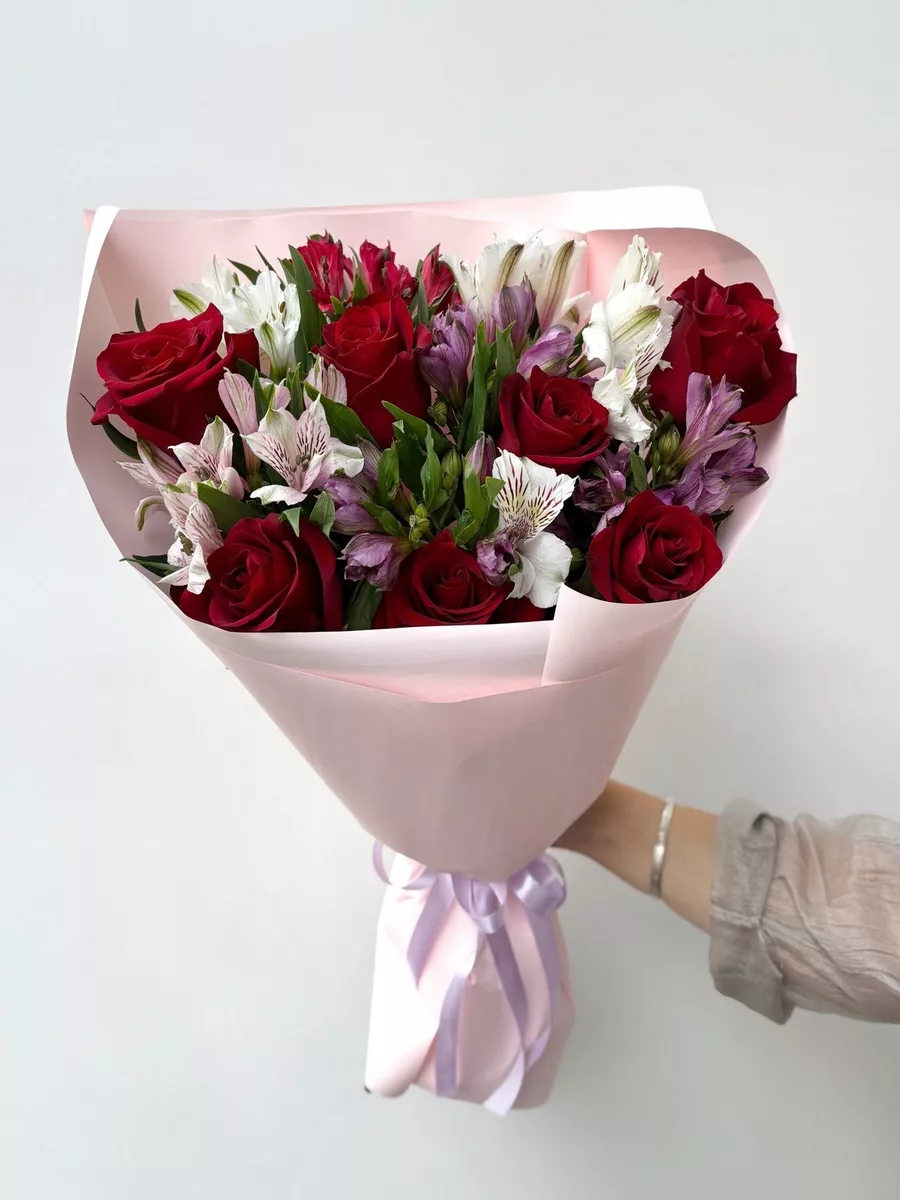

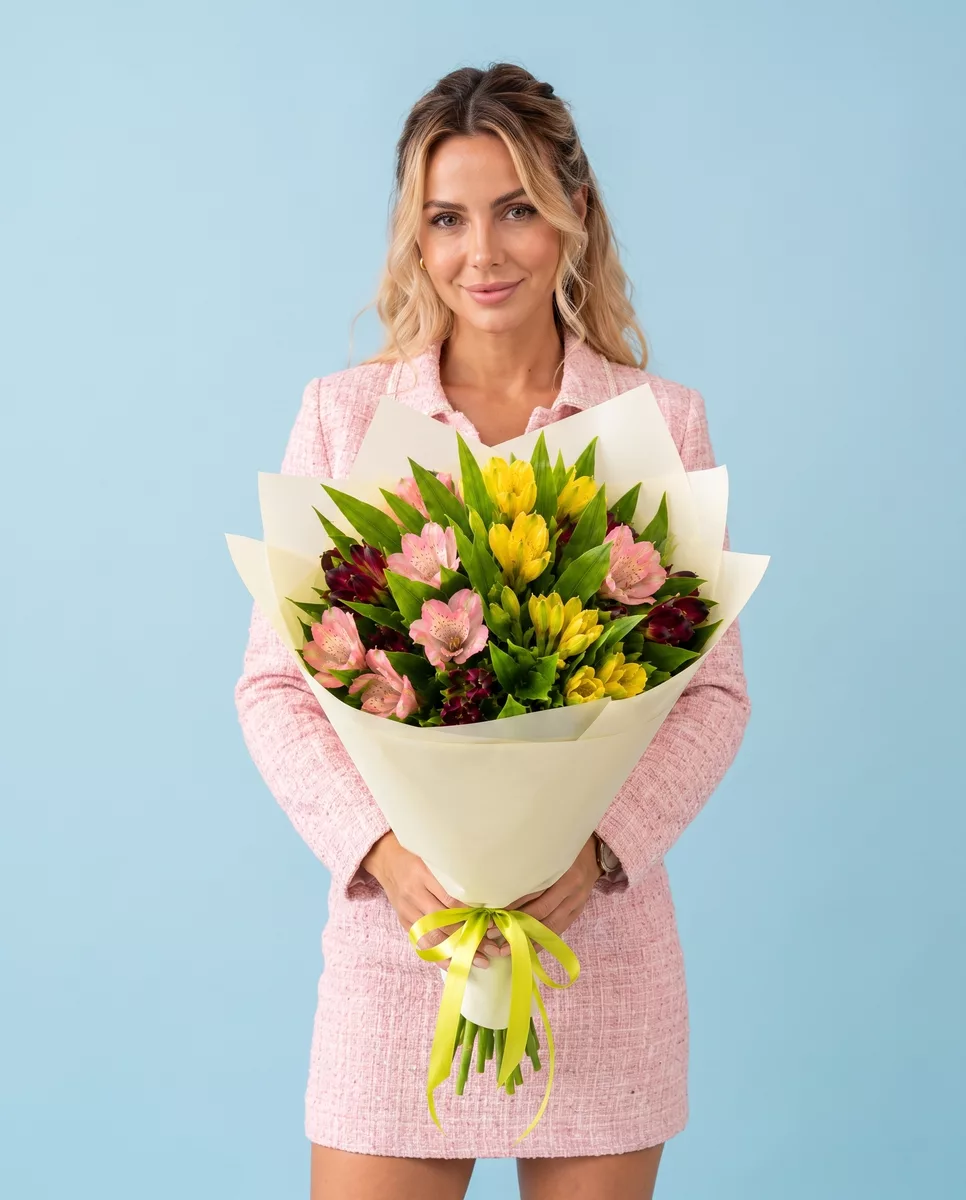
Varieties Available in the Russian Market Right Now
The Russian wholesale and retail market carries a relatively stable set of alstroemeria varieties, and knowing the names helps when you are specifying a bouquet. White Sensation is the dominant white variety and holds its colour without browning at the petal edges even in warm rooms. Tiara is a pale yellow with faint burgundy streaking on the inner petals and is one of the most requested varieties for spring arrangements. Fuego is the most widely available red-orange option and has a long stem length, typically sixty to seventy centimetres, which suits tall vase arrangements. Princess Fabiana is a deep pink that reads almost magenta under indoor lighting and pairs cleanly with white spray roses. Napoli is a bicolour variety, white base with a pink-purple edge, and it is frequently used in wedding work because it photographs well without heavy editing. Purple Rain is the closest thing to a true purple available in this flower family, though it leans more toward a dusty lavender in person. Yellow King is a saturated yellow that holds its colour well even as the flower ages, unlike some lighter yellows that fade toward cream. Availability shifts by season: reds and oranges are easier to source in autumn and winter, while pinks and whites are consistently available year-round. When you are ordering a bouquet that specifies alstroemeria by colour, tell the florist the room temperature where the bouquet will live, because some varieties open faster in warm conditions and the florist will adjust which stage of bud development they select from the wholesale lot.
Why Russian Florists Use It as a Filler, Not a Feature
In Russian floristry, alstroemeria occupies a specific structural role: it is almost always the supporting flower rather than the centrepiece. This is not a reflection of its quality but of its shape. The branching stem and multiple small flowers create volume and texture without competing visually with a focal flower like a peony, a large-headed rose, or a garden dahlia. A typical mixed bouquet assembled in a Saint Petersburg flower shop might use three or five stems of alstroemeria alongside five roses, two or three stems of eustoma, and some greenery such as ruscus or eucalyptus. The alstroemeria fills the gaps between the larger flowers, prevents the bouquet from looking sparse, and — critically — outlasts everything else in the arrangement. When the roses start to drop petals around day five or six, the alstroemeria is still fully presentable and the recipient can pull out the spent roses and keep the remaining stems in the vase for another week. That two-stage vase life is something customers rarely consider when ordering but consistently appreciate after delivery. There is also a practical pricing logic here: because alstroemeria stems are less expensive than roses or peonies, using them as fillers allows a florist to build a visually full bouquet at a mid-range price point without sacrificing longevity. A bouquet that is all roses at the same price point will have fewer stems, less volume, and a shorter effective display life. Russian customers increasingly understand this, especially repeat buyers who have compared bouquets over time.
Vase Life: What Fourteen Days Actually Requires
Fourteen days is achievable, but it requires the right conditions from the moment the bouquet arrives. The single most important factor is water temperature and cleanliness. Alstroemeria should go into cool water, ideally between eight and twelve degrees Celsius, and the water should be changed every two days without exception. Most apartments in Russia run warmer than many European homes, particularly in winter when central heating systems push indoor temperatures to twenty-two or twenty-four degrees Celsius. In those conditions, bacterial growth in the vase accelerates and the stems deteriorate faster. Adding a small amount of flower food — the sachet that often comes with a delivered bouquet — genuinely extends vase life by providing sugar for the still-opening buds and an antibacterial agent for the water. The stems should be recut at an angle each time the water is changed, removing about one centimetre from the bottom. Use a sharp knife rather than scissors, because scissors compress the stem tissue and reduce water uptake. Keep the vase away from direct sunlight, radiators, and fruit bowls. Ethylene gas released by ripening fruit is one of the less obvious causes of early flower decline, and alstroemeria is moderately sensitive to it. A north-facing windowsill in winter or a spot on a table away from heat sources is ideal. Florists in Saint Petersburg often tell customers that the bouquet will last longer in the hallway than in the living room simply because hallways are cooler. That advice sounds odd but is genuinely correct in most Russian apartment layouts where the entrance area sits away from radiators.
Seasonal Availability and What Changes by Month
Alstroemeria is one of the few flowers with genuinely year-round availability in Russia, but the source and quality shift across the calendar. From November through March, the dominant supply comes from Dutch and Colombian imports, and stem quality is typically very high because those growing operations are optimised for winter export. Prices at the wholesale level are stable during this period. From April through June, Russian greenhouse production ramps up and domestic stems become more prevalent in the Saint Petersburg market. These stems are sometimes slightly shorter than imported ones but are fresher in terms of time from cut to sale, which can actually mean better vase life when the logistics chain is short. July and August see the widest variety of colours available because outdoor-grown stems from southern Russia supplement greenhouse supply. However, summer heat creates logistics challenges: stems cut in thirty-degree heat and transported without adequate refrigeration can arrive with already-compromised vase life even if they look fine on delivery. A reputable florist refrigerates stems at four to six degrees Celsius between purchase and arrangement and delivers in a temperature-controlled vehicle. When ordering in July or August, ask whether the shop has refrigerated storage and delivery, because this matters more for alstroemeria in summer than it does for many other flowers. September and October are generally excellent months for alstroemeria in Russia — temperatures drop, logistics improve, and the new autumn crop from Colombian farms arrives in quantity with strong stem quality and good colour saturation across all the main varieties.
Combining Alstroemeria with Other Flowers: What Works
The practical question florists get most often is what to pair with alstroemeria, and the answer depends almost entirely on the dominant flower in the arrangement. With garden roses, specifically David Austin-type roses with their cupped, many-petalled heads, alstroemeria works best in white or pale pink because the colour contrast is subtle and the textures complement each other without one overpowering the other. With spray roses, which are smaller and more casual in form, alstroemeria in bolder colours like Fuego orange or Purple Rain lavender creates an energetic, informal look that suits birthday bouquets. With eustoma, also called lisianthus, alstroemeria in white or cream creates an almost monochromatic arrangement that reads as sophisticated without being stiff. Peonies are a trickier pairing because the peony's large, dramatic head tends to make everything else look small, but two or three stems of alstroemeria tucked low in the arrangement add colour at a different level and extend the bouquet's life well past the peony's typical five to seven days. Chrysanthemums and alstroemeria are both long-lasting, making them a practical combination for bouquets sent to hospitals or to recipients who live alone and may not change vase water as frequently as recommended. Greenery choices matter too: ruscus and pittosporum work well because their dark leaves make alstroemeria colours pop, while eucalyptus adds a scent contrast that some customers find appealing but others find overpowering in an enclosed room.
What to Check When Ordering Alstroemeria for Delivery
When ordering a bouquet that includes alstroemeria for delivery in Russia, there are four specific things worth checking before confirming the order. First, ask what stage of bud development the stems will be at on delivery. Stems sent in tight bud will last longer in transit and open progressively over the first week, which is ideal if the bouquet is a gift that will sit in a vase for days. Stems already in full bloom look impressive on arrival but have less remaining vase life. A good florist will send stems at mixed stages: one or two open flowers for immediate visual impact, the rest in various stages of bud. Second, confirm the colour. Alstroemeria variety names are not universally standardised across suppliers, and what one wholesaler calls Tiara another may call a different name. Describing the colour you want — pale yellow with dark inner markings, for example — is more reliable than specifying a variety name you read online. Third, check the delivery time relative to the recipient's schedule. Alstroemeria left in a warm entrance hall or outside an apartment door for more than two hours in summer will suffer. Fourth, ask whether the bouquet includes a water source for transit — a water tube on the stem ends or a wet wrap — because alstroemeria dehydrates faster than many customers expect during a one to two hour delivery window in warm weather. At Five Flowers we pack stems with hydration in mind for every order, but it is worth confirming this explicitly with any florist you use.
Alstroemeria is the most practical flower most customers never think to request by name. It costs less than the focal flowers it supports, outlasts almost everything else in the arrangement, comes in a reliable range of colours year-round, and requires nothing exotic in terms of home care — just cool water, a clean vase, and a spot away from the radiator. If you are ordering a bouquet that needs to look good for more than a week, or if you want more visual volume without a proportionally larger budget, asking for alstroemeria in the mix is the single most effective change you can make. Florists who work with it regularly reach for it automatically; customers who discover it through one good bouquet tend to ask for it in every order after that. We deliver bouquets across Russia in 1–2 hours.
Frequently asked questions
How long does alstroemeria actually last in a vase at home?
In a cool room with water changed every two days and stems recut each time, alstroemeria typically lasts twelve to fourteen days. In a warm Russian apartment with central heating running at full capacity in winter, expect ten to twelve days. The buds continue opening progressively, so the arrangement looks fresh well past the point where roses in the same bouquet would have finished.
Is alstroemeria a good choice for a birthday bouquet in Russia?
Yes, and it is particularly practical for birthdays where the recipient will be away from home for part of the day. The flower tolerates a few hours without water better than many alternatives, the colour range covers almost every preference, and the long vase life means the recipient enjoys the bouquet for the full week after the occasion rather than just the first two days.
Can alstroemeria be ordered as the main flower in a bouquet, not just a filler?
Absolutely. A mono-bouquet of fifteen to twenty alstroemeria stems in two or three complementary colours — say, white, pale pink, and deep pink — creates a full, layered arrangement with real visual presence. It is less common in Russian retail than rose mono-bouquets but works well and lasts considerably longer. Specify the colour combination clearly when ordering.
Why do some alstroemeria bouquets smell and others do not?
Alstroemeria has very little natural fragrance, which is actually an advantage for recipients who are sensitive to strong scents or who work in offices. If you notice a smell from an alstroemeria bouquet, it is almost always coming from the water or from bacterial activity in the vase rather than from the flower itself. Change the water and recut the stems and the smell will stop.
What is the best way to store alstroemeria before putting it in a vase?
If the bouquet arrives before you are ready to arrange it, keep the stems in their wrapping with the water tube intact and place them in the coolest room in the apartment, ideally somewhere between ten and fifteen degrees Celsius. Do not put them in the freezer. The hallway or a cool bathroom works well in most Russian apartments. Avoid leaving them near a window with direct sunlight even in winter.
Ready to send a bouquet?
Pick a city, choose the flowers, and we will hand them over with a photo confirmation.
Choose a city →