
Anonymous Flower Delivery: What the Recipient Sees and What They Don't
At least once a week someone calls the shop and asks the same question: if I don't sign the card, will she figure out it was me? The honest answer is that it depends entirely on how you place the order and what you put in each field. A blank card is not the same as a truly anonymous order. This article walks through every point where your identity can leak — the delivery slip, the card message, the courier's phone, the payment receipt — and explains exactly how to close each one.
What a Standard Delivery Slip Contains
Every order that leaves our refrigerated van arrives with a delivery slip attached to the bouquet or box. The standard slip carries the recipient's name, the delivery address, the date and time window, and a short card message if one was added during checkout. It does not automatically print the sender's name, phone number or email unless you typed those details into the card message field yourself. That distinction matters more than most customers expect. The slip is generated from the order form, so whatever you write in the 'message to recipient' box appears word for word on the paper the courier hands over. If you write 'Love, Dmitri from accounting,' Dmitri is identified. If you write 'Thinking of you' and nothing else, the slip carries no name at all. The courier's printed copy, which they keep for route confirmation, shows the recipient address and order number but not the sender's personal data — that stays in the internal system. So the physical paper that ends up in the recipient's hands is controlled almost entirely by what you choose to type. One common mistake: customers assume the shop automatically adds a 'from' line. We do not. The card is blank by default and fills only with what you write. A second common mistake is copying a personal email address or phone into the message box as a return contact — that defeats the purpose immediately. Keep the message field clean of identifying details and the slip will carry none.
Bouquets we can deliver



How to Fill the Order Form Without Leaving Traces
The order form asks for a sender name and contact phone so the courier can reach someone if the recipient is unavailable or the address is unclear. This information stays inside our dispatch system and is not printed on the delivery slip or shared with the recipient. You can enter a first name only — 'Anna' rather than 'Anna Volkova' — and a phone number that belongs to you but that the recipient does not recognise. That is a perfectly normal way to order. What you should not do is use a name the recipient would immediately connect to you, especially if you are sending to a small office where everyone knows each other. Using a nickname or a short form of your name keeps the dispatch record functional without being a giveaway if the recipient somehow sees the courier's screen. Payment details are another place people overlook. If you pay by card and the recipient later sees a bank notification on a shared account or a linked card, the merchant name on the statement will show the shop name, not yours — but the amount and timing can be enough for a careful person to connect the dots. Paying by a separate card or through an online wallet reduces that risk. When you reach the checkout screen, read each field label before typing. The 'comment for courier' field is for delivery instructions such as door codes or floor numbers — it is internal and not shown to the recipient, so you can safely note 'please do not mention the sender's name' there, and the courier will follow that instruction.
The Card Message: Where Most Senders Accidentally Identify Themselves
The card message is the single most common place where anonymity breaks down. People write in a style so specific to them — a running joke, a shared reference, a pet name — that the recipient knows immediately who sent the bouquet even without a signature. This is not a logistics failure; it is a writing failure. If you want genuine anonymity, the message needs to be either entirely absent or written in language that could come from anyone. A line like 'Congratulations on your promotion' is neutral. A line like 'Remember what we talked about at the lake last summer' is a fingerprint. Florists see both every day, and the second type is almost always followed by a call asking whether the shop told anyone. We did not. The sender told everyone themselves. If you want to say something personal but still stay anonymous, consider writing in a different register than you normally use. Short and formal works well: 'Wishing you a wonderful day.' Longer and emotional tends to reveal voice. Another trap is referencing the specific flower variety in the message — 'I chose ranunculus because I know you love them' — which narrows the field of possible senders to people who know the recipient's preferences. Ranunculus are beautiful, widely available from late autumn through spring, and a reasonable choice for many occasions, but mentioning them by name in the card is a clue. Write the message last, after you have chosen the bouquet, and read it back imagining you are the recipient trying to guess the sender.
What the Courier Knows and What They Will Say
Couriers working a delivery route carry a list of stops with addresses, recipient names, order numbers and time windows. They do not carry a printed list of sender names, and they are not briefed on the relationship between sender and recipient. If a recipient opens the door and asks 'who sent this,' the courier's honest answer is that they do not know — because they genuinely do not. The order number on their sheet does not mean anything to the recipient, and couriers are not trained to look up sender information on the spot. However, recipients sometimes press hard, and a courier who is trying to be helpful might say something like 'it came through the website' or 'it was ordered this morning,' which narrows timing without revealing identity. If timing is sensitive — for example, you are the only person who knew the recipient would be home at noon — you can note in the courier comment field that the delivery time should not be discussed. That is an unusual request but a reasonable one, and couriers follow written instructions. What couriers cannot do is lie about the shop's name or pretend the flowers appeared without any order. The shop name will be visible on the van, on the packaging tape, and on the slip. If the recipient searches the shop online, they will find the ordering page. That is unavoidable. Anonymity here means the recipient cannot identify you specifically — not that they will believe the flowers arrived by magic. Set that expectation before you order.
Flowers That Stay Fresh Long Enough to Outlast the Mystery
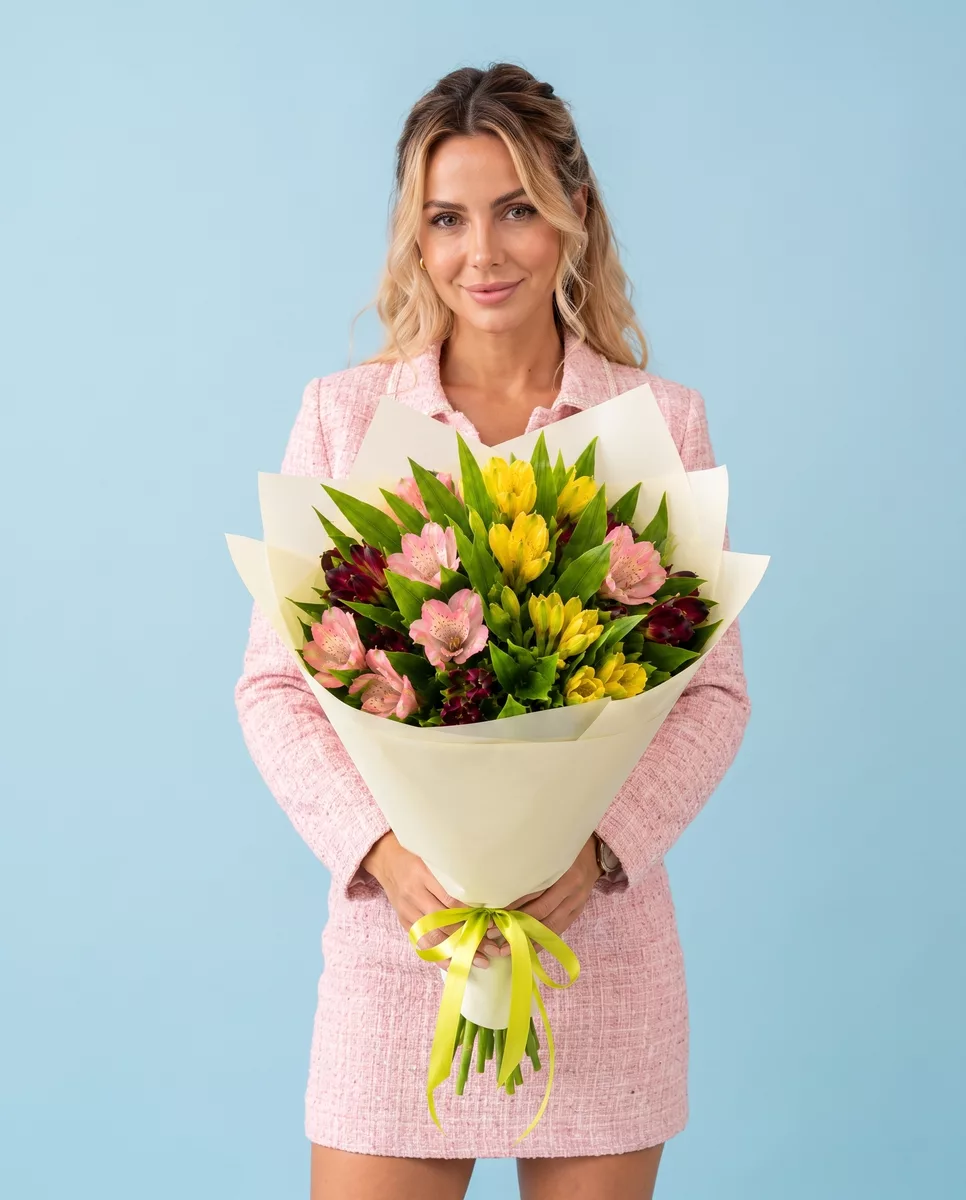
Anonymous deliveries sometimes arrive when the recipient is not home, which means the bouquet may wait in a hallway, a building lobby or with a neighbour for one to three hours before it is collected. That wait is harder on some flowers than others, and choosing the wrong variety for an anonymous delivery can mean the flowers look tired by the time the recipient unwraps them — which is not the impression anyone wants to leave. Chrysanthemums, alstroemeria, and spray roses handle temperature variation well and hold their shape for several hours outside refrigeration. Peonies and garden roses are more sensitive and wilt faster in a warm lobby. Tulips are fine in cool weather but soften quickly above eighteen degrees Celsius. If you are sending in summer or to a building with heated common areas, lean toward chrysanthemums or alstroemeria. Both come in a wide range of colours and work well in structured bouquets that look intentional rather than improvised. Eustoma, also called lisianthus, is another solid choice — the flowers are layered and elegant, they last well out of water for a few hours, and they are available year-round from commercial growers. When placing an anonymous order, add a note in the courier comment field about leaving the bouquet in a cool spot if no one answers. The courier cannot guarantee this, but a shaded stairwell is better than a sunny windowsill, and most couriers will make the effort if asked in writing.
Russian Customs Around Anonymous Gifts and What Recipients Expect
In Russia, receiving flowers without a known sender is not unusual around certain dates — March 8th, Valentine's Day, and professional appreciation days like Teacher's Day in October produce a wave of anonymous bouquets every year. Recipients on those dates often assume the sender is someone from their immediate circle and may not investigate further. Outside those dates, an unexpected anonymous delivery draws more curiosity, and the recipient is more likely to call the shop or ask neighbours whether they saw who delivered it. This is worth knowing before you order. If you are sending on a culturally loaded date, anonymity is easier to maintain simply because it fits the pattern. If you are sending on a random Tuesday in November, the gesture stands out more and the recipient will think harder about who might have sent it. Russian recipients also tend to share news of unexpected deliveries with friends and family quickly — a photo of the bouquet on a messaging app within the hour is common. That means the circle of people speculating about the sender expands fast. If anyone in that circle knows you sent flowers, the anonymity dissolves socially even if the delivery slip is perfectly blank. Think about who else might know you placed the order — a friend you consulted, a colleague who saw your screen — before assuming the secret is fully contained. The delivery itself can be silent; the social layer around it often is not.
Checking Your Order Before You Confirm It
Before you press the final confirm button, open the order summary and read every field as if you are the recipient seeing it for the first time. Start with the card message: does it contain your name, a nickname, a shared reference, or a writing style that identifies you? If yes, rewrite it. Move to the sender name field: is it a name the recipient would recognise? If yes, use a shorter or different form. Check the contact phone: is it a number saved in the recipient's contacts? If yes, consider using a different number for this order, even a temporary one, since the courier may call it if there is a delivery problem and the recipient might see the incoming number on the courier's screen. Look at the delivery time window: does it coincide with a moment only you would know the recipient is available? If so, widen the window or shift it slightly. Finally, check the bouquet itself: did you choose a variety or colour combination so specific to the recipient's known tastes that only a close acquaintance would have selected it? That is a clue in its own right. White freesias for someone who always wears white, or deep burgundy dahlias for someone whose kitchen is painted that colour — these are details that point to a sender who knows the recipient well. You do not need to choose a generic bouquet, but be aware that very specific choices carry information. A mixed seasonal arrangement in soft colours is readable as a warm gesture from almost anyone. A single-variety bouquet of the recipient's favourite flower is readable as a gesture from someone who knows them closely.
Anonymous flower delivery is straightforward when you understand which fields carry your identity and which do not. The delivery slip is blank by default. The card message is entirely in your control. The courier does not know who you are and will not say. The places where anonymity breaks down are almost always the sender's own choices — a signed message, a recognisable writing style, a flower variety that only one person would have chosen, a delivery timed to a private schedule. Treat the order form as a document the recipient might eventually see, and fill it accordingly. Do that, and the flowers arrive with no trace of who sent them except the warmth of the gesture itself. We deliver bouquets across Russia in 1–2 hours.
Frequently asked questions
Will the shop tell the recipient who sent the flowers if they call and ask?
No. Sender information is treated as private order data and is not shared with recipients over the phone or in person. The recipient can confirm that an order was placed and delivered, but the shop will not disclose the sender's name, phone number or any other identifying detail from the order record.
Can I send flowers anonymously to a workplace address?
Yes, but be aware that office receptionists and colleagues often see the delivery and the bouquet before the recipient does. The slip will not carry your name, but coworkers may speculate aloud. If the recipient works in a small team where everyone knows each other well, anonymity is socially harder to maintain even when the paperwork is clean.
What if the courier cannot reach the recipient and needs to call someone?
The courier will call the contact number you provided in the order form. That number is not shown to the recipient, but if the courier's phone is visible during a handover, the recipient could potentially see it on the screen. Using a number the recipient does not have saved reduces that risk significantly.
Is there a way to send a message without any card at all?
Yes. Simply leave the card message field empty when placing the order. The bouquet will arrive with a blank slip and no written message. Some customers prefer this because even a neutral sentence can feel like a clue. A bouquet with no card at all is a valid and complete anonymous gesture.
Which flowers are best for an anonymous delivery where the recipient might not be home immediately?
Chrysanthemums, alstroemeria and lisianthus hold up best if the bouquet waits in a lobby or hallway for an hour or two. They tolerate room temperature without wilting quickly. Avoid peonies and open garden roses in warm weather — they soften fast out of water and will look tired before the recipient unwraps them.
Ready to send a bouquet?
Pick a city, choose the flowers, and we will hand them over with a photo confirmation.
Choose a city →