
Corporate Flower Accounts: Scheduled Deliveries and Consolidated Invoicing
Most offices that call us about a corporate account have already had the same bad experience: someone from accounting scrambles to find a florist the morning of a board meeting, pays retail price, gets whatever is in stock that day, and the bouquet arrives forty minutes late. A recurring account solves all three problems at once. You agree on a schedule, lock in varieties and volumes, receive one invoice per month rather than a receipt per order, and a single manager handles every delivery without you chasing anyone.
What a Corporate Account Actually Means in Practice
A corporate flower account is not a loyalty card or a discount code. It is a formal service agreement between your company and the shop, covering delivery frequency, preferred flower varieties, recipient addresses across your city or across Russia, billing terms, and a named contact on our side who knows your preferences. When offices first hear this, they assume the minimum order must be enormous. In practice, accounts start from a single weekly delivery — say, fresh stems for a reception desk — and scale up to dozens of bouquets sent to clients and partners on the same day. The key difference from one-off ordering is predictability. We pre-order your chosen varieties from our suppliers in advance, which means you are not competing with walk-in customers for the last batch of garden roses or ranunculus on a busy Friday. Your stems are reserved. Billing is consolidated: instead of individual receipts that your finance team has to match against card statements, you receive one itemised invoice at the end of each calendar month, formatted for Russian accounting requirements with all the necessary VAT documentation. For companies registered outside Russia that still send flowers to Russian clients, we issue the same consolidated document and can correspond in English throughout. The account is active from the date the agreement is signed, and the first scheduled delivery can happen within forty-eight hours of that.
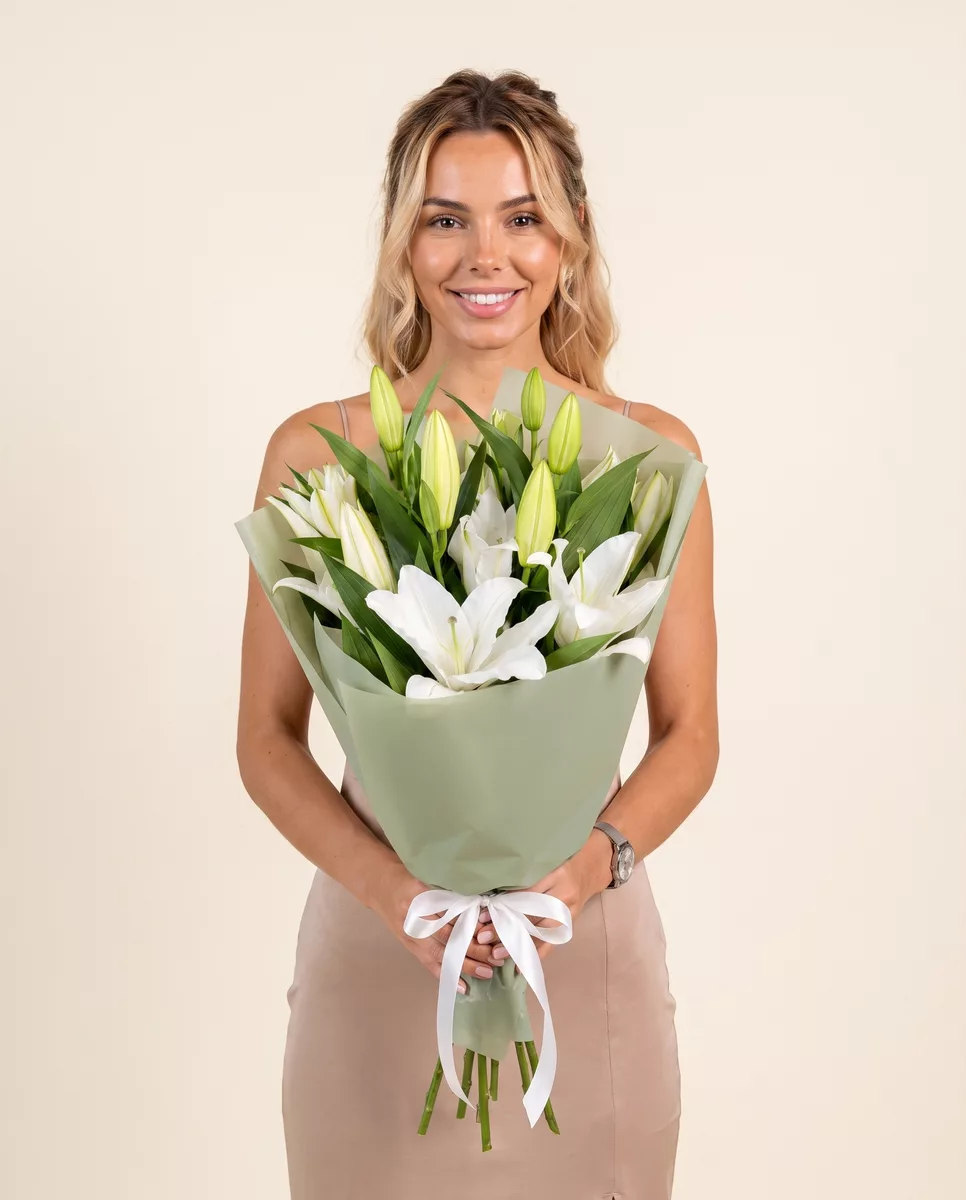
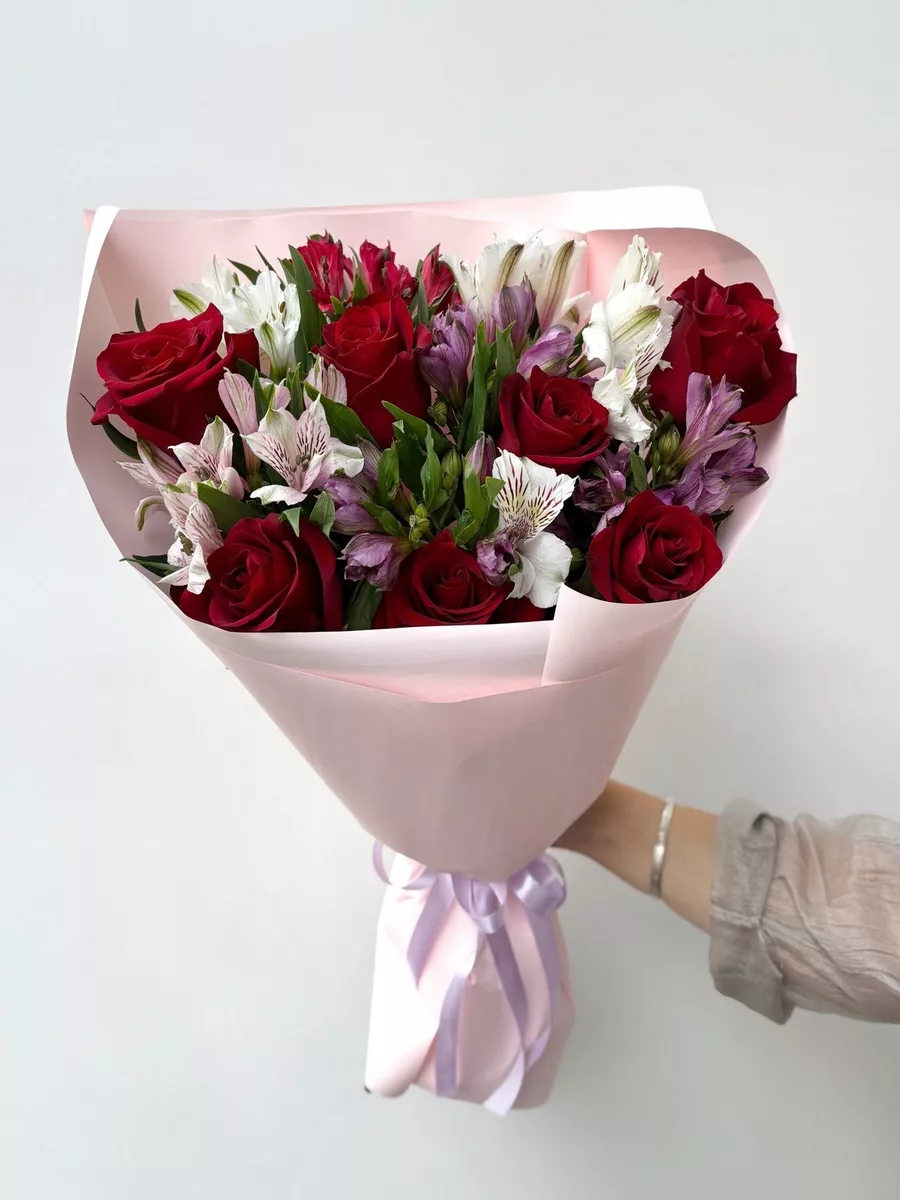
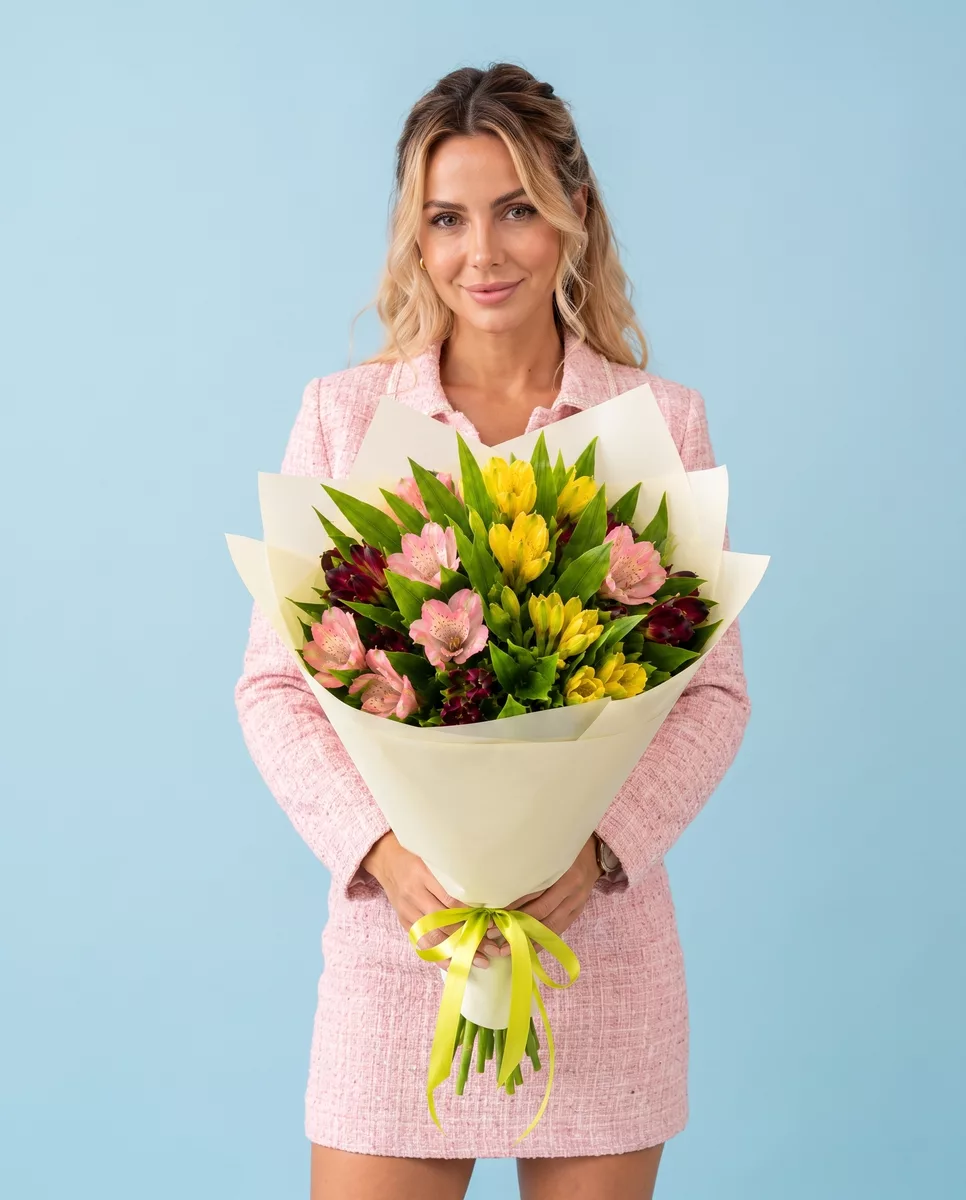
Bouquets we can deliver

Choosing Flowers That Hold Up in an Office Environment
Office conditions are harder on cut flowers than most people expect. Central heating in Russian winters drops indoor humidity well below fifty percent, and air conditioning in summer creates similar dryness. Flowers that look spectacular in a cool shop window can drop petals within two days on a reception desk near a heating vent. When we set up a corporate account, we discuss the placement of arrangements before recommending varieties. For reception desks and conference tables, chrysanthemums, alstroemeria, and spray carnations are reliable choices: they tolerate dry air, last seven to ten days with basic care, and come in enough colour ranges to match most corporate palettes. Lisianthus and gerbera also perform well and photograph cleanly for offices that use flowers as a backdrop in video calls. Roses are popular for client gifting but need more attention in dry environments; garden varieties with dense petals — David Austin types — hold moisture better than standard long-stem roses and are worth the slightly higher stem cost. Tulips are a spring staple in Russia and clients love them, but they continue to grow after cutting and will lean dramatically within two days if the vase is too short. We note all of this in the account profile so the delivery team brings the right vase depth. Orchid plants rather than cut stems are an option for desks that receive direct sunlight, since they tolerate warmth and need watering only once a week — relevant for offices where no one wants to be responsible for daily flower care.
Setting the Delivery Schedule: Weekly, Biweekly, or Event-Based
The schedule is the backbone of the account. Most offices choose one of three patterns. The first is a fixed weekly delivery on the same day and time — Monday mornings are the most requested, because fresh flowers at the start of the working week set a tone and last until Thursday or Friday before needing replacement. The second pattern is biweekly, common for smaller offices or companies that want flowers only when clients are expected. The third is event-based: a base delivery every two weeks plus additional orders triggered by board meetings, product launches, or official Russian holidays. Russian corporate calendars have several dates when flowers are expected as a matter of professional courtesy. March 8th, International Women's Day, is the most significant: it is a public holiday and virtually every office sends flowers to female employees and clients. Demand peaks sharply, and without a pre-agreed account order placed at least two weeks in advance, availability of preferred varieties cannot be guaranteed. February 23rd, Defender of the Fatherland Day, is the male equivalent and is observed with gifts in many companies. New Year deliveries run from late December through early January. We flag all of these dates in the account calendar automatically and send a reminder six weeks ahead asking you to confirm volumes. For companies new to the Russian market, this calendar guidance is one of the practical reasons to run a formal account rather than ordering ad hoc: you will not miss a date that your Russian colleagues consider standard professional practice.
How the Dedicated Manager Role Works
Every corporate account is assigned one manager who handles all communication for that account. This is not a call centre rotation. The same person receives your messages, knows your recipient list, understands which of your clients prefers compact arrangements over large statement pieces, and remembers that your CEO dislikes lilies because of the pollen. In practical terms, this means you send a single message — by email, by phone, or by the messenger your team prefers — and the manager coordinates everything internally. If a delivery address changes, a recipient is travelling, or you need to add an unscheduled bouquet for a last-minute client visit, you contact one person and it is handled. The manager also monitors the condition of flowers at the time of dispatch. Our shop in Saint Petersburg maintains a storage temperature of two to four degrees Celsius for most cut varieties. Before a corporate delivery leaves the shop, the manager confirms stem condition and, for deliveries going to other Russian cities, checks transit packaging to ensure flowers arrive in presentable condition after the journey. For long-distance deliveries — Moscow, Kazan, Yekaterinburg, and other cities we serve — the manager advises on which varieties travel well and which should be substituted for the route. Peonies, for example, are beautiful but fragile in transit during warm months; lisianthus or alstroemeria are more practical for a shipment that spends several hours in a courier vehicle. These substitutions are agreed in the account profile upfront, so there are no surprises on delivery day.
Invoicing, Documents, and What Finance Teams Need
Russian accounting requires specific documentation for any business expense, and flowers are no exception. A corporate flower account with us produces a full document package at the end of each billing period: a consolidated invoice listing every delivery by date, recipient, and item; a closing act of services rendered; and VAT documentation where applicable. All documents are issued under the legal name and tax identification number of your company as provided in the account agreement. If your finance team uses an electronic document exchange system — Kontur.Diadok and SBIS are the most common in Russia — we can route documents through those platforms directly, which eliminates the need for paper originals and speeds up approval cycles. For international companies paying from a foreign entity, we discuss payment terms individually at the account setup stage, since currency and banking arrangements vary. One thing finance teams consistently get wrong when they first set up an account: they expect to approve each individual delivery before it goes out, the way they would approve a purchase order. That workflow defeats the purpose of a recurring account. The agreement itself is the approval document. Individual deliveries execute automatically on the agreed schedule, and the monthly invoice is the reconciliation point. We explain this clearly at onboarding because the first month often involves a conversation between whoever manages the account day-to-day and the finance department about how the approval chain should be restructured. Getting this right at the start saves significant back-and-forth later.
Minimum Orders, Flexibility, and What Happens When Plans Change
A common question at the account setup call is whether there is a rigid minimum spend per month. There is a minimum per delivery rather than a monthly floor, because the logistics cost of a single delivery does not change much with volume. We set that threshold to keep deliveries economically viable for both sides. Within a scheduled delivery, you can combine multiple bouquets going to different addresses in the same city into one dispatch run, which is how larger offices keep per-bouquet costs reasonable. Flexibility within the account matters because business schedules are not perfectly predictable. If your office is closed for a public holiday that falls on your usual delivery day, the manager shifts the delivery to the nearest working day without you needing to remember to ask. If you need to pause deliveries for two weeks because the office is closed for renovations, you notify the manager and the schedule resumes automatically on the date you specify. Changes to the recipient list, delivery addresses, or preferred varieties can be made at any point with reasonable notice — we ask for forty-eight hours for variety changes because some stems need to be pre-ordered. Same-day additions to a scheduled delivery are possible if the varieties are already in stock, which your manager can confirm in a few minutes. The account agreement runs on a rolling monthly basis with a standard notice period for cancellation. There is no annual lock-in. This matters to companies that are uncertain about their flower budget or are trying the service for the first time before committing to a longer arrangement.
Opening the Account: Steps from First Call to First Delivery
The process from initial enquiry to first delivery is straightforward and takes less time than most procurement teams expect. The first step is a call or meeting with the manager assigned to your account. This conversation covers your delivery schedule, typical volumes, preferred varieties, recipient geography, and billing requirements. It usually runs thirty to forty-five minutes. After the call, we prepare a draft account agreement and a suggested delivery plan with variety recommendations matched to your office conditions and schedule. You review, request changes if needed, and sign. We ask for your company's legal details and tax identification number at this stage for the document setup. Once the agreement is signed, we confirm the first delivery date and add all subsequent scheduled dates to your account calendar. You receive the manager's direct contact details and a brief summary of how to reach them for urgent changes. The first delivery is treated as a check-in point: the manager follows up afterward to confirm that stem condition, arrangement size, and timing met expectations, and adjusts the account profile based on any feedback. This is the moment to flag things like a reception desk that gets strong afternoon sun, a building with access restrictions that affect delivery timing, or a preference for arrangements without strong fragrance in a shared workspace. Hyacinths and stargazer lilies, for instance, have intense scents that work beautifully in open spaces but can be overwhelming in a small meeting room — we note these preferences and apply them to every subsequent delivery without you needing to repeat them.
Running flowers through a corporate account removes the friction that makes ad hoc ordering frustrating: the last-minute scrambling, the inconsistent quality, the accounting paperwork that multiplies with every individual receipt. What you get instead is a predictable system — agreed varieties that your office conditions can actually support, a schedule that accounts for Russian professional calendar dates your team may not yet know, one manager who holds all the details, and monthly documentation that your finance department can process cleanly. The first delivery can be running within forty-eight hours of signing the agreement, and the setup conversation takes under an hour. We deliver bouquets across Russia in 1–2 hours.
Frequently asked questions
Can we send flowers to recipients in multiple Russian cities under one corporate account?
Yes. The account covers deliveries across all cities we serve, including Moscow, Saint Petersburg, Kazan, Yekaterinburg, and others. Each destination is listed in the account profile with its own address and recipient details. The monthly invoice consolidates all cities into one document, so your finance team receives a single reconciliation rather than separate receipts per city.
What happens to our scheduled delivery if a Russian public holiday falls on that day?
Your dedicated manager monitors the Russian public holiday calendar and shifts affected deliveries to the nearest working day automatically. You do not need to track this yourself. If your preference is to deliver on the holiday itself — for example, flowers specifically for March 8th — we arrange that as part of the account schedule, since we operate on all major Russian flower-giving dates.
How much notice do we need to give to change the flower varieties in our account?
Forty-eight hours is the standard notice for variety changes, because some stems need to be reserved from our suppliers in advance. Changes to delivery addresses or recipient names can be made with shorter notice. Same-day additions using in-stock varieties are possible — your manager can check availability in a few minutes and confirm whether the request is feasible for that day's dispatch.
Do you issue documents compatible with Russian electronic accounting systems?
Yes. We issue a full monthly document package including a consolidated invoice, a closing act of services rendered, and VAT documentation. For companies using Kontur.Diadok or SBIS for electronic document exchange, we can route documents through those platforms directly. Paper originals are also available on request. The documents are issued under your company's legal name and tax identification number as provided at account setup.
Which cut flower varieties travel best for deliveries to cities outside Saint Petersburg?
Alstroemeria, chrysanthemums, lisianthus, and spray carnations handle transit well and arrive in good condition after several hours in a courier vehicle. Peonies and open garden roses are more fragile in warm months. Your account profile notes preferred varieties alongside approved substitutes for long-distance routes, so the manager can make the right call without contacting you each time transit conditions require an adjustment.
Ready to send a bouquet?
Pick a city, choose the flowers, and we will hand them over with a photo confirmation.
Choose a city →