
Corporate Flower Spend by Tier: Arrangement Size, Variety and Packaging
Every week we take calls from office managers who have been handed a number by their finance department and need to know what that number actually buys. The question is always the same: will this look serious on the reception desk, or will it look like an afterthought? The answer depends entirely on three things — stem count, variety choice, and how the arrangement is finished — and those three things move in lockstep with budget. This article breaks down three tiers we see most often in corporate orders, explains what is realistic at each level, and tells you what to check before you confirm any order.
Why Corporate Flower Budgets Need a Different Framework
Personal flower orders and corporate orders look similar on the surface but behave very differently in practice. A private customer buying roses for a birthday can be flexible on timing and packaging; a corporate buyer usually has a fixed event date, a reception desk or boardroom table with specific dimensions, and a finance system that requires an invoice. Those constraints mean the budget conversation has to start earlier and be more precise. At Five Flowers we handle corporate accounts ranging from single monthly deliveries for a small office to standing weekly orders for hotel lobbies and bank branches across Saint Petersburg. The most common mistake we see is a buyer who picks a number without knowing what that number produces in terms of visible volume. A small arrangement that looks generous in a kitchen looks sparse on a two-metre reception counter. Stem count matters, but so does the choice of focal flowers versus filler: a bouquet built around large-headed peonies or garden roses reads as generous even at a moderate stem count, while a bouquet of the same price built around spray chrysanthemums reads as functional rather than impressive. Corporate contexts in Russia also carry specific expectations around presentation. Flowers arriving for a client visit or a signing ceremony are expected to be wrapped or boxed rather than handed over in craft paper alone. Ribbon, a branded card holder, or a box with a lid signals that the order was considered rather than assembled in a hurry. Understanding these baseline expectations is what lets you allocate budget intelligently across the three tiers.
Bouquets we can deliver
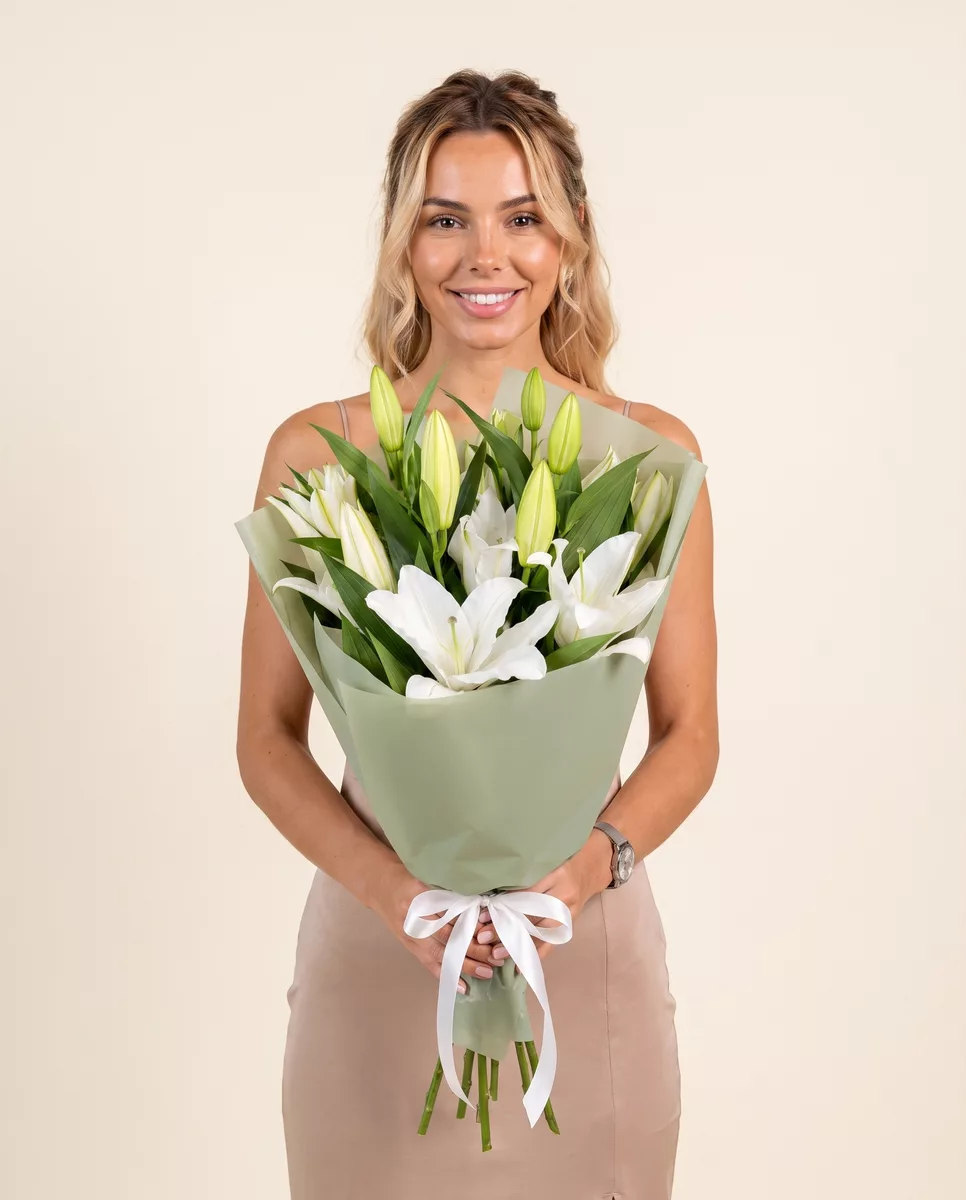
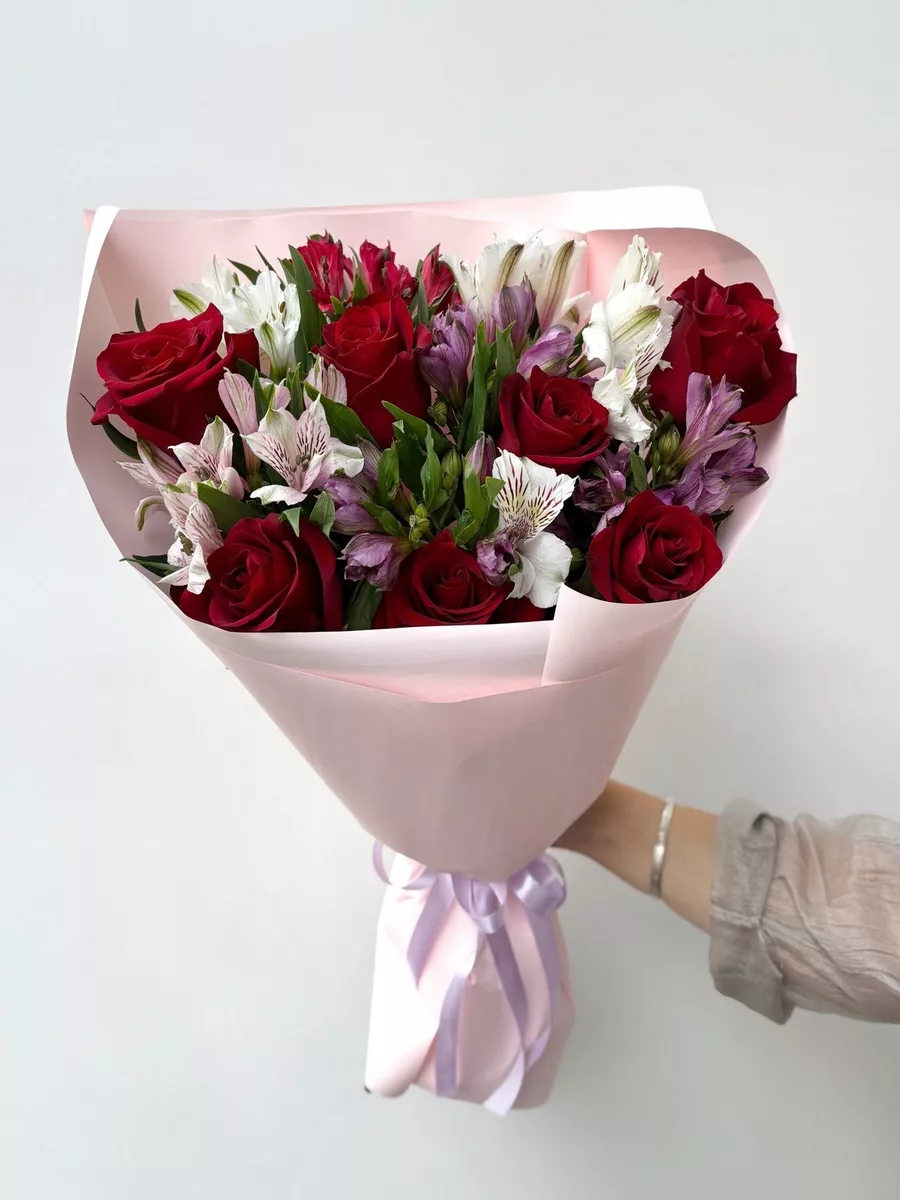
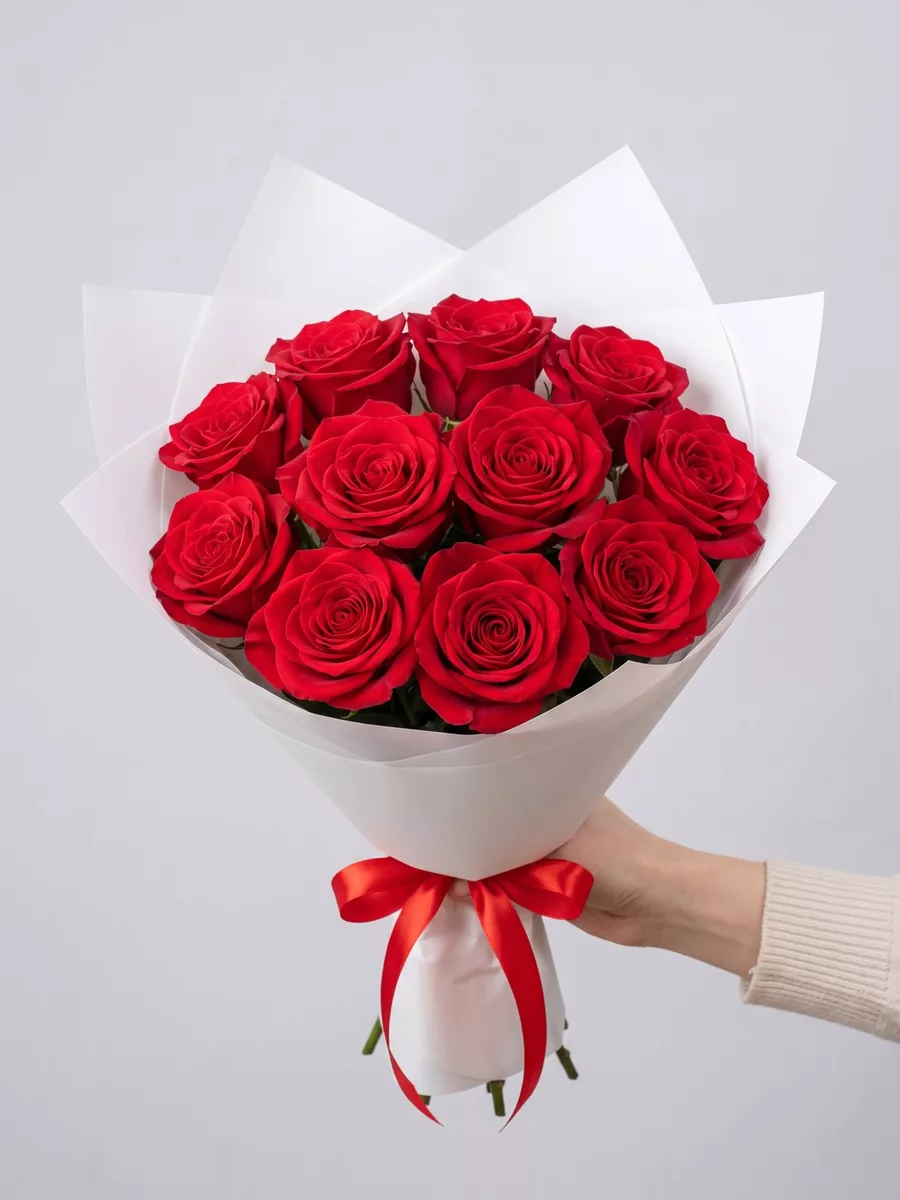
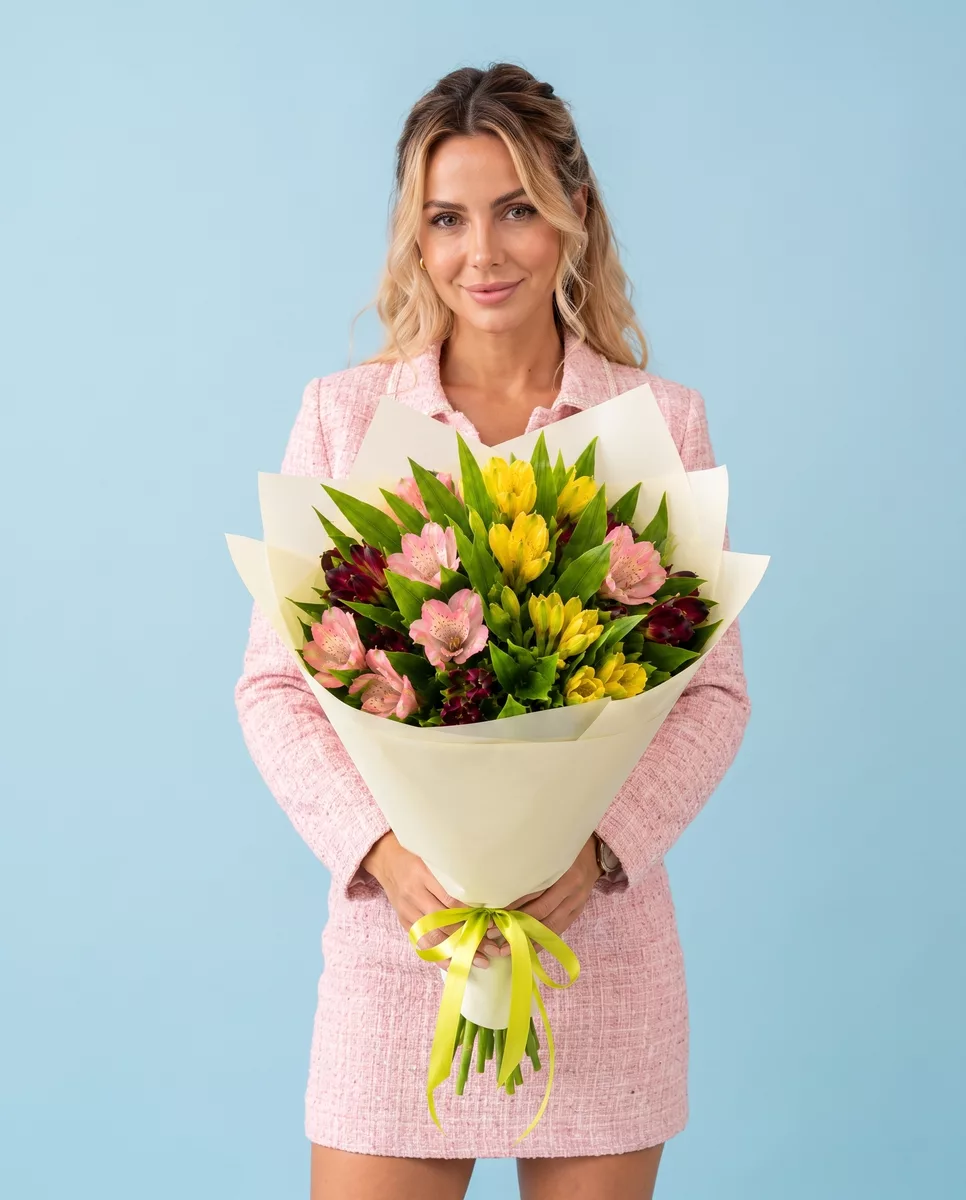
Entry-Level Tier: Functional Presence Without Focal Drama
The entry-level corporate tier covers arrangements intended to maintain a consistent, tidy presence rather than to impress a specific guest. Think weekly flowers for a shared kitchen, a small waiting area, or a secondary meeting room that clients occasionally pass through. At this level you are working with a modest stem count, and the variety list skews toward flowers that hold well across five to seven days without specialist care: standard alstroemeria, spray carnations, statice, solidago, and single-variety tulip bunches in season. Tulips are worth mentioning specifically because they remain one of the best-value focal flowers available in Russia, particularly from January through April when Dutch imports are supplemented by domestic greenhouse production. A well-packed tulip arrangement in a cylindrical vase can look clean and deliberate without requiring the stem count that roses demand. What this tier does not reliably deliver is variety mixing. When budget is tight, asking for three or four flower types in one arrangement usually produces a result where each type is represented by too few stems to read clearly. A better approach is to choose one or two varieties and commit to them. Packaging at this tier is typically craft wrap with a simple ribbon or a standard cellophane sleeve. Branded elements — printed cards, tissue paper in company colours, custom boxes — are not economically sensible here unless ordered in volume. Delivery windows at this tier are the same as for all Five Flowers orders: one to two hours across Saint Petersburg, with the same freshness guarantee regardless of order size.
Mid-Range Tier: Mixed Varieties and Visible Volume
The mid-range tier is where most serious corporate accounts sit, and it is the level at which arrangement design starts to have real flexibility. At this budget you can combine a focal flower with two or three supporting varieties and still have enough stems of each for the combination to read intentionally rather than accidentally. Typical focal choices at this tier include standard roses in single or mixed colours, lisianthus, gerbera, and freesia. Lisianthus is particularly useful in corporate contexts because its ruffled petals photograph well, it has a vase life of ten to fourteen days under normal office conditions, and it mixes cleanly with almost any supporting variety. Freesia adds fragrance, which matters in reception areas where scent contributes to the first impression a visitor forms. Supporting varieties at this level usually include one or two of the following: pittosporum or eucalyptus for greenery, waxflower for texture, and a filler such as gypsophila or limonium to add depth without competing with the focal flower. Arrangement size at the mid-range tier is noticeably larger than the entry level: a vase arrangement for a reception desk would typically stand forty to fifty centimetres tall and have visible fullness from all angles, which matters when the desk is approached from different directions. Packaging steps up meaningfully here. Hat boxes, kraft boxes with lids, and satin ribbon become standard rather than optional. If the flowers are accompanying a gift or a client presentation, a printed card with the company name can be included without adding significant cost to the overall order.
Premium Tier: Statement Arrangements and Seasonal Specifics
The premium tier is reserved for situations where the flowers are themselves part of the message: a signing ceremony, a VIP client visit, an anniversary of the company, or a seasonal event like New Year or International Women's Day on the eighth of March, which is the single largest flower-ordering date in Russia and requires planning weeks in advance. At this level the focal flower is typically a premium variety: garden roses with cupped, multi-petalled heads such as David Austin types, peonies when in season from late April through June, ranunculus in winter and spring, or large-headed hydrangea in late summer and autumn. Stem count is high enough that the arrangement makes an immediate visual impression before anyone looks closely at the variety. A premium reception arrangement might stand sixty to seventy centimetres in a tall cylinder or be constructed as a low, wide table centrepiece for a boardroom, depending on the setting. Seasonal availability is a real constraint at this tier because premium varieties are not available year-round. Peonies, for example, have a short domestic season and are imported at high cost outside it. An office manager who builds a premium budget around peonies in December will either need to revise the variety or revise the budget. We always advise corporate clients to discuss seasonal substitution rules in advance: agree on which varieties are acceptable alternatives so that an unexpected supply gap does not stall the order. Packaging at the premium tier includes branded or custom boxes, tissue paper, satin or velvet ribbon, and a high-quality printed card. Delivery is timed to the minute where possible, particularly for event-day orders.
Standing Orders Versus One-Off Orders: What Changes
Corporate clients frequently ask whether a standing weekly or monthly order changes what their budget delivers compared to a single purchase. The honest answer is yes, but not because of discounts alone. Standing orders allow the florist to plan purchasing more precisely, which means fresher stock and better variety availability. When we know a client needs forty stems of lisianthus every Monday morning, we can align our wholesale purchasing to that schedule rather than working from whatever arrived in the general delivery. The practical result is that a standing-order client at the mid-range tier often gets arrangement quality that would otherwise sit at the top of that tier, because waste is reduced and planning is tighter. One-off orders, particularly for events, require more lead time at the premium level. Ordering a large arrangement for a signing ceremony with two hours' notice is possible within our delivery window, but the variety options are limited to what is in the shop at that moment. An event planned three to five days ahead can specify varieties, request custom packaging, and confirm exact dimensions. For International Women's Day and New Year, we strongly recommend placing corporate orders at least two weeks in advance. Demand across Saint Petersburg spikes sharply, wholesale prices rise, and premium varieties sell through quickly. A standing order that covers these dates is the most reliable way to guarantee both availability and pricing. Clients who place standing orders also benefit from a consistent point of contact who knows the delivery address, the vase situation at the office, and any specific preferences the reception team has noted over time.
Packaging and Presentation Across All Three Tiers
Packaging is the element corporate buyers most often underestimate when building a budget, and it is the element most visible to the person receiving the flowers. In a private context, a bouquet wrapped in kraft paper is charming. In a corporate context, particularly when flowers are being presented to a client or displayed in a branded environment, kraft paper alone reads as informal. The three tiers correspond to three packaging levels that we apply consistently. Entry-level orders use clean craft wrap with a single ribbon and a standard card. Mid-range orders use a box or a structured wrap, a ribbon in a colour chosen to complement the flowers, and a printed or handwritten card. Premium orders use a custom or branded box, tissue paper, a premium ribbon, and a card that matches the occasion. Beyond the outer packaging, there is the question of water and conditioning. Arrangements delivered in vases arrive water-ready. Bouquets delivered for the recipient to arrange themselves should come with a care instruction card explaining that stems need to be cut at an angle under water before placing them in a vase, that tap water at room temperature is fine, and that the vase should be kept away from direct sunlight and heating vents. In Russian offices, radiators run hot from October through April, and a bouquet placed on a windowsill above a radiator will lose two to three days of vase life. This is not a variety problem or a freshness problem; it is a placement problem, and a brief care note prevents it. Corporate clients who want to maintain a consistent standard across multiple office locations should ask for care cards to be included with every delivery as a standing instruction.
Common Mistakes When Setting a Corporate Flower Budget
The most frequent mistake is setting the budget based on what flowers cost at a supermarket or a street stall. Supermarket flowers are typically purchased in bulk from a single origin, conditioned minimally, and displayed in conditions that accelerate ageing. A fresh arrangement from a florist using properly cold-chain-managed stock will cost more and last significantly longer, which changes the per-day cost calculation. A bouquet that lasts ten days at a higher price is often cheaper per day than one that lasts four days at a lower price. The second common mistake is specifying a variety without checking seasonal availability. Clients who request peonies in November or lily of the valley in August will either face a significant price premium for imported stock or need to substitute. Building a variety shortlist with two or three acceptable alternatives avoids this problem entirely. The third mistake is ordering too small for the physical space. We regularly receive requests for a reception arrangement with a budget that would produce something beautiful on a kitchen counter but invisible on a wide marble reception desk. Before placing the first order, measure the surface: width, depth, and the height clearance if there is a shelf or overhead element. Share those dimensions when ordering and the florist can advise on the appropriate arrangement scale. The fourth mistake is leaving the first corporate order until the day it is needed. Even within our one-to-two-hour delivery window, a same-day order for a premium arrangement with custom packaging requires that the components are in stock. For any order above the entry level, placing it the day before is strongly preferable to placing it the morning of the event.
Corporate flower spend is straightforward to manage once you know what each budget tier actually produces in terms of stems, varieties, and presentation. Entry-level budgets keep spaces tidy with durable, single-variety arrangements. Mid-range budgets allow genuine variety mixing and proper packaging. Premium budgets deliver statement arrangements built around seasonal focal flowers with fully branded presentation. The single most useful thing any corporate buyer can do before placing a first order is to share the dimensions of the space, the date of the event, and a variety preference with at least one alternative. Those three pieces of information allow the florist to give a precise answer rather than a vague estimate, and they are the difference between an arrangement that works and one that needs to be reordered. We deliver bouquets across Russia in 1–2 hours.
Frequently asked questions
Can we split a corporate budget across multiple smaller arrangements rather than one large one?
Yes, and it is often the right approach for offices with several distinct spaces. A budget split across three small arrangements placed in a reception area, a main meeting room, and a director's office typically produces better overall visual coverage than one large arrangement in a single location. Discuss the split with your florist before ordering so stem count and variety can be allocated sensibly across all three.
How far in advance do we need to order for International Women's Day on March 8th?
For corporate volumes, two weeks minimum and three weeks if you need premium varieties such as peonies, ranunculus, or garden roses. Wholesale supply across Russia tightens significantly in late February, and prices for premium stems rise sharply in the final week. Standing-order clients who include March 8th in their annual schedule are best protected against both availability gaps and price increases.
Do the flowers arrive in water, or does the office need to provide vases?
It depends on how the order is placed. Arrangements can be delivered in vases, which arrive water-ready and require no preparation. Bouquets intended for the recipient to arrange themselves are delivered wrapped and need a vase and fresh water on arrival. Specify at the time of ordering which format you need, and mention whether the office has suitable vases available or whether one should be included.
What happens if a variety we specified is unavailable on the delivery day?
For standing orders and planned event orders, we contact the client in advance if a specified variety is unavailable and propose an alternative of equivalent quality and price. For same-day orders, the substitution may need to be confirmed quickly. The simplest way to avoid delays is to agree on one or two acceptable substitute varieties when placing the original order, so the florist can act without waiting for approval.
Is there a minimum order size for corporate accounts?
There is no separate minimum for corporate accounts beyond our standard order minimum. However, for standing weekly or monthly orders we recommend discussing the arrangement size and budget in advance so we can align purchasing and ensure consistent variety availability. Very small standing orders are handled the same way as individual orders but benefit from the planning advantages that come with a confirmed schedule.
Ready to send a bouquet?
Pick a city, choose the flowers, and we will hand them over with a photo confirmation.
Choose a city →