
Managing Flower Budgets for Large Corporate Orders Across Russia
Corporate clients ordering flowers for fifty recipients make the same mistakes as those ordering for five — they price by gut feeling, underestimate delivery logistics, and choose arrangements that look impressive on screen but fall apart in transit. At Five Flowers we handle bulk orders for Saint Petersburg offices, Moscow branches, and companies shipping across multiple Russian cities, and the questions are always the same: how much per person, which flowers actually survive the journey, and where does the budget quietly leak. This article answers all three.
Setting a Realistic Per-Recipient Budget Before You Order
The first thing a procurement manager needs to pin down is a per-head ceiling, not a total order figure. A total budget of, say, a large round number sounds manageable until you divide it by sixty recipients and realise the per-person allocation covers only a single stem and some filler. In Russian corporate culture, flowers given to employees or clients carry visible weight — they are examined, photographed, and compared — so an arrangement that reads as token will do reputational damage rather than build goodwill. The practical floor for a mono-bouquet that reads as genuinely generous is five to seven stems of a mid-range variety such as spray roses or alstroemeria, assembled with greenery. Below that threshold the arrangement starts looking like an afterthought. Budget tiers work better when you separate recipients by tier yourself: senior management or key clients receive a larger mixed bouquet with, for example, garden roses and eucalyptus, while a broader staff pool receives a compact mono-bouquet of chrysanthemums or carnations — flowers that hold their shape for four to six days without refrigeration, which matters when recipients are collecting from a reception desk rather than a chilled locker. Locking these tiers in writing before the florist begins sourcing prevents the common situation where a client approves a quote, then asks to upgrade half the order the day before assembly, which breaks the pricing logic entirely and usually costs more than simply ordering the higher tier from the start.
Bouquets we can deliver



Which Flower Varieties Scale Well and Which Create Problems
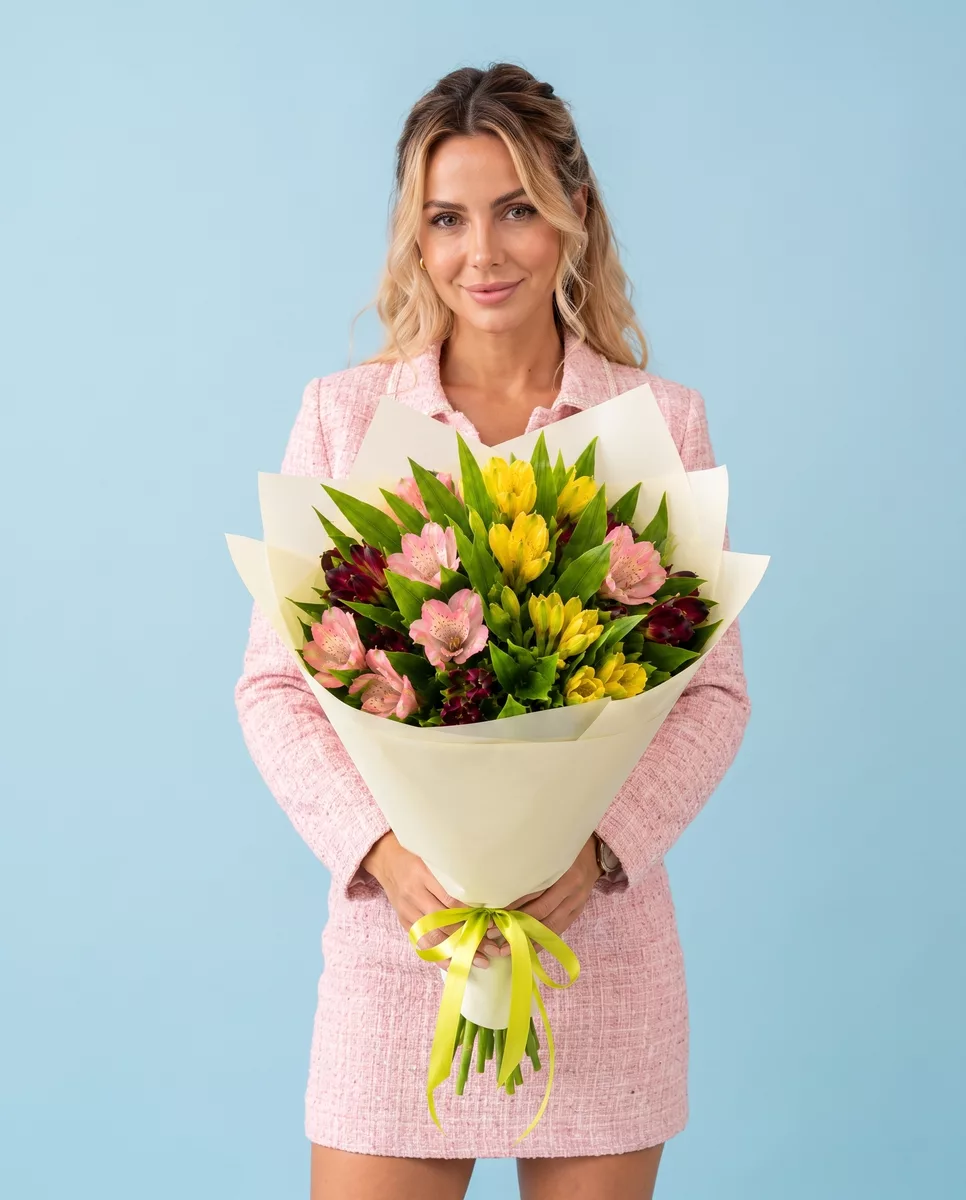
Scalability in floristry means a variety that can be sourced in consistent quality across the volume you need, assembled quickly into a repeatable form, and transported without significant loss. Roses are the default choice for corporate orders, but standard hybrid tea roses in long stems are actually one of the harder varieties to scale on short notice — stem counts per box vary by supplier batch, heads bruise if boxes are stacked incorrectly, and colour consistency across fifty bouquets requires careful lot selection. Spray roses, by contrast, come in dense clusters, are more forgiving in transit, and give a bouquet visual fullness at a lower per-stem cost. Alstroemeria is another strong scalable choice: it ships well, lasts seven to ten days after cutting, and comes in a reliable range of whites, pinks, and yellows that suit neutral corporate aesthetics. Chrysanthemums — both the large single-head santini type and the smaller pom-pom varieties — are extremely robust and hold colour well under office lighting conditions. Tulips are a seasonal variable: they are abundant and affordable from February through April, but outside that window they are imported, more expensive, and more sensitive to temperature swings above eighteen degrees Celsius. Hydrangeas look generous and photograph well, but they wilt within two hours if left without water, which makes them unsuitable for any order where recipients will not be receiving flowers directly into a vase. Knowing these constraints before you build the order brief saves the conversation where a client insists on a variety that the logistics simply do not support.
Packaging Choices That Protect the Budget and the Flowers
Packaging is where corporate clients consistently underestimate cost and overestimate what they are getting. Kraft paper wrapping is the standard for most bouquets and works well for same-day delivery to a single address — the recipient unwraps it, trims the stems, and puts the flowers in water within the hour. For bulk corporate orders delivered to a single office address, kraft is fine. The problem appears when orders are split across multiple addresses or when flowers need to sit at a reception desk for several hours before distribution. In those cases, aqua packaging — a small water reservoir sealed around the stems — extends the flower's viable window by three to four hours and is worth the additional cost per unit if your distribution window is longer than ninety minutes. Hat boxes and branded boxes add significant cost and are appropriate for a top-tier recipient list but make no sense for a general staff order of forty people. Ribbon and decorative elements add assembly time, which on a large order translates directly into a higher labour component in the final price — something many clients do not realise until they see the itemised quote. The practical rule is to match packaging complexity to the recipient tier you defined earlier: simple kraft for the broad staff tier, aqua or box for senior recipients. Trying to give everyone the premium packaging to avoid the appearance of inequality usually pushes the order over budget without meaningfully improving the experience for the majority of recipients.
Timing the Order to Avoid Rush Surcharges and Stock Gaps
Russian corporate gifting clusters around predictable dates: International Women's Day on March 8th, February 23rd which is Defender of the Fatherland Day and is increasingly used for male staff gifts, New Year in late December, and company anniversaries. If your order falls within ten days of March 8th, you are competing with every other corporate buyer in the country for the same Dutch auction stock, and prices on roses and tulips can increase substantially compared to a standard week. Placing the order at least three weeks before the target date allows the florist to source from the regular import schedule rather than the emergency spot market. For orders outside peak periods, a five-to-seven business day lead time is sufficient for most volumes up to one hundred arrangements. Same-day bulk orders are possible but carry a real risk of variety substitution — if the requested flower is not in stock that morning, the florist will use the nearest available alternative, which may not match the approved design. Delivery timing within the day also matters for corporate orders. Morning deliveries before eleven o'clock are preferred for office settings because recipients are present, the flowers can go into water quickly, and the gesture lands at the start of the working day rather than being left on a desk at six in the evening. If your office has a security desk that holds parcels, confirm whether they have a cool storage area — leaving aqua-packed bouquets in a warm lobby for three hours negates the benefit of the packaging entirely.
Controlling Costs on Delivery Across Multiple Addresses
Delivery structure is the single largest hidden cost in a corporate flower order, and it is the area where clients most often receive a quote that looks reasonable and then see the final invoice and feel surprised. Delivering one hundred bouquets to one address is a fundamentally different logistical operation from delivering one hundred bouquets to forty addresses across a city. The first is one courier run with a van; the second is forty individual stops, each with its own time window, recipient confirmation, and potential waiting time. If your order involves multiple delivery addresses, consolidate wherever possible. Ask whether the recipient's HR department can distribute internally from a central drop-off point — most can, and this alone can cut the delivery component of the budget significantly. For orders going to multiple Russian cities, the timing question becomes a question of our own delivery radius: Five Flowers delivers across Russia, and orders to cities outside Saint Petersburg need to be placed with enough lead time to account for the logistics of reaching that city within the one-to-two hour delivery window we guarantee in covered zones. Confirm the delivery zone for each address before finalising the order, not after. Addresses on city outskirts or in industrial zones sometimes fall outside the standard delivery window and require a scheduled slot, which needs to be built into the timeline. A clear delivery manifest — recipient name, exact address including floor and office number, and a contact phone number — submitted with the order prevents failed deliveries, which on a large order are expensive to reattempt and embarrassing for the client.
Substitution Policies and What to Approve in Advance
Every professional florist operates with a substitution policy for bulk orders, and understanding it before you sign off on the brief protects you from surprises on delivery day. Substitution happens when a specific variety, colour, or stem length is unavailable at assembly time — which is more common than clients expect, because flower availability is driven by auction lots and import schedules that shift weekly. The standard professional approach is to substitute within the same price tier and the same colour family: if white spray roses are unavailable, white alstroemeria of equivalent stem count will be used. What clients need to approve in advance is the colour palette range they find acceptable and the varieties they consider unacceptable under any circumstances. Some corporate clients have brand colour guidelines that make certain flower colours genuinely off-limits — a company with a strictly blue-and-white brand identity may find a substitution of pink flowers problematic. State this in writing at the order stage. Similarly, if there are recipients who have known allergies — lilies and their pollen are the most common issue in office environments — flag these at the order stage so those specific arrangements can be built pollen-free using closed lily buds or lily-free designs entirely. Clients who leave substitution decisions entirely to the florist without any stated parameters are the ones who end up with an order that is technically correct but visually inconsistent across the recipient list, which undermines the impression of a well-organised corporate gift. A half-page substitution brief submitted with the order costs nothing and prevents most of these problems.
Reviewing the Order Before It Goes to Assembly
The review stage is the last point at which changes are genuinely free. Once assembly begins on a large order — typically three to four hours before the first delivery window — changes to variety, count, or packaging require either stopping the line or running a parallel correction, both of which carry cost. The checklist that experienced procurement managers use before approving a large flower order covers six things: total recipient count confirmed against the HR list that morning, because people are added and removed from distribution lists until the last minute; delivery addresses verified including building access codes and floor numbers; recipient tiers matched to the correct arrangement type and packaging; substitution parameters signed off in writing; a named contact at each delivery address who will accept the order if the primary recipient is not present; and the delivery time window confirmed with the florist, not assumed. On the flowers themselves, ask the florist to confirm the cutting date of the main varieties in the order. Roses and alstroemeria cut within forty-eight hours of delivery will have a vase life of seven to ten days; flowers that have been in cold storage for five days before delivery will look identical on arrival but will begin declining within two to three days. For a gift that is meant to sit on a desk for a week and remind the recipient of your company, the cutting date is a meaningful quality indicator, not a technical detail. Florists who cannot or will not confirm cutting dates for a large corporate order are worth questioning before the order is placed.
Large corporate flower orders go wrong at the planning stage, not at the florist's bench. The clients who get consistent results are the ones who define recipient tiers before they call, understand which varieties survive the logistics of their specific delivery situation, submit a substitution brief, and place the order far enough ahead of the date to avoid the spot market. The flowers themselves — spray roses, alstroemeria, santini chrysanthemums, seasonal tulips — are reliable when matched to the right packaging and delivery window. The budget leaks happen in last-minute upgrades, multi-address delivery underestimates, and premium packaging applied uniformly across a tiered recipient list. Fix those three things and a corporate flower order becomes a repeatable, controllable process rather than a stressful one-off. We deliver bouquets across Russia in 1–2 hours.
Frequently asked questions
How far in advance should a large corporate flower order be placed?
For orders of twenty or more arrangements, five to seven business days is the minimum outside peak periods. For orders falling within ten days of March 8th or other major Russian gifting dates, three weeks minimum is strongly recommended. Earlier placement allows sourcing from the regular import schedule rather than the more expensive spot market, and gives time to confirm delivery addresses and recipient lists properly.
Can flowers be delivered to multiple cities across Russia in the same order?
Yes. Five Flowers delivers across Russia, but each city address needs to be confirmed against the delivery zone before the order is finalised. Addresses outside the standard zone for a given city may require a scheduled delivery slot rather than the standard one-to-two hour window. Submit all addresses at the order stage so zone confirmation can happen before assembly begins.
Which flowers are safest for recipients who will not put them in water immediately?
Chrysanthemums, alstroemeria, and spray roses tolerate two to three hours without water better than most varieties. Hydrangeas and open garden roses are the most sensitive and should only be ordered when same-day water access is guaranteed. Aqua packaging — a sealed water reservoir around the stems — extends the safe window for any variety by three to four hours and is worth specifying for office deliveries.
Is it possible to have different arrangements for different recipient tiers in one order?
Yes, and it is the recommended approach for most corporate orders. Define two or three tiers — for example, senior management, general staff, and external clients — with a specific arrangement and packaging type for each. Submit the tier breakdown as part of the order brief with a named list matched to each tier. This prevents mix-ups at delivery and keeps the budget proportional to the relationship level.
What happens if a recipient is not present at the delivery address?
Provide a named backup contact for each address when you submit the order — typically a reception desk or office manager. Without a backup contact, a failed delivery on a large order requires rescheduling, which adds cost and delays the gift. For multi-address orders, a single internal distribution point with one responsible person accepting the full delivery is the most reliable arrangement.
Ready to send a bouquet?
Pick a city, choose the flowers, and we will hand them over with a photo confirmation.
Choose a city →