
Dahlias in Russia: Late-Summer Blooms Worth Waiting For
Every August, the same question comes over the counter: why are dahlias suddenly everywhere, and why did nobody mention them in June? The answer is simple — dahlias are a field crop in Russia, cut fresh from outdoor plots in the Moscow and Leningrad regions, and they simply do not exist in meaningful quantity before late July. When they do arrive, they arrive fast, in every colour and form imaginable, and at prices that make imported roses look extravagant. If you have never ordered dahlias before, this is the article that will stop you from missing the window.
When Dahlias Actually Appear in Russian Markets
Russian dahlias are not a year-round product and any florist who tells you otherwise is selling you imported stems at a steep markup. Domestic field-cut dahlias begin arriving in Saint Petersburg and Moscow wholesale markets in the last week of July, with volumes building sharply through August and peaking in September. The season closes when the first hard frosts hit the growing regions, which in a typical year means mid to late October in the Leningrad Oblast and slightly later for farms further south toward Tula and Voronezh. Within that window of roughly ten to twelve weeks, the variety and price situation is genuinely excellent. Outside it, you are looking at Dutch greenhouse imports, which are available but cost two to three times more per stem and come in a narrower colour range. The practical implication for customers is straightforward: if you are planning a large event, a birthday, or a significant bouquet for late August or September, dahlias are the smartest choice on the market. If you are ordering in November, they are gone. Florists at Five Flowers track the arrival of first-season batches from our regular growers each year, and the timing shifts by no more than a week in either direction depending on how warm the preceding June was. A cool, wet June pushes the first cut to early August. A hot June means stems by the third week of July. Asking your florist which week the new batch arrived is a completely reasonable question and a good sign that you are paying attention.
Bouquets we can deliver



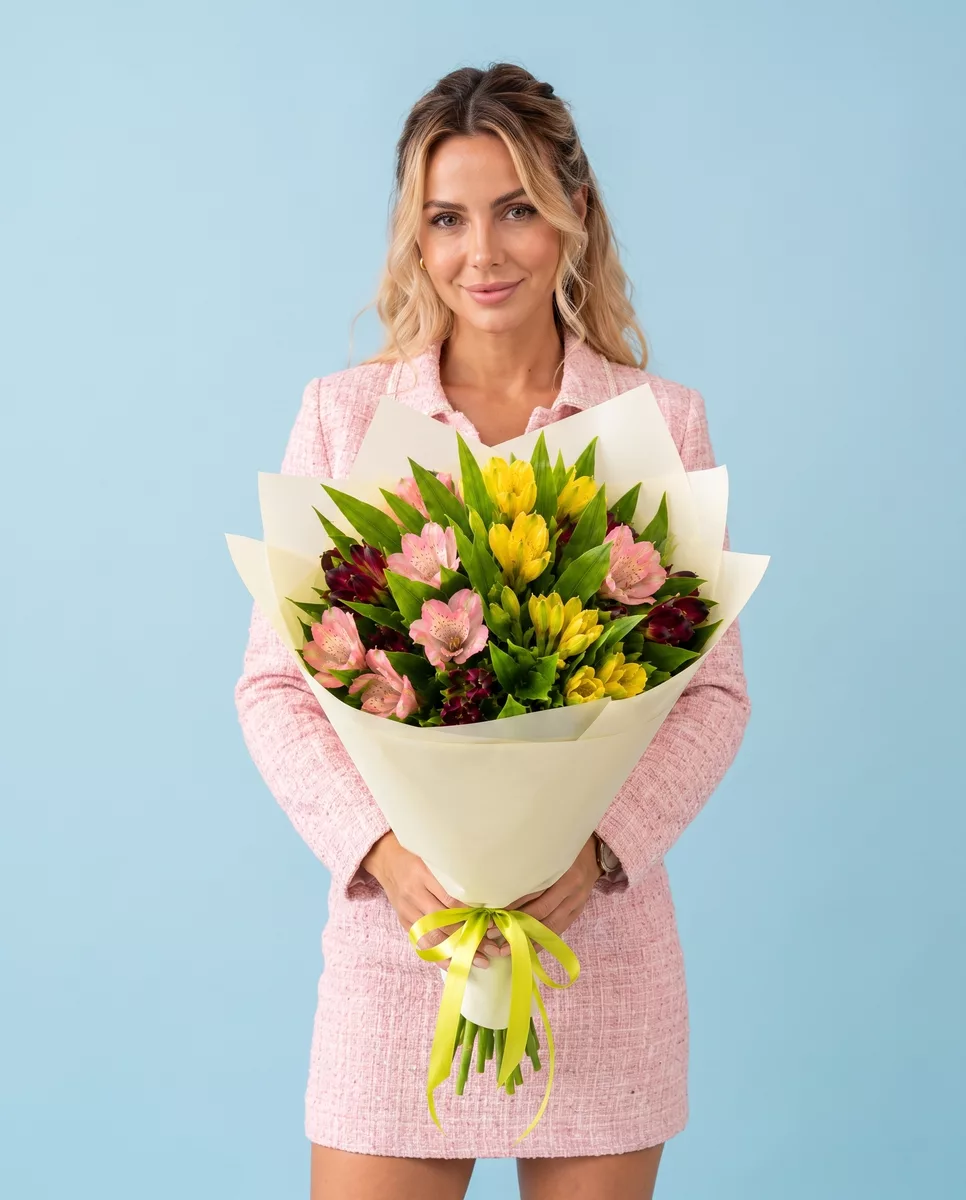
The Main Forms You Will See and What They Mean for a Bouquet
Dahlias are classified by flower form, and the form determines how the bloom sits in an arrangement, how long it lasts in the vase, and how much stem you actually need to work with. The most common type arriving at Saint Petersburg markets is the decorative dahlia — large, fully double blooms with broad, flat petals that layer outward from the centre. Varieties like Cafe au Lait, a creamy blush-toned decorative, have become extremely popular in bridal and gift work over the past several years and are now grown domestically in reasonable volumes. Ball dahlias are smaller, perfectly spherical, and extraordinarily long-lasting once cut — their compact form means less surface area exposed to air and slower water loss. Pompon dahlias are the miniature version of the ball type, rarely exceeding five centimetres across, and they work beautifully as filler when you want texture without competing with a central flower. Cactus dahlias have pointed, rolled petals that give an almost spiky silhouette — they are dramatic in single-variety bunches but can be difficult to pair with soft-petalled flowers without the arrangement looking busy. Dinner plate dahlias are the giants, sometimes exceeding twenty-five centimetres in diameter, and a single stem can anchor an entire arrangement. When ordering, specifying the form rather than just the colour will get you a much more predictable result. Telling a florist you want large decorative dahlias in burgundy is far more useful than asking for big red ones.
Colours Available and Which Sell Out First
The colour range of dahlias grown in Russia is one of the most complete in any seasonal flower, running from pure white through every shade of yellow, orange, coral, pink, red, burgundy, and deep purple, with a strong selection of bicolour and variegated stems. In practice, the colours that disappear from market fastest are the ones that photograph well in warm tones — burnt orange, deep coral, and the burgundy-to-almost-black varieties like the decorative type commonly sold under the name Black Jack or similar dark cultivars. These sell out by midweek at wholesale and by Thursday at retail in a normal August week. White and pale yellow dahlias move more slowly and are generally available throughout the week, which makes them the safer choice if you are ordering for a weekend event and placing the order on a Thursday. Bicolour varieties — stems with a white or cream base and a contrasting tip or edge in red, purple, or pink — are popular but inconsistent in supply because growers cut them selectively and they do not always arrive in uniform batches. If you have a specific colour requirement for an event, the correct approach is to tell your florist at least four to five days ahead and ask them to reserve stems from the next delivery. At Five Flowers we receive fresh dahlia deliveries multiple times per week during peak season, but specific colours in specific quantities need to be flagged in advance. Leaving colour choice entirely to the florist on the day of delivery is fine for a casual gift but risky for a table centrepiece where matching matters.
How Long Dahlias Last and What Affects Vase Life
Dahlias have a reputation among some customers for being short-lived, and that reputation is partly deserved and partly the result of poor handling. A freshly cut dahlia stem delivered the same day it was cut, placed in clean water with the stem end trimmed at an angle, and kept in a room below twenty degrees Celsius will last seven to ten days without difficulty. The problems begin when any of those conditions are not met. Dahlias are hollow-stemmed, which means they take up water quickly but also lose it quickly if the stem is not re-cut after transport. The single most common mistake customers make is putting dahlias straight into a vase without trimming the stem — the cut end seals over during delivery and water uptake drops sharply. Re-cut at least two centimetres off the stem end with a sharp knife, not scissors, which crush the hollow channel. Temperature is the other major factor. Dahlias sitting in a warm apartment above twenty-four degrees will drop their petals within four or five days regardless of water quality. Keeping them away from direct sunlight and away from fruit bowls — which emit ethylene gas that accelerates petal drop — adds two to three days of vase life. Ball and pompon forms consistently outlast decorative and dinner plate forms because their denser petal structure loses moisture more slowly. If you are ordering dahlias for an event that is two days away, ball types are the practical choice. If the event is tomorrow, dinner plate varieties are perfectly fine and will be at their most open and dramatic on the day.
What a Dahlia Bouquet Actually Costs in Season
One of the consistent surprises for customers who have not bought dahlias before is how much stem you get for the money compared to imported flowers in the same season. During peak August and September supply, dahlias sit at a price point that allows a florist to build a genuinely full, visually generous bouquet without the arrangement looking sparse or padded with filler greenery. A mono-bouquet of fifteen to twenty large decorative stems is a substantial gift by any standard. A mixed arrangement combining dinner plate dahlias with ball types and some seasonal foliage — think eucalyptus or ornamental grasses, which are also in domestic season at the same time — can fill a large vase and make a strong impression at a fraction of what an equivalent rose or peony arrangement would cost in July. The price advantage is most pronounced for large orders: event floristry, table centrepieces, and corporate gifting all become significantly more accessible during dahlia season. Customers who have been quoted a figure for a peony table arrangement in June and then come back in September asking for something similar are often surprised to find dahlias deliver a comparable visual effect at a lower cost per stem. The caveat is that price rises toward the end of the season as supply tightens. Late September and October batches cost more than August batches because growers are harvesting fewer stems and quality control becomes harder as temperatures drop. Ordering in August rather than waiting until October is the financially sensible move if your schedule allows it.
Combining Dahlias with Other Late-Summer Flowers
Dahlias do not need to be arranged alone, and some of the most effective bouquets we put together at Five Flowers in August combine them with other flowers that are simultaneously at their domestic seasonal peak. Lisianthus, which is grown in Russian greenhouses and reaches peak quality in late summer, pairs well with decorative dahlias because its ruffled petals echo the layered structure of the dahlia without competing for visual attention. Statice and dried-look fillers are in season and add texture without drawing the eye away from the main bloom. Sunflowers, which are a major domestic crop in Russia with peak cut availability in August and September, create a bold, high-contrast combination with burgundy or deep purple dahlias — a pairing that sells consistently well for September birthdays and early autumn celebrations. Zinnias, another field-cut domestic flower peaking in August, work well with pompon and ball dahlias because their scale is similar and the colour ranges overlap. What does not work as well: pairing dahlias with flowers that have very different water and temperature requirements. Tropical flowers like anthuriums or birds of paradise prefer warmer conditions than dahlias and the compromise temperature satisfies neither. Roses can be combined with dahlias successfully, but the arrangement needs to be kept cool, which means both flowers last well. The practical rule is to combine dahlias with other domestic seasonal flowers and you will rarely go wrong. Asking your florist what else came in on the same delivery as the dahlias is a reliable way to find the best pairings of the week.
What to Check When Ordering Dahlias for Delivery
Ordering dahlias for same-day or next-day delivery involves a few specific checks that are worth making before you confirm. First, ask when the stems in stock were cut or received — dahlias that have been in a cooler for four days are not the same as stems that arrived that morning, and during peak season fresh batches arrive frequently enough that a florist should be able to tell you. Second, specify the form: decorative, ball, pompon, cactus, or dinner plate. If you leave this unspecified, you will receive whatever is most abundant that day, which may not match what you pictured. Third, if you have a colour preference, state it explicitly and ask whether that colour is confirmed in stock or whether the florist will substitute if it is unavailable. Substitution is standard practice in floristry and not a problem in itself, but knowing it might happen lets you decide whether to confirm the order or wait. Fourth, check the delivery temperature chain — during hot August days above thirty degrees, flowers in transit without cooling can deteriorate quickly. Five Flowers uses cooled transport for dahlia orders precisely because the stems are sensitive to heat during delivery. Fifth, if the bouquet is for an event rather than immediate gifting, tell the florist the event date and time so the stems can be timed to be at their best opening stage when they are needed, rather than fully open on delivery and past peak by the event. Dahlias delivered in tight bud will open over twenty-four to forty-eight hours at room temperature, which can be used deliberately to time the display.
Dahlias are one of the clearest examples of a flower that rewards customers who pay attention to the calendar. The season is fixed, the quality during peak weeks is high, and the value compared to imported alternatives is genuine. Knowing your forms, asking about delivery dates on the stems, and placing colour-specific orders a few days ahead are the three habits that separate a good dahlia order from a disappointing one. From late July through October, they are worth building your bouquet around. We deliver bouquets across Russia in 1–2 hours.
Frequently asked questions
Can I order dahlias from Five Flowers outside of the late-summer season?
Dahlias are available from Dutch greenhouse imports outside the domestic season, roughly November through June, but the variety is narrower and the cost per stem is significantly higher than during the August-to-October domestic peak. If you have a specific need outside that window, contact us and we will advise on what is currently in stock and at what price.
How should I store a dahlia bouquet if I am not giving it immediately after delivery?
Keep the stems in clean, cool water in a room below twenty degrees, away from direct sunlight and fruit. Re-cut the stem ends before placing them in water. Do not refrigerate domestic dahlias in a standard household fridge, as the temperature is too cold and the ethylene from food will damage the petals. A cool hallway or shaded room is ideal.
Why do some dahlias drop petals very quickly after delivery?
The most common cause is heat during transit or in the room where they are displayed. Dahlias above twenty-four degrees drop petals faster than in cooler conditions. The second cause is a sealed stem end — if the stem was not re-cut after delivery, water uptake is poor and the bloom dehydrates. Re-cutting and moving to a cooler spot will slow petal drop noticeably.
Are dahlias appropriate for a birthday bouquet, or are they considered a specific occasion flower in Russia?
Dahlias are considered a general celebration flower in Russia with no specific occasion association. They are widely given for birthdays, anniversaries, housewarming gifts, and as general gestures of appreciation during the late-summer months. There is no cultural restriction on when or to whom they can be given, making them a flexible and well-received choice.
What is the difference between a decorative dahlia and a dinner plate dahlia — are they the same thing?
Dinner plate dahlias are a size category within the decorative form — both have the same broad, layered petal structure, but dinner plate refers specifically to blooms exceeding twenty centimetres in diameter. A decorative dahlia can be medium or large without reaching dinner plate size. When ordering, specifying both form and approximate size will give your florist the clearest picture of what you want.
Ready to send a bouquet?
Pick a city, choose the flowers, and we will hand them over with a photo confirmation.
Choose a city →