
Flower Colour Combinations Russians Consider Lucky or Unlucky
Every week someone calls us having already ordered a bouquet and then, halfway through the conversation, asks whether the colours are 'right'. Russian colour rules for flowers are not written down anywhere official, but they are very much alive on the shop floor — and ignoring them can make an otherwise beautiful arrangement land badly. This article lays out what we actually see customers worry about, which combinations sell without question and which ones we gently talk people out of, and why the reasoning behind each rule makes practical sense once you know the background.
Why Colour Rules Matter More in Russia Than You Might Expect
Russia has a strong folk tradition of reading symbolic meaning into everyday objects, and flowers sit squarely inside that tradition. Colour combinations carry social signals that most Russians absorb without being explicitly taught — they simply know that certain pairings feel wrong at a birthday and others feel exactly right. When a customer from outside Russia orders a bouquet for a Russian recipient, they often discover this layer of meaning only after delivery, which is too late. The rules are not uniform across all regions or age groups, but there is a solid core that holds across Saint Petersburg, Moscow and most large cities. Yellow paired with red, for instance, reads as energetic and celebratory to most people under fifty, while some older recipients still associate yellow with separation or envy. White combined with any bright colour is almost universally safe, because white in Russian flower culture signals purity and sincerity rather than absence. The practical consequence for ordering is this: if you do not know the recipient's age, regional background or personal associations, sticking to combinations that have no contested history is the lowest-risk strategy. We ask customers three questions before building a mixed bouquet — the recipient's approximate age, the occasion and whether the bouquet is romantic or friendly — because the answers shift the colour palette significantly. Getting this right is not about superstition; it is about the bouquet landing with the emotional weight the sender intended.
Bouquets we can deliver


Red and White Together: the Combination That Divides Opinions
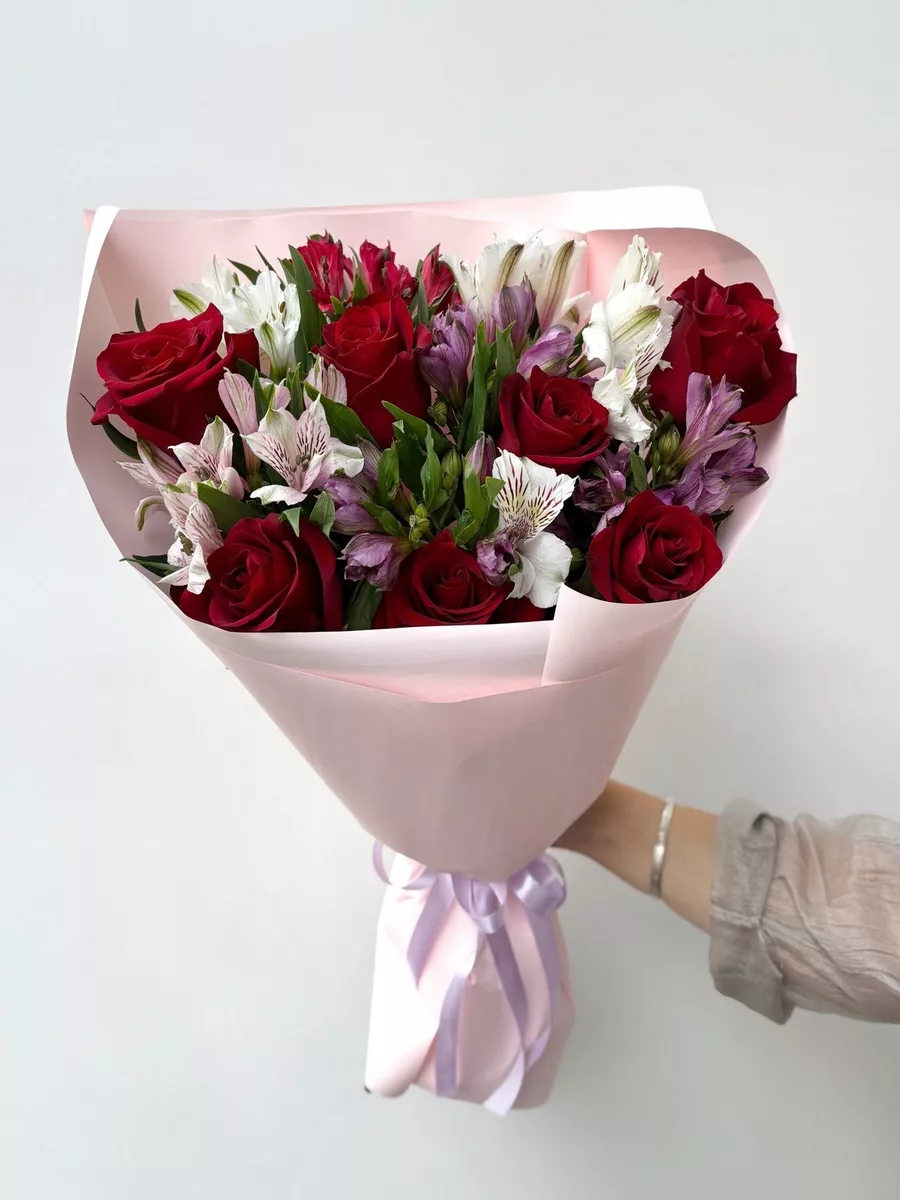
Red and white is probably the most debated pairing we handle. In Western floristry it is a classic — red roses with white gypsophila, red tulips with white ranunculus — and it looks clean and high-contrast. In Russian tradition, however, red and white together carries an association with blood and bandages that dates back to wartime imagery, and a meaningful share of older Russian recipients will notice this immediately. The association is not universal: younger customers rarely mention it, and in a large, lush arrangement where the proportions are generous and greenery breaks up the contrast, most people do not register the concern. Where it becomes a real issue is in small, tight bouquets of, say, five red roses and five white roses with nothing else — the two-colour starkness is exactly what triggers the association. Our standard workaround is to introduce a third element: blush or cream spray roses, eucalyptus, or pale pink lisianthus soften the contrast and shift the reading entirely. A bouquet of red garden roses, white peony-type lisianthus and silver-green eucalyptus reads as elegant and layered rather than binary. If the order comes in for same-day delivery in summer, we often substitute white ranunculus for lisianthus since ranunculus holds better in temperatures above 22 degrees Celsius during transit. The rule of thumb we give customers: if you want red and white, always add a third colour or a substantial amount of textured greenery, and the symbolic concern disappears entirely.
Yellow Flowers and the Separation Question
Yellow is the colour that generates the most customer calls. The folk belief — still active among people born before roughly 1975 — is that giving yellow flowers to a romantic partner signals a wish to separate or signals infidelity. The origin is unclear but the belief is consistent enough that we flag it proactively when someone orders a yellow bouquet for a partner without specifying the recipient's age. For friendships, professional occasions and family celebrations, yellow carries no such baggage and is actually popular: yellow mimosa on Women's Day in March, yellow tulips for spring birthdays, yellow chrysanthemums for autumn teacher appreciation gifts. The problem is exclusively in the romantic context with recipients who hold traditional views. Yellow mixed with orange, red or deep coral reads as warm and festive to virtually everyone — sunflowers with orange gerbera, yellow freesia with coral roses, golden solidago with peach spray roses. These combinations test well across age groups because the warmth of orange neutralises any cool reading of the yellow. Where yellow becomes genuinely risky is when it is paired with white in a romantic bouquet for an older recipient: both colours have contested associations in that context and the combination can feel cold. A practical check: if the recipient is over fifty and the occasion is romantic, ask whether they have any colour preferences before confirming a yellow-dominant palette. This one question prevents the majority of colour-related complaints we receive.
Orange, Coral and Red: Combinations That Almost Never Go Wrong
The warm spectrum — red, orange, coral and their adjacent shades — is the safest territory in Russian flower culture for celebratory occasions. These colours together read as generous, energetic and unambiguously positive, and we rarely receive any concern about them regardless of the recipient's age or background. A bouquet of red spray roses, orange gerbera and coral alstroemeria is one of our most reordered combinations precisely because it offends no one and photographs well. Deep burgundy paired with orange is slightly more sophisticated and works well for professional occasions — burgundy dahlias in late summer with orange marigolds and bronze chrysanthemums, for instance, is a combination that reads as considered rather than generic. The practical advantage of working in this colour range is also botanical: red and orange flowers tend to be among the most robust in transit. Red roses hold well up to about 24 degrees Celsius if properly hydrated before delivery; orange gerbera are sensitive to stem blockage but last well if cut cleanly and kept in fresh water. Coral alstroemeria is one of the best choices for longer delivery windows because it continues to open after arrival, which means the recipient sees the bouquet improve over two to three days rather than peak immediately. For winter deliveries in Saint Petersburg, where transit temperatures can drop below zero, red and orange flowers show cold damage less visibly than white or pale pink varieties, which develop translucent patches on petals when chilled. This makes the warm spectrum practically as well as symbolically reliable.
Purple and Blue Tones: Elegant but Context-Dependent
Purple, violet and blue-toned flowers occupy an interesting position in Russian colour perception. Deep purple — eustoma in plum, violet lisianthus, dark purple statice — reads as refined and slightly formal, which makes it well-suited to professional occasions, significant anniversaries and gifts to older recipients who appreciate restraint. Pale lavender and lilac tones are associated with early spring through the prevalence of lilac blossom, and a bouquet of lilac-toned flowers in April or May carries strong seasonal warmth. The combination of purple with white is almost universally well-received: purple lisianthus with white roses, violet freesia with white waxflower, lavender statice with white gypsophila. Where purple becomes context-dependent is when it is paired with yellow. Purple and yellow is a bold, high-contrast combination that some customers love and others find visually jarring — it does not carry a specific folk association, but it reads as unconventional, and in a culture where flower-giving is often conservative, unconventional needs to be intentional. We suggest purple-and-yellow only when the customer explicitly asks for something striking or non-traditional. True blue flowers are rare in fresh floristry — delphinium is the main option, and it is fragile in transit. We use it in arrangements that stay in one place rather than travel, or in cooler months when temperatures stay below 18 degrees Celsius. Blue hydrangea is more transit-stable and pairs well with white and cream, producing a combination that reads as calm and sincere across all age groups.
Even Numbers of Flowers and How Colour Interacts with Count
One rule that surprises non-Russian customers is the strong preference for odd numbers of stems in a bouquet. Even numbers — two roses, four tulips, six gerbera — are associated with commemorative occasions rather than celebrations, and while the rule is softening among younger urban Russians, it remains active enough that we default to odd counts unless a customer specifically requests otherwise. The reason colour matters here is that colour combinations interact with stem count in how the bouquet is perceived. A tight bouquet of ten red and white roses in equal numbers — five of each — reinforces both the even count and the contested colour pairing simultaneously, which compounds the concern for traditional-minded recipients. Switching to eleven stems and adding a third variety breaks both issues at once. When customers order by variety rather than by colour — 'I want roses and tulips' — we always confirm the count and propose an odd number, and we explain why. Most customers appreciate the information and adjust the order without hesitation. The practical floristry note here is that odd-numbered bouquets also tend to have better structural balance: a central focal flower flanked by supporting varieties creates a natural visual hierarchy that even numbers work against unless the arrangement is very large. For mixed bouquets of three varieties, we typically work in ratios of 5-3-3 or 7-5-3 by stem count, which produces a dominant colour, a secondary colour and an accent. This ratio also makes colour combination concerns easier to manage — the dominant colour sets the tone, and the accent can introduce a contested colour at low enough volume that it reads as detail rather than statement.
What to Check Before Confirming a Mixed-Colour Order
Before confirming any mixed-colour bouquet for a Russian recipient, three checks cover the majority of potential issues. First, establish the dominant colour and ask whether the recipient has any known preferences or aversions — this takes thirty seconds and eliminates the most common complaints. Second, check the occasion against the colour palette: yellow and white together is fine for a housewarming but needs review for a romantic anniversary; red and white together is fine in a large arrangement with greenery but needs a third colour in a small tight bouquet. Third, confirm the stem count is odd. Beyond these three checks, the remaining decisions are mostly botanical rather than symbolic. Lisianthus and spray roses are the most versatile mixed-bouquet flowers because they come in nearly every colour, hold well in transit at temperatures between 5 and 20 degrees Celsius and pair with almost any other variety without clashing. Freesia adds fragrance and fine texture but wilts quickly above 22 degrees, so in summer orders it works better as a minor accent than a dominant variety. Gerbera is bold and colourful but needs a clean stem cut and deep water to avoid drooping during delivery — we hydrate them for at least two hours before dispatch. For orders placed before noon, we can source most colour combinations from the morning market arrival; afternoon orders work with what arrived that morning, which occasionally means a colour substitution. When we substitute, we always call the customer first and explain the botanical reason — usually availability or condition — rather than just swapping silently. That transparency is the single most effective way to keep a colour-sensitive order on track.
Russian colour customs for flowers are practical knowledge rather than superstition — understanding them means the bouquet you send actually lands the way you intended. The core rules are manageable: avoid equal-measure red and white without a third colour, treat yellow carefully in romantic contexts for older recipients, stay with odd stem counts, and lean on the warm spectrum when you are uncertain. Every other decision is floristry: which varieties hold best in transit, which ratios create visual balance, which combinations photograph well and last longest in a vase. When you order from us, we ask the questions that surface these issues before the arrangement is built, not after delivery. We deliver bouquets across Russia in 1–2 hours.
Frequently asked questions
Is it really true that yellow flowers mean separation in Russia?
The association exists primarily among Russians born before the mid-1970s and applies mainly to romantic contexts. For birthdays, professional occasions and family celebrations, yellow flowers — tulips, mimosa, sunflowers — are entirely normal and popular. If you are unsure about the recipient's views, pairing yellow with orange or red removes any ambiguity.
Can I order a red and white bouquet for a Russian recipient?
Yes, but add a third colour or substantial greenery. The folk concern with red and white together fades when the bouquet has visual complexity — blush roses, eucalyptus or pale pink lisianthus break the two-colour starkness. A large, layered arrangement reads as elegant; a small, tight two-colour bouquet is where the association tends to surface.
Why do Russian bouquets almost always have an odd number of flowers?
Even numbers carry an association with commemorative rather than celebratory occasions in Russian tradition. The rule is strongest among older recipients and in more traditional regions, but it is observed widely enough that florists default to odd counts. Switching from ten stems to eleven costs almost nothing and removes a potential concern entirely.
Which colour combinations are completely safe for any Russian recipient?
White with any bright colour, the full warm spectrum of red, orange and coral together, and purple or violet with white are the lowest-risk combinations across age groups and occasions. These pairings have no contested folk associations and work for romantic, friendly and professional contexts. Adding textured greenery to any combination further reduces the chance of misreading.
Does the season affect which colour combinations are available for delivery?
Yes. Some varieties that anchor popular combinations — peonies for blush-and-white, dahlias for burgundy-and-orange — are only available in specific months. Lisianthus and spray roses cover most colour ranges year-round and are the most reliable base for mixed bouquets regardless of season. We confirm availability when you place the order and suggest botanically equivalent substitutes if a specific variety is out of season.
Ready to send a bouquet?
Pick a city, choose the flowers, and we will hand them over with a photo confirmation.
Choose a city →