
Flower Delivery to Dankov from Abroad: What Senders Need to Know
Most calls we get from overseas senders start the same way: someone in Berlin or Toronto wants flowers at a Dankov address by a specific hour and has no idea whether that is even possible. Dankov is a small city in Lipetsk Oblast, roughly 450 kilometres south of Moscow, and it sits well outside the same-day delivery radius that works for Saint Petersburg or Moscow. That does not mean the order is impossible — it means the planning has to be sharper, the lead time longer, and the variety choices more practical than they would be for a capital city order.
Where Dankov Sits and Why Distance Changes Everything
Dankov has a population of around 20,000 and lies in the Lipetsk region, a part of central Russia that most international senders have never had to think about before. The city is reachable by road from Lipetsk city in about an hour and a half, and from Moscow in roughly five to six hours by car. When you place an order from abroad, the flowers leave our Saint Petersburg facility and travel to the recipient's address through a coordinated logistics chain that we manage directly. That chain works, but it takes time, and time is the first thing international senders underestimate. A same-day order placed at noon Moscow time is not realistic for Dankov. The standard window we quote for this destination is next-day delivery, and that assumes the order is confirmed before 14:00 Moscow time on the day prior. If you are calling from New York at 10 p.m. your time, that is already 5 a.m. Moscow time the next morning, so the math shifts again. The practical advice is to add at least 48 hours of buffer when you are ordering from a timezone more than three hours behind Moscow. Dankov also experiences genuine seasonal weather: winters bring temperatures well below zero, summers can push above 35°C, and both extremes affect which flowers survive transit in good condition. We will come back to that in the variety section, but the geography point stands on its own — knowing where Dankov is helps you understand every other decision in this order.
Bouquets we can deliver



Time Zones, Cut-Off Times and When to Place Your Order
Russia operates on Moscow Standard Time, which is UTC+3 with no daylight saving adjustment. That means when it is 9 a.m. in London, it is noon in Moscow. When it is 9 a.m. in New York during Eastern Standard Time, it is 5 p.m. in Moscow. Our order cut-off for next-day Dankov delivery is 14:00 Moscow time, and that deadline is firm because the logistics preparation for a regional city of this distance begins in the early afternoon. If you miss the cut-off by even thirty minutes, the delivery shifts to the day after, which is not a problem unless the occasion is fixed. The most common mistake we see from international customers is placing the order at what feels like a reasonable hour locally — say, 11 a.m. on a Tuesday in Los Angeles — without realising that Tuesday in Los Angeles is already late Tuesday evening in Moscow, and the cut-off for Wednesday delivery has long passed. The fix is simple: convert to Moscow time before you do anything else. Use any world clock application, find the Moscow column, and work backwards from the delivery date. If the occasion is a birthday on a Friday, confirm your order by Wednesday at 13:00 Moscow time at the latest to give yourself a margin. Weekend deliveries to Dankov are possible but require the same advance notice — we do not reduce lead times on Saturdays and Sundays for regional destinations. Public holidays in Russia also affect logistics, and the Russian holiday calendar differs from Western ones, so check before you assume a Monday is a normal working day.
Which Flowers Actually Arrive Fresh in Dankov
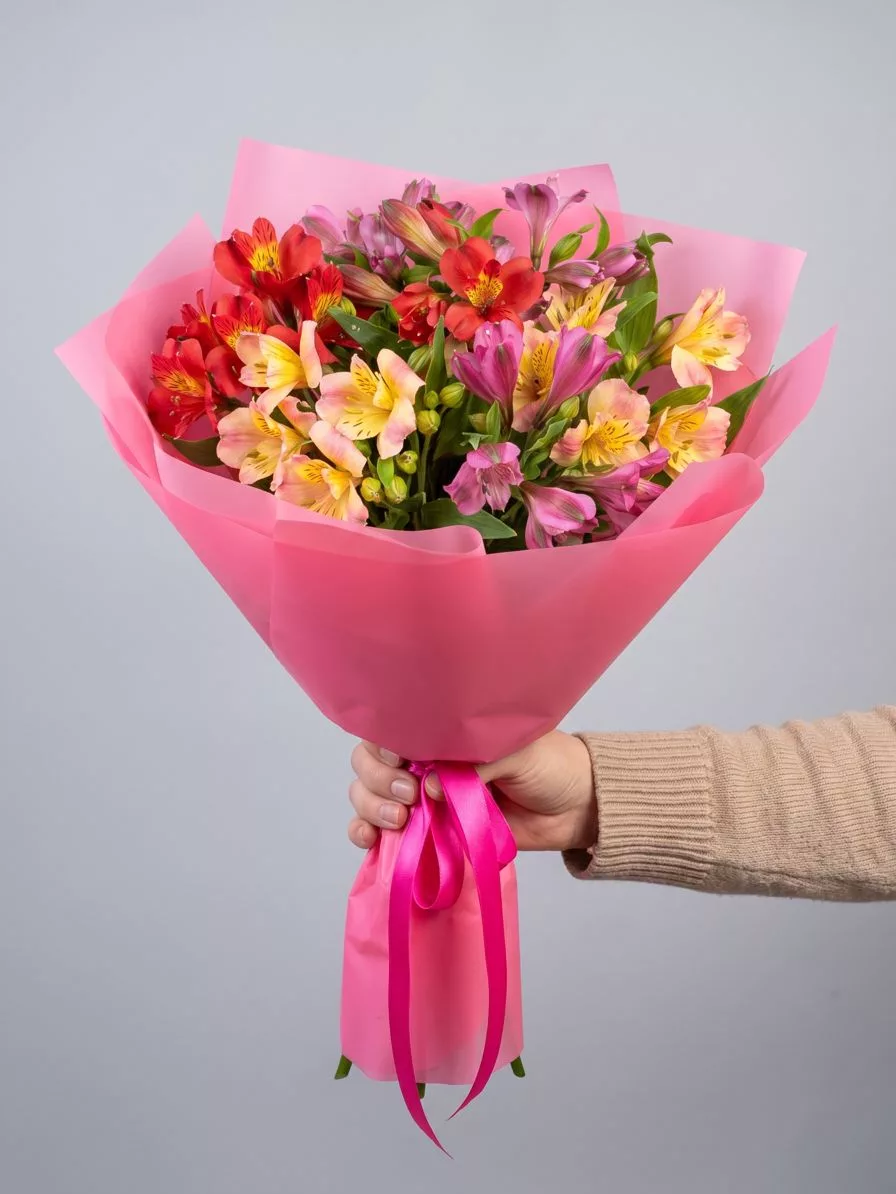
Transit time and temperature are the two filters that determine which varieties are worth ordering for a Dankov delivery. Roses are the most reliable choice: Dutch garden roses and standard spray roses both handle 24-to-48-hour transit well when properly conditioned, and they arrive with enough vase life remaining to make a real impression. Chrysanthemums — both single-headed and spray types — are similarly robust and hold colour and form through long journeys. Alstroemeria is an underrated option for regional deliveries because its petals are firm, it does not bruise easily in packaging, and it comes in a wide colour range from white through coral to deep burgundy. Carnations, both standard and mini, are another dependable choice; they have a reputation for being ordinary, but a well-composed mono-bouquet of garden carnations in a single colour is striking and completely appropriate for a birthday or anniversary. What tends to struggle on this route is anything with delicate open petals or high moisture needs: open garden peonies in summer, fully open ranunculus, and large-headed hydrangea all risk arriving in poor condition after a regional transit. Tulips are seasonal — fine in spring but not available year-round, and in summer heat they collapse quickly. Eustoma, also called lisianthus, sits in the middle: it is more resilient than it looks, but it needs to be ordered in bud stage rather than fully open to survive the journey. When you call to confirm an order, ask specifically what stage the flowers are in — a good florist will always know.
Seasonal Considerations: Summer Heat and Winter Cold
Lipetsk Oblast has a continental climate with real seasonal extremes, and those extremes are not abstract concerns — they change what we pack and how we pack it. In winter, which in Dankov runs from November through March with hard frosts common in January and February, the risk is freezing during the final delivery leg. Flowers exposed to sub-zero temperatures for even fifteen minutes in a vehicle with the engine off can suffer irreversible cell damage, particularly in stems and petals. We use insulated packaging for winter regional deliveries, and we time the final handoff to minimise exposure. Customers ordering in winter should make sure someone is available at the address to receive the bouquet promptly — leaving flowers on a doorstep in a Dankov January is not a good outcome. Summer presents the opposite problem. July and August in central Russia can bring heat above 30°C, and a bouquet sitting in a warm vehicle during a long delivery run will wilt faster than expected. This is when variety choice matters most: we steer summer Dankov orders toward roses in tight bud, chrysanthemums, and alstroemeria, and away from anything that is already open or moisture-sensitive. The shoulder seasons — April through May and September through October — are actually the easiest time to send flowers to regional destinations. Temperatures are moderate, a wider range of varieties is available from Dutch and domestic growers, and transit conditions are the most predictable. If you have any flexibility on the occasion date, spring and autumn are the windows where we can offer the broadest selection with the highest confidence in arrival quality.
What to Include in Your Order: Address, Recipient Details and the Card
Getting the address right for a Russian regional city is the step where international senders most often create problems. Russian addresses follow a specific format: country, then region, then city, then street, then building number, then apartment number. For Dankov that looks like: Russia, Lipetsk Oblast, Dankov, then the street name in Russian, then the building and flat numbers. If you are providing the address in Latin characters, include a phonetic transliteration and also the original Cyrillic version if the recipient or anyone in their household can supply it — Cyrillic is always more reliable for the delivery driver's navigation. The recipient's phone number is not optional for a Dankov delivery; it is essential. The driver will call ahead, and if the number is wrong or the recipient does not pick up, the delivery cannot be completed. Include the country code if the recipient has a foreign number for any reason, though most Dankov residents will have a Russian mobile number starting with 7 or 8. The card message is where cultural context matters for international senders. Russian recipients appreciate directness — a simple, warm message in Russian lands better than a translated English sentiment that reads awkwardly. We can help with basic translation if you provide the message in English or another major European language. Keep it short: the recipient's name, the occasion, and a sentence of warmth. Avoid overly formal language, which in Russian can read as cold. Flowers in Russia are given with genuine emotion, and the card should reflect that without being elaborate.
Russian Flower Customs That International Senders Ask About
The question we get most often from senders outside Russia is about the odd-number rule. In Russia, even numbers of flowers are associated with mourning and funerals, so bouquets given as gifts are assembled in odd numbers: three roses, five stems of alstroemeria, seven chrysanthemums, or any odd count. This is not a rigid superstition that every Russian observes strictly, but it is a real cultural norm, and giving an even-numbered bouquet to someone who notices will create an awkward moment. We always compose gift bouquets in odd numbers by default, so you do not need to specify this — just be aware that if you count the stems in the photo confirmation and see an odd number, that is intentional. Colour carries some weight in Russian flower culture as well, though less rigidly than the number rule. Red roses are strongly romantic, which is appropriate for a partner but can be misread if sent to a colleague or a grandmother. White flowers are versatile and appropriate for almost any occasion. Yellow flowers have a reputation in older Russian tradition for signifying separation or bad luck, though younger Russians largely ignore this. Mixed colour bouquets sidestep any ambiguity entirely. Wrapping style also differs from Western norms: Russian bouquets are typically presented in full round wrapping that covers the stems completely, with the blooms visible from the top, rather than the cone-wrapped style common in European markets. We wrap according to Russian presentation standards as a matter of course.
Confirming the Order and Tracking the Delivery
Once you have placed an order for Dankov, you will receive a confirmation that includes the expected delivery window. For regional cities we quote a four-hour window rather than a specific hour, because road conditions, building access and recipient availability all introduce variables that a precise time cannot account for. If the recipient has a fixed schedule — a lunch break, a work shift end, a specific event time — tell us when you order so we can aim for the earlier part of the window. We send a delivery confirmation once the bouquet has been handed to the recipient, and that confirmation comes to the email address or phone number you provided at checkout. International customers sometimes find the confirmation arrives while they are asleep due to the time difference, which is fine — the important thing is that it arrives. If you have not received a confirmation within two hours of the end of the quoted delivery window, contact us directly. Do not wait until the next day hoping it will appear. For Dankov specifically, delays are uncommon but not impossible: road conditions in Lipetsk Oblast in winter can slow the final leg, and occasionally a recipient is unreachable by phone and the driver has to make a second attempt. We handle rescheduling at no extra charge when the delay is on our side. When it is the recipient who is unreachable, we will contact you to agree on a new delivery time. Having an alternative contact number for someone near the recipient — a family member or neighbour — is worth including in the order notes if you can get one.
Sending flowers from abroad to a regional Russian city like Dankov is not complicated once you understand the two things that actually drive the outcome: lead time and variety choice. Get the order in at least 48 hours before the occasion, pick varieties suited to the season and the transit distance, make sure the recipient's phone number is correct, and the rest follows. We have been delivering to addresses across Russia for years, and Dankov is a route we know. The florists who pack these orders understand what arrives in good condition and what does not, and that knowledge is what you are paying for when you order from a specialist rather than a generic platform. We deliver bouquets across Russia in 1–2 hours.
Frequently asked questions
Can I order flowers for Dankov delivery on the same day I need them delivered?
Same-day delivery to Dankov is not available. Dankov is a regional city in Lipetsk Oblast, and the logistics require next-day scheduling at minimum. Place your order before 14:00 Moscow time the day before the occasion. If you are ordering from a timezone significantly behind Moscow, build in an extra day to avoid missing the cut-off.
What happens if the recipient does not answer the door or phone when the flowers arrive?
The driver will attempt to reach the recipient by phone. If there is no answer, we contact you as the sender to agree on a new delivery window. A second delivery attempt is arranged at no extra charge when the missed delivery is due to recipient unavailability. Providing a backup contact number in the order notes speeds up this process considerably.
Do I need to write the card message in Russian, or can it be in English?
You can provide the message in English and we will help with a straightforward translation into Russian. Most Dankov recipients will read the card in Russian, so a translated message lands more naturally. Keep the text short and direct — the recipient's name, the occasion, and a warm sentence work better than a long translated paragraph that can read awkwardly.
Are there flowers I should avoid ordering for a Dankov delivery in summer?
In summer heat, avoid fully open peonies, open ranunculus and large hydrangea heads — these struggle through a long regional transit. Stick to roses in tight bud, chrysanthemums, alstroemeria and carnations, which all handle heat and travel time significantly better. If you are unsure, ask us when you call to confirm: we will tell you what is in good condition that day.
Why do Russian bouquets always have an odd number of flowers?
Even numbers of flowers are traditionally associated with funerals in Russian culture, so gift bouquets are always assembled in odd numbers. This is a genuine and widely observed custom, particularly among older recipients. We follow this automatically for every gift order, so you do not need to specify it — but it is useful to know so the stem count in your confirmation photo does not surprise you.
Ready to send a bouquet?
Pick a city, choose the flowers, and we will hand them over with a photo confirmation.
Choose a city →