
Flower Delivery in Karachev: Zones, Timing and Prices
Karachev is a small city in Bryansk Oblast, and customers ordering flowers here often have the same three questions: will the bouquet actually arrive today, what condition will it be in after the road, and which varieties hold up best in transit. These are exactly the right questions to ask, and this article answers all of them with the kind of detail that makes the difference between a bouquet that impresses and one that disappoints.
Which Parts of Karachev We Deliver To
Karachev sits along the Snezhet River roughly 40 kilometres east of Bryansk city centre, and the delivery zone covers the main residential districts including the central streets around Sovetskaya and Lenina, the neighbourhoods closer to the railway station, and the private housing areas on the city's outskirts. We do not split the city into premium and secondary zones — the same delivery conditions apply whether the address is a flat in a Soviet-era block near the market or a private house on one of the garden streets to the south. What matters for timing is not the district but the time of day the order is placed. Orders placed before noon on a working day are almost always fulfilled within the standard window. Orders placed in the evening or late at night for same-day delivery require confirmation, and we will tell you honestly at the point of ordering whether that window is realistic. If the address is outside the built-up area — a dacha settlement or a village that uses Karachev as its postal address — please specify this clearly in the order comments, because travel time increases and we may need to adjust the delivery slot. Getting the address right the first time saves everyone the awkward phone call when the courier is already on the road.
Bouquets we can deliver



How Long Delivery Actually Takes
The standard delivery window for Karachev is one to two hours from the moment the order is confirmed, not from the moment you click the button on the website. Confirmation means the order has been checked, the flowers are available and a courier slot has been assigned. During busy periods — Valentine's Day, International Women's Day on the 8th of March, and the last week of August before the school year begins — the queue of orders is longer, and we advise placing orders at least four to six hours ahead to stay within a predictable window. On ordinary weekdays in, say, October or November, same-day delivery with two hours' notice is entirely realistic. The single most common mistake customers make is ordering at 17:00 and expecting delivery by 18:00 on a Saturday in early March. That is not a window we can guarantee, and we will say so clearly rather than confirm and then miss the time. If you have a specific moment that matters — a surprise at the office at exactly 12:00, for example — put that in the order notes and we will work backwards from it to tell you the latest safe ordering time. Evening deliveries up to a stated cut-off time are available; check the current cut-off when you order because it can shift seasonally.
Which Flowers Travel Well to Karachev
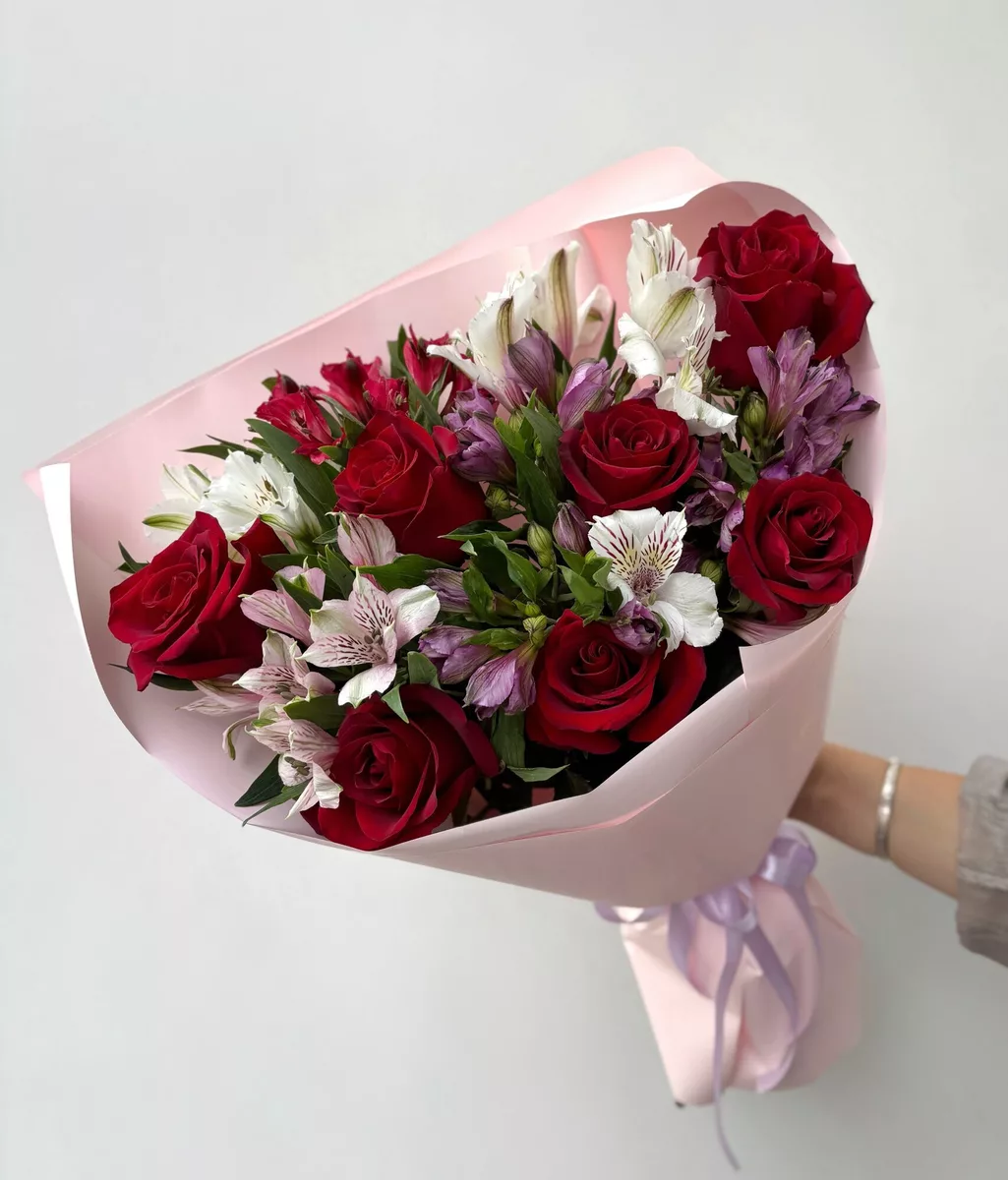
Not every variety that looks beautiful in the shop window is a good choice for a delivery route. Roses are the most forgiving in transit when they are cut at the right stage — tight buds rather than fully open heads — because they continue opening gradually after delivery and arrive looking fresh rather than blown. Dutch roses in standard stem lengths of 50 to 70 centimetres are a reliable choice year-round. Spray chrysanthemums are exceptionally robust; their stems branch into multiple flower heads, so even if one head is slightly bruised the overall bouquet holds together well. Alstroemeria is another strong traveller — the flowers are small, the petals are firm and the stems are flexible enough to survive packaging without snapping. What travels poorly: fully open peonies in June, which bruise at the petal edges with any vibration; ranunculus in warm weather above 20 degrees Celsius, because the thin petals collapse quickly without chilled water; and large-headed hydrangea in summer, which wilts within 90 minutes of leaving water if the temperature is above 18 degrees. We pack all bouquets in aqua packs — small water-filled sachets attached to the stem ends — for routes over 30 minutes, which covers Karachev deliveries. In winter, outer kraft paper wrapping protects against frost below minus five degrees Celsius during the brief time between the courier's vehicle and the recipient's door.
Seasonal Availability and What Changes Month to Month
Russia's flower market runs largely on imported stock from the Netherlands, Ecuador and Colombia, which means the core range — roses, carnations, alstroemeria, gypsophila, spray chrysanthemums — is available twelve months of the year with relatively stable quality. What changes is price and the availability of supplementary varieties. In January and February, tulips from Dutch growers flood the market ahead of Women's Day, and the price per stem drops noticeably compared to October. In May and June, peonies from domestic Russian growers in southern regions become available; these are often better quality than imported peonies because the transit time is shorter and the buds arrive firmer. Sunflowers are a summer and early autumn flower; the Russian domestic crop runs from July through September and the quality during this window is noticeably higher than imported sunflowers in winter, which tend to arrive with the outer petals already yellowing. Lisianthus, sometimes called eustoma, is available most of the year but peaks in quality from August through October. If you are ordering for a specific colour scheme and the month matters — say, deep burgundy tones for an autumn event — it is worth mentioning this in the order notes because we can advise which varieties are currently at their best rather than substituting something that does not match. Availability shifts week to week depending on what arrived at the wholesale market, and we update the catalogue accordingly.
What to Check Before You Confirm the Order
Three things cause the majority of delivery problems, and all three are easy to catch before you confirm. First, the recipient's phone number. In Russia it is standard practice for the courier to call ahead ten to fifteen minutes before arrival, partly to confirm the address and partly to make sure someone is actually there to receive the flowers. If the number is wrong, or if the recipient has their phone on silent, the delivery stalls. If this is a surprise and you do not want the recipient called in advance, note this clearly and provide a backup number — your own, for example — so the courier can reach someone. Second, the exact address including the flat number, entrance number and floor. Russian apartment buildings often have multiple entrances numbered separately, and the wrong entrance adds time and confusion. Third, the delivery time window. Be honest with yourself about when the recipient will actually be at that address. A bouquet left with a neighbour or a building concierge is not the same experience as a hand delivery, and we would rather you choose a slot when the person is home. If the recipient is at a workplace, confirm that outside visitors are permitted in the building and that there is a reception or security point where the courier can hand over the flowers without needing internal access.
How Russian Flower Customs Might Surprise You
If you are not familiar with Russian gifting culture, a few things about flower-giving here are worth knowing before you order. The number of flowers in a bouquet matters: an even number of stems is traditionally associated with mourning and funerals, so bouquets for celebrations are always made with an odd number of stems — three, five, seven, eleven, fifteen and so on. This is not a superstition that is fading; it is still observed consistently across all age groups, and recipients notice. We count stems before packing and always make up odd numbers. Second, roses are by far the most expected and appreciated gift flower in Russia across all occasions and all demographics — this is not a cliché but a straightforward market reality. Third, yellow flowers carry an association with separation and bad luck in some Russian cultural contexts, though this varies by generation and region; if you are unsure, it is worth asking or simply choosing a different colour. White flowers are entirely positive and appropriate for birthdays, anniversaries and professional occasions. Large, dramatic bouquets are generally preferred over small, delicate arrangements for significant events; a bouquet of five stems is a token gesture, while fifteen or twenty-five stems reads as a serious gift. If you are ordering from outside Russia and are uncertain about any of this, the order notes field is the right place to ask — we read every note before packing.
What Happens If Something Goes Wrong
Deliveries occasionally run late, and flowers occasionally arrive in a condition that does not meet expectations. Both situations have straightforward resolutions. If the delivery is running more than thirty minutes past the confirmed window, the courier will contact you proactively rather than wait for you to call. If for any reason contact fails, you can reach us directly and we will give you a live update on where the courier is. We do not offer vague reassurances; if the delay is significant, we will tell you the revised time and explain why. On quality: if the bouquet arrives with damaged stems, browning petals or flowers that have opened far beyond what was packed, photograph it immediately and contact us the same day. We assess these situations individually. Common causes of post-delivery deterioration that are not quality failures: leaving the bouquet in a hot car for two hours before presenting it, placing it next to a radiator, or not trimming the stems and changing the water within the first twelve hours. Roses in particular need a fresh diagonal cut of about two centimetres when they arrive home, and the water in the vase should be changed every day or every second day. Hard tap water is fine; adding a small sachet of flower food — which we include with most bouquets — extends vase life noticeably. With proper care, roses last seven to ten days, alstroemeria ten to fourteen days, and chrysanthemums up to three weeks.
Ordering flowers for delivery in Karachev is straightforward when you know what to check: a correct address with flat and entrance number, a reachable phone number for the recipient, an honest delivery window that matches when the person is actually there, and a variety choice that suits the season and the transit conditions. The flowers that arrive in the best condition are not always the most expensive ones — they are the ones chosen with the route and the temperature in mind. If you have a specific occasion, a colour preference or a timing constraint that feels complicated, put it in the notes when you order and we will work with it directly. We deliver bouquets across Russia in 1–2 hours.
Frequently asked questions
Can I order flowers for same-day delivery in Karachev if I order in the morning?
Yes. Orders placed before noon on working days are almost always fulfilled within the standard one-to-two-hour window. On busy dates like March 8th, we recommend ordering at least four to six hours ahead to secure a specific slot. The website will show you current availability when you select your delivery time.
What if the recipient is not home when the courier arrives in Karachev?
The courier calls ahead ten to fifteen minutes before arrival using the number you provide. If the recipient is unreachable, the courier will attempt contact and then reach you on your number. We do not leave bouquets unattended outside a door. If no one is available, we reschedule the delivery and keep the flowers in water until the next slot.
Why do Russian bouquets always have an odd number of flowers?
An even number of stems is traditionally associated with funeral flowers in Russian culture. For any celebratory or personal gift, an odd count is always used — three, five, seven, eleven and so on. This custom is observed across all generations and regions. We always count stems before packing and correct even numbers automatically.
Which flowers last the longest after delivery in Karachev?
Spray chrysanthemums regularly last two to three weeks in a vase with proper care. Alstroemeria holds ten to fourteen days. Standard roses last seven to ten days if the stems are trimmed on arrival and the water is changed every day or two. Avoid placing any cut flowers near radiators or in direct sunlight to extend vase life.
Can I request a specific delivery time rather than a window?
You can request a target time in the order notes — for example, arrival at exactly 12:00 for an office surprise. We will confirm whether that precise time is achievable given current order volume. On quiet weekdays this is usually possible. On peak dates we offer a thirty-minute window rather than a single minute, which is still more precise than a standard two-hour slot.
Ready to send a bouquet?
Pick a city, choose the flowers, and we will hand them over with a photo confirmation.
Choose a city →