
Flower Delivery in Kirovsk: Zones, Timing and Prices
Kirovsk sits about 50 kilometres south of Saint Petersburg along the Neva River, and customers there ask us the same questions every week: can you actually reach us, how long will it take, and will the flowers still look fresh when they arrive? The answers depend on the district, the time of day, and what you order. This article lays out exactly what we know from delivering to Kirovsk regularly.
Which Parts of Kirovsk We Deliver To
Kirovsk is a compact industrial town in the Leningrad Oblast, and the delivery zone covers the central residential streets, the area around Kirovsk railway station, and the newer residential blocks on the eastern edge of town. Addresses near the Nevsky Pigment plant and the older Soviet-era mikrorayons are all within range. What occasionally causes delays is the industrial road network: some streets have limited access during shift changes at the large factories, typically between 7 and 8 in the morning and between 4 and 5 in the afternoon. If you are sending flowers to a workplace rather than a home address, note the building entrance number — many factory administrative buildings share a single street number but have four or five separate entrances, and an incorrect entrance adds time. Residential tower blocks in Kirovsk usually have working intercoms, so include the flat number and the intercom code if the building has a coded entry panel. Dachas and private houses on the outskirts of town, particularly those on unpaved lanes near the river, may require a short walk from the nearest accessible road. Our courier will always call ahead when the address needs clarification, so keep the recipient's phone switched on. Covering the full town means we do not restrict delivery to a single central zone, but the outer addresses do take longer than the town centre.
Bouquets we can deliver



Typical Delivery Times and What Affects Them
From the moment an order is confirmed, the standard delivery window for Kirovsk is one to two hours. That window holds for most of the day, but there are two periods when it stretches: the Murmanskoe Highway corridor between Saint Petersburg and Kirovsk sees heavy lorry traffic on weekday mornings from roughly 8 until 10, and weekend afternoons between 2 and 5 can be slow because of leisure traffic heading toward the Ladoga shore. Ordering before noon on weekdays gives you the most predictable timing. Evening deliveries, meaning orders placed after 7 in the evening, are possible but the two-hour window should be treated as a minimum rather than a target. Weather is a real factor in winter: Kirovsk sits in a frost pocket, and temperatures there often drop two or three degrees lower than central Saint Petersburg. Ice on the Murmanskoe Highway slows the route noticeably. For time-sensitive occasions — a birthday dinner, for example — place the order at least three hours ahead in winter months. Summer deliveries are generally faster because the road is clear and daylight is long, but heat above 25 degrees Celsius is hard on open roses and ranunculus, so the courier keeps flowers in a cooled compartment for the entire journey. We will always send you a message when the courier leaves and again when delivery is completed.
Bouquets That Travel Well to Kirovsk
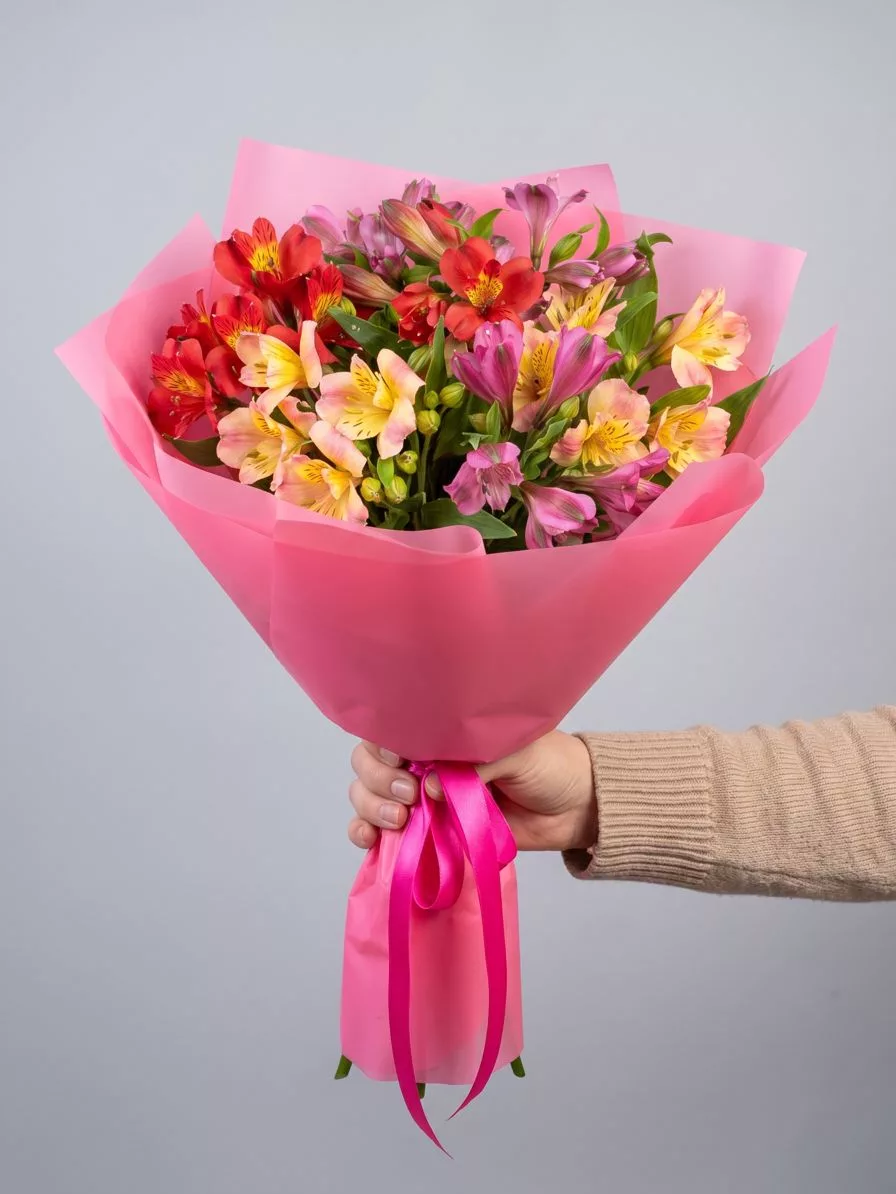
The 50-kilometre drive from Saint Petersburg to Kirovsk is not long, but it is long enough that flower choice matters. Chrysanthemums, alstroemeria, and spray carnations are the most road-tolerant options: they are dense, their petals do not bruise easily, and they hold their shape even if the van hits a rough patch of road. Standard large-headed roses travel well when they are cut at the right stage — buds that are one-quarter open rather than fully blown. A fully open rose loses petals on any bumpy road. Peonies are popular in Kirovsk from late May through June, and they travel fine when bought in bud, but avoid ordering them in tight bud in cold weather because they may not open for two days after delivery, which surprises recipients who expect an instant display. Tulips in spring are a good choice but they continue to grow after cutting, sometimes by three to four centimetres, so a bouquet that looks proportional in the shop may look top-heavy by the time it arrives. Orchid stems — cymbidium and dendrobium varieties — are excellent for longer journeys because they are robust and last ten to fourteen days in a vase. Hydrangea is beautiful but needs water constantly; we wrap the stems in wet paper for transit, and the recipient should put them in a deep vase immediately. Avoid ordering open garden roses in summer heat unless the recipient can put them straight into water.
Seasonal Availability and What Changes Month to Month
Kirovsk customers sometimes call and ask for flowers that are simply not in season, and it is worth explaining what that means in practice. Dutch auction tulips are available almost year-round, but their quality peaks in February through April when the growing conditions in the Netherlands are optimal. Russian-grown tulips from Krasnodar appear in March and are often more fragrant than the Dutch ones. Peonies from local growers arrive in late May and sell out fast; if you want them for a June event, order early in the week. Sunflowers are available from July through September at their best; outside that window they come from hothouses and are smaller with thinner stems. Lilies — Oriental and Asiatic varieties — are available throughout the year, but note that Oriental lilies are strongly scented and not suitable for small rooms or for recipients who are sensitive to fragrance. In November and December, amaryllis becomes widely available and is one of the best winter choices because the large blooms are dramatic, the stems are sturdy, and the flowers last well in heated Russian apartments, which tend to be kept at 22 to 24 degrees Celsius. Ranunculus appear in February and March and are delicate; they are worth ordering in cooler months only. Anemones follow a similar pattern. In summer, the shop receives freesia, lisianthus, and statice regularly, all of which travel well and add texture to mixed bouquets without adding fragility.
Packaging and Care on Arrival
Every bouquet leaving for Kirovsk is wrapped to protect it from both physical damage and temperature change. In winter this means an insulating kraft paper outer layer and a cellophane inner sleeve that traps warmth around the stems. In summer the wrap is lighter but the stems are still secured so they do not shift during the drive. When the courier hands over the bouquet, the recipient should hold it upright — not at an angle — until it reaches a vase. This matters most for tall arrangements with top-heavy blooms like sunflowers or large lilies. The first thing to do at home is cut the stems at a 45-degree angle under running water, about two centimetres from the bottom. This removes any air that entered the stem during transit and allows the flower to drink immediately. Remove any leaves that would sit below the waterline in the vase because submerged leaves rot within a day and contaminate the water. Change the water every two days. Kirovsk tap water is hard, meaning it has a high mineral content, and some flowers, particularly roses, respond better to filtered or boiled-and-cooled water. If the bouquet came with a sachet of flower food, dissolve the whole sachet in the vase water at the start; do not split it across two changes of water. Keep the vase away from radiators, which are on at full power for most of the year in Russian apartments, and away from direct sunlight. A cool windowsill on the north side of the apartment is ideal.
What to Check Before Confirming Your Order
Three things cause the most problems with Kirovsk deliveries, and all three are easy to avoid. The first is an incomplete address. Kirovsk has several streets with similar names, and the town shares a postal district with the nearby settlement of Otradnoye. Always include the full street name, the building number, the flat or office number, and the entrance number if the building has more than one. The second common problem is an unreachable recipient. If the person you are sending flowers to is at work, confirm that they are actually in the office that day and that their phone is on. A missed delivery means the courier waits up to ten minutes, calls twice, and then contacts the sender. Rescheduling adds time and the flowers sit in the van longer than intended. The third issue is ordering the wrong bouquet for the occasion. In Russia, even numbers of flowers are traditionally associated with mourning, so bouquets are almost always made in odd numbers — five, seven, nine, eleven stems. If you are assembling a custom bouquet, ask for an odd count. This is not a superstition you need to follow, but if the recipient is Russian and notices an even number, it can cause awkwardness. Also check whether the recipient has any known allergies: lilies and freesia are the most common triggers. Finally, if the delivery is a surprise, make sure the building door can be opened by the courier — some Kirovsk residential blocks have courtyard gates that are locked from the outside.
Corporate and Bulk Orders for Kirovsk Businesses
Several businesses in Kirovsk order flowers regularly — office receptions, a handful of restaurants along the central street, and administrative offices that like to keep fresh arrangements at the front desk. For recurring orders, the practical approach is to set a fixed delivery day and time each week, which lets us prepare the flowers in advance and guarantees the freshest stock. Weekly office arrangements work best with long-lasting varieties: chrysanthemum pompons last ten to fourteen days, alstroemeria lasts a similar period, and lisianthus holds well in a warm room. Roses in office arrangements need water every day because heated Russian offices are dry. For large one-off events — a company anniversary, a product launch, a conference — place the order at least five days ahead. This gives time to source the specific varieties in the quantities you need, because buying fifty identical stems of one variety at short notice is not always possible from the auction. Large orders also need a clear point of contact at the delivery address, someone who can receive multiple boxes and direct them to the right rooms. Flower arrangements for reception desks should be ordered in containers rather than hand-tied bouquets, because a container sits stably on a flat surface without needing a vase. We can prepare arrangements in low ceramic bowls, tall glass cylinders, or wooden boxes depending on the desk style. Corporate clients in Kirovsk who order regularly can also request a standing account, which simplifies the payment process for their accounting department.
Delivering flowers to Kirovsk is straightforward when the address is complete, the recipient is reachable, and the bouquet is chosen with the season and the journey in mind. The town is well within our regular delivery range, and most orders arrive within the two-hour window without any complications. The details that make a difference — stem cutting, water temperature, keeping flowers away from radiators — take two minutes to follow and extend the life of any bouquet by several days. If you are unsure which flowers suit the time of year or the occasion, call the shop and ask; we know what is fresh today and what will look best when it reaches a door in Kirovsk. We deliver bouquets across Russia in 1–2 hours.
Frequently asked questions
Can you deliver flowers to Kirovsk on the same day I order?
Yes, same-day delivery to Kirovsk is standard. Place your order before 6 in the evening and delivery completes within one to two hours in most cases. For winter days when the Murmanskoe Highway is icy, allow an extra hour as a buffer, especially for evening orders after 7 pm.
What is the minimum bouquet size for delivery to Kirovsk?
There is no minimum stem count, but practically speaking, a bouquet of fewer than five stems looks sparse after wrapping and transit. Most customers ordering for a birthday or celebration choose seven to eleven stems. Single-stem deliveries, such as one large orchid spike in a gift box, are also possible and travel well.
Will the flowers arrive fresh if it is very cold outside?
Yes. In temperatures below minus 10 Celsius, which is common in Kirovsk in January and February, we use insulated packaging and keep the van heated. Tropical flowers like anthuriums and orchids are most sensitive to cold and get extra wrapping. The journey from Saint Petersburg takes under an hour, so cold exposure is brief.
Can I order a bouquet without knowing the exact address yet?
You can place and pay for the order and provide the final address later, as long as you confirm it at least 30 minutes before the requested delivery time. We need a full Kirovsk address including building, entrance and flat number before the courier departs. Vague addresses cause delays that affect the freshness of the flowers.
How do I make the bouquet last longer in a Kirovsk apartment?
Cut stems at a 45-degree angle the moment the bouquet arrives, place them in clean cool water, and keep the vase away from radiators. Russian apartments are heated to 22 to 24 degrees Celsius, which shortens flower life. Change the water every two days and remove any leaves below the waterline. Chrysanthemums and alstroemeria last longest under these conditions.
Ready to send a bouquet?
Pick a city, choose the flowers, and we will hand them over with a photo confirmation.
Choose a city →