
Sending Flowers to Konstantinovsk from Abroad: What You Need to Know
Most international orders for Konstantinovsk arrive with one of three problems: a vague address, a recipient who was never warned to stay home, or a sender who assumed same-day delivery works the same way it does in London or Berlin. It does not, and the gap between expectation and reality is usually just a few missing details. Here is what actually matters when you are placing an order from outside Russia for a recipient in Konstantinovsk, Rostov Oblast.
Where Konstantinovsk Sits and Why That Affects Your Order
Konstantinovsk is a small town on the Don River in Rostov Oblast, roughly 130 kilometres northeast of Rostov-on-Don. It is not a regional capital, which means flower logistics work differently here than in Saint Petersburg or Moscow. Delivery windows are tighter, and the range of available stem varieties on any given day depends on what has moved through the supply chain from the larger regional hubs. When you place an order from abroad, you need to account for this geography rather than assume that every variety shown online is sitting in a cooler five minutes from your recipient's door. Roses, chrysanthemums, carnations and seasonal spray flowers are reliably available. Exotic tropical stems such as anthuriums or bird of paradise are possible but should be confirmed when ordering rather than assumed. The town's climate also matters: Rostov Oblast gets genuine summer heat, sometimes exceeding 35 degrees Celsius in July and August, which compresses the safe window for unrefrigerated flowers between leaving the shop and reaching the recipient. Winter is cold but manageable for most cut flowers. Ordering in mid-summer for an outdoor handoff, or for a recipient who will not be home, is the single biggest timing risk for international senders. Stating the recipient's schedule clearly in the order comments is not optional — it is the detail that determines whether the bouquet arrives fresh or sits in a warm hallway.
Bouquets we can deliver



Time Zones: Calculating When to Place Your Order
Konstantinovsk runs on Moscow Time, which is UTC plus three hours and does not observe daylight saving. That puts it three hours ahead of Paris in winter, four hours ahead in summer, eight hours ahead of New York in winter, and eleven hours ahead of Los Angeles. If you are ordering from Western Europe on a weekday morning, Konstantinovsk is already well into the afternoon, which means a same-day delivery for that calendar date may already be impossible depending on the cutoff time. From North America or Asia, the gap is large enough that most senders effectively need to order the day before the occasion. The practical rule is this: find the current local time in Konstantinovsk before you open the order form, not after. A birthday that falls on a Saturday in Canada may already be Sunday in Rostov Oblast by the time you finish checkout. This catches international senders repeatedly, especially for New Year, which in Russia is celebrated on the night of December 31 into January 1 — the same calendar moment as everywhere else, but the time zone difference means a sender in San Francisco placing an order at 8 p.m. on December 31 is already two hours into January 1 in Konstantinovsk. Pre-ordering twenty-four to forty-eight hours ahead eliminates this problem entirely and also gives the florist time to confirm stem availability for less common varieties. There is no premium for advance orders, and the bouquet is assembled fresh on the delivery day, not when the order is placed.
Varieties That Travel Well to a Small Town in Summer and Winter
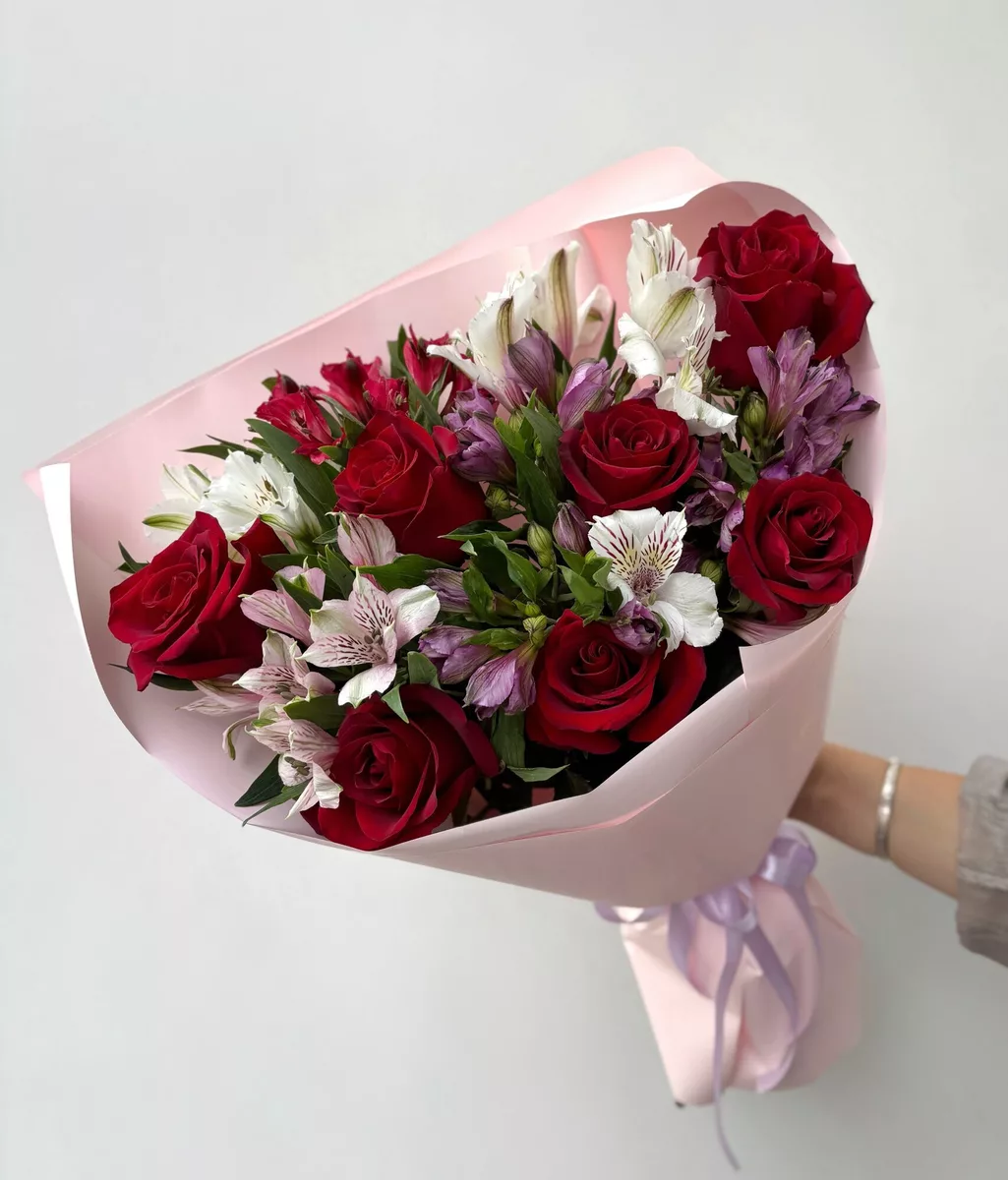
The safest choices for Konstantinovsk delivery, regardless of season, are garden roses, spray roses, alstroemeria, chrysanthemum disbuds, carnations and lisianthus. These stems hold well in transit, tolerate brief temperature variation and look presentable when a recipient opens the door rather than immediately after leaving a climate-controlled cooler. Garden roses in varieties such as David Austin-style cupped blooms are popular for milestone occasions, while spray roses work well in mixed bouquets where volume matters more than single-stem drama. Alstroemeria is often underestimated by international senders who associate it with filler, but a well-assembled alstroemeria bouquet in cream, coral or burgundy reads as a considered gift rather than a budget substitute. In winter, tulips become available from roughly January through April and are extremely popular in Russia for Women's Day on March 8 — the single busiest flower date in the Russian calendar, comparable to Valentine's Day in the West but with higher order volumes and earlier sellout of premium varieties. If you are planning a March 8 delivery to Konstantinovsk from abroad, place the order at least three days in advance and specify whether you want single-colour or mixed tulips. In summer, sunflowers are a practical and locally appreciated choice: they tolerate heat better than most cut flowers, they are visually striking, and they carry no cultural weight that might be misread. Avoid delicate stems like sweet peas or anemones for summer delivery unless the recipient will be home to receive them immediately.
Payment from a Foreign Bank Card: What to Expect
Paying from outside Russia is the part of the process that creates the most friction for international senders, and it is worth understanding before you reach checkout rather than during it. Russian payment infrastructure changed significantly after 2022. Many international card networks have limited or suspended direct processing with Russian merchants, which means a Visa or Mastercard issued in Germany, the United States or Australia may be declined at the payment stage even if your card is technically valid and has sufficient funds. This is not a problem with your card or your bank in most cases — it is a processing gap at the Russian end. The practical solutions are to use a payment method that routes around this gap: some international senders use cards issued by banks in countries that maintained processing links, such as cards from certain Central Asian or South Caucasus banks. Others use cryptocurrency payments where the shop accepts them, or ask a contact inside Russia to pay on their behalf and reimburse them separately. It is worth contacting the shop directly before placing the order to confirm which payment methods are currently working for your country of residence. This takes five minutes and prevents a situation where you complete the entire order form, choose your bouquet, write your card message, and then cannot finalise payment. The shop's customer service team handles international inquiries in Russian and can usually clarify the current payment situation quickly. Having the recipient's full address and phone number ready before you call speeds the process considerably.
The Recipient's Address: What Russian Addresses Actually Need
Russian postal addresses follow a specific order that differs from Western conventions, and getting this wrong is the most common operational mistake on international orders. A complete Russian address for a residential delivery in Konstantinovsk should include: the city name, the street name, the building number, the apartment number if applicable, and the postal code. In Russian address format, larger geographic units come first — so the region, then the city, then the street, then the building, then the apartment. When filling in an order form in English, provide all of these elements separately rather than pasting a single line. The building number in Russia often includes a korpus, which is a secondary building number written as a letter or as a slash-separated numeral, indicating which block within a larger residential complex is meant. If your recipient lives in a multi-building complex and you do not know the korpus, ask them directly — delivering to the wrong building in a large Soviet-era residential development can add significant time or result in a failed delivery. Apartment buildings in Russia also have an entrance number, called a podyezd, and an intercom code if the entrance is locked. These details matter for delivery to a door rather than a lobby. For a private house rather than an apartment, note that explicitly, since the delivery approach differs. The recipient's mobile phone number is not optional — it is the primary way the courier confirms arrival and navigates any last-minute address questions. A Russian mobile number starting with 7 is ideal; if the recipient uses a messaging app such as WhatsApp or Telegram on that number, note that in the order comments.
Card Messages and What Russians Actually Write
The card message is where international senders sometimes overthink or underthink. Russian greeting culture is warm and direct — short messages work well, and elaborate poetic inscriptions are less common than in some Western traditions. A message of two to four sentences stating the occasion, the sender's name and a direct expression of feeling is entirely appropriate. You do not need to write in Russian: the shop can print a message in English, and many recipients in Konstantinovsk, particularly those under forty, read basic English. However, if you want the message in Russian and you are not a native speaker, write what you want to say in English and ask the shop to translate it rather than using an automated translation tool, which frequently produces awkward or grammatically incorrect Russian that the recipient will notice. A few cultural notes worth knowing: in Russia, even numbers of flowers in a bouquet are traditionally associated with mourning, so bouquets are assembled in odd numbers — five, seven, nine, eleven stems and so on. This is handled automatically by a professional florist, but if you are specifying an exact stem count in your order, choose an odd number. Red roses carry a strong romantic connotation in Russia, more so than in many Western countries, so a red rose bouquet sent to a colleague or a distant relative can be misread. For non-romantic occasions, mixed colours, whites, pinks or yellows are safer choices. Yellow flowers do not carry the negative symbolism in Russia that they carry in some other cultures — yellow tulips and yellow roses are perfectly appropriate gifts.
Tracking and Confirming Delivery When You Are in a Different Country
Once your order is confirmed and paid, the question every international sender asks is: how do I know it arrived? The practical answer involves two channels. First, the shop sends a confirmation when the order is dispatched and, where possible, when it is delivered. If you provided your email address at checkout, that confirmation goes there. Second, and more reliably, the recipient themselves will usually message you — which means telling the recipient that a delivery is coming is both courteous and logistically useful. Some international senders want the delivery to be a surprise, which is understandable, but a surprise delivery to someone who is not home is simply a failed delivery. If you insist on a surprise, the minimum information to give the recipient is that they should be at home during a particular two-hour window on a particular day, without explaining why. This is usually enough. If the recipient is at work and cannot leave, ask whether their workplace accepts deliveries — many offices in Russian towns do, and the courier can leave the bouquet at a reception desk. For high-stakes occasions such as anniversaries or significant birthdays, consider requesting a delivery photo from the courier, which some shops can arrange. Note the time difference when you expect to hear back: if delivery is scheduled for 3 p.m. Konstantinovsk time and you are in Toronto, that is 8 a.m. your time, so plan accordingly rather than waiting up through the night for confirmation that will arrive while you are having breakfast.
Ordering flowers for someone in Konstantinovsk from outside Russia is straightforward once you have resolved the three practical bottlenecks: confirming that your payment method will process, providing a complete address with apartment and entrance details, and accounting for the time zone so the order reaches us before the delivery window closes. The flowers themselves — roses, alstroemeria, chrysanthemums, tulips in season — are not the variable. The logistics around getting the order placed correctly from several time zones away are where international senders consistently run into difficulty, and every one of those difficulties is solvable with a phone call or a message to the shop before checkout rather than after. We deliver bouquets across Russia in 1–2 hours.
Frequently asked questions
Which stem varieties are actually available in Konstantinovsk on short notice, not just listed on the website?
Garden roses, spray roses, carnations, chrysanthemum disbuds, alstroemeria and lisianthus move through the regional supply chain reliably and are the safest to order without advance notice. Peonies, tulips and ranunculus depend heavily on season and regional stock levels. If your order includes a variety that cannot be sourced, a florist should contact you before substituting, not after delivery.
The article mentions Konstantinovsk is 130 kilometres from Rostov-on-Don — does that distance affect the bouquet condition on arrival?
It can, particularly in summer. Stems assembled in Rostov and driven to Konstantinovsk spend roughly two hours in transit. Varieties like carnations and alstroemeria tolerate this better than open garden roses or hydrangea. Ordering locally assembled bouquets rather than transferred ones reduces that risk, and asking the florist directly where assembly happens is a reasonable question before confirming.
What time of day in my country do I need to place the order to still get same-day delivery in Konstantinovsk?
Konstantinovsk runs UTC plus three hours with no daylight saving adjustment. A sender in Paris on a winter weekday needs to order before roughly 9 a.m. local time to reach Konstantinovsk before early afternoon. From New York in winter, that window closes around 4 a.m. Eastern. Same-day delivery in a small town is genuinely tight, and next-day ordering is the more reliable choice from most time zones.
How do I pay for a Konstantinovsk flower order if my bank card is issued outside Russia?
Russian domestic payment systems stopped accepting most foreign Visa and Mastercard transactions after 2022. Florists serving international senders typically accept PayPal, Wise transfers, or cryptocurrency as workarounds. Some operate invoicing through non-Russian entities. Confirm the payment method before spending time building the order, because checkout friction is the most common point where international orders stall or fail entirely.
What address details does the florist actually need for a residential delivery in a small town like Konstantinovsk?
Street name, building number, apartment number if applicable, and a working mobile number for the recipient are the minimum. In small Russian towns, entrance number and floor are often needed for multi-storey blocks. A vague address such as a street name alone is the single most common reason deliveries are delayed or returned. If you are unsure of the full address, confirm it with the recipient before placing the order.
Ready to send a bouquet?
Pick a city, choose the flowers, and we will hand them over with a photo confirmation.
Choose a city →