
Sending Flowers to Krasnozavodsk from Abroad: What You Need to Know
Krasnozavodsk is a small town in the Sergiev Posad district of Moscow Oblast, and senders calling from Germany, Israel, the United States or the UAE ask us the same cluster of questions every week: can you actually reach it, how long does it take, and will the roses survive the road? The answers are specific and worth knowing before you place an order.
Where Krasnozavodsk Sits and Why Distance Matters for Fresh Flowers
Krasnozavodsk lies roughly 70 kilometres northeast of Moscow, inside Moscow Oblast but well outside the Moscow Ring Road. That distance is not trivial when you are ordering cut flowers. A bouquet assembled in the morning needs to reach the recipient before the stems have been out of water long enough to begin wilting, which in a heated vehicle in summer means you have a window of roughly three to four hours before quality visibly drops. The town itself is compact — most addresses are reachable from the main entry road — so once a courier arrives, the final delivery leg is short. The real variable is the Moscow-to-Krasnozavodsk stretch along the A108 and regional roads. In winter that road can add thirty to forty minutes compared to a clear summer run, and in spring the road surface after frost cycles slows vehicles further. When you order from abroad, you are not physically present to judge conditions, so it matters that you order from a shop that accounts for seasonal road time rather than quoting a flat figure year-round. Flowers travel in insulated packaging, but packaging is not refrigeration. Roses and ranunculus are the most sensitive to heat buildup inside a closed vehicle; chrysanthemums and alstroemeria handle the journey better. Knowing the distance also helps you set realistic expectations: same-day delivery to Krasnozavodsk is achievable when the order is placed before noon Moscow time, but it is not a guaranteed one-hour window the way central Saint Petersburg deliveries are.
Bouquets we can deliver



Time Zones and the Ordering Window from Outside Russia
Moscow Standard Time runs at UTC+3 year-round — Russia does not observe daylight saving. That single fact saves senders a lot of confusion. If you are in London, you are three hours behind Moscow in winter and two hours behind in summer because the UK does switch clocks. A sender in New York is eight hours behind Moscow in winter. This means that if you wake up at seven in the morning in New York and decide to order flowers, it is already three in the afternoon in Moscow, which is workable for same-day delivery to Krasnozavodsk only if the bouquet can be assembled and dispatched within the next two hours. Evening orders placed from North America — say, nine or ten at night local time — land in Moscow at four or five in the morning and will be processed when the shop opens, making next-day delivery the realistic outcome. Senders in the UAE and Israel are much closer to Moscow time: the UAE is one hour ahead, Israel is zero to one hour ahead depending on the season. Those senders can comfortably order mid-morning local time and reach the same-day window. The practical rule: calculate the Moscow time at the moment you place the order, and if it is past two in the afternoon Moscow time, plan for next-day delivery rather than same-day. Trying to rush a delivery to a regional destination after the midday cutoff usually means a courier driving in evening traffic, which in the Moscow Oblast area can be heavy on weekdays.
Which Flowers Actually Travel Well to a Regional Town
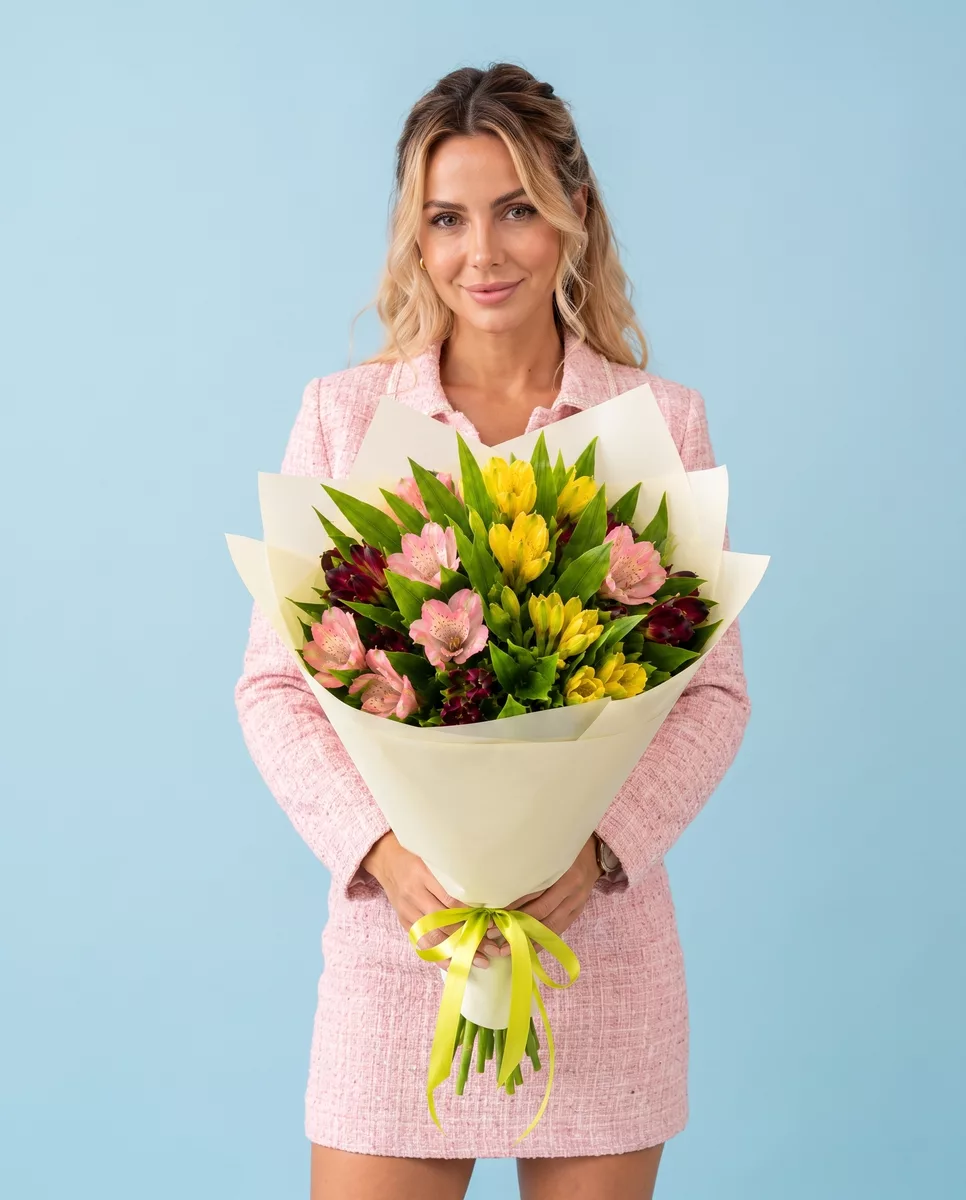
The bouquets that hold up best on a longer delivery run are built around varieties with firm, waxy petals and strong stems. Garden spray roses in blush and cream tones are a reliable choice — they are less fragile than large-headed hybrid tea roses and recover well if the water in the transport packaging is briefly insufficient. Alstroemeria is one of the most practical flowers for regional delivery: the stems are sturdy, the blooms are tightly closed when cut and open gradually, and the variety tolerates temperature swings between roughly five and twenty degrees Celsius without immediate damage. Eustoma, sometimes called lisianthus, is another strong candidate — the ruffled blooms look elaborate but the cut stems are surprisingly durable over two to three hours of transit. Chrysanthemums, both single-stem and spray types, are almost indifferent to the journey and arrive looking the same as they left the cooler. What travels poorly: open garden peonies in June and July, because the petals are fully open and bruise against packaging; open tulips in spring, for the same reason; and large-headed David Austin roses in warm weather, because the dense petal mass traps heat. If you want roses specifically, ask for buds at stage two — just beginning to open — rather than fully open blooms. Greenery such as eucalyptus, ruscus and pistache adds volume without adding fragility, and it keeps the bouquet looking full even if one stem shifts during transit. Seasonal flowers are almost always fresher than year-round imports, so matching your order to the Russian floral calendar improves quality.
Russian Customs Around Bouquet Size, Odd Numbers and Colour
Senders from outside Russia frequently ask whether the local customs they have heard about are real or exaggerated. The odd-number rule is real and widely observed: bouquets of three, five, seven, nine or eleven stems are given for celebrations and living recipients, while even numbers are associated with mourning. This is not a rigid law but it is a strong social convention, and most Russian recipients will notice if the count is wrong. A bouquet of ten roses will register as unusual at minimum. When you specify a quantity, always choose an odd number. Colour conventions are softer but still present. Red roses carry a strong romantic signal — giving them to a colleague or a distant relative would be read as strange. White flowers are associated with purity and are fine for birthdays and housewarming gifts but some older recipients still link all-white arrangements to memorial contexts, so mixing white with pink, yellow or peach is a safer default for a general celebration. Yellow flowers had a negative reputation in Soviet-era folklore — associated with separation — but that association has faded significantly among people under forty. A mixed bouquet with yellow ranunculus or yellow tulips is now entirely normal in most Russian cities and towns. The size of the bouquet signals the weight of the occasion. A seven-stem arrangement is a polite everyday gift; fifteen or more stems signals a significant event. For a birthday, name day or anniversary, a bouquet of fifteen to twenty-five stems is appropriate and will not seem excessive. Name days — the feast day of the saint whose name a person bears — are still celebrated in many Russian families, particularly among older generations, and are treated similarly to birthdays.
Payment from Abroad: Cards, Currencies and What to Expect
Paying for a flower delivery to Russia from outside the country involves a step that surprises many first-time senders. Russian banks and international payment systems have operated under restrictions since 2022, which means that standard Visa and Mastercard transactions issued by non-Russian banks may not process directly on Russian retail websites. The practical workaround that most international senders use is paying through a payment link sent via messaging applications, or through services that still maintain cross-border functionality such as certain payment aggregators that accept cards from specific countries. When you contact the shop, ask explicitly which payment methods work for your country of residence — this is a normal question and the answer will save you time. PayPal is not widely used in Russia. Cryptocurrency payments are accepted by some Russian businesses but not universally. Wire transfers in euros or dollars are possible but add processing time and bank fees on both ends. The currency you see quoted on a Russian website is rubles. The ruble exchange rate against the euro, dollar or shekel fluctuates, so the ruble price you see today may translate to a slightly different amount in your home currency by the time the payment clears. This is not unique to flower shops — it applies to any purchase from Russia. The total you pay covers the bouquet assembly, packaging and courier delivery to the Krasnozavodsk address. There are no hidden customs fees for flowers delivered within Russia to a domestic address — the flowers are already inside the country. What you are paying for is a domestic Russian delivery, not an international import.
Getting the Recipient's Address Right for Krasnozavodsk
Krasnozavodsk uses a standard Russian postal address format, and errors in the address are the most common reason a delivery is delayed or returned. The full address needs: the street name in Russian, the building number, the apartment number if applicable, the town name written as Krasnozavodsk in Latin or as Krasnogorodsk in Cyrillic — note that some mapping services confuse Krasnozavodsk with other similarly named towns, so specifying the district as Sergiev Posad district, Moscow Oblast removes any ambiguity. The postal index for Krasnozavodsk is 141320. Including it is not strictly required for courier delivery but it confirms the location unambiguously. If you are ordering on behalf of someone and you only have the address in Latin transliteration, pass it to the shop in whatever form you have it — the staff will convert it to the correct Cyrillic format. What causes real problems: building numbers with a korpus suffix, written as, for example, building 5 korpus 2, which indicates a secondary block in a residential complex. If you omit the korpus number, the courier will arrive at the wrong entrance. Apartment numbers matter too — in Russian apartment buildings the door is usually not labelled with the resident's name, so the courier calls the recipient by phone to coordinate entry. This is standard practice and not considered impolite. Make sure the phone number you provide for the recipient is a current Russian mobile number with the country code 7. If the recipient does not have a Russian number and uses a foreign SIM, note this when ordering so the courier can use a messaging application instead of a voice call.
What to Check Before You Confirm the Order
Before you click pay or confirm a payment link, run through a short checklist that catches the mistakes senders most often make. First, verify the delivery date against Moscow time, not your local time — confirm that the Moscow date matches the occasion. A birthday bouquet ordered on the evening of the 14th from California is placed on the 15th in Moscow, and if the birthday is the 14th, the bouquet arrives a day late. Second, confirm the recipient's phone number is active and that the person will be available to receive the delivery. Russian courier services do not leave bouquets with neighbours or in lobbies as a rule — the recipient signs or acknowledges receipt. If the recipient is at work, provide the work address rather than the home address, or arrange a specific time window. Third, check the stem count is odd. Fourth, if you are sending flowers as a surprise, make sure the card message does not reveal information the recipient is not supposed to see — the card is typically handed over with the bouquet, not sealed in an envelope. Fifth, ask about the packaging for cold weather. Between November and March, temperatures in Krasnozavodsk regularly fall below minus ten degrees Celsius, and bouquets need thermal wrapping for the walk from the courier vehicle to the building entrance. This is standard practice but worth confirming. Finally, save the order confirmation number and the shop's contact details in your messaging application — if you need to adjust the delivery time or address after placing the order, having the reference number speeds up the correction significantly.
Sending flowers to Krasnozavodsk from abroad is straightforward once you account for the time zone gap, the regional delivery distance, and the local conventions around stem count and colour. The flowers that travel best — alstroemeria, spray roses, eustoma, chrysanthemums — are also widely available year-round, so you are not limited to seasonal windows. Get the address in full Cyrillic with the korpus number if applicable, confirm the recipient's Russian phone number, place the order before two in the afternoon Moscow time for same-day delivery, and choose an odd stem count. Those five steps resolve nearly every issue we see with international orders to this destination. We deliver bouquets across Russia in 1–2 hours.
Frequently asked questions
Can I order flowers to Krasnozavodsk the same day from abroad?
Yes, if you place the order before 14:00 Moscow time. Calculate the time difference carefully — Moscow runs at UTC+3 year-round with no daylight saving. Orders placed after the midday cutoff are delivered the following day. Krasnozavodsk is about 70 kilometres from Moscow, so the courier needs enough time to complete the run before evening.
What happens if the recipient is not home when the courier arrives?
The courier calls the recipient's phone to coordinate. If there is no answer, they typically wait a short period and try again. Bouquets are not left unattended. Providing an accurate phone number — a current Russian mobile with the +7 country code — is the most important step to ensure a smooth handover. If the recipient is at work, use the work address instead.
Does the bouquet need special packaging in winter?
Yes. From November through March, temperatures in Krasnozavodsk regularly drop below minus ten degrees Celsius. Flowers need thermal kraft wrapping for the time between the vehicle and the building entrance. We apply this as standard for cold-weather deliveries, but it is worth mentioning when you order so the assembly team accounts for it from the start.
Why does the stem count need to be an odd number?
In Russia, even-numbered bouquets are associated with mourning and are brought to funerals. For any celebration — birthday, anniversary, name day, housewarming — an odd number is the correct choice. Most recipients will notice and remember an even count. Three, five, seven, nine, eleven, fifteen and twenty-five are all standard celebration quantities.
Which payment methods work for senders outside Russia?
Standard Visa and Mastercard issued by non-Russian banks often do not process on Russian retail sites due to current banking restrictions. Contact us directly and we will send a payment link compatible with your country. Some aggregators accept European and Israeli cards. Confirm your country of residence when you get in touch so we can tell you the fastest working method before you attempt payment.
Ready to send a bouquet?
Pick a city, choose the flowers, and we will hand them over with a photo confirmation.
Choose a city →