
Flower Delivery in Kurchaloy: Zones, Timing and What to Expect
Customers calling from Kurchaloy usually ask the same first question: can you actually get here? The answer is yes, and the second question — how fresh will the flowers be after that distance — is the one worth spending time on. Here is everything you need to know before you place an order.
Where We Deliver in Kurchaloy and the Surrounding Area
Kurchaloy is a town in the Chechen Republic, and we cover the central streets, the residential quarters near the main bazaar, and the blocks extending toward the outskirts along the Kurchaloy–Gudermes road. Addresses in the immediate surrounding villages — Belgatoy, Tsentoroi and Starye Atagi — fall within the extended delivery radius and are handled on the same order form, though you should note the settlement name clearly in the address field. The most common mistake we see is a customer writing only a street number without specifying the district or the nearest landmark, which adds unnecessary back-and-forth and can delay the courier by fifteen to twenty minutes in an unfamiliar area. Kurchaloy's street grid is not always indexed consistently in mapping apps, so we ask every customer to include a phone number for the recipient — the courier will call ahead five to ten minutes before arrival. If you are ordering a surprise and do not want the recipient to know, specify that in the comments and the courier will use a neutral greeting. We do not refuse addresses in outlying parts of the district as long as the road is passable, but during heavy rain in autumn the unpaved approach roads to some rural addresses can slow things down, so factor that in when choosing a delivery window.
Bouquets we can deliver



How Long Delivery from Saint Petersburg Actually Takes
The distance from our Saint Petersburg workshop to Kurchaloy is roughly 2,200 kilometres by road and air combined. We do not drive bouquets across the country in a van — flowers travel by air freight to Grozny, and our courier picks them up from there and completes the final leg to Kurchaloy. The total time from the moment you confirm your order to the moment the bouquet is at the door is typically between 18 and 28 hours depending on flight schedules, which is why we always recommend placing orders at least one full day in advance. Same-day delivery is possible in some cases if you order before 10:00 Moscow time and there is a suitable afternoon flight, but it is not guaranteed, and we will tell you honestly at the point of order whether it is realistic that day. The freshness question is the one florists care about most: roses, spray chrysanthemums and alstroemeria travel well in chilled packaging over this kind of distance, while open garden flowers like ranunculus or sweet peas are better ordered in bud so they open after arrival. We pack every bouquet in temperature-controlled boxes with moisture-retaining wrapping, and the box is sealed in a way that keeps the stems hydrated throughout the flight and the final road leg from Grozny.
Which Flowers Travel Best to Kurchaloy
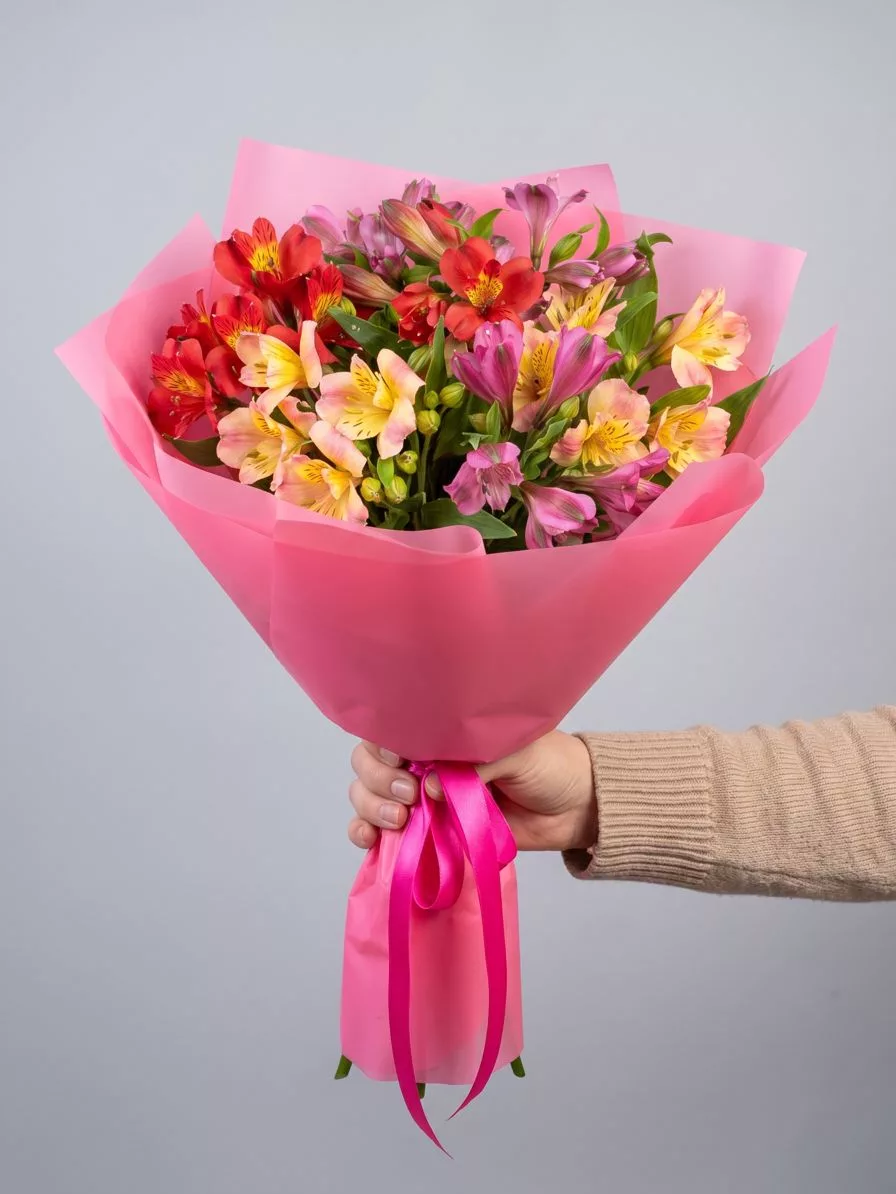
Not every flower in our Saint Petersburg studio is equally suited to a long-haul delivery, and being honest about that is part of the job. Roses — both standard long-stem and garden varieties like David Austin — are among the most reliable travellers when cut at the tight bud stage. Eustoma, also called lisianthus, holds its structure well and arrives looking nearly identical to how it left the workshop. Spray chrysanthemums are almost indestructible in transit and add volume to a bouquet without adding fragility. Alstroemeria is another strong choice: the stems are firm, the flowers open gradually over several days after delivery, and the colour range is wide enough to build a complete bouquet from them alone. Tulips are seasonal — they travel well in winter and early spring but are sensitive to heat in summer, and Kurchaloy summers are warm, so we advise against tulips for June through August deliveries unless the customer specifically wants them and accepts the risk. Orchid stems, particularly cymbidium, are excellent for structured arrangements but need careful unpacking by the recipient. Peonies are available from May through early July and travel well in bud; they are one of the most requested flowers for celebrations in the region. We do not recommend delicate open garden flowers — anemones, cosmos or fully open poppies — for this route because they do not survive the transit time in acceptable condition.
Bouquet Formats That Work Well for Kurchaloy Orders
Customers ordering to Kurchaloy tend to fall into two groups: those sending a birthday bouquet to a family member and those marking a formal occasion such as a graduation, a wedding anniversary or a professional milestone. For birthday bouquets the most popular formats are a classic round bouquet of 25 or 51 roses in a single colour, or a mixed bouquet combining roses with eustoma and eucalyptus for texture. These proportions hold their shape during transport and look full when unwrapped. For formal occasions, a structured mono-bouquet — 51 or 101 roses of the same variety — reads as a serious, considered gift and is easy to display in a tall vase, which most households have. Flower boxes have become popular over the past two years: a flat or hatbox filled with roses or a mix of roses and ranunculus looks elegant in photographs and is easy to carry, which matters if the recipient is at a public event. We also prepare flower baskets for table centrepieces, though these require slightly more careful handling during the final courier leg, and we note that in the order. Mono-bouquets of peonies in season are a strong choice for Chechen celebrations because the flower is associated with generosity and abundance in the broader regional culture — customers who mention the occasion often receive a suggestion to add two or three stems of white eustoma to balance the peony heads visually. Sizes start from 11 stems and scale up; most customers ordering to this distance choose at least 25 stems so the bouquet makes a visible impression on arrival.
Packaging and Condition on Arrival
We use corrugated temperature-retaining boxes lined with kraft paper and a water-absorbing floral foam pad at the stem ends. The lid is taped shut so the box can be handled vertically or at an angle without the bouquet shifting. Every box includes a small card with care instructions in Russian — how to trim the stems, what water temperature to use, and how long to expect the flowers to last. Roses cut at the bud stage and properly conditioned in fresh water on arrival will last seven to ten days in a cool room; eustoma lasts similarly. Spray chrysanthemums routinely go twelve to fourteen days. The recipient should cut two centimetres off each stem at a diagonal angle immediately after unwrapping and place the bouquet in clean, room-temperature water — not cold, not warm. This single step makes the biggest difference to vase life. We hear from customers occasionally that flowers arrived with some petals bent or outer guard petals slightly bruised; this is normal for roses that have been boxed for transit and those outer petals are meant to be removed — they protect the inner petals during travel. The bouquet underneath is intact. If a bouquet arrives with broken stems, wilted heads or obvious damage that is not attributable to normal transit compression, we ask the recipient to photograph it immediately and send the image to our customer service — we will replace or refund without argument. Packaging is included in the order price and is not charged separately.
What to Tell Us When You Order
The information that prevents most delivery problems is straightforward: the recipient's full name, a working mobile number, the precise address including floor and flat number if it is an apartment building, and the preferred delivery window. If you are ordering for a celebration that starts at a specific time — a dinner, a party, a ceremony — tell us the start time, not just the date, and we will work backward from that to confirm whether the timing is achievable. If the bouquet is a surprise, say so explicitly and we will instruct the courier to call the recipient only when already at the building entrance rather than announcing the delivery in advance. Ribbon colour, wrapping paper colour and whether you want a message card are all details you can specify in the order comments; we do not charge extra for a handwritten card. If you have a preferred flower or a flower the recipient dislikes — some people are allergic to certain pollen-heavy varieties — note it and we will adjust the composition. One thing that causes delays more than anything else is an incorrect or incomplete address. Kurchaloy has several streets with similar names, and the courier needs a house number and ideally a landmark. If you are not sure of the exact address, the recipient's phone number is the essential fallback. We also ask for the sender's contact number in case we need to clarify anything before the order goes into production — once the bouquet is cut and wrapped, changes to the composition are not possible.
Seasonal Availability and the Best Times to Order
Flower availability shifts through the year and knowing the calendar helps you choose a bouquet that looks exactly as expected rather than one that has been substituted at the last moment. January through March is the strongest period for roses, tulips, hyacinths and ranunculus — these are all at peak supply and the cold transit temperatures actually help preservation. April and May bring the first peonies, lilac branches and fritillaria; May is the single best month to order a mixed seasonal bouquet because variety is at its widest. June through August is the warm season and the most challenging for long-haul delivery: we recommend roses, eustoma and chrysanthemums over heat-sensitive flowers, and we pack with extra cooling material. September and October bring dahlias, late-season roses and dried flower mixes, which are increasingly popular as gifts because they last indefinitely without water. November and December are dominated by roses, amaryllis and winter branches — eucalyptus, cotton stems and similar material that travels well in cold conditions. The busiest ordering periods are the days before 8 March (International Women's Day, the largest flower holiday in Russia), 14 February, and the Eid al-Adha and Eid al-Fitr periods, which are widely celebrated in the Chechen Republic. For any of these dates, ordering three to five days in advance is strongly recommended — not because we run out of flowers, but because delivery slots fill up and securing your preferred window requires early booking. Last-minute orders for peak dates are accepted when slots remain available, but the choice of delivery time becomes limited.
Ordering flowers to Kurchaloy is straightforward once you understand the logistics: air freight to Grozny, a short courier leg to the door, and a bouquet packed to survive the journey in good condition. The variables that matter most are lead time, address accuracy and flower choice for the season. Give us those three things clearly and the rest is our responsibility. We deliver bouquets across Russia in 1–2 hours.
Frequently asked questions
Can I order flowers to Kurchaloy for delivery today?
Same-day delivery to Kurchaloy is possible if you order before 10:00 Moscow time and a suitable afternoon flight to Grozny is available that day. We confirm availability at the point of order. If same-day is not achievable, we will tell you immediately and suggest the earliest realistic slot, usually the following morning.
How do I make sure the bouquet is a surprise?
Write 'surprise delivery' in the order comments. The courier will call the recipient only when standing at the building entrance, using a neutral introduction that does not reveal who sent the flowers. If the recipient is in a workplace or a public venue, note that too so the courier can coordinate discreetly with reception or security.
Which flowers last longest after delivery to a warm climate like Kurchaloy?
Spray chrysanthemums, eustoma and alstroemeria are the most durable in warm indoor conditions, regularly lasting ten to fourteen days with basic care. Roses last seven to ten days when stems are trimmed on arrival and water is changed every two days. Avoid leaving any bouquet in direct sunlight or near a heat source.
What happens if the bouquet arrives damaged?
Photograph the bouquet immediately and send the image to our customer service contact. We distinguish between normal transit compression — outer guard petals on roses, for example — and genuine damage. If the flowers are genuinely damaged beyond what is expected from packaging, we replace or refund without requiring lengthy explanations or dispute processes.
Do I need to be present to receive the delivery, or can someone else accept it?
Any adult at the address can accept the delivery. If no one is available at the agreed time, the courier will call the recipient and can wait a short period or arrange a revised handover time. We do not leave bouquets unattended outside a door because temperature and security both matter, so a contactable recipient number is essential.
Ready to send a bouquet?
Pick a city, choose the flowers, and we will hand them over with a photo confirmation.
Choose a city →